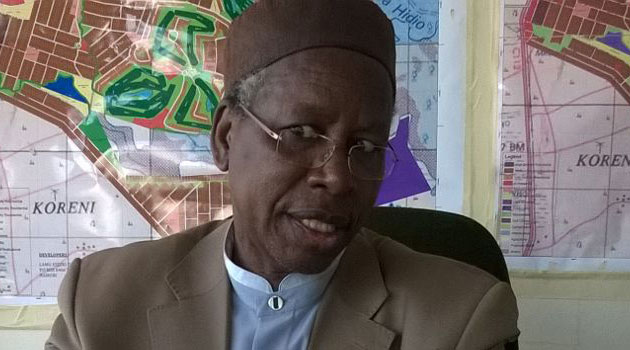
Joseph Kaguthi who heads the Nyumba Kumi initiative. Photo courtesy of www.capitalfm.co.ke
Daniel Kituku
Forty seven heads of the Nyumba Kumi initiative from Mithumoni sub location, Makueni County have benefited from a paralegal training organized and funded by Resources Oriented Development Initiatives (RODI ) Kenya.
The program aims at equipping the village heads with paralegal skills to enable them to solve conflicts through alternative dispute resolution mechanisms and reduce crime by networking with the national and county administration.
Speaking at the graduation of the paralegals at Mithumoni, Executive Director RODI Kenya Eliud Ngunjiri said the beneficiaries will be expected to pursue alternative resolutions of conflicts at the village level besides working with relevant stakeholders such the prisons and department of probation to stem crime.
Ngunjiri appealed for the use of reconciliation mechanisms through the trained paralegals and avoid court processes which he said were tedious and expensive.
“Court cases especially those that deal with family conflicts among others are a waste of time, money and also brings enmity among society members,” he said.
Ngunjiri lauded the efforts done by the government to improve security but urged the government to mainstream security issues in all ministries.
He noted that most of the crimes committed especially in rural areas are as a result of poverty and advocated for sustainable agriculture for food security and crime reduction.
‘’ We can only reduce crime through development,’’ said Ngunjiri.
Nyumba Kumi, an initiative by the national government, aims to unite law enforcement, private individuals and businesses in a nation-wide effort to reduce crime.
Speaking at same event area Deputy County Commissioner Franklin Ongori lauded the project and asked RODI to roll over the training of paralegals across the county.
He pledged to fully support the project saying that although it was the government’s responsibility to ensure security to all Kenyans such efforts from stakeholders to supplement the government should be encouraged.
Area Assistant Chief Abel Ngule who was among the graduands said since the project was initiated the number of conflicts reported in his office have drastically reduced.
“Many cases that used to pile pressure in my office have now been handled at the villages by the trained paralegals,”he said.
The six week training covered among other topics Constitution and Human Rights, Gender and Gender based violence, Democracy , Governance and Elections, Succession and Inheritance, Family , Land, Labor Laws and Relations, Child rights, Alternative Dispute Resolution, Crime , Criminal and Civil Procedure and Law of Conflict.
Paul Gicheru, the Njoro teacher who is accused of sexually molesting his students. A magistrate who was handling his case excused herself from the case for lack of objectivity.
By Lorna Abuga.
A magistrate handling the case in which a male high school teacher in Njoro is accused of sexually molesting six girls disqualified herself over loss of objectivity in the case.
Nakuru Chief Magistrate, Doreen Mulekyo disqualified herself after the State Counsel in the case Nelly Ngovi made a fourth application to be served with an amended or a substituted charge sheet which had the correct dates which the Swahili teacher from Njoro Girls School, Paul Gicheru, is accused of sexually molesting the girls.
Mulekyo said that she was dissatisfied in the manner over which the prosecution had handled the case owing to the fact that on the case had previously been adjourned three times so as to give the prosecution more time to amend the charge sheet and ensure the dates the minors recorded in their statements tallies with ones the investigation officer had recorded on the charge sheet.
“The Prosecutor is still asking for more time to amend charge sheet and yet for the past one month she has made the same application. Therefore there is need for the prosecution to put her house in order,” she said.
The defense lawyer Karanja Mbugua was also not satisfied in the way the prosecution was handling the case.
“This case has been delayed on the grounds that the prosecution needed additional time to come up with new a charge sheet and even today she still wants the same to be done,” said Mbugua.
“I advise her to dig into the matter to get the correct facts so that we can continue with the case without further delay,”
he added even as the prosecutor continued with her request.
The court had been told that accused person allegedly committed the acts between May 2014 and June 2015. He denied the allegation and was granted a bond of Sh500,000 or a cash bail of Sh200,000.
Mulekyo instructed the teacher to report to the Njoro Police Station on a weekly basis to ensure that he does not abscond the bail or bond terms.
The Swahili Teacher is facing charges of defilement and five counts of indecent acts where he purportedly, unlawfully and intentionally touched the private organs of the under aged girls between 15 years and 16 years. He is said to have sought sexual favors from the minors so as to award them favorable grades in the examinations.
It will be noted that, in criminal cases such as this one, it is usually the responsibility of the prosecution to prove ‘beyond reasonable doubt’ that the crime was committed. It is also worthy to note that many cases have been lost through mistakes of the prosecution.
Hundreds Kisumu residents today Friday 21st August turned out in large numbers in a peaceful demonstration to petition the County Police Commander and The Governor of Kisumu to take action against an increase in crime rate in the Lakeside city of Kisumu.
This is following active online rallying and mobilisation among active social media users in Kisumu city through the hastags #InsecurityinKisumu and #KisumuLivesMater from Wednesday 19th August and a unified call to turn out in large numbers at the Taifa Park to demand action on the growing insecurity in the county.
The residents have for the past few weeks been forced to live in fear following an upsurge in criminal gang activity in the town as thugs raided the residents walking at night in Kisumu streets.
The attacks had since escalated to residential areas where the criminals have been breaking houses in Kisumu estates, killing most of their victims and raping women and young girls.
The worst affected areas are the up market Riat estate, Milimani Estate, Migosi Estate, Manayatta, Nyalenda, Kenya-Re, Obunga and Car wash.
Hundreds of Kisumu residents turned up at the Taifa Park on Friday morning and marched through Kisumu town to the County Police Headquarters where they delivered their petition
In their petition the residents demanded that the police officers who have stayed in Kisumu for a long time be transferred to other areas, the county government to erect more security lights in the estates and registration of all bodaboda operators in the county.
The audio gave the impression of a helpless lady who was being sexually molested by a man.
By Benjamin Mwithali
After listening carefully to the ‘Mollis’ audio clip that has been doing rounds on social media, I have been left at crossroads on who to exactly to blame.
The clip which is believed to have been recorded by a man (Maurice but whose name was pronounced by the lady as ‘Mollis’) as they were having sex (as was the impression), at one point painted a picture of a helpless lady who was pleading with the man to stop the act since she was ‘tired’.
But the man did not stop and she continued to plead making some analysts conclude by refusing to listen to the pleas by the woman, the man ended up raping her.
However while that may be as the analysts may conclude, I have a feeling that the lady ought to have done more than just pleading with the man to stop his ‘beastly’ act. Yes, the Mollis lady should have done more – either scream, bite the man, kick him – I mean anything to just show her attempt to speak against the alleged injustices that were being committed against her.
Let me put it this way. In our society discrimination against women has over the years been a great menace that has continued to persist even with modern day enlightenment. My take is that chauvinism is the main reason why this happening, and this partly because of the inability of women to challenge its order.
In Kenya a huge chunk of men tend to be prejudiced against women in a myriad of ways and this I believe has its foundation on the myth that even in the biblical times women were made to play subordinate roles and the males the grander roles. This is what therefore makes men to strive to remain at the top while at the same time ensuring that women remain at the periphery.
Unfortunately women just accept that bottom place they have been designated to by the society without questioning. Or the few who challenge the status quo are easily branded as being big headed hence ‘unmanageable’ and every step is made to make them not ‘influence’ the one who are not ‘corrupted’ yet. At the end of the it is the men’s side of the world that is left to see the sun.
Then there is the inability of women, or the lack of it, to form strong bonds among themselves to rise above the injustices. It has to do with the myth that women are enemies of themselves. In Kenya while they command the highest voter numbers they never campaign for one of their own to take up some of the highest positions on land. As we speak, Kenya’s history of the Presidency has not known a woman president. Not even one of the 47 County heads is a woman. Why?
Discrimination is not a concept that happens without our knowledge. In fact it is a disease of the mind that starts from deep within oneself, you cannot move forth if you believe that you can’t. Moving forth starts from an internal self-drive before being influenced by any other external factors.
I therefore think that even if ideally we cannot have absolutely equal opportunities between men and women we can be somewhere close if only women became more aggressive in demanding what is rightfully theirs. This cannot be achieved by just making noise and subsequently failing to take any action.
So if the lady could have gone a notch higher and perhaps tried demanding what was rightfully hers, that is her freedom, to make a decision by even hitting the guy with any object that she could find in the house, or perhaps scream out loud to convince us that she was really against what was happening we would be having a different version of ‘Mollis’. That of a heroine who stopped cruelty on herself by rising up and saying enough is enough.
It is on the same breath that I ask all women, whenever faced with a situation that demands they take action against injustices on them they should take action.
*Benjamin Mwithali is a student at Egerton University, Nakuru.
Tharaka Nithi finance executive Mate Murithi (Left) and County assembly Budget and appropriation Committee chairman Karani Laban in white shirt. Photo courtesy of www.the-star.co.ke
Auditor General Edward Ouko has shone a spot light on Tharaka Nithi County Assembly for its poor budgetary expenditures during the financial period 1 July 2013 to 30 June 2014. The report states that the assembly could not explain some difference of over sh19 million.
An analysis of the total annual expenditure in the manual vote book revealed that the total expenditure controlled through the vote book was sh188,046,860, which differs with the monthly expenditure returns of sh207,433,902. The difference of sh19,387,042 has not be explained.
The assembly also failed to properly account for unutilized funds
The unutilized funds as at 30 June 2014 totaled sh66,269,188 as analyzed in the vote books. These balances were supposed to have been surrendered to the County Exchequer Account and a surrender statement prepared and forwarded to the Controller of Budget. There was no evidence that this was done.
When reviewing the Tharaka Nithi County Assembly accounting system, the auditor unearthed that audit verification of the monthly expenditure returns that the total expenditures incurred during the year ended 30 June 2014 totaled sh207,433,902. However there were no monthly ledgers to support this expenditure.
The auditor also has concerns over the procurement of ipads.
The County Assembly incurred an expenditure of sh1,632,000 on purchase of sixteen (16) Samsung Ipads at a cost of sh102,000 each. The items were supplied and taken on charge in stores ledger and issued to senior officers in the County Assembly. However, the users did not avail the items for physical verifications despite several requests. 3 In the circumstances, it was not possible to confirm the existence of the items.
There were also unaccounted for funds for training. The auditor notes that examination of expenditure records revealed that the County Assembly made payments totaling sh2,452,600 on training and workshops during the period under review. However, the payments were made without the necessary supporting documents, such as minutes, local purchase orders, workshop invitation letters, attendance register, vehicle work tickets/bus tickets and signed payment schedules. As a result, the propriety of the expenditure of sh2,452,600 could not be confirmed.
Some issues in the hiring of new employees without confirming authenticity of various documents was also flagged by the Auditor General.
Audit verification of some of the employees’ files revealed the following;
The copies of the testimonials attached to the job application forms were not certified as true copies of the originals. Further, the County Assembly Service Board had not taken steps to confirm the authenticity of the certificates.
None of the files had a copy of the birth certificate of the employee and it was therefore not possible to confirm the dates of birth of the employees.
(i) The KSCE certificate of one staff who was employed as a Sergeant at Arms showed a mean score of D+ while the advertisement for the position required candidates to have a mean score of C (Plain).
(ii) One staff that was recruited as a Secretarial Assistant had scored a mean score of D (Plain) with a D (Plain) in English in the KCSE while the advertisement indicated that a mean score of C- (minus) and C (Plain) in English was required.
(iii) One staff was recruited as a driver II. However, no driving license and an occupational test certificate were attached to the job application as was required in the advertisement.
The Auditor therefore calls for adherence to the laid down laws and regulations to ensure the anomalies do not recur. Specifically he calls for fidelity to the Public Finance Management Act, 2012, Public Procurement and Disposal Act, 2005 and the Public Procurement and Disposal Regulations 2006.
Children during the North Eastern Province demonstrations in Garissa town protesting the education crisis due to lack of teachers
Hundreds of residents in the three counties of the North Eastern Province today took to the streets protesting against the worsening situation in the education sector in the region.
Led by civil society groups in the region, the placard waving students, parents and angry residents presented their grievances to the local education offices.
Education in the region came down to its knees after non-local teachers fled the region following increased terror threats climaxed by the Garissa University attack on April 2 in which 147 people most of the students lost their lives.
In Garissa, the procession started from Garissa Primary school and ended at the county headquarters in Province area where activists presented a raft of demands and recommendations to the regional commissioner’s office.
“Children have the right to education. We are here today demanding that right and raise the plight of our children” said Awdol.
Locals say Al-shabaab is having the last laugh as they have reached their target as the government seems resigned to defeat with the way it managed the crisis. More than 800 non-local teachers sought transfers to other parts of the country. Although the void they left could not be filled, schools employed non trained teachers while many local form four leavers volunteered to teach.
Dear GOK, End Corruption, hire qualified security officers and stop scapegoating NEP for ur incompetence. #EndNEPEducationCrisisNow
In Wajir the Wajir procession started from the county headquarters and ended at the county commissioner’s office while in Mandera the protest begun from Moi Girls school to the TSC offices and then to the county commissioner’s office.
The processions at the counties came even as leaders from the region today held a consultative meeting with Ministry of Education and Teachers Service Commission on the status of Education in the region. The meeting was chaired by Deputy President William Ruto.
Led by Majority Leader in the National Assembly and Garissa Township MP Aden Duale, the leaders agreed with the Ministry of Education and Teachers Service Commission that extra Teachers and untrained teachers will be employed through the Board of Management of both primary & secondary schools in the three counties of North Eastern.
“We also agreed that this year, KNEC will administer the Kenya National Examination in NEP like the rest of the country and Teacher Training Colleges will admit 500 students from NEP in the next 3years in order to have more local teachers in the future” Said Duale.
The leaders previously rejected calls to have National Examinations postponed in the region.
A Peaceful demonstration being organised by Kisumu residents to speak out on the growing insecurity
This post first appeared on HukuKisumu by Daniel Ominde.
For the past few months Kisumu residents have known no peace. Like village chicken they have been forced to go back to their homes by sunset as gangs wreck havoc in the lakeside city with impunity. Not even the recently launched Quick Response Unit that consist of specially trained officers with state of the art toys have managed to tame this crime wave.
Now the homes are not safe either, you get home early but they will still come and break your windows and doors with specialized equipment. What is sickening about this panga wielding gangs is that they do not stop at robbing.
They come to kill as well and when they do not kill they maim but not before raping the women and girls.
Kisumu residents are living in fear…the women cannot wake up early to get to Kibuye market for fresh supply of vegetables to their stalls. Those going to offices and work places that require them to venture out before sunlight cannot dare to. Investors in Kisumu are counting losses because they cannot open their businesses early and neither can they close late – this even as we aim to become a 24 hour economy.
But even with all that nobody is safe in Kisumu – when your day comes they will get you from your house.
They will rape your wife and daughter before your very eyes.
They will slash your husband and son to pieces as you watch.
Residents have now become a helpless lot, with nobody to turn to.
Even the police seem to have given up…they too must be very afraid to venture out in the cold dark night lest the panga wielding gang strike in the dark streets – streets dark because the county government does not see the need to light them up.
After all they will just kill us.
Rising Insecurity in Kisumu
You do not know helplessness until you hear the police deny this very thing I am talking about – they say only four incidents have been recorded in the past month while the truth is that everyday the gang strikes somewhere raping women and girls, slashing men and boys but the police who are also too afraid will not only do nothing but they will say nothing as well.
I get it, I really do. The police boss has a job to protect, you wouldn’t want to lose your job because you cannot contain crime, would you?
We are now living like orphans, vulnerable with no one to protect us.
But this is lives we are talking about here – do Kisumu lives really matter?
For how long will we be butchered as our leaders and those assigned to protect us watch.
Kisumu people are now saying they have had enough, they are saying #KisumuLivesMatter they are saying #InsecurityInKisumu has gotten out of hand.
They are not just saying, they are getting out to say they will not live like slaves in their own town.
They are saying it’s time to get the leaders and the security apparatus working – enough is just enough.
This is why if you love Kisumu you have to add your voice to this, you have to show up at Taifa Park on Friday at 10 am wearing white T-shirts because the residents have organized a mammoth march to the police station and the county headquarters not to ask for but demand action.
We march because we have had enough of living in fear!
Use of Social Media by Kisumu Residents to speak out on insecurity
A group of active Kisumu resident on twitter started the hashtags #InsecurityInKisumu and #KisumuLivesMatter on Wednesday 19th August prompting other residents to join in the conversation and demand action from their leaders.
Baringo Governor Benjamin Cheboi. According to the Auditor General, the county executive cannot account for close to 137 million spent during the 2013/2014 financial year (Photo: Standard).
The County government of Baringo cannot conclusively show how it spent close to sh137 million during the 2013/2014 financial year. After an audit of the county’s accounts of the said period the Auditor General reported a repeated trend in irregular spending and allocation of funds as well as disregard of government policy in procurement processes.
The above amount includes sh48 million that was spent in the implementation of civil works projects by the health department. The projects were to be done by 7 contractors who were awarded the contracts through the
“request for quotations method although the contract sums for each exceeded the sh4 million threshold for class A procuring entities.”
“However, there was no documentary evidence to show how the subcontractors for these works were selected and awarded contracts. Also the purpose of the project management expenses included in the provisional costs has not been explained or accounted for,”
the Auditor General says while questioning why some of the contracts were halted.
“As at the time of this audit, construction of (a) theatre at Kabartonjo District Hospital had stalled and the contractor was not on site. No reason was provided for this state of affairs.”
“Further, construction of (a) mortuary at Kabarnet District Hospital which commenced on 28 October 2013 and ought to have been completed by 28 June 2014, was still not complete. Partitioning and floor tiling were yet to be done,” the Auditor General says.
He adds,
“the rest of the work that had been completed had not been handed over. In addition, the minutes of the Contract Tender Opening Committee and Tender Committee awarding the contract were not provided for audit review.”
Apart from the sh48 million the government could not support its expenditure of sh30 million which is detailed in the report as ‘Payment to Institutions.”
Leading in that list of the expenditure which was supported by “LPOs (Local Purchase Orders), payment vouchers, invoices and goods receipt notes” is KEMSA (Kenya Medical Supplies Authority) with sh10.7 million, Kabarnet District Hospital with sh6.4 million and a company called M/s Unlock Africa with sh5.5 million.
Again the audit revealed that imprests amounting to more than sh20 million were not cleared in time as is required by law.
“In addition, some officers were holding multiple imprests contrary to Government Financial Regulations and Procedures governing issuance of imprest. No reason was provided for holding some imprests since April 2013 and not complying with the regulation,” the Auditor General says.
The Auditor General also questioned the use of more than sh5.6 million which was
“irregularly charged to wrong expenditure items without authority to reallocate expenditure.”
“Such irregular charge of expenditure may adversely affect the implementation of some programs,” he observed.
He also noted irregularities in the procurement processes in the county that could not be well explained. This included the single sourcing of legal and hotel services as well as irregular payment of pending bills of defunct local authorities, all of which gave a total of more than sh5 million that could not be well accounted for.
“The Baringo County Executive should address the anomalies noted in order to ensure effective delivery of services to the people of Baringo County. Laid down Government procedures and processes should be adhered to ensure public resources are only utilized for purpose for which they were intended,”
Some of the youth championing Jukumu in Kisumu County
By Jemima Otieno
The first week after the Youth Democracy Ambassadors camp began with my search for a theatre team that would help bring out democracy issues in a clear and understandable manner and at the same time be entertaining, educational and ensure engagement of the audience. The main consideration for this selection was age, availability, ability, knowledge and willingness of the team to work voluntarily with minimal allowances during Activity presentation.
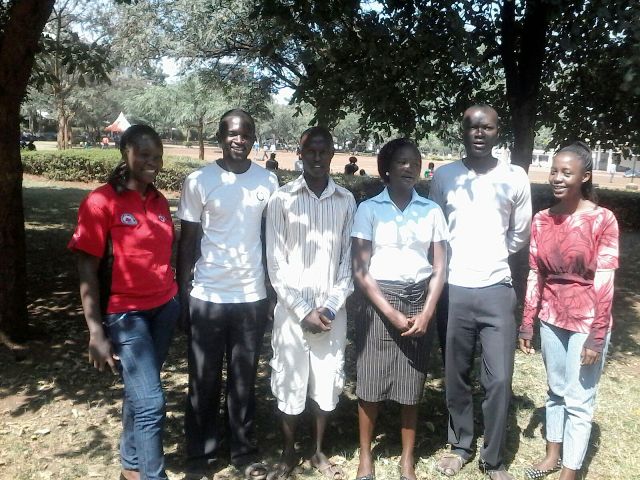
After thorough consultation with different leaders of different theatre groups I was able to pick out a theatre group comprising of 5 youths, 3 of them students of Kisumu Polytechnic, 1 an Alumni of Kisumu Polytechnic and the fifth one a 1st year student at Egerton University and finally the Training of Trainers date was set for 7th August 2015.
On the training of trainers (TOT) day we began the session at 9am in the morning with introduction of the participants and then myself and then I addressed the issue of expectations in terms of what I expected from them and what they would expect from me. Before tackling any modules I tried to assess the level of understanding of the Constitution by the participants by asking basic questions like asking them the wards they came from and their Members of County Assembly (MCAs), their constituencies and Members of Parliament (MPs), then the Governors, Senators and Women Representatives and it was truly shocking to realize that most of them were unaware of their leaders but I challenged them to find out because “Katiba ni Jukumu Letu.”
During the training the following modules were covered:
Leadership and integrity
The benefits of devolution
Budgeting
Importance of public participation
I started by facilitating the modules one at a time and in order to ensure understanding I would ask the participants to put the same in form of theatre where applicable. The session was very interesting and the participants were very excited especially when it came to infusing theatre to relay the same message and I remember that we made a lot of noise we actually had to change locations from Youths for Sustainable Development (YUSUD) offices and had to relocate to the Jomo Kenyatta Sports ground where we wouldn’t disturb the peace of anyone who was trying to get their work done and even there we attracted a crowd of people who wanted to know who we were and what we were doing and I took the opportunity to invite them to the official youth day 12th August 2015 where we are to make a formal presentation with the theme being “The Youth and Civic Engagement.”
All in all the day was one full of success and I would like to thank the Institute for Education in Democracy (IED) for the opportunity and for empowering me in order to empower and make a change in the community I come from and even beyond for a better Kenya and for better democratic governance.
Tharaka Nithi Governor Samuel Rangwa. Photo courtesy of county-yangu.com
Tharaka Nithi County did not spend sh111,700,000 which was transferred to the health docket in the financial year 2013/14 yet the county needs these urgent services. According to information from the Auditor General’s report, these funds were meant for the development of different health centers. However at the closure of the 2013/2014 financial year,
the fund had not been spent and neither was it repaid to the county revenue fund or a refund statement was prepared in regard to the fund.
Information from the County’s website states that the county intends to have
Ultramodern medical care
Diseases diagnostic centres
Ultrasounds and scans centres
Emergency Services
Morgue services
Private clinics and care centers
Wellness centres and advisory.
Physiotherapy and community health services.
Recently, Tharaka Nithi Governor Samuel Ragwa launched a sh120 M health project which will see 54 health centers in the county get funded for construction of crucial facilities. Ragwa said that the facilitation would include construction of wards, maternity wings, laboratories, staff quarters and other facilities that will see smooth running of the health centers.
Located in Kenya’s former Eastern Province, the county has an area of 2409 km² and had a population of 365,330 as of the 2009 census.
While it is not clear whether the Governor’s launch financial details are the same as what the Auditor General’s alluded to not having been spent as the amounts involved are the same, perhaps the county’s inability to show whether they have already spent it, partly or otherwise raised the red flag during the audit process.
In addition, the Auditor General’s report states that County failed to produce ledger accounts and other statutory reports. The report says
expenditure returns made available for audit indicated that the County Executive incurred an expenditure of sh884,882,885 as at 30 June 2014. However, no monthly ledgers to support the expenditure in respect of recurrent and development votes were provided.
The county was also using two systems of accounts
Further, the County Treasury was using the manual vote book and the Integrated Financial Management Information System (IFMIS) concurrently. The two accounting systems in use did not produce ledger accounts, trial balances, statutory control reports, detailed head/item analysis and AIE expenditure statements complete with grouping of accounts codes in to the prescribed bands as required by Section 5.11.3 of Government Financial Regulations and Procedures.
The Auditor General further reveals that the recurrent expenditure reflected in the expenditure returns exceeded the IFMIS vote books by sh474,107,183 while the development expenditure in the IFMIS vote book exceeded the expenditure returns amount by sh48,047,353.
On expenditures, the county could not account for over sh100m. This includes sh56,785,505 of unauthorized expenditures, sh46,402,882 of unaccounted for expenditures and shs12,813,910 of unsupported expenditures.
Tharaka Nithi County Executive flouted procurement rules by buying vehicles without subjecting them to an open tender system.
The County Executive procured motor vehicles worth sh41,881,755 from a firm in Nairobi, using direct procurement method. No reasons were provided for the departure from the open tendering procurement method required by Section 62 of the Public Procurement and Disposal Regulation, 2006 (Revised 2013).
Other procurement related anomalies by the county included a total of sh3,645,960 incurred for study tour in Israel for without showing evidence of competitive sourcing, sh11,083,050 expenditure for various water services without pre-qualifying the goods providers and irregular procurement of media equipment worth sh6,614,750 among others.
The county also has poor revenue records and under-collection of revenues. During the period under review, three sub-counties had collected a total of sh29,556,206. However, a comparison of these collections to the actual banking made to the Tharaka-Nithi Revenue Account revealed that the revenue had been under banked by sh2,125,947 which the Auditor says needs to be investigated.
In addition, the audit says that uncollected revenue amounting to sh27,188,236 was outstanding as at 30 June 2014. It was further noted that these arrears were not disclosed in the notes to the financial statements. Strikingly, the audit adds
under collection of revenue comparison of revenue collected between July 2012 and March 2013 and July 2013 and March 2014 in the sub counties of Chuka Igamba Ngombe and Chuka Urban revealed an under collection of revenue in the year 2013/2014 totaling sh9,040,063.
Moving forward, Auditor General Edward Ouko recommends that the county needs to adhere to various legal regulations. These include the Public Procurement and Disposal Act, 2005, Public Finance Management Act, 2012 and Government Financial Regulations and Procedures.
The management should enhance accountability in the management of the public funds by ensuring that the accounting system in place is effective and efficient. The County Executive should request the National Treasury to second experienced accountants to assist the county staff in setting up a proper accounting system in accordance with Section 14(1) of Public Finance Management Act, 2012.
In addition the reports calls for differences noted between the IFMIS and expenditure returns should be reconciled and explained appropriately
Finally, and what is coming out clearly in all government institutions, the Auditor General is urging that the necessary reports and accounting statements should be easily produced by the system to enhance Financial Management of the County Executive.
Baringo County Assembly chambers. The Auditor General has questioned how MCA’s in the county were issued with car loans totaling to Ksh. 96 million (Photo: Daily Nation).
The County Assembly of Baringo issued car loans to its members (MCA’s) without following the due procedure. According to the Auditor General’s report the Assembly issued sh96 million car loans to 48 members who received sh2 million each on April 30 2014.
“However, information provided for audit review indicated that the loans were disbursed without considering the ability of the members to repay the loan and also various documents were not provided for audit review such as the vehicles valuation report and joint ownership log books,” the Auditor General reports.
The report further says that the Assembly did not show evidence of whether the fund (Car Loan Scheme) is being administered according to the law.
“The management should ensure that the provisions contained in the County Assembly Car Loan Scheme Fund Regulation 2014 are complied with and where loans have been disbursed without the laid down procedures appropriate action is taken against the persons involved in line with Government Financial Regulations and Procedures and Public Financing Act,” the report recommends.
But that is not all. The Assembly was unable to show evidence for its expenditure of more than sh20 million that it spent between June 30 2013 and July 1 2014.
This amount included sh2,025,298 which was used as motor vehicle running expenses and sh2,209,000 which was used for traveling and subsistence allowances for local travel.
“The payments were not supported with work tickets, fuel receipts and imprest warrants as required by Government Financial Regulations and Procedures. Also, the details of the expenditures were not recorded in the imprest register and accounted for on return from the journey, but were rather expensed contrary to the requirement of Government financial regulations and procedures,” the report says.
The report also questions whether the MCA’s actually traveled to the United States of America (USA), Uganda, Rwanda, Tanzania, Colombia and Singapore in the months of July 2013, May 2014 and June 2014 trips in which they are said to have spent sh16,961, 971.
“Records provided for audit review were not supported by copies of clearance certificates and stamped passports to confirm that the members of the County Assembly indeed traveled abroad. Also, the training programmes while abroad and reports of programmes attended were not availed for audit verification and it was not clear whether the same evidence was subsequently tabled in the County Assembly as required by the standing orders,”
the Auditor General says while querying the trips.
Actually on local travel allowances the Assembly spent sh1,710,500 above its sh15 million budget on per diem and on foreign trips it spent sh785, 451 as at June 30 2014 above its sh26 million budget during the year.
Further the Auditor General questions the payment of sitting allowances to the MCA’s for attending a goat auction event.
“A review of the County Assembly records available indicated that the members on 20 December, 2013 were paid a total of sh207,300 as sitting allowances for attending Kimalel goat auction contrary to (the) regulation that sitting allowance are paid to Members of the County Assembly for Plenary and Committee Sittings only.”
Perhaps because of this, the Assembly spent an excess of sh501, 800 in sitting allowances.
The Auditor General recommends action against all persons who may have been involved in issuing of the funds against the law “unless prove is provided”. This includes stating that the MCA’s refund the funds that they may have received contrary to the legal requirements.
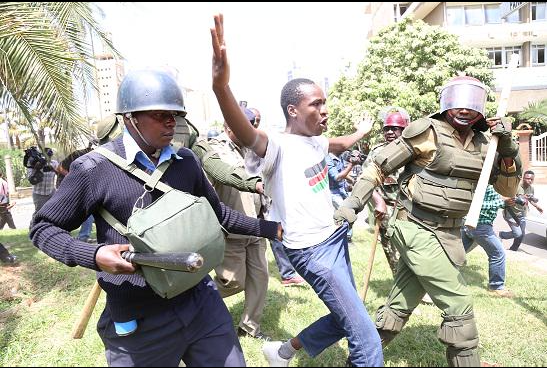
Activist Francis Sakwa being man-handled by police officers
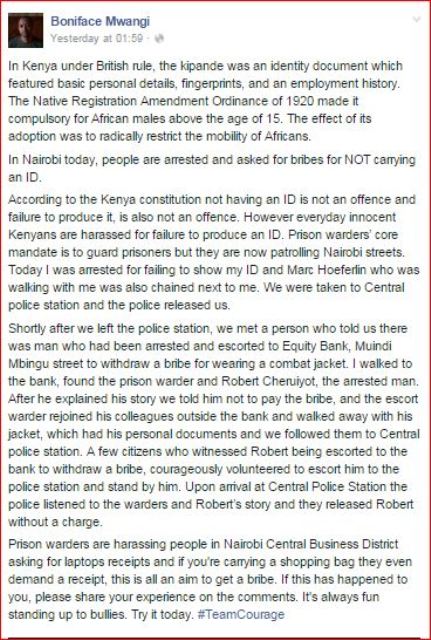
Boniface Mwangi, a photojournalist and activist was this week arrested by prison warders patrolling the streets of Nairobi for not having an identity card (ID). He actually had the requisite document but refused to show it to them because it is not a must that you show it, but need to produce it to have it and when requested, produce it. The same applies to a driving license.
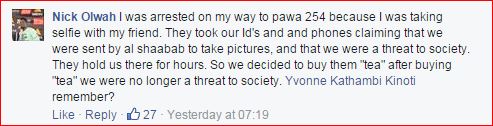
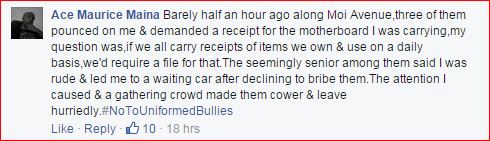
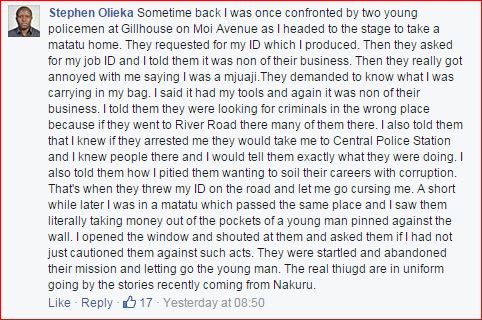
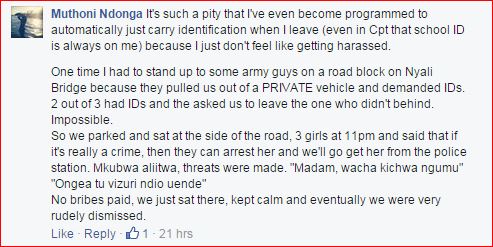
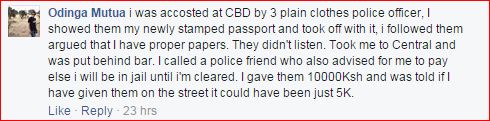
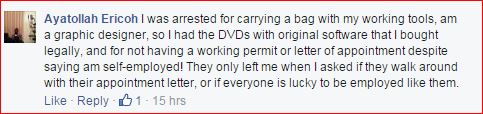
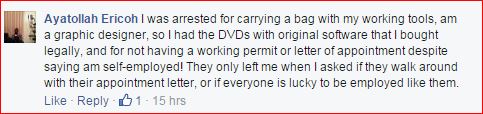
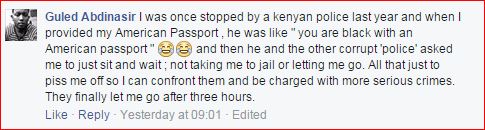
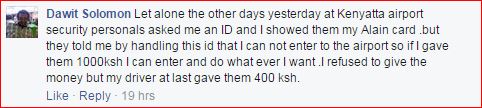
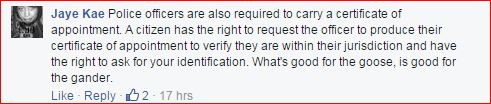
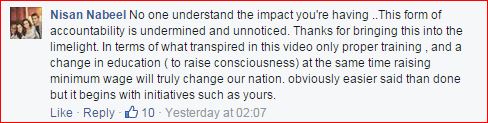
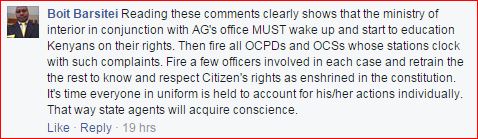
Mr. Mwangi narrated this story on his Facebook account and comments from the post show that many Kenyans have at one point or another been held, taken to a police station, or let go, depending on how the person argues for their freedom.
From the post, Kenyans of different walks of life took the opportunity to share their experiences. See some sampled comments from over 250 comments from the post
Do Kenyans know their rights?
Perhaps Boniface Mwangi is doing a good job in highlighting these issues.
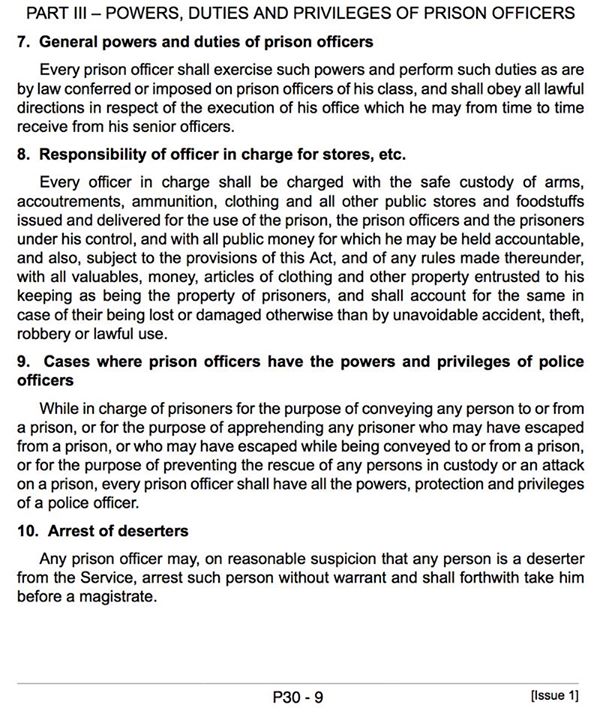
Prison officers do have some powers to perform some police officers’ duties but not unfettered.
However, lawyer Mugambi Laibuta weighed in on the matter, arguing that Kenyans are taking the issue out of hand.
There is no law stating that someone must carry their identity card. However, Kenya like any nation in the world, you are expected to carry an ID card to identify yourself. This applies to both Kenyans and non-Kenyans. The reasoning here is that you can be assumed to be an illegal immigrant hence you need proof.
Mugambi also stated that there is no law that compels a person to produce an ID card 24 hours after being requested by an enforcement officer; police or prison officers. Prison officers have been deployed in the streets of Nairobi to help in the curbing of insecurity in the city.
But for Soyinka Lempaa, a lawyer, someone is supposed to walk with some form of documentation, which also includes a photocopy of an ID card and where they do not have it, provide it within 24 hours.
The expectation that you have to show an ID card applies when you enter a building or institution that requires it, including security installations.
Lempaa further weighed in on what happens if you do not have it
The police should arrest you when they have reasonable suspicion that you are not a Kenyan.
This reasonable requirement is perhaps what many feel the police will never be. As seen in the comments from Boniface Mwangi’s post, many require to pay off their way to freedom. For some like in Eastleigh, Nairobi this is a daily occurrence and perhaps as Lempaa argues, the reason could be on suspicion of being alien in the country.
Lawyer Edward Oonge, known for helping in the release of Allan Wadi from jail stated that not caring an identity card is not a crime. He says law enforcement officers can request one to produce an identification card and when you do not have it, should allow for time to produce it.
Law enforcement officers can request you to provide an ID if you are not carrying it. If they have reasonable grounds to believe that you do not have it or are alien, they can hold you until you figure out your way (like by calling someone to bring it to you), and show it to them and you will be released.
Police spokesman Charles Owino did not respond to calls or texts to comment on the matter. Should he get back, we shall update the post accordingly.
There is a grey area on the requirement to produce an identification within 24 hours as some have argued. However, what seems to be the best way out is to carry it at all times and if not, talk politely to the law enforcement officers about you producing it. Hopefully, you do not have to part with a bribe to be let go.
Health Workers in a previous strike Photo:Aljazeera
Operations at the Makueni County Referral hospital were yesterday paralyzed after health workers downed their tools over July unpaid salaries. The workers carrying twigs and chanting slogans marched to the County headquarters offices in Wote town and confronted Governor Kivutha Kibwana over the monthly dues.
Led by the Civil Servants Union Secretary Makueni branch Justus Ndonye the workers demanded to know from Governor Kivutha why they had not been paid yet their counterparts in the neighboring Kitui and Machakos counties had received their July salaries.
“We have not paid house rent and neither do we have money to fend for our families. How does the county government expect us to work on empty stomachs,” lamented Ndonye.
Ndonye said most of the workers rely solely on salaries and accused the government of lying to them that the salaries would be paid on time.
“We have been patient for long. We were told that the salaries would be paid latest yesterday,” he said.
Despite pleas by the Governor that the Finance department was working on the salary issue the workers stood their ground and vowed not to go back to work.
“No money; no work,” they chanted.
The workers defiance however irked the Governor who told them to continue with the strike as his government works on the problem.
“As civil servants you have every right to picket and demonstrate. I was among the people who spearheaded the Constitution that gives you the right to hold demonstrations. You can continue with the strike while we pursue the matter,” said Kivutha.
“You have the right not to work but you must know that the services you offer are emergency services,” he continued.
The Governor absolved his government from any wrong doing and apportioned blame on the National Treasury which he said had not disbursed the county allocations hence the delay.
“We are trying as much as possible to get money from Central Bank through G-Pay and our expectations is that by the end of the day the salaries shall be paid,” said Kibwana.
The Finance Executive Mary Kimanzi who had flagged the Governor also had a hard time convincing the striking workers that she was working round the clock to have the money deposited in their respective accounts.
“We expect the Central Bank will activate the G-Pay as soon as possible,” said Ms. Kimanzi.
Meanwhile a spot check by Kenya Monitor revealed that the operations at the referral hospital remain paralyzed as the workers kept off the health facility while patients sat desperately at the waiting bay.
The strike of the health workers paints a gloomy picture on the already ailing health sector and patients who cannot afford to seek alternative health care in private hospitals can only hope that the problem will be solved in the shortest time possible.
The delay of the disbursement of the county allocations by the National Treasury should also be avoided at all costs to avoid similar incidents.
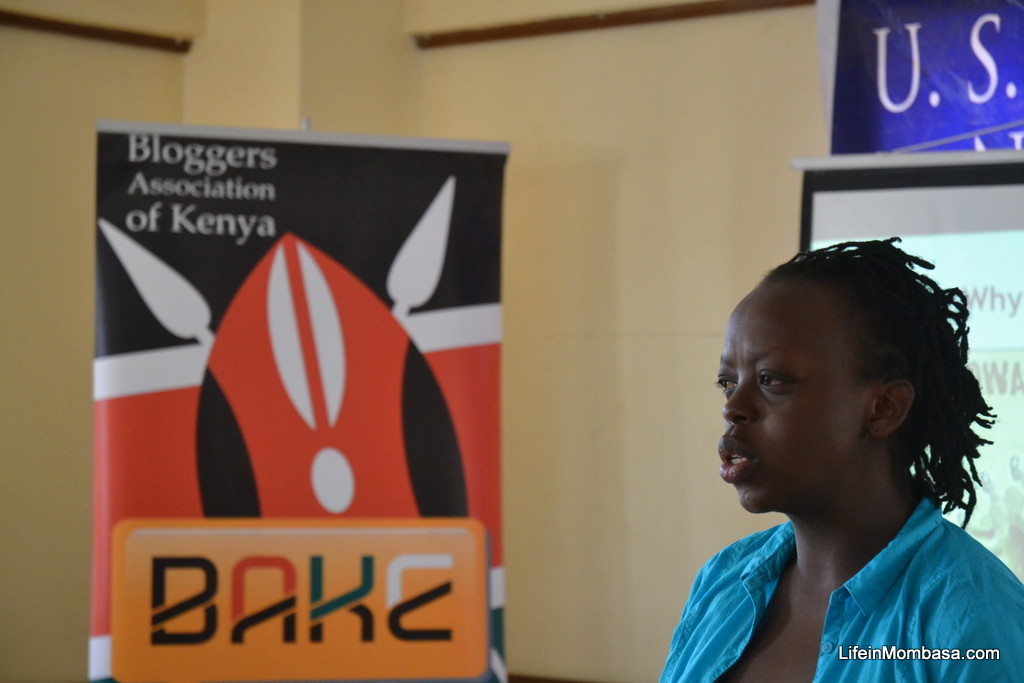
Njeri Wangari of BAKE training Mombasa bloggers at MEWA Library
The growth of blogging in Kenya in the last decade has been immense. There are countless blogs and in some areas like fashion blogs provide more and better quality of content than local mainstream media. The growth of blogging can also be seen from the quality of blogs entered in the annual Kenya blog awards organized by the Bloggers Association of Kenya (BAKE) where over 150,000 Kenyans voted for the best blogs across 18 categories in this year’s awards held in June 2015.
As part its mandate, BAKE undertakes training of bloggers with the aim of encouraging youth to create content in their different areas of interest and enable them to be able to make a living through their blogs.
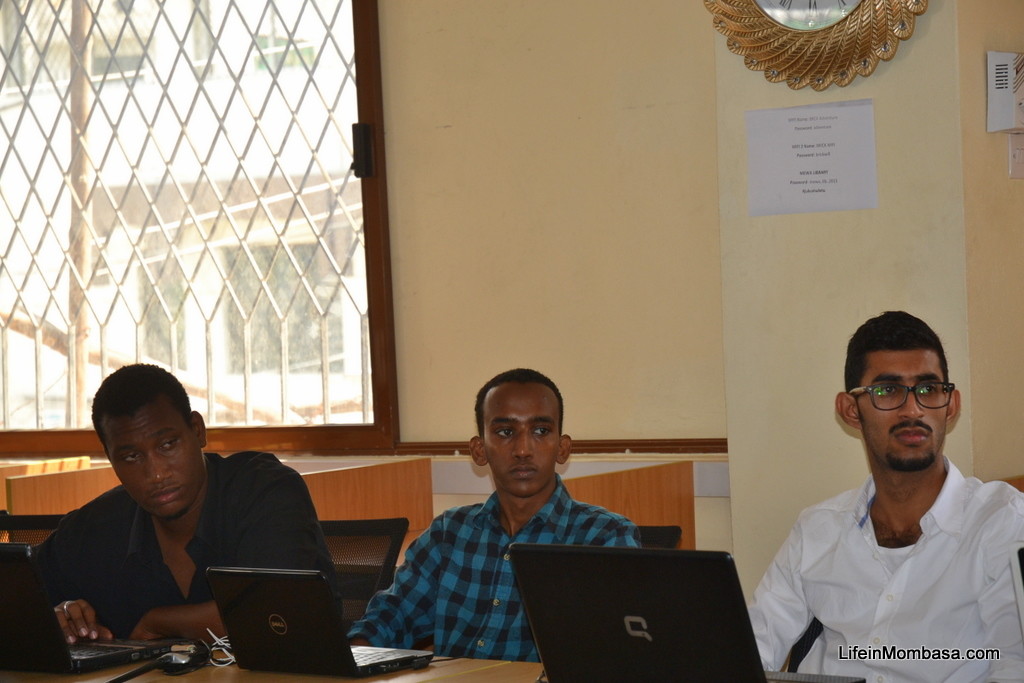
Upcoming and established bloggers in Mombasa got a chance to upgrade their skills during the BAKE training that was held at the MEWA Library. The free training was attended by many blogging enthusiasts both during the Jukumu Letu blogging training and also another one on general blogging dynamics.
For the online content creators in the region, BAKE training comes at a time when the demand for local content on blogs is at an all time high. According to the BAKE’s State of Blogging and Social Media Report, there are estimated 15,000 registered blogs in Kenya with 3,000 being active blogs and more than seven million people on social media in Kenya.
Despite the growth of blogs in Kenya, there are legal concerns that bloggers should be aware of. According to the report,
“Bloggers and Social media users getting into trouble with law enforcement agencies: Of concern noted in the report is Section 132 of the Penal code that talks about the undermining authority of public office and misuse of licensed telecommunications equipment.”
The hands on training sought to create an understanding about all the elements it takes to start, publish and publicize a blog. In additional, the training covered the steps it takes to become a better blogger such as how to use social media to grow blog readership.
Jamila Hassan attended the training and she was happy to finally have Mombasa based bloggers on the map. She said,
“Blogging in Mombasa has not been embraced as much as Nairobi as people are not aware of such platform where they can express themselves. Bringing the training in Mombasa is a great asset to the Mombasa people, once people have been informed on blogging the residents of Mombasa can now tell their stories.”
According to James Wamathai, BAKE’s director of partnerships, there will be more trainings held in Mombasa to promote further content creation in the coast region.
In closing, one of the attendees was optimistic that better content will be seen from Mombasa bloggers.
“Mombasa is rich in culture and history, with the digital world it will be amazing to capture it through personal journeys in the blogging sphere. I also hope that after the training, more bloggers who are not vocal will see the opportunity to come out and provide good content. Indeed, there are many good bloggers in Mombasa but they are not given attention because blogging is still a new concept in Mombasa.”
Dr. Auma Obama with Lonah Abuga, a Nakuru based journalist during the event (Photo: James Wakibia).
By Njeri Mwangi
I first saw and met Auma Obama during the Nakuru Story Moja Festival an event that took place towards the end of the month of May at the Kenya National Library in the county.
As a journalist, then attached at Egerton Radio, I had been sent to cover the event in which Auma would address Kenyans and perhaps shed light on the coming of his brother, US President Barrack Obama, to the country (which she didn’t as she wanted the visit not to overshadow the Storymoja event).
Being two months away at the time, the Obama visit had not attracted much attention. Partly because of this, the presence of his sister at the event did not cause any ripples among journalists. After all, we knew little about Auma Obama. On several occasions I thus tried to dodge the sessions she was facilitating. I felt like they did not have much “newsworthiness”.
Finally, one day a colleague of mine managed to convince me to attend one of the sessions. We found Auma playing and dancing freely with children from various primary schools in the country that had attended the festivals. She could dance to the songs they were singing and seemed so comfortable interacting with the little ones.
At the time the identity she would later have, especially after the ride in ‘The Beast’ and the close contact she had with Obama during his July visit were nowhere to be seen, even detected. Or maybe my colleague did, for she made sure she took a photo with her as I shied away. It was a “non issue” for me at the time.
Then came the evening of July 24, after Air Force One touched down at the Jomo Kenyatta International Airport (JKIA) and it downed on me who Auma was. She was more than the lady I had found dancing with children at the library encouraging them to develop a reading culture. She is a close sister to one of the most influential if not most powerful men in the world.
It is at that point that it dawned on me that I should have a closer interest in her – listen to her more and even take the photo I ran away from. It is not that I wanted to have a snip of her fame, but yes, I discovered much later that she was an influential leader in her own self. The more the reason why I should have drank from the pot of her wisdom.
But what even struck me most about her is her humility, perhaps this is the reason why there wasn’t much talk about her during the event. It’s a humility very few people hardly posses. Many a times you see people making stunts out of the status of their close relatives and friends. And I dare to ask how many times have we made people suffer or even made people take note of our presence just because our so and so is the head of a certain organization?
I think we can learn a few lessons from her on remaining true to our identities and how not to find our own spaces without riding on those of our influential relatives and or friends.
*Njeri Mwangi is a student at Laikipia University studying Communication and Media.