Monday, December 22, 2025
Home Blog Page 34

Small scale fishermen in Mombasa get boost

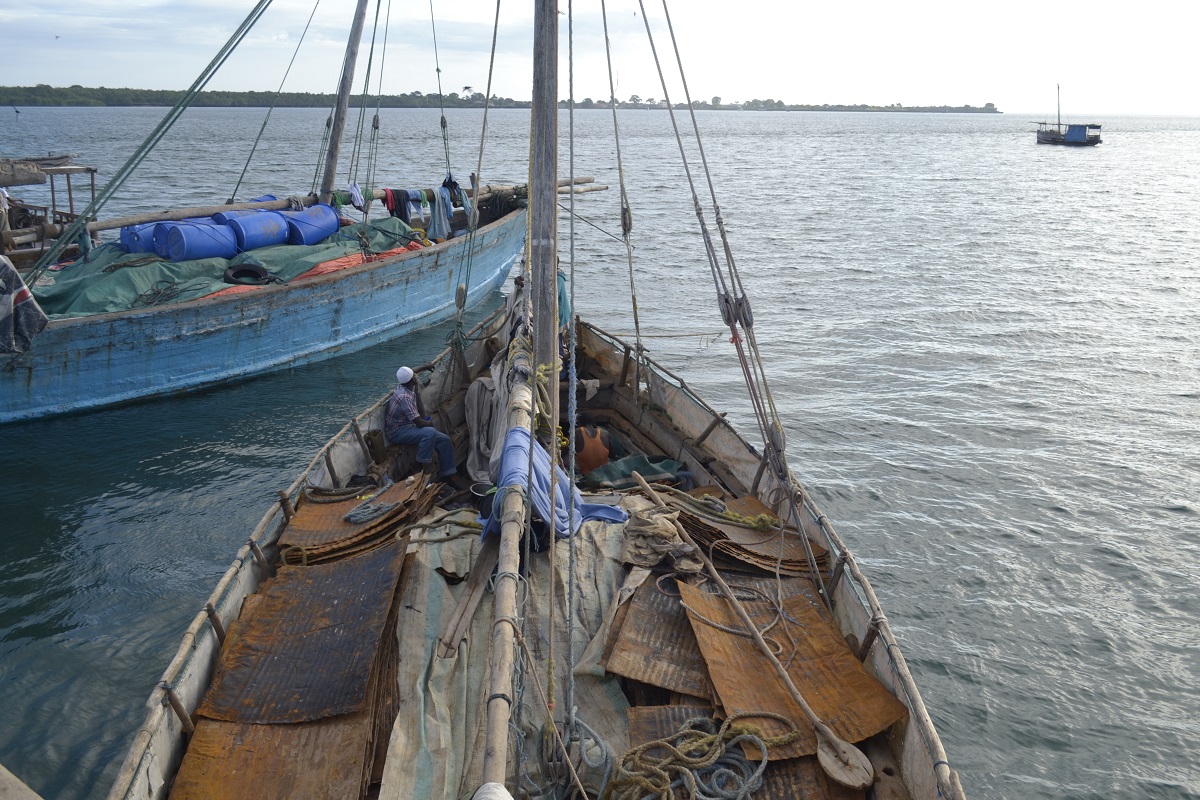
Fishing Vessels at the Kenyan Coast  (www.lifeinmombasa.com)
Fishing Vessels at the Kenyan Coast (www.lifeinmombasa.com)

Efforts by the Mombasa County to register and empower fishermen through Beach Management Units (BMU) are finally bearing fruit. This follows the announcement that the County Government working with KCB Foundation will be helping the BMU’s to procure fishing vessels with capacity to haul up to to 10 tonnes of fish.

The county has embarked on training on financial management among the BMU members to improve capacity and skills as they prepare to scale up fishing activities in Mombasa. With the new boat, fishermen can now replace their ‘ngalawas’ and their dugout boats with better purpose built vessels that can venture out to the deep sea. Due to the enhanced catch, the BMU’s will create even more jobs in the supply chain from the landing, processing and transportation of the fish.

To the small scale fishermen, the opportunity to scale up their operation is an excellent opportunity to improve livelihood and  alleviate poverty. Also working in a group, the fisherman will be able to draw strength and skill in numbers thus improving their chances. Members of the BMU’s have been trained on budget planning and financial management by the county government.

For a start, two 10 ton fishing vessels will be bought and handed over to 2 BMU’s. Notably, the vessels will be built locally further enhancing the local boat making industry to the tune of sh30 million. Rachael Gathoni, KCB Foundation Manager was said.

“We have our own criteria on how we will select the two BMU’s to loan the boat, basically we will focus on the group that has good records doing business and repaying its loans. I urge some young groups to learn from the ones we will give the loan so as to grow and master good practices”

According to to the county government,

“This will go along way into improving the livelihood of our fishermen, promotion of food security in the county as well as improved nutritional levels for our people.”

According to the Lighthouse Foundation,

“ The problem of over-fishing in the shallow coastal waters has been accentuated by the increasing number of fishermen who, because of the lack of alternatives, have been forced to use the simplest types of equipment to earn a living”.

By venturing to the deeper sea, the fishermen allow shallower fishing waters  to rejuvenate and replenish stocks.

Currently, the County through the Ministry of Agriculture, Livestock and Fisheries is making efforts to source for another 13 boats working with partners so that all BMU’s can be gainfully employed.

Secure whistle blowing platform for Africa AfriLeaks to launch in Kenya

AfriLeaksAfriLEAKS, a secure anonymous whistle blowing platform for African nations will be formally launched first in Kenya, Nigeria and South Africa respectively in the next few months according to Ruth Kronenburg, the Director of Operations at Free Press Unlimited, one of the partners in the joint project. Ruth was speaking at a session in the just ended Deutsche Welle Global Media Forum in Bonn, Germany.

Afrileaks  is run by an alliance of African news organisations that are committed to speaking truth to power. The site whose concept was greatly  WikiLeaks was set up early this year. Unlike the longer established Wikileaks, the Africa version won’t release secret information directly to the public, according to Khadija Sharife of the African Network of Centers for Investigative Reporting (ANCIR) – the organization that hosts the platform.

“[AfriLeaks will] provide a secure tool for connectivity between the whistleblowers and the media who then investigate the substance and character of the leak,” she told Deutsche Welle in an interview ahead of the launch.

According to the DW article, whereas the aim of Wikileaks has been to publish and disclose information, AfriLeaks is there to provide leads for stories to media and research organizations. The new platform will allow whistleblowers to choose the media or research organization to which they want to send the information.

Whistle blowers can send documents and select which of the AfriLeaks member organisations should perform an investigation.

During the Global Media Forum  workshop  titled Digital Media, citizen Journalism and whistleblowing: overcoming the challenges of national security and corporate capture in 2015, Ruth together with fellow panelists spoke about other similar initiatives to AfriLeaks that have been setup elsewhere such as the successful MexicoLeaks site.  Ruth disclosed that AfriLeaks is modelled along the lines of Europe’s GlobaLeaks with the aim of making whistle-blowing safer and that the site guarantees the whistle blowers safety by use of leaking tools such as TOR and secure drop.

Njoro teacher accused of defiling his students denied bail

0
Paul Gacheru
Paul Gacheru, a Kiswahili teacher at Njoro Girls High School who is being accused of sexually molesting his students (Photo/Star).

By Lorna Abuga.

A high school teacher facing charges of defiling his student and sexually assaulting five others has been denied bail by a Nakuru court.

Paul Gicheru who teaches Kiswahili at Njoro Girls High School will remain in custody until his lawyer proves that he will not interfere with the witnesses once bailed out.

This directive follows another one that had been given on Monday by Chief Magistrate Doreen Mulekyo that the prosecutor updates the court on the whereabouts of the schoolgirls he is said to have molested, as well as their safety before he is considered for bail.

“We do not want to endanger the lives of the minors and thereby there is need for the prosecutor to gather enough information about the status and whereabouts of the minors”, said Mulekyo.

The prosecutor told the court that releasing the accused on bond or cash bail may interfere with his witness, a plea which was opposed by the defendants lawyer Karanja Mbugua who said that his client was innocent and that students had rioted upon learning of his arrest over the alleged charges.

Gicheru’s lawyer Karanja Mbugua had applied for bail terms for his client who has been charged with committing the beastly acts to the six girls for the last one year. The accused who shook his head while staring at the floor denied the charges saying they were a plot to tarnish his good bright teaching career of “25 years”.

The school has since been closed after students held a demonstration in protest.

Lawyer Mbugua argued that, since the students went on strike over the weekend the learning activities at the school had been stopped thus the accused could not be of any harm to them as they were away.

Present during the court session was Nakuru County Teachers Service Commission (TSC) Director Agnetta Kitheka who told the court that her office had considered the gravity of the matter by taking the victims for counseling.

She said security measures were being put in place to ensure their safety. Also in the court were the parents of the affected students who were granted permission to go home with their children. Before being handed over to the parents the children were being handled by the children department in the county. The parents promised to be accompanying them to court whenever required to do so.

Magistrate Mulekyo passed a strong message to the TSC office that the case was a serious one and the court would not entertain drama of any nature that will interfere with the integrity of the case.

Also see ‘Teacher charged with sex attack on students‘.

How Boxing Day errand turned awry for Njoro girl

0
Rape Snip
An poster to end rape. The Njoro girl was allegedly defiled and infected with HIV/AIDS when she went to buy sugar on Boxing Day last year (Photo/Google).

By Lorna Abuga.

Every year Christians all over the world look forward to Christmas. It is the day to mark the birth of their saviour Jesus Christ. They also usually look forward to the day after Christmas – Boxing Day. It is the day they open gifts sent by friends.

These two days are important to Christians. They always come with niceties, including delicacies and festivities that only come once in a year. And once the two days are done, Christians sometimes keep the memories engraved in their hearts – after all they are good memories.

But for one 13 year old girl in Naishi, Njoro, last year on Boxing Day her mother sent her to a nearby shop to buy sugar. It was the normal errands that mothers ask their children to do. Little did she and her mother know that the day would leave a life time memory in her, and a bad one for that.

When she got to the shop she claims, the shop keeper, who is a middle aged man asked her to get into his shop. It is then that he stripped her and defiled her. The man, Raphael Mbugua then threatened her not to tell anyone lest he kills her.

The girl then went home, terrified! But she would never to disclose to anyone. What she did not know is that the man had infected her with HIV/AIDS.

That remained a secret in her for some time until her father was infected with tuberculosis. The father was asked by his doctor to bring all his family members for routine check up. During that time all were tested for tuberculosis and HIV/AIDS. It is then that the girl tested positive to the surprise of everyone.

It was then that she disclosed what had happened and the suspect was arrested and later arraigned in court.

“I discovered that I was HIV positive when the doctors examined me and immediately they enrolled me on the ARVs program,”

the minor told Nakuru Resident Magistrate Eunice Kelly last week.

Last week the court was also told that the accused and the minor had been taken to the Nakuru Level 5 hospital by the investigation team and they both tested positive.

The accused denied the charges and will be held in custody until his hearing this year December 7 this year.

According to the Sexual Offences Act both the

“A person who commits an offence of defilement with a child between the age of sixteen and eighteen years is liable upon conviction to imprisonment for a term of not less than fifteen years.”

The same Act states that anyone who intentionally infects someone else with HIV/AIDS

“shall be liable upon conviction to imprisonment for a term of not less than fifteen years but which may be for life.”

Also read ‘Nakuru Court hands man 75 year jail term for indecent act with daughter’.

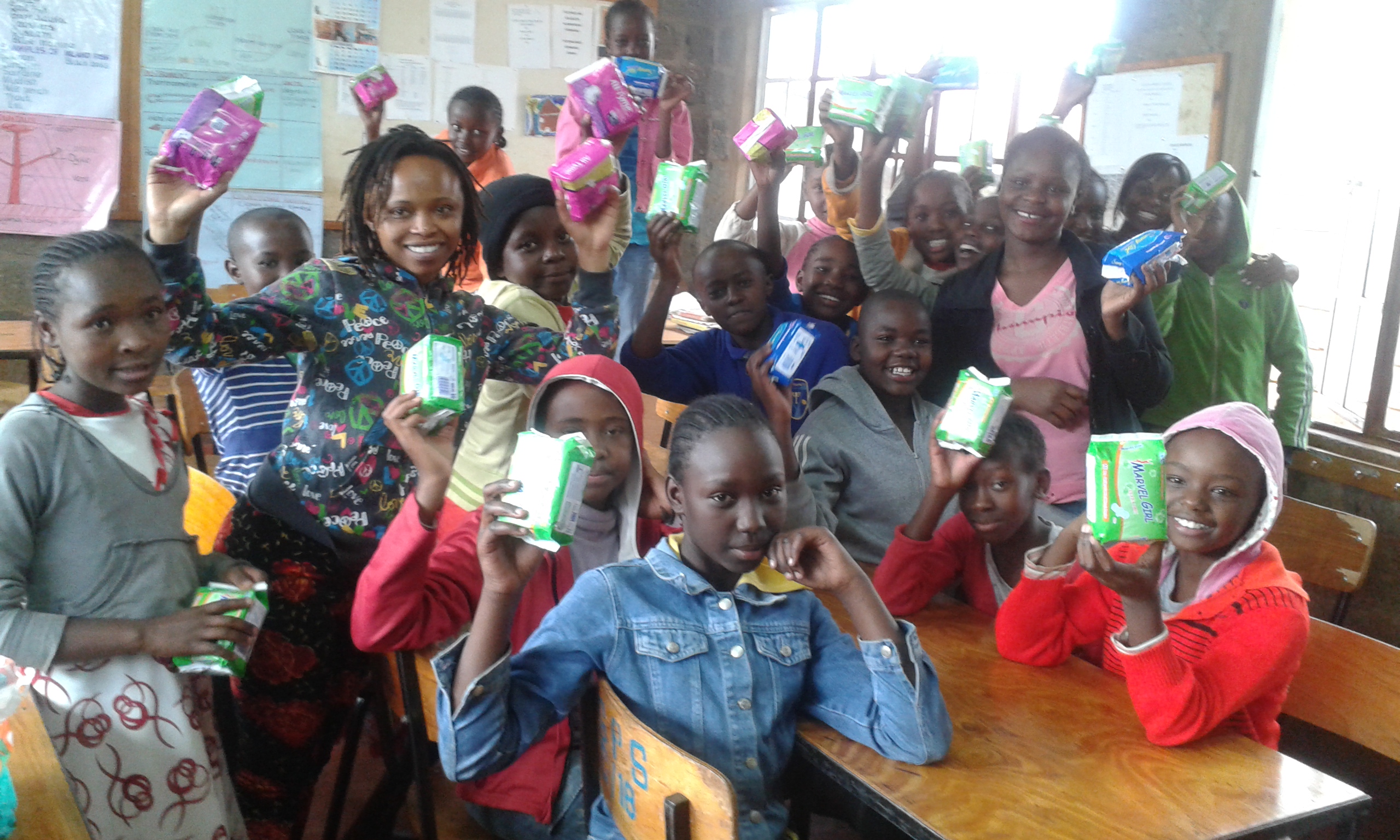
Girl smile initiative giving girls a second chance

Photo courtesy of www.kindermusik.com


Having traveled the country, Evans Paul realized that there was a gap in the way the girl child was being attended to. In his observations, young girls, both school going and those at home went through difficult times during their menses, hence hindering their academic performance.

It was at this point that he founded the Girl Smile Initiative in the beginning of the year, after realizing that these girls could not afford sanitary pads.

Paul, who is in his mid twenties was born and brought up in Diani area of Kwale County. Having lost his father at a tender age, Paul was often with his mother and realized the generosity that the mother showed to the needy and helpless in the society.

“She kept encouraging me to do the same and here I am talking about Girl smile,” says Paul.

According to Paul, the organization, the cost of starting the organization wasn’t much but the real cost, he says, is to put a smile into the faces of the needy girls.

“I don’t know how much that will cost but I am determined to go the distance. Our aim is to reach out to the less fortunate school-going girls by providing them with sanitary towels to help them stay in school,” he adds.

“So far, we support 450 girls to stay in school on a regular basis and we want to reach 1000 by December this year.”

The organisation works in three counties including Kwale, Kajiado and Nairobi County in the informal settlements.

Besides the sanitary towels, the organization has a team of professionals including motivational speakers, nurses and experienced journalists who train and educate the girls on how to live and endure hard times.

“Motivational and inspiration talks changes perception and opinion and in addition we give them sanitary pads just to add icing on the cake,” says Paul.

On whether the government, private sector and the non-governmental organizations have given so much attention to the girl-child at the expense of the boy-child, Paul says that the issue is debatable, urging the society to instead focus on the good work and the benefits to the common wananchi in the society. He adds:

“The society we are in gave so much to boy-child that girl-child was wallowing in oblivion and when reality hit home, majority of us woke up and did the right thing-support the girl-child.”

Unlike other initiatives, Paul says that the Girl Smile Initiative is comprised of volunteers who are young at heart and fund their projects from their own finances. The team reaches the 450 girls every month to provide them with sanitary towels. Besides, the girls benefit from peer education programs and sanitation and hygiene programs.

To monitor the progress of the girls, Paul says that they have contacts of the schools that they work with and visit the schools every month to monitor their progress.

“Performance of the girls is also very key to our evaluation,” he adds.

The determination of the initiative is to have more girls access sanitary towels other than use other alternatives such as blankets, rags, mattress pieces, handkerchiefs, tissues paper and cotton wool because sanitary towels are expensive.

The organization that comprises 15 young people will be visiting Gentiana primary school in Dagoretti South in July.

Majority of Makueni residents want the County dissolved

Makueni probe team chair Mohammed Nyaoga and Commissioner Ali Taib in KICC Photo:Standard
Makueni probe team chair Mohammed Nyaoga and Commissioner Ali Taib in KICC
Photo:Standard

Majority of residents from Matiliku, Makueni county want the county dissolved over what they termed as irreconcilable differences between Governor Kivutha Kibwana and Members of the County Assembly (MCAs)

While giving their submissions to the probe team looking into the possible dissolution of the county, close to 90 percent of the residents who attended a public hearing held at Matiliku Catholic church said the persistent wrangling between the legislative and the executive arm was irreversible and called on the Mohammed Nyaoga – led commission to recommend for dissolution.

Bernard Nzoka, a resident said the frosty relationship between the governor and the MCAs had derailed development and dissolution was the only solution to end the wrangling.

Nzoka accused the MCAs of deliberately delaying the budget and working in cohort with other political forces outside Makueni to frustrate Kibwana’s development agenda.

“The MCAs are corrupt and are not ready to work with the governor, the county should be dissolved so that we can elect a fresh team,” he said.

Nzoka also faulted the MCAs for failing to adhere to the budget ceilings set by the Commission of Revenue Allocation.(CRA)

James Mwikya attributed the wrangling to the continuation of political rivalry from the 2013 general elections in which the governor defeated former MP for Kibwezi Professor Philip Kaloki, a close ally of Speaker Stephen Ngelu.

He took a swipe at the county leaders of lying to the residents and rooted for dissolution.

“These leaders cannot reconcile yet the common man is suffering. Let them go home,” he said.

Esther Mueni, also a resident regretted the standoff and condemned the county leaders for the poor leadership.

She cited lack of respect among the leaders as the key problem behind the infighting and said that the people of Makueni should be given another chance to elect fresh leaders.

“The most unfortunate thing is to elect leaders who instead of serving the electorate go for each other necks,” said Mueni.

Musau Ndunda said most of the MCAs were semi-literate and could not understand their constitutional mandate.

Ndunda noted that the MCAs’ ignorance made them easy targets of arm-twisting and manipulation by other leaders keen on pursuing selfish interests.

“Let the county be dissolved the wrangles especially on budget are an indication that the MCAs are greedy and selfish,” he said.

Daniel Kimilu noted that the poor track of development in the county occasioned by the infighting should act as an impetus for the county to be dissolved.

Kimilu said both arms had failed in their functions and should therefore be send packing.

“Most of the projects are incomplete and the legislations are few, let the leaders know that Makueni is bigger than any individual and we shall not watch as they destroy the county,” he said.

However, a few residents opposed the dissolution and turned the heat on the governor whom they accused of being incompetent.

Kavi Mutuku said Kibwana was behind the wrangling and accused him of inciting the public against the MCAs.

He castigated the governor for his poor record on development saying that governor was using the wrangling to shift the blame to the MCAs for his ineptitude.

“The governor is a non- performer, cunning and an inciter who hates anyone who confronts him with the truth,” said Mutuku.

He also accused the governor of running a corrupt government riddled with nepotism.

Mutisya Mutua also criticized the governor for what he termed as efforts by the executive to obstruct the oversight role of the county assembly.

Mutua said the governor had initiated the culture of activism in the county making it ungovernable.

“The governor is gifted in shifting blames, when he was an MP he terribly failed but blamed the councilors for misleading him. This activism should stop,” he said.

Stephen Mutuku called for reconciliation among the warring parties noting that there was no time to hold a snap election.

Mutuku opposed dissolution and underscored the need for civic education for proper governance.

“It is important for the public to know the roles of each arm to avoid the current blame game,” he said.

Last year more than 50,000 residents from Makueni filed a petition to suspend the county government owing to the prolonged infighting between the governor and MCAs.

Subsequently, a six-member commission was formed to look into the petition. The commission is currently holding public hearings at the sub county level.

Chair Nyaoga has said the commission will expedite its work and present the findings to President Uhuru Kenyatta within two months.

Makueni County to hold marathon to sensitize residents on water harvesting

maji

Makueni County is classified as an arid and semiarid land characterized by low and poorly distributed rainfall that ranges between 100-600mm per year. Due to the harsh climatic conditions, water is scarce and residents walk for long distances in search of water for both domestic and animal use.

Water is one of the most pressing needs in the county. It is against this backdrop that the county government has embarked on an ambitious project of harvesting water across the county as a way of cushioning the residents against the biting water scarcity.

Dubbed ‘Kitwiikanya Kiwu’ (harvesting water) the project aims at supporting residents to establish water pans at every household for both domestic and small scale irrigation. Director Agriculture David Musyoki told Kenya Monitor that the department targets to have 600 pans by the end of the year.

“We plan to have the pans at high potential areas like Mbooni, Kilungu before we roll out the entire project in the whole county,” he said.

To support the initiative, the Department of Sports will hold the first annual half-marathon to encourage residents to harvest water during the rainy seasons.

Gender and Sports Executive Rose Maundu said the marathon to be held at the Makueni Boys School will kick off on Saturday June 27 starting from 6am.

The half marathon according to Ms. Maundu will have several categories that include a fun run, a walk and 5km, 10km and 21 km run.

She also disclosed that the marathon will be an annual event.

Registration is currently going on at Sh500 for individual and Sh10, 000 for corporates.

According to the information posted on the county website, the water Department is one of the key departments in the county whose activities will make or break the meaning of devolution to the ordinary citizenry.

The County Government has identified provision of sufficient clean drinking water and water for irrigation and livestock use as one of the key development agenda as captured in the County Integrated Development Plan 2013-2018.

The government plans to establish 100 earth dams by 2017 by rolling out six 30-acre earth dams, one in each constituency and at least three other smaller dams of at least 50,000 metric tones in each of the 30 wards.

Already, some of the mega earth dams such D4 in Kilome Sub County have been completed while construction of Kwambila dam within Makueni is ongoing

Besides the earth dams, the county is also setting up sand dams with Kaiti sand dam having being operationalized to provide water to the residents of Wote town.

Kuza project to create 5000 jobs in Mombasa

2
Opening of a Youth Center in Likoni (thekuzaproject.org)

Youth unemployment stands at 64 percent in Mombasa. This high level of unemployment is unsustainable and has resulted in more youth engaging in vices such as crime, drug abuse and getting radicalized. Reports from the Lamu following the killing of 11 Alshabab militants shows that a number of them were Mombasa youth. It is therefore important that Mombasa finds ways of getting the youth gainfully employed.
The UK government through the Department for International Development (DFID) is hoping KUZA (‘grow’ in Kiswahili) a project designed to improve skills and employability of the youth can be one of the solutions. The project is working with the county government will run for 3 years and intends to create 5,000 jobs in Mombasa alone for the youth.

In addition the project will train 8,000 youth in business skills and offer courses, career guidance and job search assistance.

“What KUZA is doing is creating jobs for the youth, it is doing that by taking different sectors, building the skills and job centers. Creating the opportunities at a very local to get youth into work,” said Christian Turner outgoing British High Commissioner.

Some of the targeted sectors include manufacturing where KUZA will work with players in the sector to increase competitiveness and growth. KUZA will also work with the construction industry to the skills of the youth working in the sector. This will be done by advising on the reformation of the vocational education system to ensure the development of construction skills in the youth.

For the youth working in the informal sector there is a plan to link them to big businesses like Unilever to give them access to better markets and even potential investment opportunities. Tony, a trader based at the Kongowea market welcomes the opportunities that would arise from such an arrangement as many traders incur losses or make very little profit especially when the markets are weak.

KUZA is also working with the county government with the intention to unlock the opportunities for employment in solid waste management ecosystem. Currently, KUZA is conducting a waste collection and management study in Mombasa whose findings will be important to ending the solid waste challenges in the city.

Christian Turner sees massive potential in the youth.

“The potential of Kenyan youth makes me so optimistic about this country, we want to unleash that to give them opportunities that can generate growth and further investment.”

Mbele, a young university graduate who is also a member of a self help group thinks it is a great idea though remains cautiously optimistic.

“Government and NGO’s have come with many youth projects in the past but nothing really changes for us the youth. If KUZA changed that it would be the best thing for us young people of Mombasa.”

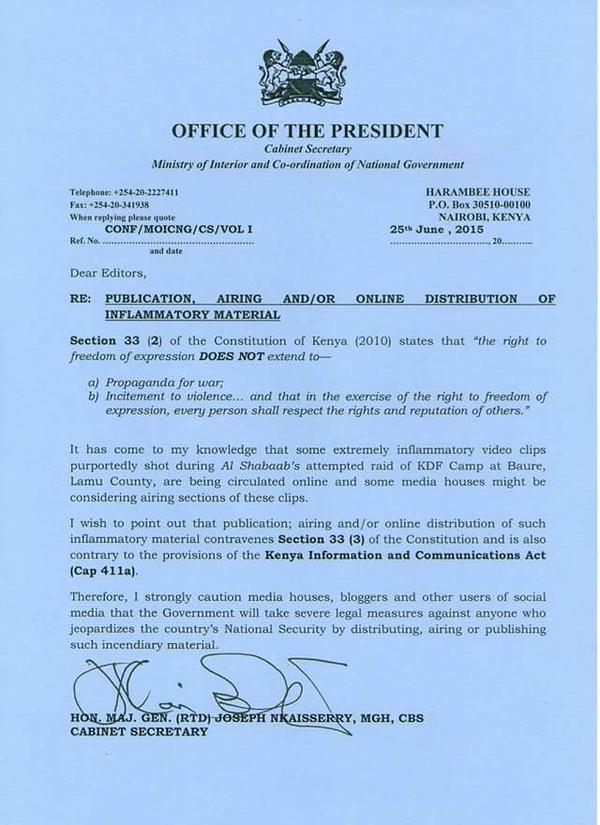
Nkaissery gag order on distributing Lamu Al-Shabaab video lawful

Media Gag - Clear

Interior Cabinet Secretary Joseph Nkaissery’s gag order on sharing a video online that showed the last moments of the Al Shabaab before they attacked the Kenya Defence Forces (KDF) Baure camp in Lamu County is lawful and constitutional.

The video which was published by ITV shows the moments before the Al Shabaab fighters were preparing to battle KDF forces and half way through the fight, it goes off, indicating their death.

Mugambi Laibuta, an Advocate of the High Court of Kenya argues that the order is lawful as rights guaranteed in the constitution are unlimited. In the gag order, sent to editors, the intention seems to prevent them from airing it in their stations. The idea being that it will reach a larger number, beyond those who may not be able to see it or seen it online. It however also cautions online users to desist from distributing it.

The concern by the Interior Minister is that the video amounts to propaganda to war and incitement to violence. Indeed the Constitution in Article 33 asserts that the freedom of speech does not extend to incitement to violence, hate speech and propaganda to war.

Kenyans went online to share their thoughts on the issue.


Some questions were also directed as to who really should be investigated or stopped in the first place.  


It cannot be expected that a civilian first got the video and sold it to ITV. It is likely to a KDF officer hence the Cabinet Secretary should expend energies towards the forces so as to really show that he does not want Kenyans to disregard the Constitution.

On the material of the video and whether it actually amounts to incitement to violence or propaganda to war, Laibuta asserted that

“I think the Minister fears it might glorify those people as Al Shabaab matyrs.”

The Constitution in Article 24 provides for the limitation of rights and says that the limitation shall only be by law and to the extent that the limitation is justifiable and reasonable. In addition, Article 25 lists the fundamental rights and freedoms that may not be limited. The list does not include freedom of speech.

Gagging mainstream media from airing the video is easy and will happen. The best they will do and some have is to do a story on it without showing the video. However, preventing people from sharing it online is impossible. In fact, the move has increased interest in people and more and more are sharing it. Looking at comments from across social media platforms, the video is making Kenyans proud, something Nkaissery is missing or has not aptly captured the emotions Kenyans are having.

Posting on his Facebook page after the botched attack at the KDF camp in Baure, Lamu County, Security Expert Mwenda Mbijiwe asserted

The pundits and naysayers should now notice we are suddenly becoming a rapid response nation! Al-shabaab will soon be…

Posted by Mbijiwe Mwenda on Sunday, 14 June 2015

As to whether the gag order was necessary for national security reasons, Mwenda said

No of course! Even ISIS brutal videos are on YouTube.


The legality of whether the order is accurate may not be argued. However, as to whether it was a necessary move remains the question since government cannot pull it down, it will continue to go viral and its contents unlikely to come close to propaganda to war or incite violence.

Delamare staff steal sheep to pay themselves salaries

Sheep Snip
Picture of a sheep. The two Delamare staff stole a sheep (different from the one in picture) after their salaries were delayed (Photo/ Google).

By Lorna Abuga.

If you are employed to take care of your employer’s livestock and the employer delays your salary will you ‘steal’ one of the livestock you are taking care of and pay yourself?

Well, that is exactly what two employees at the Delamare Farm Limited decided to do recently at the company’s Soysambu ranch in Gilgil, Nakuru county.

Charles Tobiko and Lelaike Ole Lepirkine stole a sheep at the Delamere farm before they were arrested and charged in court. And when they appeared before Chief Magistrate Joel Ng’eno at the Nakuru Law Courts on Monday June 22 they quickly pleaded guilty saying they were paying themselves their salaries.

“Our salary had been delayed,”

said Tobiko while responding to the Magistrate’s question on why they had committed the crime.

Had they sold the sheep it would have fetched them sh5,000 meaning each of them would have gone home with sh2,500, and that is if they were to share the loot equally. However they never got to sell the sheep as they were arrested by the farm’s Chief Security Officer Jeff Mitto just in time.

“We are the sole breadwinners in our families,”

said Tobiko while pleading with the Magistrate to be lenient with them.

The two were fined sh5,000 and asked to have an out of the court settlement with their employer.

Meanwhile, another court in Nakuru sentenced a middle aged man to 20 years imprisonment for defiling his daughter aged 13.

The court heard that, the accused, Samuel Njoroge had separated with his wife a few years back and had been left with the sole responsibility of taking care of the girl. The court was told that Njoroge took advantage of the minor and on several occasions indulged the girl in the indecent act.

The girl at first reported the incident to her grandmother, who unfortunately, did not report the matter to the relevant authorities.

The recurrence of the beastly act prompted minor to seek intervention from a close neighbor who in turn reported the matter to the Chief at their Maili Kumi residence in the outskirts of Nakuru who in turn informed the police.

The man was then arrested and a case against him was started. The court was told that on the several occasions the man had been defiling the girl for two years between the year 2012 and 2014.

The accused had denied the charges and had since been in custody.

In her ruling however, Resident Magistrate Mary Otindo said the Prosecution had proved the case beyond reasonable doubt to warrant the sentence.

“It took the prosecutor’s intervention to summon five witnesses who in their testimony confirmed the charges read against the accused,” she said in her ruling.

“The victim’s medical report obtained from Maili Kumi Hospital also established that she had indeed been defiled,” the Magistrate said.

Defilement cases are very common in the Nakuru Law Courts. In most cases they are committed by male relatives and neighbors.

In March this year, one court in Nakuru sentenced a man to 75 years in prison for an indecent act with his daughter aged 14.

Nyakundi case highlights need for education on the law and Internet in Kenya

Photo courtesy of www.mashada.com

The court case against blogger Cyprian Nyakundi highlights the need to learn about online freedoms and responsibilities. Certainly the internet does not exist in a vacuum.

Nyakundi, after reading the summons to appear in the newspaper tweeted


In addition to the above, he also retweeted what people were commenting about the court case. Most of these comments were disparaging Safaricom’s move. It is good to note from the go that tweeting and retweeting are both publishing. Neither has a lesser obligation. In addition, neither does stating half of retweets are not endorsements or retweets are not necessarily endorsements in the profile of your account reduces your culpability.

The legal framework governing the internet in Kenya is still evolving. However a point to note is that what governs media and freedom of speech offline also governs its online. That means that what is illegal or unlawful or should be avoided offline, should be replicated online.

The Bloggers Association of Kenya (BAKE) in whose mandate is to promote online local content has been running a project called ifreedoms. The project seeks to enlighten Kenyans of all walks of life about the law and the internet in Kenya. It conducts these training’s in various locations around the country. So far, these training’s have been held in Nairobi, Kisumu and Nyeri. It intends, in the long run, to go nationwide.

It is in the interest of BAKE that Kenyans know how they should conduct themselves online so that they responsibly, accurately and consistently tell their own stories online through blogs and social media platforms. Certainly when a blogger has a legal issue, BAKE may intervene when the cause is genuine and especially when it involves its members. It does these by assisting with legal counsel, popularizing the issue on social media and documenting it.

This Nyakundi court case validates what BAKE is doing. Nyakundi is still innocent until proven guilty. However, if he knew his legal rights and obligations, he probably would not be in the situation he is today. More importantly, more Kenyans should take queue from this to learn how they should conduct themselves online.

The State of Blogging & Social Media in Kenya report brought out some of the cases bloggers are facing. It also stated that one challenge they face, including social media users is knowledge of their rights including basics like the rights of an arrested person.

There is a court ruling that sheds light into the issue of sharing secondary content that comes with responsibility as the primary publisher of the content. In the case, CFC Stanbic Bank Limited v Consumer Federation of Kenya (COFEK) Being sued through its officials namely Stephen Mutoro & 2 others [2014], two things stand out, they read

On or about 1st October, 2014, the Defendant caused to be published in its web-site http://www.cofek.co.ke an article entitled “How true is this allegation on Stanbic Bank Juba Branch on Foreign Exchange Transactions.”  In the said article, there were allegations against the Plaintiff’s Juba branch of lack of integrity in Foreign Exchange dealings; breach of Bank of South Sudan and Central Bank of Kenya regulations; arrogance by the Plaintiff’s Foreign Exchange dealer; breach of consumer rights and lack of integrity and responsibility by the Plaintiff’s management team.

On 2nd October, 2014, Messrs Wamae & Allen Advocates the Plaintiff’s advocates demanded from the Defendant the immediate removal of the said article from the Defendant’s website, facebook and Twitter accounts.  On receipt of the said demand, the Defendant responded that they were not the authors of the said anonymous article but had brought the said article to the attention of the public in general to have more complaints and have a public explanation given.

The court held that in the

Safaricom Limited  Vs porting Access Kenya Ltd (2011), repetition of a rumour is libel itself.  By republishing what is libelous, the Defendant is taken to have assumed responsibility in respect hereof.

Ruling on the 5th December 2014, Justice A. Mabeya ruled that

I have considered that the article complained of is not only defamatory but its  continued publication on the world wide web may continue to damage the Plaintiff’s international business, the Plaintiff is a bank of repute operating not only in Kenya but throughout Africa; the continued circulation of the article in the worldwide web of the Defendant may hinder or affect the Plaintiff’s reputation and business operations;

The above case sheds light into the practice of sharing content. Sharing includes retweeting on Twitter and sharing on Facebook. It also follows that re-publishing such content has ramifications, equal to the first publisher hence responsibility must be critical.

The onus on how on Safaricom to charge and argue whether;

1. Cyprian Nyakundi indeed has a blog and it is his blog that Safaricom alleges published defamatory statements,

2. The posts, it needs to produce them in court in some format, were defamatory. Already, the court has ordered they be pulled down.

Moving forward, Kenyans need to learn how, what to publish online and what not to as there are consequences for the choice of words you put online.


Makueni County records improvements in maternal health services

First Lady Margaret Kenyatta holds a new born baby when she visited Makueni County Referral Hospital during the handing over of the 30th Beyond Zero mobile clinic to Makueni County. Photo:Facebook
First Lady Margaret Kenyatta holds a new born baby when she visited Makueni County Referral Hospital during the handing over of the 30th Beyond Zero mobile clinic
Photo:Facebook

The dream of every pregnant woman is to give birth to a healthy baby that will live to celebrate many birthdays. However, more often than not, some mothers in Kenya never live to achieve this dream as they die while giving birth ushering the innocent babies into a motherless world. In extremes cases both the mother and the child lose their lives adding to the worrying statistics of maternal and child mortality in the country.

It is estimated that 6,000 women in the country die yearly during childbirth, with 488 deaths for every 100,000 live births. Subsequently 100, 000 children according to the Commission on Information and Accountability for Women and Children’s Health 2013 Update Report, never live to celebrate their fifth birthday due preventable causes.

Mary Mutuku, a resident of Makueni knows too well the pain of losing a child. It’s only this February that she lost her baby boy at a Machakos hospital after delivery. The 28- year old is yet to come to terms with the loss of her first-born child who she had named Noel.

Her pregnancy had progressed well and though she had planned to deliver at the Makueni County Referral Hospital, she later changed her mind and went to the neighboring Machakos County.

“I felt the county referral hospital was ill equipped and that is the reason I went to a private hospital in Machakos only for me to lose the baby after a normal delivery.

Mary blames the death of her baby to negligence of the medical staff and believes that her son died due to suffocation.

“My son was born health but suffocated at the nursery,” she says.

Kyalo Wolile, also a resident was widowed in 2002 after his wife died while giving birth to their third born child at the referral hospital. She bled profusely during delivery and eventually died and so did the newborn.

Wolile has been left to fend for his two daughters and life has never been the same again. He has now taken to drinking to drown his sorrows and from his looks it’s evident that his wife’s death has taken a toll on him.

“My wife’s death has affected every aspect of my life, I have never remarried and I wish she was still around to help me with the girls,” he says.

It is for these reasons that the First Lady Margaret Kenyatta launched the Beyond Zero Campaign initiative to improve the maternal and child healthcare and avert such deaths.

The campaign launched in 2014 also aims to eliminate new HIV infections among children. The initiative has also seen the first lady roll out mobile clinics that will provide integrated HIV, maternal and child health outreach services in the country. So far 30 counties have received the mobile clinics.

Last week Makueni County received the 30th mobile clinic in a colorful ceremony that was graced by the first lady, Governor Kivutha Kibwana among other senior government officials from both the county and national governments.

The county despite the wrangling between the governor and Members of the County Assembly has made major strides in improvement of health care and especially maternal services. For the last two years, the percentage of women who deliver in the hospital has increased from 21 to 53 percent, three points higher of the national rating that stands at 50.

Health Executive Dr.Andrew Mulwa attributes the performance to massive sensitization on the need for women to give birth at the hospitals under the care of skilled medical personnel.

Dr. Mulwa says the department has recruited the help of 106 community health workers across the country to ensure that all pregnant women access antenatal care.

“We use the community health workers to mobilize women to deliver in health facilities hence averting maternal related complications that sometimes lead to death,” says Dr. Mulwa.

The health executive also notes that HIV transmission from mother to child has drastically reduced for the last three years.
He says in 2013 out of 1042 women who tested positive 938 gave birth to HIV free babies while in 2014 of the 1011 infected pregnant women 948 did not infect their babies a scenario also replicated in 2015, where out of 728 HIV positive mothers 687 gave birth to HIV free babies.

Mary Malonza, HIV positive mother is a living testimony that the HIV mother to child transmission can be eliminated.

She turned positive six years ago and despite her condition, with the help of the medical staff at the county referral gave birth to a healthy baby boy now aged five.

She urges fellow women to give birth in hospitals and not to shy away form declaring their HIV status.

“I delivered at the hospital and now my baby is healthy,” said Ms. Malonza.

The improvement of maternal health services in Makueni County is an indication that access to quality health care to mothers and children is possible. Such efforts complimented by the first lady’s Beyond Zero Campaign noble initiative can help accelerate the attainment of HIV, maternal and child health targets. However, to achieve this goal, there is need for enhanced collaboration among health stakeholders both at the county and national level.

Safaricom sues blogger Cyprian Nyakundi for defamation

Photo credit: www.magazinereel.com

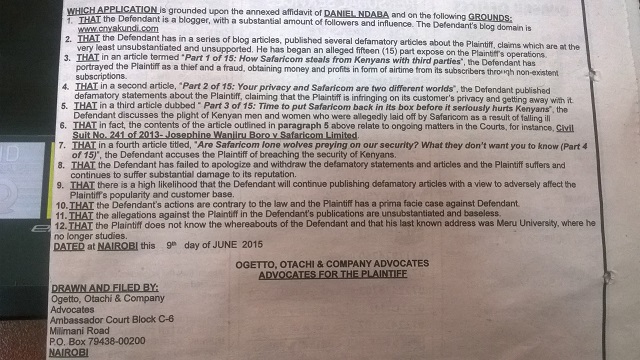
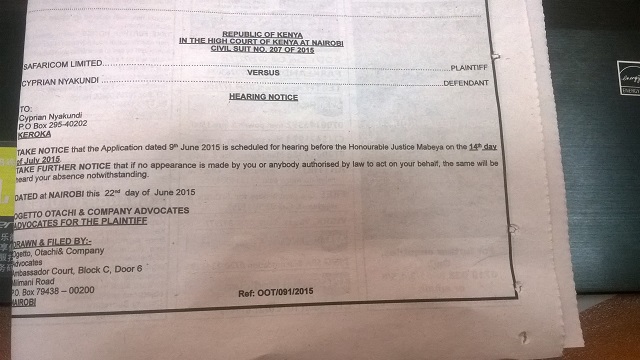
Safaricom has sued blogger Cyprian Nyakundi for defamation. In a paid advertisement in the Nation, dated 24th June 2015 on page 51, Honorable Justice Mabeya has ordered Nyakundi to do among others;

1. Pull down all posts in his blog that are defamatory to Safaricom.

2. A permanent injunction has been issued against him, his blog, agents or any other blog, publish any posts on his blog on Safaricom that border on the litigation matters. This injunction also applies to future publications on his blog that would be deemed defamatory to Safaricom.

According to the advert/summon to appear, Nyakundi has failed to apologize and withdraw the statements in the blog posts. The result of this is that Safaricom suffers and continues to suffer substantial damage to its reputation. It further states that the result of this is that he can continue to do it in future which will negatively impact Safaricom’s popularity and customer base.

1

2

3

4

(Download a PDF of the full court summons HERE)

Safaricom argues that the allegations are unsubstantiated and baseless. It further states that it does not know the whereabouts of Nyakundi as his last known address was Meru University, where he no longer studies. It is this lack of location and address that the judge allowed them to issue the summon to appear through the newspapers.

The hearing of the case is set for the 14th of July 2015.

Nyakundi says he only saw the orders in the newspapers and no communication had been made earlier.

Section 16A of the defamation Act says

16A.
Award of damages

In any action for libel, the court shall assess the amount of damages payable in such amount as it may deem just:

The above means that the court will have its liberty to decide how the such damages, if any, would be adduced. Perhaps what the Judge could consider, if and when it comes to that, is precedence. There have been have defamation cases against some media personalities or publications, most popularly the case involving veteran politician Nicholas Biwott.

Arguing on damages is considered based on issues like distribution reach and popularity of the medium used. In this case, online distribution is worldwide and Nyakundi’s blog is quite popular. It is possible for Safaricom to use Alexa or Google ranking to know or tell how popular the blog is globally and in Kenya and use that to argue for higher damages in addition to other punitive measures like permanent injunction against defamatory posts about Safaricom.

Previous defamation cases could be considered here;

In the Biwott vs Mbuguss case, sh10M were awarded.

In the Nicholas Biwott vs Kalamka Ltd, the publisher of “The People Daily” in 2002, the court awarded Biwott sh20M. Justice Joyce Aluoch stated that the publication on Biwott was tantamount to

 “unmitigated and defenceless character assassination.”

In the Charles Kariuki T/A Charles Kariuki & Co Advocates, sh10M were awarded.

In the Christopher Obure vs Tom Oscar Alwao and others sh15M were awarded.

In the Johnson Gicheru va Andrew Morton and another case, it was first set at sh2.5M where upon on appeal, increased to sh6M.

In the Richard Otieno Kwach vs The Standard Limited and others sh5.5M were awarded.

A more recent ruling is that of Francis Ole Kaparo vs Standard Media group and others in which Justice D. A. Onyancha ruling on 1st February 2010, awarded Kaparo sh7M. In his ruling the learned Judge said the damages are

…not meant to enrich the plaintiff hence the idea is not to make them excessive… I am aware however that the court is not prevented from making a reasonably high award in a proper case.

Read it here

This case (Civil Suit No 27 of 2015, Ref. No. OOT/091/2015) is pivotal in many ways.

1. It has implications for both blogs and micro-blogs; Twitter and Facebook stand out.

2. It will define how Kenyans interact with issues, people and institutions when allegations come up. Some kind of ethical blogging will need to be a new trade.

Some of the specific concerns Safaricom has in the blog are titled

“Part 1 of 15: How Safaricom steals from Kenyans with third parties” here

“Part 2 of 15: Your privacy and Safaricom are two different worlds” here

“Part 3 of 15: Time to put Safaricom back in its box before it seriously hurts Kenyans.” here

“Are Safaricom lone wolves preying on our security? What they don’t want you to know (Part 4 of 15)” here

Nyakundi has published over 10 blog posts on Safaricom some on its former staff and how the company dealt with them, for instance sacking them. You can find nine of them, including the four above, which we took screen shots and saved on this platform for future reference.

The Bloggers Association of Kenya (BAKE) recently published a report on blogging and social media in Kenya. One of the things the report records are the court cases against bloggers. This case will therefore have meaning and implication on future and conduct of bloggers and social media users in Kenya.

Nakuru mother finds wealth in caskets

1
Casket snip
A casket (not among made by Njeri at her workshop). Most businesses in Kenya that involve handling the dead are run by men. (Photo/Google).

By Lorna Abuga

While most women are still shying away from stigmatized jobs such as handling the dead, a mother in Nakuru has defied all odds to make caskets so as to make a living.

“Working here has been fruitful for me since I do not have to beg to earn a living. All I do is designing and making caskets that I finally sell,”
says Joyce Njeri who has been running Kay Man Workshop, a casket making business next to the Nakuru referral hospital for the last five years.
Njeri had previously been running a boutique in Nakuru town before she decided to start the casket business.
“I closed my boutique because I was not making much to support my family. Since I had developed some interest in this job. I had to be trained for three years in order to perfect my designing and carpentry skills,” she said.
Njeri normally designs at least three caskets in a day which, she says are paid depending on the quality of the materials used. Other jobs that arise during the day at the workshop include making clutches for the physically challenged people.
“I charge between Sh3,000 to 10,000 for the general caskets while for classic ones the charges go up to Sh30,000 per casket.”
Like any other business Njeri says that casket business has its low and high seasons. All this depends on the number of deaths reported at the Nakuru hospital which majorly determines her customers.
“During the peak season, I have to make more caskets so as to meet the demand of the customers by ensuring that ready made caskets are always in stock,” she said.
She claims that her services are always needed despite the way people stigmatize the career.
“People tend to forget that we are just taking good care and giving a decent send off to our beloved.”
“It is just normal daily work; there are no evil spirits involved here or fights. Through the earnings I get, I have been able to provide for my families and this has boosted my living standards,”
she added without disclosing how much she makes in a month.
Njeri explains that the most challenging time is when people passing near the workshop hail abuses to her claiming that she perhaps always longs for people to die so as to make money out of her caskets making business.
“Whether we make them or not people will continue dying for one reason or the other and therefore the community should not think that we pray for people to die so as to make a living.”
The mother of five is grateful to her family for
“relentlessly given me moral support which has helped me overcome the stigma associated with my job”
and she now hopes to expand the business in order to cater for the demand of her customers which she says is rising day after day.

Lack of facilities regressing sports development for youths in Mombasa – part 2

Jubilee Manifesto had a lot in store for the youth

For these youth on the other hand, simpler interventions would make a bigger difference than one big stadia for the entire county. For example laying proper turfs for community grounds, building shaded stands to encourage fans to attend matches and building changing rooms would make massive differences. These small interventions replicated across all counties would have a much deeper impact for the youth than 5 stadia across the country.

For these youth, their plight has been fodder for every politician in the past years. They receive handouts every now and then, donations of equipment, kit, boots are appreciated but none of those things are more important than the infrastructure.

According to the manifesto, the Jubilee government will,

“upgrade existing sporting facilities at the County level to accommodate swimming, tennis, basketball and rugby.”

Expecting development from the central government may not materialize judging from the 2015/2016 budget estimates. From the budget, only Moi and Ruringu stadium are scheduled for development. There ministry of housing also purposes to build two stadia whose details are not specified.

In the budget, the Ministry of Sports makes a sweeping statement about

“rehabilitations of 20 other community sports facilities across the country”

without specifying which of these 20 grounds are due for rehabilitation. The ministry also intends to identify and develop 500 youths in sports.

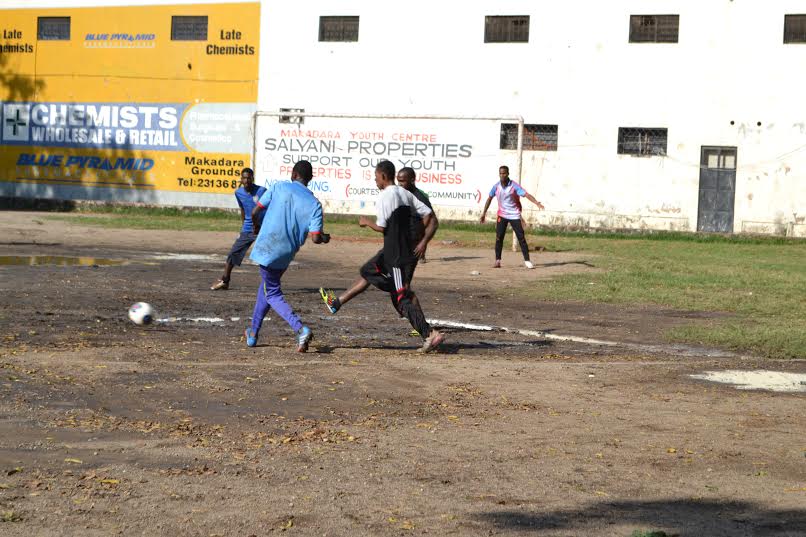
youth footballers playing at makadara
Youth playing football at Makadara grounds

How this would work for Modi and his friends is still unclear. The same ministry has allocated money to train 1,000 personnel in sports matters. The irony of training more officials than youth is stark, perhaps an indication of how much things haven’t changed in government.

Clearly youth struggling with sport at the grassroots are not the focus of the government. The manifesto however, promised to

“Facilitate and encourage the better management of sports .Facilitate the professionalization of sports through introduction of professional coaches in schools.”

Notably, the ministry of planning through the National Youth Service will have the biggest impact on the youth as more than 21,000 are set to join and graduate from the programme. However, the structure of the NYS does little to nurture sports, that mandate lies with the ministry.

According to the youth, they feel that the government needs to improve accessibility to sporting facilities in communities. Sports is important in keeping the youth away from vices, some of which like drug abuse are becoming more rampant.

The government on its part needs to liaise with the youth and youth based organisations to identify projects that improve sport at the grassroots level. Some of the suggested interventions include grants for self sustaining community teams that meet set criteria channeled through the Uwezo fund.

Cocky Van Dam a Dutch football coach who runs a girls football programme intimates that the lack of investment in the youth wastes talents. In the Netherlands, football scouting and development starts when children are four years and they have leagues from that level on wards.

“Regular matches are absolutely essential to develop the talent and having leagues at all levels is important. Having the right facilities and organisation would make a lot of development in sports right now.”

For Modi and his friends, they are more concerned with government programmes that will affect their sports directly and not the big fancy stadia or the mega projects that may have been in the manifesto.