
Home Blog Page 40

Kenya accuses Norway of “supporting” terror

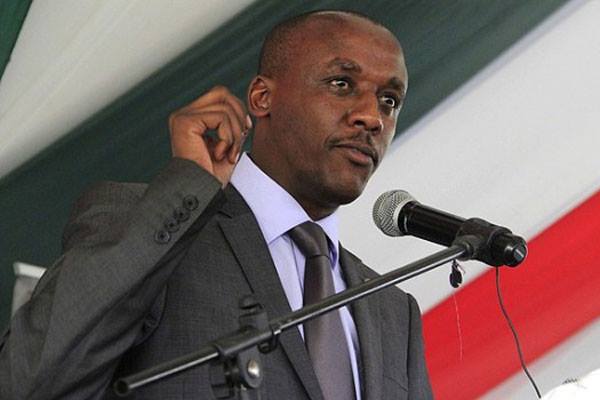
Dennis Itumbi has accused Norway of supporting terror in Kenya (photo: www.dennisitumbi.com)

In a startling development, a highly placed spokesperson for the Kenyan government has accused Norway of “supporting” terrorist activities in Kenya. Dennis Itumbi, the Director of Digital Communication in the Office of the President, on Monday morning tweeted that Norway’s decision to continue funding Haki Africa, a Mombasa-based NGO, amounts to being on the opposite side of Kenya’s fight against terror.

Haki Africa was among several NGOs blacklisted by the Kenyan government for being linked to terrorists in the aftermath of the attack on Garissa University College. The Foreign Affairs Ministry on May 12th wrote to the US, UK and Norwegian government asking them to stop funding Haki Africa. Norway’s ambassador to Kenya Victor Rønneberg issued his reply through the press saying his government would continue to fund the NGO because the vital work it does.

“We support the organisations because of their valuable contribution to the realization of human rights on the Kenyan coast and for their important contribution to countering violent extremism. Norway supports Haki Africa together with the USA and UK and have carried out due diligence on the organisation,” said the ambassador according to the Nation newspaper.

It’s this reply that appears to have angered Itumbi.

Itumbi had an opportunity to walk back the diplomatically explosive claim in his tweet when he was put to task by journalist Samira Sawlani and activist Boniface Mwangi but he stuck to his guns. He’s also been quite adamant on who he speaks for.

Itumbi has gotten an equal measure of criticism and support for his broadside against Norway.

Itumbi made his name as blogger before being appointed to join then newly-elected President Uhuru Kenyatta’s press team in 2013. He’s widely known to be among the people who craft the president’s media strategy. Norway and Kenya have always enjoyed cordial relations so it will be interesting to see how this pans out.

The only time Kenya had strained relations with Norway was during the Moi regime when Norway hosted several Kenyans who took refuge there due to the repressive Kenyan government. Using the harshtag  #NorwaySupportsTerror is not only unfortunate, thoughtless but also likely to spark a diplomatic raw as any issues Kenya has should address them diplomatically not on twitter.
Kenyan High Court arguments reveal gains of gay rights movement in Kenya

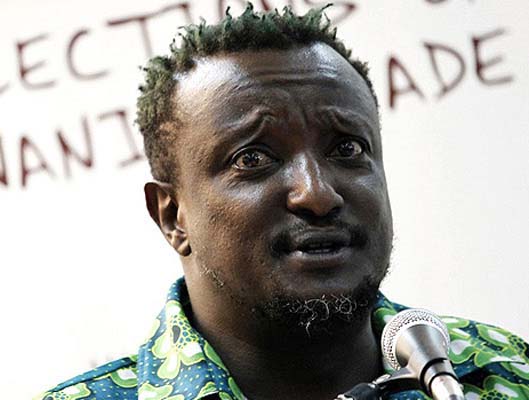
Celebrated Kenyan writer Binyavanga Wainaina who recently came out and has been a vocal spokes person for the Gay rights movement in Kenya

Report written by Samuel Wamwea Sr.

As Kenya’s High Court ordered the government to register a gay rights group that the government had earlier refused to recognize on moral and religious grounds last month, one thing was clear: win or lose, the gay rights movement has made huge inroads.

Opponents have questioned the ruling constitutionality and say its passage would allow state-sanctioned discrimination, destroying Kenya’s reputation and, through trial and error, they’re determined to continue, recalibrating, hoping to get it just right.

The debate come amid fear after Kenya’s Citizen Weekly Newspaper dated 11 May 2015 exposed 12 LGBTI activists and leaders claiming to expose more Politicians and a gospel singers as it cited on its FrontPage headline : ‘TOP GAYS, LESBIANS LIST IN KENYA OUT’. Moreover a conservative Kenya society where 96 percent of Kenyan residents believed that homosexuality is societal curse and shouldn’t be accepted and allowed by all means.

 “Same-sex marriage has “fundamental implications for the place of the family in our society, and so requires extremely careful examination,” Ann Wanjiru Kibicho, University Of Nairobi Alumni told us on phone.

In doing so, the High Court undercut much of the support for laws that discriminate against homosexuals or treat them differently.

“For many persons these are not trivial concerns but profound and deep convictions accepted as ethical and moral principles,” the justices acknowledged.

The issue before the Court, however, was not one of morality,

“but whether the majority may use the power of the State to enforce these views on the whole society through operation of the criminal law,” the Court concluded.

“Our obligation is to define the liberty of all, not to mandate our own moral code so state “cannot rely on religious texts or its views of what the moral and religious convictions of Kenyans are to justify the limitation of a right.”

Dishon Dubai Kirangi, a Kirinyaga county based politician lamented why Gay rights activists are trying to harness their momentum on same-sex marriage to push for anti-discrimination laws yet the constitution is clear,

“Article 45 of the constitution states that marriage shall be based only on the mutual consent of both opposite sexes which imply that same-sex marriage is not permitted , Also The Kenyan Penal Code of 1930 state that Any person who attempts to commit Unnatural offenses and Indecent practices is guilty of a felony and is liable to imprisonment for seven years”.

While same-sex marriage has become increasingly common in the U.S. and Western Europe and has become a tool of campaign, it’s still rare in Kenya. In 2010, Kenya Prime Minister Raila Odinga who was a front runner Presidential hopeful candidate in Kenya’s 2013 Presidential elections Ordered Arrest of Gay and lesbian Couples. Also on this month, Kenya’s deputy president William Ruto said there was “no room” for homosexuality in Kenyan society in remarks at a church service.

“The Republic of Kenya is a republic that worships God. We have no room for gays and those others,” Ruto told a Nairobi church congregation in Swahili.

There’s no doubt here whether the debate about Religious liberties vs. gay rights in Kenya gains the momentum or is Kenya society going to embrace homosexuality.


Infotrak ranks Makueni Senator position 22

Makueni Senator Mutula Kilonzo Jnr.The senator has asked speaker stephne Ngelu and MCAs in the list of shame to step aside Photo:Facebook
Makueni Senator Mutula Kilonzo Jnr.
Photo:Facebook

The CountyTrak Senator’s approval survey, conducted by Infotrak Research on behalf of the Daily Nation on the perceived performance of Senators and published on Tuesday this week ranked Makueni Senator Mutula Kilonzo Jnr position 22 with an approval rating of 51.8 percent.

Although the research done between the months of December 2015 and February 2015 ranked the youthful senator’s performance slightly above average, he was the last in the Lower Eastern region. Mutula Jnr, elected to the senate through a by -election following his father’s death Mutula Kilonzo Snr, was beaten by his Machakos and Kitui counterparts Senator Johnstone Muthama and David Musila, ranked in the 13th and 16th positions with an approval ratings of 55.7 and 54.9 percent respectively.

The lawyer- turned politician  according to Mzalendo, a parliamentary watchdog institution, has spoken 331 times in the Senate. His latest appearance was on the 19 May when he gave his contribution to a statement requested by Kitui Senator David Musila from the Ministry of Gender and Social Services on the status of cash transfer program for  the elderly and vulnerable persons.

Mutula Jnr, stated in his contribution that the officers coordinating the disbursement of the cash as well as the number of recipients in Makueni County were unknown. He also questioned the manner in which the money was being paid to the beneficiaries terming the payment process through the post office and banks as opaque.

“These cash transfers are done through the post office in a manner that is not understood by anybody or through banks, we would also like to know the persons who are said to be doing this in counties,” he said.(sic)

However, the senator’s statement came barely two weeks after the Department of Gender and Social Services disbursed sh40m to more than 5, ooo beneficiaries under the cash transfer program begging the question whether, he is in touch with what happens at the grass root level.

The electronic payments that were officially launched at the Kenya Commercial Bank Wote, branch in the presence of the Branch Manager Lawrence Musyoka and Gender  Officer Peter Ng’an’ga saw more 122 beneficiaries from Wote division receive each sh8,000 as a bi-monthly stipend of sh2,000 for January to April.

The Senator on the same day contributing to a point of order raised by Mombasa Senator Hassan Omar on county health services opposed the reversion of the health function from the counties to the national government. He dismissed the clamor to return the health services as misleading, pointless and instead called for more funding from the Commission of Revenue (CRA) to support the function.

Mutula Jnr also proposed that the Senate Committee on Health should prepare a report on the sufficient funding required for the health function and table it to the senate for adoption.

He said “My own perspective would be that our Committee on Health should give a report on the budget that is sufficient to cater for this function to this Senate that we should adopt.”(sic)

Mutula Jnr’s assertion for increased funding for health services, was perhaps informed by the lack of quality health care services at the county level with the frequent strikes, go slows and mass exodus of health practitioners from public health hospitals painting a grim picture on the health function.

Although Makueni County has not witnessed any such cases, the services are no better and most health facilities are understaffed a predicament that Health Executive Dr. Andrew Mulwa admits poses a great challenge to quality health care.

The senator’s previous appearance was on May 13 where he supported the Public Audit Bill 9 (National Assembly Bill No 38 of 2014.) that seeks to provide for the functions and powers of the Office of the Auditor-General in accordance with the Constitution.

In his submissions, the Senator underscored the need for every county to have an auditor general to monitor spending. He noted that the current audit office in its capacity could not expedite its work and especially for the troubled Makueni County whose audit report for the 2013/2014 financial year would have helped the commission of inquiry appointed to look into the possible dissolution of the county in determining its fate.

“The Auditor-General says that the audit for Makueni County for the Financial Year, 2013/2014 is not ready. This, therefore, presents a tragic situation that when a county like mine is facing all sorts of issues, including allegations of misappropriations all over the place, we do not have a method of dealing with the issue.’’he said(sic).

The incessant wrangling between Makueni Governor Kivutha Kibwana and Members of the County Assembly on budget related issues has led to accusations and counter accusations of misappropriation of funds by the two arms of the government and the senator’s support on the public audit bill could therefore, not come at a better time .

Another notable contribution by senator Mutula jnr was on March 17 on the setting of budgetary ceilings for county assemblies by the CRA, a thorny issue in Makueni county. The Makueni County Assembly had declined to heed to the ceilings prompting a budget stalemate after the governor refused to assent to the 2014/2015 budget citing huge budgetary demands by the MCAs.

Although the court had ordered the county assemblies to adhere to the ceilings, the Senator pointed out that the stalemate in Makueni had led to the delay of salaries for the county assembly staff including the MCAs.

Mutula Jnr said “The court has made a finding on the legality of ceilings and the Speakers’ forum which filed this matter in court has not appealed that decision…while people are complaining here, the Members of the County Assembly (MCAs) of Makueni have not received salaries for a period of four months.”(sic)

Others issues that the Senator has raised in the Senate are pollution of Athi river which traverses the county, rural electrification, boundary disputes between Makueni and neighboring counties and especially the long standing feud over the location of the Konza techno city as well as human wildlife conflict especially along the areas that border Tsavo and Chyulu National parks leading to loss of lives and property worth millions of shillings.

The Senator has sponsored one Bill, the Government Proceedings (Amendment) Bill, 2014 which seeks to amend section 21 of the Government Proceeding Act, CaP 40, so as to extend its application to county governments and protect the interests of the county entities.

Most of the issues that Mutula Jnr has raised in the senate resonate with the needs of the residents and the rankings by Infotrak with an average approval rating of 51.8 percent may not accurately represent his contributions in the floor of the Senate. But this could be that the people are unaware of the specific contributions he made.

Makueni probe team orders the arrest of a witness for perjury

Makueni probe team chair Mohammed Nyaoga and Commissioner Ali Taib in KICC Photo:Standard
Makueni probe team chair Mohammed Nyaoga and Commissioner Ali Taib in KICC
Photo:Standard

The commission of inquiry looking into the possible dissolution of Makueni County has directed the police to arrest a witness for perjury. The head of the probe team Lawyer Mohammed Nyaoga ordered police to arrest Peter Mwanthi, a former councilor for lying that he had appeared before the commission on behalf of a local organisation called Makueni Amani Association.

However, when hard-pressed by Governor Kivutha Kibwana’s lead counsel Fred Nyamu to table the registration documents of the association before the commission, the former councilor said the documents were in custody of the association’s secretary Mambo Ngundi, who he alleged was in Busia.

Upon further prodding by Counsel Nyamu, the witness gave out Ngundi’s number which the police traced in Wote town, Makueni but not in Busia as alleged by the witness.

Mwanthi, who on Wednesday told the commission that there was no need of dissolving the county besides accusing Kibwana of initiating the petition process, has since gone missing and police have launched a manhunt.

County Criminal Investigations Director Erick Onyango said police are looking for the witness to record a statement for lying to the commission.

“We are looking for him and once we find him he will record a statement and then present him to the commission,” said the CID .

Meanwhile, the Kamba Council of elders have blamed the governor for the woes bedeviling the county.

Led by the Chair Titus Muumbi, the elders said that the governor as the head of the county failed to convene a meeting with the MCAs to address the infighting.

“The governor as the chief executive officer did not bother to put his house in order and instead rooted for dissolution,” said the chair.

The elders also accused the governor of snubbing peace talks meeting held in Maanzoni Lodge in Machakos and failing to pick their calls.

They opposed dissolution and called for reconciliation between the warring parties adding that negotiation, as an alternative solution of solving the wrangling was not exhaustively pursued.

“The reconciliation talks were not exhaustive and there is still room for negotiations,” said Muumbi.

This is the second group of witnesses to root for reconciliation after the clergy who also accused the governor of snubbing reconciliation talks.

Curios traders count losses due to declining number of tourists

curios
Photo courtesy of www.maasai-association.org

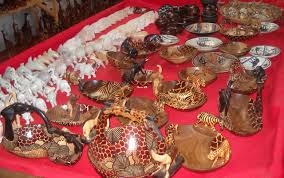
The alarming decline in the number of tourists visiting the country has led to the loss of jobs and income and among those paying the price are Embakasi Village Curios who depend mostly on foreign tourists to sell their products. Situated along Mombasa road near Cabanas Junction and with more than 50 workshops inside, the compound provides job opportunities to many families which earn a living from the making of curios. Embakasi Curios makes various products from local and imported materials. Some of their products include leather made belts; Akala sandals, wood carvings, and beads, as well as fabricated clothes with Kenyan flag colors.

Even though many of the stalls are owned by men, women and youth have not been left behind as they too indulge in weaving Kiondos as well as cloth purses bearing the national flag. The unique features attached to the curios and their fine finish attract many tourists who wish to have them as souvenirs when they visit Kenya. Of late however, the number of tourists has significantly reduced as they fear for their safety due to frequent attacks by Al-Shabaab insurgents.

The security situation has led to a drop in sales of their products and forced some to close down their stalls due to lack of enough capital to purchase raw materials. Atson Nyasimi aged 34 is one among the traders.

“I haven’t attended market in the last two sessions as my previous visit generated little profit. We have designated open places where we market our products since we don’t have a permanent place where one can access our products. On Wednesday, we usually hold our market at Capital Center along Mombasa road, other days at the space on the Supreme Court Buildings,” noted Atson

A simple decorated key-holder made of wood and with one’s name inscribed on it used to sell at sh1000 in 2008 but now retails at sh500. And according to traders, domestic tourists still do not think it is worth that much. On a good market day, Nyasimi would go home with over sh15000 or more but today that amount has reduced drastically.

The fear of attack is causing panic among tourists and dictating where and how long they stay at certain areas. Susan Ryan a tourist from Netherlands says

“I usually make one trip to market but I don’t stay long. I fear for my life,”

perhaps a thought shared by many who haven’t visited the country. With domestic tourism still low in the country as many people are forced to choose between leisure and basic needs, the ripple effect of this decline has even affected hotels forcing them to shutdown and thousands becoming jobless.

However, Embakasi Village Curios has decided to try other strategies in marketing their products. Now they are planning to make brochures with direction and the products they offer then rent a small office at the Jomo Kenyatta International Airport (JKIA). By issuing the brochures and samples of their products to tourists arriving in the country, they hope to stand a better chance of increasing their sales. In addition, those interested will have chance to pass at their workshop on their way to Central Business District (CBD) and choose what pleases them.

Political Blogging in Africa discussed at re:publica 15 Conference

The Africa blogging panel at re:publica 15
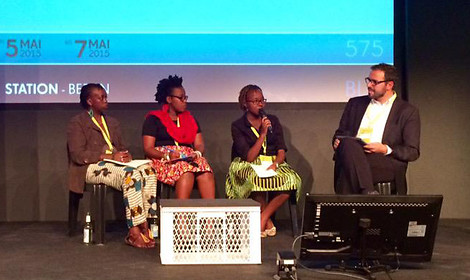
The Africa blogging panel at re:publica 15(image courtesy of Dw.de)

At the beginning of this month, I got to  attend the re:publica Conference in Berlin Germany for the first time since its inception in 2007. I had been invited by the Konrad Adenauer Stiftung (KAS) Media Africa based in Bonn Germany to join a panel to discuss political blogging in Sub-Saharan Africa.

KAS Media Africa hosted a #AfricaBlogging panel at this year’s re:publica 15 in Berlin and invited bloggers from Kenya and Uganda to discuss the state of political blogging in Africa. Moreover, the upcoming launch of the #AfricaBlogging platform was announced.

I was joined on the panel by Brenda Wambui the co-founder of Brainstorm and Ruth Aine, a Blogger and communications consultant based in Kampala who is passionate about bringing governance and democracy issues online.

On the panel, we discussed the state of political blogging in Sub-Saharan Africa, the achievements made by many in free speech, the challenges as well as  the changing landscape in the state of internet freedoms in most African Countries that are experiencing fast internet growth. The session was moderated by Christian Echle, director of KAS Media Africa.

I would like to thank the KAS Media Africa team for inviting me, and for their generous hospitality throughout my stay in Berlin.

A video of our session is now available.

Election pledges return to haunt MPs

Kenyan MPs haven't covered themselves sin glory and are testing the patience of their constituents. (Photo/info.mzalendo.com)
Kenyan MPs haven’t covered themselves in glory and are testing the patience of their constituents. (Photo/info.mzalendo.com)

Election pledges made during the run-up to the 2013 general elections have returned to haunt Members of Parliament who have failed to deliver on their promises to voters two years into their term. Kenyan MPs regularly attract the anger of the public for neglecting their duties while, by and by, expecting to be handsomely compensated for it but this is the first time the spotlight has been put on the election pledges of the MPs of 11th parliament.

Using the hashtag #WhatMyMPPromised disappointed constituents have been expressing why they feel let down by their members of parliament.

The grievances with the MPS run the gambit from unmet pledges on security, health, infrastructure and accountability on how funds allocated to constituencies are spent.

Some of the criticism was particularly caustic and pointed – even going so far as to name-check the offending MPs.

Members of County Assemblies (MCAs) were not spared either having also proven themselves to subscribe to the same “me first” ethos as MPs. Coming under particular criticism is the Kiambu County Assembly which seems bent on pushing through a petition that will see the county spend sh290 million to buy high end cars for county administrators despite the fact that many roads within the constituency are in need of improvement.

Accountability has lately become a watchword as Kenyans tire of politicians not following through on their election pledges. The criticism against MPs for not delivering on their election promises comes two days after an Infotrak poll ranked MPs based on their approval ratings. Wilber Ottichilo of Emuhaya came first while John Waluke and Mary Emaase of Sirisia and Teso South constituencies came second and third respectively.

Former New York Governor Mario Cuomo popularized the expression “politicians campaign in poetry and govern in prose.” Campaign pledges necessarily come with a sprinkling of fantasy because, like advertising, they are about edging out the competition. That said, Kenyan MPs must remember that the Kenyan electorate has a long memory and will make them pay for their sins – of commission and omission – come the next elections.

Legal framework governing the internet in Kenya

Samsung-Solar-Powered-Internet-School
Photo courtesy of Hapakenya.com

Internet regulation in Kenya is still evolving. The country does not have specific cyber laws and as such the entry point of any legal analysis are the existing media, communications and information laws, the international instruments and the Constitution of Kenya. However, there is a draft law being prepared.

Already, Article 19 has raised a red flag on the Bill. Specifically it authors that

the Bill provides for incredibly broad speech offences that could have a devastating effect for freedom of expression online in Kenya. It also provides for unduly broad offences against computers and other computer-related offences.

Kenya’s Constitution contains elaborate provisions in the Bill of Rights. In addition, Article 2 of the Constitution recognizes that international laws signed by Kenya form part of Kenyan law including customary international law. However, some laws, like sections of the Penal Code that existed prior to independence are still existent today, some being used to stifle freedom of expressions guaranteed by the Constitution. These laws can only be removed through courts where a case is lodged with the offensive provisions or public interest litigation seeking to declare them unconstitutional.

According to a report by the Kenya Human Rights Commission (KHRC) dubbed ‘The Internet Legislative and Policy Environment in Kenya’ published in January 2014, Kenya has acceded to the main United Nations human rights instruments, including the Universal Declaration on Human Rights (UDHR); the International Covenant on Civil and Political Rights (ICCPR); and the International Covenant on Economic, Social and Cultural Rights (ICESCR); Convention on the Elimination of All Forms of Discrimination against Women (CEDAW);  and International Convention on the Elimination of All Forms of Racial Discrimination (ICERD); and the African [Banjul] Charter on Human and Peoples’ Rights.

These laws are now part of Kenya law courtesy of Article 2 (5) and (6) of the Kenyan Constitution. The Article provides that the general rules of international law, and any treaty or convention ratified by Kenya forms part of the law of Kenya. It means that someone whose internet freedom has been threatened can invoke these international instruments in a court of law to seek redress.

Critical Bill of Rights provisions in the Constitution relevant to internet freedom are; the rights to privacy; to access to information; to property; to consumer protection; to fair administrative action; to access to justice and fair hearing; to freedom of conscience, religion and opinion; to freedom of expression; and to freedom of the media.

The KHRC report authors that;

As per Article 21 of the Constitution, the State and every State organ is required to observe, respect, protect and fulfill the rights and fundamental freedoms in the Bill of Rights. It further requires the State to enact and implement legislation to fulfill its international obligations in respect of human rights and fundamental freedoms. Article 22 addresses the question of legal standing in court by granting every person the right to institute court proceedings claiming that a right or fundamental freedom in the Bill of Rights has been denied, violated or infringed, or is
threatened.

It is useful to note that these rights have limitations. Article 24, states that they can only be limited

“by law to the extent that the limitation is reasonable and justifiable in an open and democratic society based on human dignity, equality and freedom, and taking into account all relevant factors.”

Some of the rights that can be limited include freedom of conscience, religion, belief, opinion, freedom of expression and of the media.

In implementing the Constitution, some new laws passed or amended have provisions that threatened freedom of expression including internet freedoms. Some have already been used. In late 2013 Parliament passed the Kenya Information and Communication Act (KICA) 2013 which repealed the Kenya Information Act of 1998, revised in 2009, and the Media Council of Kenya Act 2013 which repealed the Media Act of 2007.

KICA 2013 undermines the freedom and independence of the media by giving the state-controlled  Communication Authority of Kenya power to regulate and control media, thereby encroaching on the functions and responsibilities of an independent statutory organ, the Media Council of Kenya as provided for in the Constitution. There is however a court case on the issue. Moreover, some bloggers have already been charged in court, as documented elsewhere in this platform, using these laws.

It establishes the Communications and Multimedia Tribunal to hear complaints against journalists or persons accused of violating the Act (with an expanded definition to include bloggers ). This tribunal, which has a heavy composition of government appointees,

essentially usurps the powers of the Media Council of Kenya, a hitherto independent body that has been the self regulatory mechanism for the media

asserts the KHRC report.


The Likoni Ferry crossing is a disaster waiting to happen

0
Stalled Likoni Ferry drifts after the engine failed.
Mombasa residents saying what most people have been saying lately.

Using the Likoni ferry is an inevitable fact for most people living in the South Coast areas of Likoni, Tiwi, Ukunda, Msambweni and beyond. For Likoni residents,crossing the ferry is a daily affair. In the morning when they go to work, market or school and in the evening when they go home.

However, for most this crossing is now filled with trepidation and uncertainty following recurring ferry stalling and mishaps. The Kenya Ferry Service is clearly struggling with running reliable ferry crossing service. In as much as the volume of cars and people has gone up, there’s a marked decline in the level of service at the Likoni crossing.

About two months ago, users had one of the worst experiences. For some reason, only 2 ferries were running on a Saturday morning resulting in a monstrous traffic build up. Yet, on Friday night there were 3 ferries running. How the Kenya Ferry Services (KFS) management allows for that to happen is beyond the understanding of many Mombasa residents.

Memories of the Mtongwe Ferry Tragedy have been reawakened.

Four days ago, a ferry stalled just when it was about to get to the ramp and started drifting off. Users of that ferry would later tell of how the engines have been struggling for a while and have been stalling a few times only to be restarted. This time the engines stayed dead and the ferry started drifting to the open sea as panicked passengers threw on life jackets.

For residents who find themselves in that predicament there’s nothing to do because there’s really no other alternative crossing. Musyoki, a tour driver from Diani says

“these days, I say a prayer before and after getting across. There were days when crossing was a breeze especially after there were 2 new ferries. Now I have no confidence in the ferries at all.”

What will it take for the ferries to be well maintained ? A lot of people feel like this is a tragedy in slow motion. One that isn’t too far away. Majority of the people blame it on the KFS inept management and the central government’s inaction. There are calls to the central government to act on KFS to ensure that the parastatal is carrying out its mandate properly. The citizens are also desperate for a solution that is safer and more reliable.

Mombasa
Stop this disaster before it happens, another commuter weighs in.

“We have serious challenges in managing the ferries as most of them are old and require regular servicing, ” Mr Hassan the Kenya Ferry Service MD intimated.

Dongo Kundu bypass is the alternative that many hope to see hastened. Progress on that road has been slow considering it is about 4 years since the project was officially announced. Recent talk of cable cars does not seem to enthrall many given that a potentially corrupt government body will be charged with its maintenance yet they are struggling with ferries that are running on diesel engines.

The Mombasa county government has been forced to intervene and formed a joint task-force to look into way of easing the challenges at the ferry crossing. The Mombasa county wants to assist assist KFS in servicing and maintaining the ferries.

image
Another commuter recalls a past ferry mishap.

Is there a chance that we can stop this tragedy before it happens?

Clergy failed to broker truce over Makueni leadership impasse

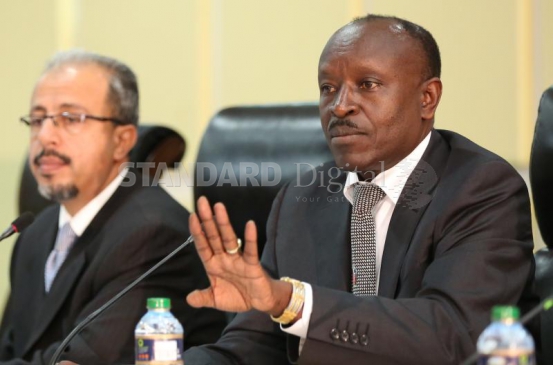
Makueni probe team chair Mohammed Nyaoga and Commissioner Ali Taib in KICC Photo:Standard
Makueni probe team chair Mohammed Nyaoga and Commissioner Ali Taib in KICC
Photo:Standard

Three members of the clergy told the commission of inquiry into the possible dissolution of Makueni County that their efforts to reconcile Governor Kivutha Kibwana and Members of the County Assembly (MCAs) hit a snag after the executive arm declined to honor reconciliation talk invites.

Makueni Parish Father- in- Charge Paul Munguti, Reverend Joseph Mutunga of the Africa Inland Church and Reverend Joseph Kanuku of Anglican Church  on Wednesday told the Mohammed Nyaoga – led commission that the church twice initiated talks to broker a truce between the warring factions but Governor Kivutha failed to turn up.

Reverend Kanuku said that during the wrangling, the clergy had agreed with the governor on a prayer meeting at the Multipurpose Hall in Wote town but the governor cancelled the meeting the last minute citing other engagements.

“The meeting aborted after the governor said he had other office engagements and when the MCAs learnt that the governor was not coming they also did not show up,” said Kanuku.

The reverend said when he called Kivutha to reschedule the meeting, the governor promised to call back but he (Kivutha) never did.

Kanuku further told the commission sitting at Wote the governor also failed to attend a peace meeting organized by the clergy, local professionals and the Kamba Council Elders at Maanzoni Lodge.

“The MCAs attended the meeting but the executive never did,”said Kanuku.

He added that corruption and nepotism were the main problems facing the county government and accused the county leaders of seeking the services of a witch doctor.

Meanwhile a witness earlier told the commission that there was no need to dissolve the county government and instead rooted for reconciliation.

Peter Mwanthi, a resident accused the governor of engineering the petition and launching it in a rally at Unoa grounds.

The witness told the commission that the county government ferried residents from different parts of the county to attend the launch of the signature collection dubbed ‘Okoa Makueni’ on October 4, last year.

More than 50,000 residents from Makueni county last year filed a petition seeking President Uhuru Kenyatta to dissolve the county owing to the incessant wrangles between the two arms of government.

The president then appointed a six member inquiry team tasked to investigate the allegations leveled against the county government by the residents.

The probe team that commenced sittings in Nairobi has now entered its  second week in Makueni,Wote and Chairman Lawyer Nyaoga has promised that the team will expedite the process.


‘Arosto’, cocktails of different narcotics, in Mombasa is getting worse

1
Drugs Peddled in Mombasa
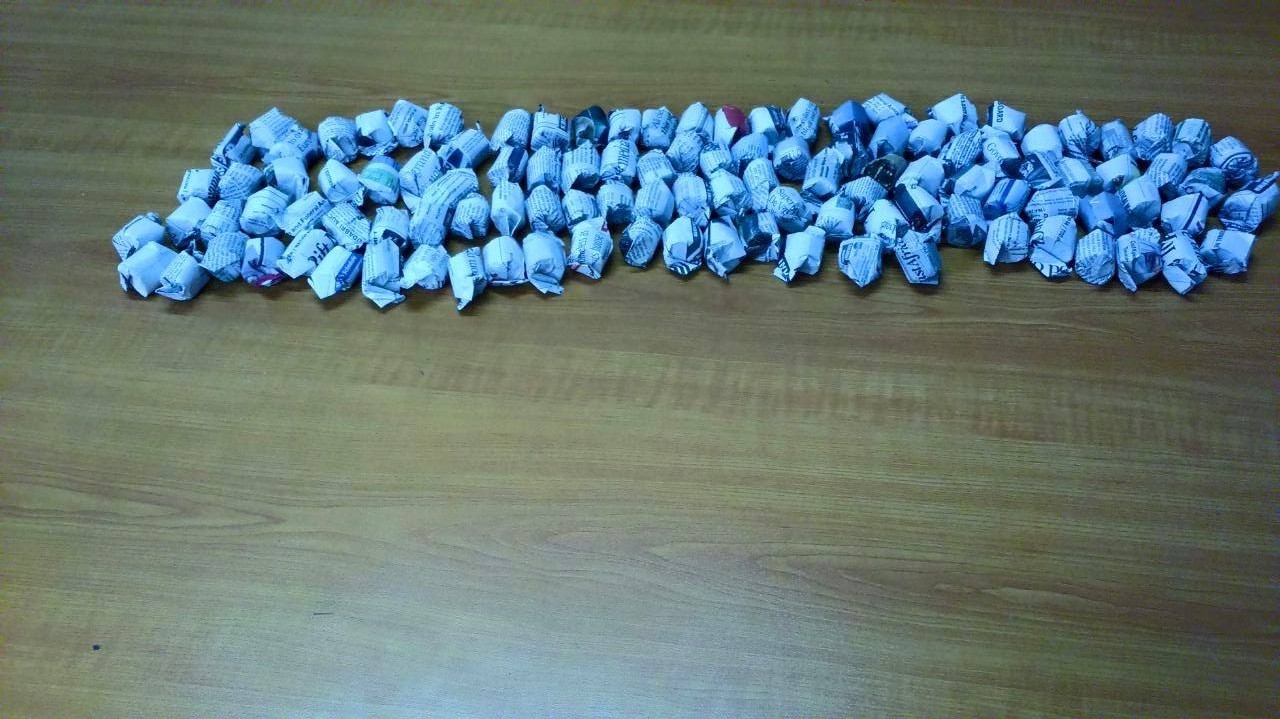
Drugs found on a peddler during a raid by the Mombasa county inspectorate officers.

Arosto is a street term used to mean being in a high drug induced state or to refer to substances that cause this high.

Drug abuse in Mombasa and other neighboring counties is a problem that cannot simply be wished away. Mombasa seems to be the most affected. So much so, that in the last 20 days or so, the county inspectorate officers have arrested over 60 peddlers in Island, Kisauni, Bombolulu, Magongo among other places.

The most common drugs used in Mombasa are cannabis, cocaine and heroin. Advanced users are now using cocktails of different narcotics to get stronger ‘arosto’. For instance rohypnol which is a pre-medication in surgical procedures is now being used to ‘boost’ the heroin high.

According to this study, the  ease  of  access  and availability of cannabis  among community  members is a contributing  factor to its  greater use. What is more, majority of drug  users start to use at their youthful age between 15 to 30 years of age and a significant proportion of the users start using at an older age. Although male  users form the majority the females are not left  out.

Mark Wesala, a Kisauni resident tells of how the area has become insecure over the years due to threats from drug users, more commonly referred to as mateja. The addicts turn to mugging and petty crime to supplement their drug habits.

“This neighborhood is no longer safe.”

A drug user displays a blue tongue from repeated use of narcotics.

Salma, who lives in Bombolulu, concurs, saying the case is the same there. She also laments how young men and women have gotten themselves into drug use and it has destroyed their lives so.

“These are young people who would otherwise have had bright futures, but once they get into doing use they do not care about their lives. Most of these mateja are people I have known since they were toddlers.”

The drugs are supplied by Drug Lords with ties to government officials or in some positions of power. Over time, these drug peddlers are proving difficult to bring to book, either due to incompetent authority mechanisms or reluctance from citizens with knowledge of their identities to reveal them. Meanwhile, more and more idle youths are engaging in drug use and drug abuse, a worrying trend in the very least.

Earlier in the year, Mombasa Governor Hassan Joho and his Lamu counterpart pledged to join forces in the fight against drug use. Measures have been put into place to achieve this. A number of campaigns have been

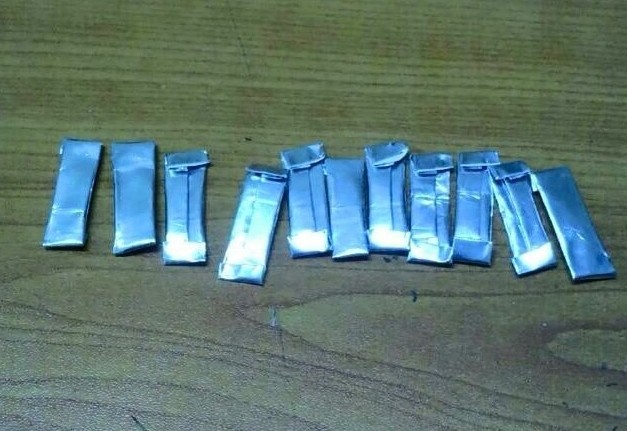
Sachets of Heroin found on a peddler in Kisauni

put in place to sensitize the youth on the dangers of drug abuse. The government hopes to get those already addicted off the drugs and prevent those who haven’t from joining.

Drug use is not just limited to shady areas in the slums. It is rife even in various institutions of higher learning. University students seem to have easy access of the drugs as they are rampant in most campuses in the county. This is worrying as the county risks losing its best brains to drugs and substance abuse. Erick Barasa who is a student at a local university thinks the institutions’ authorities are not doing enough to weed out the problem.

To most residents, it seems as if a whole generation of strong citizens will be sucked into this vice while everyone watches helplessly.

Photo Credit 

Wakali Kwanza gang terrorise Kisauni residents

Youths rounded up in Kisauni
Youths rounded up in Kisauni during a police operation (www.standardmedia.co.ke)

They are commonplace, especially on the Bamburi-Kiembeni road. You will see  them clutching papers or torn books and pens, asking for “kitabu” from matatu crews. Kitabu is the extortion fees the matatu crews must pay to the young drug-whipped men in order to operate on the streets. They are members of Wakali Kwanza, a notorious gang that terrorises residents of various locals of Mombasa by exhtorting money and other valuables.

Peter Kamau, a matatu driver who plies the Bamburi-Kiembeni route says they have no choice but to pay.

“These young men are dangerous. They are under influence of drugs and carry weapons on them. If you refuse to cooperate you will end up with a knife in your time or worse, in you.”

Katana Mwachia, his conductor, agrees.

“They lurk around in groups. If you try telling off one of them, the rest show up and threaten to beat you up or deflate your tyres. The very brave ones threaten to harm you or even kill you. We have to give them what they want otherwise we are out of business.”

The gang is not just restricted to the streets. There have been reports of robbery incidents on various public beaches in the county. Popular beaches such as Pirates and Nyali are perpetual hot-spots.  Maria tells of the day she lost her phone after being accosted by the gang.

“My cousin and I were walking slowly at the beach when suddenly we were surrounded by about six young men. Two of them were wielding daggers and threatened to kill us if we screamed. They took away our phones and money and walked away casually as if nothing had happened,” she says.

Residents of Kisauni seem to have suffered the brunt of these gang attacks. Late 2014 there were reports of a number of attacks on residents in the area. This was initially construed to be religious but turned out to be activities of the two rival gangs in the area; Wakali Kwanza and Wakali Wao. Running battles with the police became commonplace place as government agencies tried to weed out the security menace.

While the police currently deny any reports of the gang’s activities, Mzee Masoud who runs a coffee stall in Mlaleo says they have notified the police on more than one occasion.

“Many of these young men and women are people we have seen grow. Most are known. We even know where they train. We informed the police and some were arrested.”

Mama Leila thinks the residents are afraid of outing the gang members for retribution.

“They have networks, they will know if you tell on them, and then they will come for you. Some people pay protection fees so as to be spared, but many just keep quiet about the whole thing and hope it goes away soon.”

Meet the tweeting Chiefs of Nakuru County – Part 2

Chief Kihara Snip 2
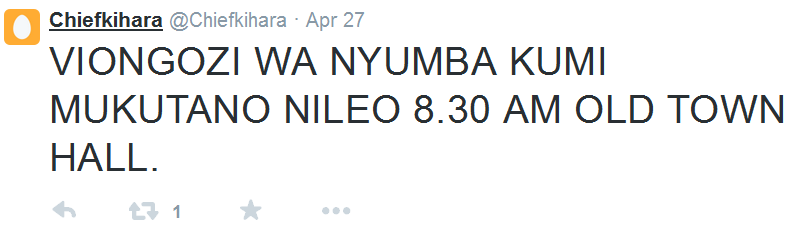
A tweet by Chief Kihara of Free Area announcing a community policing meeting to community leaders. The Chiefs use twitter for community mobilization.

The beauty of what the Chiefs are doing is that they are able to reach as many people as possible on their phones with a single text message. To do this they registered for the twitter accounts through their phones after which they ask residents to follow them for updates. Each tweet is sent to their followers at once in the very way that bulk text messages are usually sent, only it is charged as single text. In addition these messages get posted online adding their visibility.

“It is the most effective tool of communication. It is cheap and you can all the people irrespective of the type of phones they are using,” says Chief Kariuki.

Apart from using it for emergency purposes the Chiefs are using the tool to create awareness of job opportunities to their residents as well as for mobilization purposes.

“I have 26 village elders. Initially I used to call all of them every time I wanted to organize a public baraza or any other communication meant to be passed on to residents. The calls used to be very expensive and I would not be sure if they will pass it to all the intended persons, say for instance if I want to reach 5,000 people,” says Chief Rashid.

He adds that the tool has helped build social cohesion among residents as they are usually communicated to at ones and as they come out to assist each other either during emergencies or social events their ties are enhanced the more.

Besides looking at the tweets that the Chiefs send one discovers something else. Through them they have reported as many thefts as possible of livestock since they are always reporting about a stolen cow or sheep.

Chief Kimani Snip
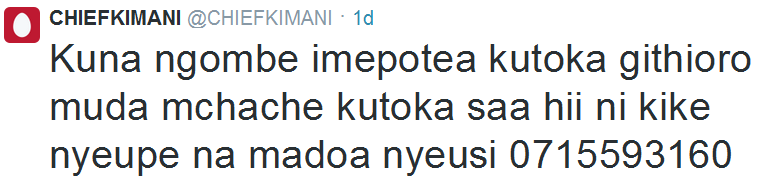
A tweet by Assistant Chief Kimani of Githioro Sub Location about a lost cow. The Chiefs use very simple language in their tweets to reach the residents.

“We have used it to stop the theft of cattle and motorbikes,”

says Chief Karanja of Free Area as Chief Kariuki adds that the secret of communicating to the residents is making the tweets as simple as possible.

“I usually don’t care what people say about the tweets. Whether they are grammatically wrong or not the aim is usually to talk to my people. I use the language they understand.”

Chief Kariuki Snip
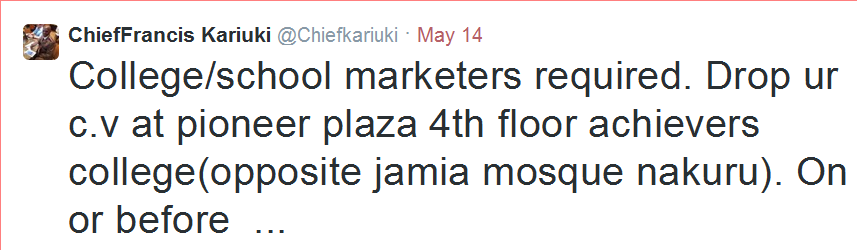
A tweet by Chief Kariuki of Lanet on job vacancies. The Chiefs also use twitter to talk about job opportunities.

Listening to these tweeting Chiefs of Nakuru enumerating what they have been able to enhance their administrative roles with the twitter technology one discovers that sometimes in life what we only need to change the status quo is simple creativity.

Their call is to the government to use their example and encourage its use in different other regions in the country.

Meet the tweeting Chiefs of Nakuru County – Part 1

Twitter logo snip
Different images of the twitter logo. The Chiefs from Nakuru are using twitter for community policing and mobilization (Photo/Google).

It started with Chief Francis Kariuki of Lanet Umoja Location in Bahati Constituency. Using the twitter handle @Chiefkariuki the local administrator has risen to international fame for using twitter as a tool of communicating government policy and for checking security in his area of jurisdiction.

“I am using twitter as a tool for community policing, neighborhood watch and crime – reporting activities,”

so reads his twitter handle page that is followed by close to 50,000 people from which he only follows about 1,300 people. His, is a story that has been told locally and internationally since it was broken several years ago with calls that more local administrators should emulate him.

And as that would be, other local administrators in the County have started using the tool for the same purposes. Or let us just say, they have been doing it only their stories have been told as that of Chief Kariuki.

“I have been telling journalists who come to cover my story to report about other Chiefs on twitter but they never seem interested. They always say they have come for my story,” Chief Kariuki told Kenya Monitor.

To confirm his word, you only need to do a quick search on twitter starting with @Chief upon which you will get at least five substantial responses: @Chiefkihara; @CHIEFKIMANI; @ChiefKaranja; @CHIEFRASHID and @Chiefkariuki, the last one being his.

Interestingly all the five Chiefs are from Nakuru County and they are all on twitter for the same purpose – to optimize modern technology in their communication with the people they serve. Together they seem to be forming a movement, however small it may be at the moment, of the ‘Tweeting Chiefs’.

Chief Kihara Snip 1
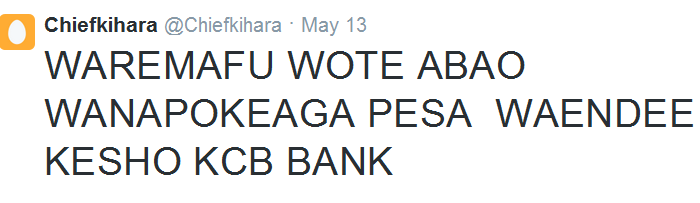
A tweet by Chief Kihara of Free Area informing the elderly that the periodic social security fund they usually receive from the government has been channeled to their banks and that they can pick it.

@Chiefkihara is a Chief at Free Area in Nakuru East Constituency while @Chiefkaranja is a Chief at Mireroni location in Bahati Constituency. @CHIEFRASHID is a Chief at Kapkures Location in Nakuru West Constituency while @CHIEFKIMANI is an Assistant Chief at Githioro Sub Location, Githioro Location, Bahati Constituency.

“We were taught by Chief Kariuki,” says Chief Karanja of Mireroni Location whose full name if James Karanja before adding that he uses twitter “for total communication.”

Chief Karanja Snip
A tweet by Chief Karanja or Mireroni Location urging parents not to allow their children waste time on play station games.

But it is his Kapkures counterpart who has the best definition of how the Chiefs are using twitter at the grassroots.

“These days we use twitter to scream,” he says reminding you of the most immediate action that residents do when attacked – that is to scream and call for assistance.

Chief Rashid Snip
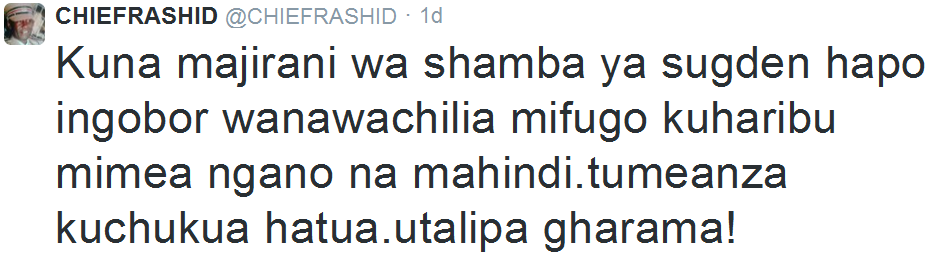
A tweet by Chief Rashid of Kapkures “screaming” to a resident whose cows have been left to destroy his neighbor’s crops.

“One day a woman in my location fell in a ditch with her child. They spent the whole night there, but when I got wind of it I used the tool to mobilize people to come and rescue them and we succeeded,”

he says picking on one of the moments he has been made to ‘scream’ to save a life on his twitter handle.

Four perish in a Nairobi-Mombasa highway accident

0
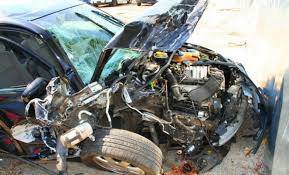
Wreckage of  a car involved in a road accident. Photo:Hivisasa
Wreckage of a car involved in a road accident.
Photo:Hivisasa

Four people were killed last night in a grisly road accident near Salama market along the Nairobi –Mombasa highway in Makueni County.

The 7pm accident involved a saloon car, which was heading to Nairobi from Mombasa and a trailer headed towards Mombasa.

Mukaa Police Boss Ferdinand Nyongesa said all the four occupants in the saloon car including the driver died on the spot.

“The saloon car which had no number plate was overtaking a trailer along the highway near the Mukaa DC’s office in Salama before it lost control and collided head-on with another oncoming trailer,” said Nyongesa.

The driver of the lorry and his turn-boy escaped unhurt.

The bodies were moved to Machakos Level Five Hospital morgue while the vehicles were taken to Salama Police Station. The police boss cautioned drivers along the highway against over speeding and careless driving.

According to Makueni Red Cross officer Joe Mbalu the county has the largest stretch of the Nairobi – Mombasa Highway leading to high number of accidents.

It is against this backdrop that the county government plans to put up a trauma center at the Makindu district hospital.

Health Chief Executive Officer Musyoki Kibwana says the trauma center will mainly cater for patients involved in accidents along the busy highway.