
Friday, December 19, 2025
Home Blog Page 17

Kenyan entrepreneur asks President Kenyatta to crack whip on ‘billionaires that have done nothing’

A Kenyan fed up with corruption in government has asking him to have ‘do nothing’ billionaires audited.

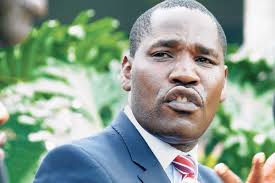
The letter by Tim Kipchumba, the Co-Founder and Chief Finance Officer (CFO) at Questworks, shows how deeply angered Kenyans are by corruption.

While his approach may not even be approved by many, Kipchumba has at least made some effort to push for transparency.

Kipchumba says he is a 30-year-old entrepreneur, a first born of four siblings and a father to two boys. In the letter, he adds that he is from Elgeyo Marakwet.

The letter shows how working for the government can be tortuous if there are no godfathers to push the papers for a Kenyan who finds themselves stuck in the same job group despite the experience they may have.

“My dad worked for our government. He worked for the ministry of public works for close to 25 years. He barely got 3 promotions in that time. He earned much less than the money our MP’s would pay for one breakfast,” Kipchumba says.

He adds that at one point his father earned as little as Sh3,000.

He continues, “

And even though he (the father) rarely took leave fixing roads, he failed to get promoted because the papers either didn’t get to Nairobi or he didn’t know or they didn’t get to him or there was “no one to push”. He passed away 2 years ago to Multiple Myeloma. The doctors said that, this was the best cancer you can get, but dad didn’t live more than a year. He passed on when he was just about your age.”

The crux of the letter is to have the president

“fight the tragedy of billionaires that have done nothing”.

Something that has been on many Kenyans’ lips is healthcare and Kipchumba asks the president to have

“healthcare and yes (the medical equipment) in working hospitals all over the country.”

Kipchumba desperately shows how dire healthcare is in Kenya saying,

“Mr. President I will only dwell with the tragedy of the billionaires that have done nothing today. I’m just unable to master the courage to write about healthcare.”


President Uhuru Kenyatta celebrates his 54th birthday today. Kenyans have given recommendations on wht he should do to restore Kenyans' confidence in his government. [Photo: france-rwanda.info]
President Uhuru Kenyatta. He has been asked to decisively deal with billionaires whose wealth is from questionable sources. [Photo: france-rwanda.info]
He continues,

“My fear now Mr President is that we have a tragedy in Kenya and in ‪Africa. It is the tragedy of billionaires who have done nothing. Elsewhere, people become billionaires and there is a solid company or value that they have created. You can trace their wealth to value they created for people. Their wealth can be explained.”

Kipchumba’s letter points to the culture people getting into government to eat as much as they can and leave nothing for those who afford them the fancy lifestyles.

Despite being in public office, most government employees who should be civil servants have meteoric rises and even though they may not flaunt the wealth ill-gotten, they cannot successfully hide it from the keen eyes all the time.

Kipchumba says,

“We Kenyans are ingenious. God loves us. We work hard to secure the future of our families and build our country. We are a resilient lot. Like other human beings, we shape our odds. What we now need is a government that can do its part to allow us all to pursue our dreams and happiness.”

He says he went to Strathmore University through a scholarship from East African Breweries Limited (EABL).

“I would not as otherwise afford that quality education, just like many young people can’t,” he elucidates.

He says Steve Jobs, Ellon Musk, Bill Gates, Carnegie, Thomas Edison, Sam Walton among others became billionaires doing something great with their lives.

“They did things. They built real value. They built industries. They changed our lives. These people become our heroes and heroines because of the incredible value and opportunities they created. Wal-Mart today is one of the biggest employers. And many young people around the world now want to do something to be like them. To be fair we have our own too in Kenya and Africa. We have our own billionaires that have actually created value and as a result they also got rewarded. Equity, Bidco, Comcraft are just among those companies that we are proud to know.”

He continues,

“What is worrying Mr. President, is the rising number of those billionaires that have created nothing.”

“Your Excellency, one of the biggest contributions to entrepreneurship that you can make is to inculcate in law and practice, a culture that encourages and rewards ingenuity and hard work while also punishing harshly those many billionaires that just rob from Kenyans. The true cost of corruption, is not just the money that tax payers loose but also the message that millions of young Kenyans get. When young Kenyans see corrupt officials that robbed the lives of their parents walk out of jail or just step aside, or a system of government that continues to deny them an honest pursuit of their dreams and aspirations, they become just disillusioned and hopeless. They become radicalized. They have little to lose. This is the real tragedy of these billionaires and millionaires who have done nothing.”


Devolution CS Anne Waiguru. She has issued a statement saying that the push for her to resign is an attack on her person and not on corruption. [Photo: standardmedia.co.ke]
Former Devolution CS Anne Waiguru. She resigned after incessant pressure from the public and the opposition over misappropriation of funds in her ministry. [Photo: standardmedia.co.ke]
He adds,

“Your Excellency, we need to turn this corner as a nation. We need to have people jailed and hanged. We need people to be disgusted at people that steal and motivated by those that work hard. We need to jail millionaires who we cannot trace their source of wealth done nothing and celebrate millionaires that have done real things for our nation.”


He suggests that

“the single action of jailing corrupt officers will reverse insecurity, improve enterprise and inculcate a more cohesive Kenya and in fact create employment.”

Kipchumba draws the President Kenyatta’s attention back to the 2007/08 election violence period saying that the chaos was due to frustrated youths who have nothing to live or die for.


Kipchumba says he co-founded Questworks at 27, a real estate consultancy firm which now directly or indirectly employs over 100 people and handling portfolios in Kenya, Uganda, Nigeria, and Zambia among other countries.

Doctor rules out possibility of lead poisoning for Thange residents affected by oil spillage

A doctor has ruled out any possibility of lead poisoning among residents of Thange village in Kibwezi, Makueni County affected by an oil spillage that contaminated water sources.

Dr. Tom Bosire Menge a Chief Toxicologist based at the Kenyatta National Hospital (KNH) assured the residents that the more than 400,000 litres of oil that seeped to River Thange and neighboring water sources from a pipeline managed by the Kenya Pipeline Company (KPC) does not contain lead and dispelled fears of possible lead poisoning.

Dr. Bosire said the only risk that the residents could have been exposed to following the massive oil spillage was hydrocarbons caused by inhalation of the oil fumes and not through consumption of the contaminated water hence ruling out any serious health complications.

The toxicologist speaking at Thange Primary School during a one-day workshop organized by KPC to sensitize residents on the effects of the oil spillage said hydrocarbon poisoning does not pose any serious health risks apart from respiratory tract infections.

“Hydro carbons are not known to cause any serious harm to humans and in this case it would only result to respiratory tract infections or inflammation of the lungs,” said Dr.Bosire.

However the statements by the Dr. Bosire who had been contracted by KPC perhaps in an attempt to dissuade the villagers from the dangers of the oil spillage were not taken lightly with a majority accusing KPC of planning to shortchange them despite the damaging effects caused by the spillage.

A resident, Martha Kilonzi said the drying of the crops in the affected region and an earlier warning by public health officers not to either use the contaminated water or the farm produce was a clear indication that the effects of the spillage were harmful not only to humans but also crops.

“We were advised not to use the water again and KPC even went ahead to provide us with clean water for domestic use which is a reaffirmation that the water is not safe,”she said.

Martha called for an independent investigation to be done to establish the extent of damage caused.

“The toxicologist has been hired by KPC and we cannot trust him, we need an independent team,” she added.

According to Acting KPC Managing Director, Flora Okoth the company has contracted Societe Generale de Surveillance (SGS) Kenya Ltd to carry out independent investigations on the impact of the oil spillage while blood samples of some of the affected residents have been taken to South Africa for testing and proper diagnosis.

The revelations by the doctor that the massive oil would not pose a serious health risk has only served to fuel mistrust between KPC and the residents who now read mischief from the company’s latest move.

“Why can’t KPC wait for the samples from South Africa and issue a comprehensive report?” wondered John Mukai also resident.

According to the National Environment and Management Authority (NEMA) County Director Stephen Kimutu both surface and underground water have been contaminated by the oil spillage making it unfit for human consumption.

Furthermore a report by Water Resources and Management Authority (WARMA) has confirmed that the water in not safe.

The report signed by Noel Ndeti a Senior Water Quality and Pollution Control Officer says in part,

“Based on the observation made on the visit of the site it is evident that both surface and underground water were highly contaminated with petroleum oil as it had taken more than three months for KPC to contain the spillage since it was first noticed.”

It further states,

“ KPC should source for and provide good quality water for domestic use and WARMA will pursue the company to ensure that the environment remediation process almost reinstates the hydrological characteristics of Thange river.”

Last week the Senate Committee on Energy led by Baringo Senator Gideon Moi visited the area and called for a thorough investigation of the incident. It would be interesting to see how KPC will handle the matter that has already created frosty relationships between the company and the affected residents.

Mobile schools in Turkana helping transform education

Education in Kenya continues facing challenges ranging from lack of infrastructure, enough study materials and poor pay for teachers.

These are just a few of the challenges known on the national scale but for communities who rarely make it to the daily news, the challenges are further compounded.

“We are a pastoral community our sons normally help us move with our animals as the girls remain with their mothers taking care of our homes. We only send our children to Kametusa primary to go and learn how to read and write. Going to school does not help us much compared to our animals so we opt to give them (animals) a lot of our attention,”

says Francis Wamalwa the acting assistant chief in Samburu, Turkana County.

As the famous say goes, ‘If you can’t beat them,’ join them, the above confession has for long deprived children born in Turkana and other pastoral communities of their education.

However, thanks to the introduction of mobile schools project, an attempt by the government in partnership with the United Nations Children Fund (UNICEF) to provide education to all Kenyan children may just turn the fortunes for these children.

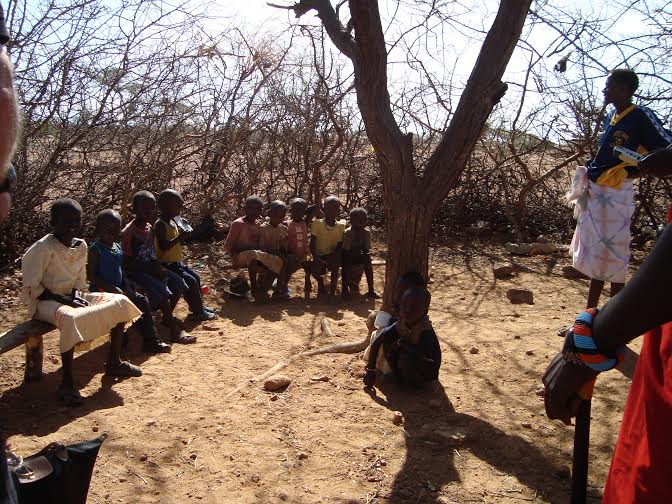
Across the vast and semi-arid north-western corner of Kenya, threatened by alarmingly high malnutrition rates, live the Turkana. This is a traditional ethnic group who work the dry plains as shepherds. In a valley of microclimates, when water and green brush run dry and brown, the communities move on foot to new areas – roaming for life’s essentials.

Samuel Loscuwat is a head teacher at a fixed stationary elementary school called St. Boniface.

“The impact of this year’s drought is severe. School enrolment is down, people are on the move with their children looking for water and grass for their livestock. In this school, enrolment has dropped from 200 in 2013 to 156 this year. The drought, worsens the already fragile food security. Families are left with no choice but to withdraw their children from school. Mitigation against that is another element of UNICEF’s work in education.”

In the attempts to ensure that people adapt to the recurrent drought and ensure that every child goes to school the government and UNICEF came up with an innovative program to this corner of the Rift Valley – mobile schools which move with the pastoralists in Turkana.

Not far (about 5km) from St. Boniface is a simple structure, thatch walls covered by slabs of corrugated roofing plastic – it is Christine Tukei’s mobile school.

Since 2008, Christine, 35, has worked as a school teacher for the Ministry of Education in the Rift Valley, and as the Turkana move, she moves with them, accompanied by her two daughters, Rael, 13, and Lydia, 12. Currently her children attend St. Boniface, but they live in a typical and simple mud house among the Turkana people. She is assisted at the school by two volunteer teachers.

“I teach kindergarten and first grade for children, but also to anyone who is interested in learning. I use simple songs to help my pupils memorize numbers and basic english words; like parts of the body, animals, and plants. The classroom walls have neatly hanging, and carefully preserved, educational posters, including a map of Kenya.”

Mobile schooling is a key strategy in the UNICEF-supported Nomadic Education Policy, enabling children to access education even in nomadic lifestyles. To improve the quality of learning, it provides mobile schools with basic learning materials, such as books. It also undertakes high-level advocacy for long-term government support to mobile schools, including employment of teachers and provision of Free Primary Education funds.

Christine explained that the community she serves has been stationary long enough that the Kenyan Government built the temporary building, and another one about 15 kilometers away, in areas where families often move to in search of water and vegetation. She has worked and lived at the other location, as well.

One of her many challenges as a teacher is that her student body changes randomly, with families coming and going. Both Christine and Samuel have requested the Government to build dormitories at their schools, as this would encourage parents and guardians to leave their children in the care of the school while they find new areas for their livestock to survive.

Christine is a dedicated, charismatic, and inspiring woman, and one living an extraordinary chapter of service. She even has a battery-powered DVD player to share educational videos with her students. It is a quite a draw to help keep her students coming back and inspire others to make the long journey to St. Boniface.

The message Pontiff left Kenyan youth and families

By Cyrus Kioko

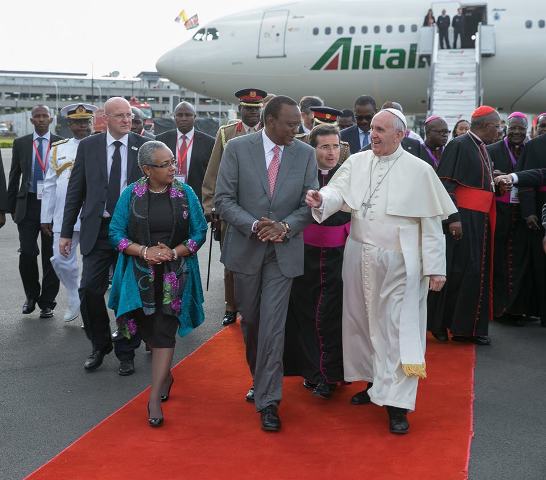
The three days visit to Kenya by Pope Francis has been celebrated nationally with thousands of people attending his public mass at University of Nairobi on Thursday.

Overwhelmed Kenyans trooped to the different venues to catch a glimpse of the Pope despite heavy rains on the early morning. None was disappointed, as the pontiff matched their expectation even slowing down his car to shake hands with some people.

The congregation was well represented by people of all and sundry ranging from children to the aged.

Youths from different counties travelled to Nairobi to attend the memorable occasion by the Pontiff at Kasarani Stadium.

About 1, 300 youths who were drawn from various primary and secondary schools, colleges and universities in the Catholic Diocese of Eldoret were among those who attended the occasion from outside Nairobi.

Those who could not make it to Nairobi followed his proceedings on local TV stations never to miss any action after he landed on Kenyan soil.

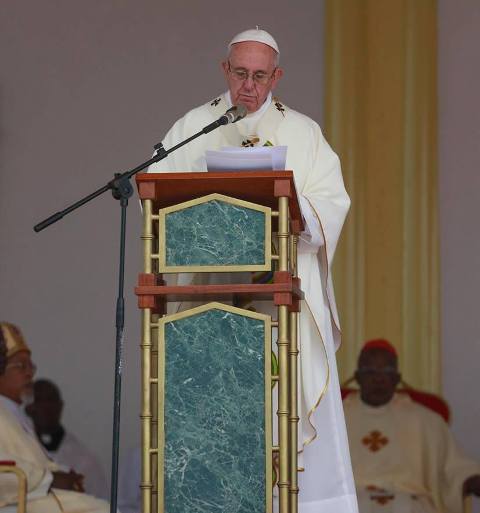
In his address to Kenyans, the Pope pointed a vital role of the youth in the society, where he termed them as representation of the future generation and playing a big role in shaping the community morals.

“Here, in the heart of this university, where the minds and hearts of new generations are being shaped, I appeal in a special way to the young people of the nation. Let the great values of Africa’s traditions, the wisdom and truth of God’s word, and the generous idealism of your youth guide you in working to shape a society which is ever more just, inclusive and respectful of human dignity,” said Pope Francis.

He also linked them to the families where he said Kenyan society has been blessed with families full of love and strong bond between the members.

Moreover, he rooted for strong family values that are bedrock for any good society, preaching religious tolerance and urging the youth to be upright.

“Kenyan society has long been blessed with strong family life, a deep respect for the wisdom of the elderly and love for children. The health of any society depends on the health of its families,” said the pontiff.

He encouraged all to join Christian families to realize success in life.

“You will succeed whenever and wherever there is the gospel. Christian families have one mission, to spread the gospel,” preached the Pope.

“Ensure the families and the society is stable if you want to breed success,” he added.

The pope’s visit to Kenya is currently in Uganda before heading to his last visit on the continent in the Central African Republic.

Education for all (EFA) remains a pipe dream to communities in the arid areas

By Malachi Motano

Over a decade ago, the UN member states rolled out Education For All (EFA) programme at a conference in Dakar-Senegal backed up in Millennium Development Goal (MDG) number 2. This was in the hope of achieving the noble goal by 2015.

It is 2015 and the big question stakeholders ask ‘where’ Kenya is? What has the government achieved?

According to the Ministry of education, Kenya has made big strides in most of the six EFA goals.

“The gross enrollment rate for Early Childhood Care and Education (ECDE) stood at 60.9 percent in 2010, which was a marked improvement from 57.9 percent in 2005, while primary school‘s net enrollment rate increased from 82.9 percent in 2005 to 91.4 percent in 2010. The gender parity index increased from 0.94 in 2007 to 1.02 in 2010.”

Other statistics from the ministry show that secondary school enrollment rate also improved from 28.8 percent in 2005 to 47.8 percent in 2010. Adult education in 2010 stood at 266,200 surpassing the projected target by 37, 319, most vulnerable children stood at 325,000 against the projected target of 728,000 as enrollment in special schools increased from 91,770 in 2005 to 221,995 in 2009 and the transition rates improved from primary to secondary from 56 percent in 2005 to 72 percent in 2010.

According to the report by UN released earlier (2014) in Nairobi, primary school enrollments stand at 90 percent.

Paulo Lewema, an ECDE teacher. He says they only want the pupils to know how to read and write. [Photo: Malachi Motano]
While Kenya celebrates the improvement of increased enrollment in primary and secondary schools, it remains a pipe dream for communities in the Arid and Semi-Arid Lands (ASAL).

John Lengoine, the head teacher at Kametusa, a community primary school in Samburu says,

“This is just a school that was put up by parents living in this area. Although it was started 11 years ago, it has never recorded steady growth because we don’t have adequate facilities.”

He adds,

“Because we are not registered with the ministry, the government cannot send us teachers. We don’t benefit at all from the free primary education programme. I am a class eight dropout from Webera, the nearest primary in Isiolo town that is 54 km away.”

Francis Wamalwa, 28, is the acting assistant chief in the area and he adds,

“We are a pastoral community our sons normally help us move with our animals as the girls remain with their mothers taking care of our homes. We only send our children to Kametusa primary to go and learn how to read and write. Going to school does not help us much compared to our animals so opt to give them a lot of our attention.”

A part from not valuing education, continuous migration (pastoralism), inadequate learning facilities, poor infrastructure, and constant conflict have also challenged the achievement of the 2015 target.

According to the EFA global monitoring report by UNESCO, armed conflict is robbing 28 million children of an education by exposing them to widespread rape and other sexual violence, targeted attacks on schools and other human rights abuses.

The report by UNESCO. Kenya will miss the EFA goals by a big margin. [Photo: Malachi Motano]
The report, The Hidden Crisis: Armed conflict and education, cautions that the world is not on track to achieve by 2015 the six Education For All goals that over 160 countries signed up to in 2000. Although there has been progress in many areas, most of the goals will be missed by a wide margin – especially in regions riven by conflict.

Mohamed Elmi, the former minister for the development of northern Kenya says,

“Northern Kenya is no strange to violence. At any given time a school somewhere in this region will be closed as a result of armed conflict. And long after the conflict has ended, its impact may still be felt.”

To cite just one example, the Turbi massacre 2 in Marsabit in 2005 left nearly 100 people dead. More than 6,000 people were displaced by the violence, twelve hundred of whom were children. Eleven primary schools in the area were affected. Twenty-two of the dead were children at Turbi Primary School, who were killed just before starting their morning class.”

He regrets that the loss of innocent life on such a scale is heart-breaking, that is further compounded by the trauma which the surviving friends, students and teachers of those children must still feel today.

“In the last few days we have seen how the conflict in Somalia continues to spill over our borders, most recently into Mandera. For many years Kenya has hosted large refugee populations from Somalia, Sudan, and other countries in Africa. Dadaab, near Garissa, is one of the largest refugee camps in the world. Its population has more than doubled in four years. As a result, an education system that was designed to provide for 30,000 children is now struggling to provide for double that number,” he adds.

Will stance on corruption cost President Kenyatta his second term?

On Monday, Kenyans waited anxiously as President Uhuru Kenyatta was to address the nation on the state of corruption in the country.

Coming just days after the resignation of Devolution CS Anne Waiguru, the nation waited in anticipation that, finally the country would be given a reason to have hope that corruption would be a thing of the past – in a practical way.

But from the feedback, it seems that Kenyans are a tired lot and the president may need to rethink the strategy on fighting corruption.

Minutes after the address by the president started, Kenyans took to social media expressing their disapproval, majorly, of how the presidency was tackling the fight against corruption.

In what was interpreted as another unnecessary lecture to Kenyans, the president focused his speech on how the private sector would do business with the government ‘as guided by our national values and ethics’.

The president said,

“Every company from now henceforth seeking to work with the government both at the national and county level, will have to sign an approved Business Code of Ethics domiciled in the Public Procurement Oversight Authority. I direct that the Cabinet Secretary to the National Treasury gives this code effect through regulations under the Public Procurement and Disposal Act.”

He continued,

“Any business that fails to comply with the Code will be disqualified from doing business with the government for a period not less than five years and the information will be made public. This disqualification will not only apply to the business entity but also to its directors.”

The president has time and again promised to but rarely, according to Kenyans, does he get to act decisively on matters corruption.

The president who has been a darling to many has been accused of tolerating rapacious looting by his people even worse than former presidents Daniel Moi and Mwai Kibaki could let happen.

President Kenyatta said that directors and senior bank officials will be pursued relentlessly, individually and collectively, in accordance with the law, should they succumb to the lure of breaking ‘our anti-money laundering laws and regulations’.

The unending chorus in Kenya has been that the lords of corruption have to be successfully prosecuted if the war on corruption has to be won. What is evident though is the unwillingness to pursue justice and recover stolen public property as politicians protect their own. The wheels of justice have been slowly for those with enough money to jam the system.

The president sought to assure Kenyans that something was being done.

“Following discussions with the Chief Justice, I am pleased to announce that he has committed to work with the National Council of Administrative Justice to actualise fast tracking prosecution of corruption and economic crimes as envisaged in the Anti-Corruption and Economic Crimes Act. He has also assured me that he will make every effort to ensure the setting up a division of the High Court on corruption and economic crimes.”

And again, the president said he was ‘directing the Chief of Staff and Head of Public Service to ensure that all staff working in the Kenya Revenue Authority, the Customs and Immigration departments to undergo integrity and competency vetting by an independent multi-agency vetting mechanism’.

These unending promises have seen Kenyans become wary and feel neglected. Service delivery in the public sector has deteriorated with public hospitals having no medicines, equipment and staff.

Runaway corruption has continued to drain funds diverting them to individuals’ pockets depriving Kenyans services they have paid for but cannot access.

Kenyatta said,

“In order to streamline government and thereby also reduce opportunities for theft and wastage, we will immediately enact the Parastatal Reform Bill. This is the least we can do to reflect the prudence that the Constitution enforces on us.”

These promises are irking Kenyans forcing a comparison between Kenyatta and newly elected Tanzanian President.

With the mood in the country, is the president working hard not to be re-elected?

Weekly reports

On implementation of directives, Kenyatta said,

“In the past, my government has issued some of the policy statements I have announced. I have not been satisfied with a lot of the implementation, partly in regard to poor coordination and the red tape involved in implementing a new constitutional dispensation. For this reason, from now henceforth, the Chief of Staff and Head of Public Service will be reporting to me on a weekly basis on progress in implementing the measures I have announced today.”

The president who declared corruption a national security threat, just short of a national disaster, said he was directing all security agencies, the Ethics and Anti- Corruption Commission, the Asset Recovery Agency and the Financial Reporting Centre to take cognizance of this.

And in his usual style, he concluded,

“We will make it expensive for anyone stealing from Kenyans and denying them education, health, security, infrastructure, water and other services that they work so hard to receive form their government. I call on every Kenyan to be the eyes, ears, and voice of this redoubled national effort. My office will spearhead these actions and hold everyone I have mentioned today responsible to deliver.”

This is despite the fact that those who whistle-blow on corruption risk jail terms, including journalists.

Pope Francis: Transforming current development models a “political and economic obligation”

During the historic visit by Pope Francis to Africa, the Pope has emphasized that transforming current development models is a “political and economic obligation”.

Speaking just a few weeks before COP 21 in Paris, France, the Pontiff said on Thursday at the United Nations Environment Programme (UNEP) Headquarters in Nairobi that there is a need to adopt low-carbon energy systems and end the “throw-away culture” that contributes to greenhouse gas emissions.

[Insert Pope’s photo]

The Pope called on world leaders to seal a strong agreement at the Paris climate change meeting next month.

Speaking to an audience of thousands, which included UNEP Executive Director Achim Steiner and United Nations Office at Nairobi (UNON) Director-General Sahle-Work Zewde, Pope Francis said:

“In a few days, an important meeting on climate change will be held in Paris … It would be sad, and I dare say even catastrophic, were particular interests to prevail over the common good,” Pope Francis said.

He added,

“In this international context, we are confronted with a choice which cannot be ignored: either to improve or to destroy the environment. COP21 (the climate meeting) represents an important stage in the process of developing a new energy system which depends on a minimal use of fossil fuels, aims at energy efficiency and makes use of energy sources with little or no carbon content. We are faced with a great political and economic obligation to rethink and correct the dysfunctions and distortions of the current model of development.”

UNEP’s Emissions Gap report, released in early November, showed that the expected Paris commitments from member states will cut up to four to six gigatonnes of carbon dioxide equivalent per year from global emissions in 2030.

This, however, is 12 gigatonnes short of the level that will keep the world on track to stay below the “safe” limit of a 2°C temperature rise this century.

UNEP Executive Director Achim Steiner praised Pope Francis’s moral leadership on the environment— which the Pontiff has already displayed with his encyclical ‘Laudato Si’ calling on the faithful to embrace their responsibilities to the environment—saying it added global momentum to efforts to close this emissions gap and implement the Sustainable Development Goals (SDGs).

“Addressing the world just a few days before the Paris climate conference, with the future of this planet hanging in the balance, you (Pope Francis) remind world leaders, business leaders and individual citizens that we each have not only a responsibility, but an obligation to act on what our conscience tells us to be right,” Steiner said.

Steiner added,

“In this pivotal year, your powerful notion of the ‘globalization of indifference’ speaks to the heart of the practical and ethical challenges ahead: both to reach a climate change agreement in Paris and to deliver it within the much broader, holistic spectrum of sustainable development that must leave no one behind.”

Pope Francis also touched upon the need to create a world in which unsustainable consumption and production patterns—which contribute to pollution, ecosystem degradation and climate change through the wasteful use of resources in the production of food and other goods—are ended.

“This calls for an educational process which fosters in boys and girls, women and men, young people and adults, the adoption of a culture of care—care for oneself, care for others, care for the environment—in place of a culture of waste, a ‘throw-away culture’ where people use and discard themselves, others and the environment.”

As a further symbol of his environmental commitment, Pope Francis planted an Olea capensis, an indigenous tree found across the continent of Africa, on the grounds of the UN headquarters before his talk.

“Planting a tree is first and foremost an invitation to continue the battle against phenomena like deforestation and desertification,”

he said.

“Planting a tree is also an incentive to keep trusting, hoping, and above all working in practice to reverse all those situations of injustice and deterioration which we currently experience.”

Steiner took Pope Francis on a tour of the UNEP offices, a sustainable facility powered largely by solar panels, to demonstrate renewable energy and energy efficiency in practice.

There, Steiner presented Pope Francis with an elephant created from discarded flip-flops (a product designed to draw attention to the issue of marine litter and plastic waste) as a token of his appreciation for the Pope’s commitment to the environment.

Chives farming transforming farmers’ lives in Bahati, Nakuru

There is nothing that makes a farmer rejoice more than knowing there is a ready market for their produce. Hassle free.

This is one advantage that a section of farmers from Bahati Constituency in Nakuru have as farming takes a more economic approach from the usual subsistence practice.

The more than 80 farmers have adopted chives production, with the export market expressing insatiable appetite for the produce. The herb that belongs to the onion family is earning them up to Sh600 a kilo.

Traditionally, farmers in Bahati farmed maize and beans but have now become net exporters after vegetable seed company Premier Seeds Limited introduced them to chives farming.

Through a group model, farmers have been able to own greenhouses on credit through a partnership between Premier Seeds and Chase Bank. The partnership allows farmers to repay the loan from the chives proceeds at favourable repayment terms agreed upon between the financier and individual farmers.

To begin, farmers make a 10 per cent deposit as a commitment to the project before the construction of the greenhouses.

Premier Seeds supplies farmers with certified chives seeds and also trains them on good agricultural practices, building their greenhouses and linking them to ready markets.

“Most of the farmers have not practiced greenhouse farming before and are growing a crop that requires observance of good agricultural practices and traceability. We have therefore had to do thorough training on every aspect of farming to ensure that the farmers’ produce is compliant with the export market,”

said Simon Andys, the founder of Premier Seeds.

Such practices include having a tracking sheet at the entrance of each greenhouse that allows farmers to record the timing of key activities in the greenhouse including spraying and irrigation times. This is in keeping with the export requirements of Good Agricultural Practices (GAP).

The crop is enjoying fanatical uptake among the farmers. It takes 45 days to mature after which farmers harvest every 20-25 days for up to three years.

An ordinary greenhouse measuring 240 metres squared produces up to 150 kilos.

The perennial crop is easy to grow and is rarely attacked by pests and diseases which has endeared it further to the farmers.

There is a high demand for chives in Europe, averaging between two and four per cent each year. This makes it a favorite across the entire herbs basket including coriander, basil and parsley among others.

The United Arab Emirates (UAE) countries have also expressed growing interest in Kenyan chives and luckily, the Nakuru farmers have found a buyer whom they have entered into a one year contract with.

“Demand has outstripped supply. We have received so many delivery orders from the export market that we have been forced to cancel some because we cannot keep up. That is how huge the export market for chives is,” said Andys.

The group model of growing chives has been strategic in allaying fears of exporters who worry about consistency in supply from individual farmers.

“Once farmers harvest their individual produce, we weigh and record them and. We then export in bulk to meet the heavy orders and assure the buyers of consistent supply. Payments are however credited to individual farmers’ accounts,” Andys added.

To farmers who are unable to raise funds for the construction of greenhouses, Premier Seeds has given them the option of growing other produce like stem broccoli, bulb onions, broad beans and beans through open field farming. The broccoli will be sold together with the chives.

“These farmers are therefore able to save even as they continue with open field farming up to the point where they will have saved enough to pay for the greenhouse,” Andys added.

Premier Seeds has received funding from the Tony Elumelu Entrepreneurship Programme (TEEP) to assist farmers in ventures like farming of high-value crops. TEEP is a continental programme that seeks to motivate entrepreneurs creating a difference in Africa.

The global market for culinary herbs and spices has been on an upward trajectory and is currently valued at approximately $2.3 billion with chives being among the front-runners according to the International Trade Centre. The European Union forms the bulk of this market.

In 2013, the EU imported some 533,000 tonnes of spices and herbs valued at €1.9 billion with imports from developing countries like Kenya accounting for 302,000 tonnes worth € 1billion.

Senate Committee on Energy orders for medical screening of Thange residents

The Senate Committee on Energy wants residents of Thange Village in Kibwezi Sub County affected by a massive oil spillage screened for possible petroleum products poisoning.

Under the leadership of Baringo Senator Gideon Moi, the committee in a recent tour of the affected region said the spillage was a serious environmental disaster and called for thorough investigations to determine the extent of the damage caused.

The spillage occurred in May after a pipeline owned by the Kenya Pipeline Company (KPC) burst and leaked more than 400,000 litres of oil into River Thange and other nearby water sources for close to six months.

Accompanied by senators Mutula Kilonzo Junior (Makueni), David Musila (Kitui) and Kimani wa Matangi (Kiambu) Senator Moi also called for compensation of the residents whose livelihoods depended on River Thange.

“Majority of the residents depend on the river for both domestic and irrigation use and now that the crops have dried they should be sufficiently compensated,” said the Baringo Senator.

He assured residents that the committee will fully probe the matter and ensure that KPC offers restitution as required.

Senator Mutula Junior regretted the incident and threatened to seek legal redress if the matter is not conclusively settled.

“This is a disaster that should not happen under the current dispensation,” said the senator.

Senators Musila and Kimani termed the spillage a violation of human rights and asked KPC to expedite the compensation to ensure that residents do not continue to suffer.

“Let KPC fast-track the compensation process and if possible by December the residents should have been compensated,”said Senator Musila.

John Mukai a resident said majority of victims of the oil spillage had developed health related problems due to consumption of the polluted water saying that quick medical interventions were required to treat the residents.

“Oil contains dangerous hydro carbons that can have long term health effects and blood samples of all affected residents should be taken and properly tested to rule out any poisoning,” said Mukai.

KPC Acting Managing Director Flora Okoth speaking at the same event expressed the company’s commitment in solving the matter.

“As a company we remain committed in ensuring that the issue at hand is fully solved,” she said .

Under the Constitution, the Senate is mandated to protect devolution. In its three years of existence, the institution has worked hand in hand with counties, to highlight their issues and also pass legislation and policies that help promote good governance at the county level.

Reprieve as Kenya Pipeline Company promises to compensate Thange residents affected by oil spillage

Hundreds of residents from Thange village in Kibwezi, Makueni County affected by a massive oil spillage from a pipeline belonging to the Kenya Pipeline Company (KPC) got a reprieve after the company promised to compensate them.

The spillage that happened in the month of May along river Thange which is the main source of water for both domestic and irrigation use has posed a serious health risk for the last six months with many residents consuming the water oblivious of the dangers.

Nearby water sources including wells and boreholes have also not been spared while crops and livestock pastures have dried up due to the spillage.

KPC Acting Managing Director (MD) Flora Okoth who attributed the spillage to either third party related activities or leakage due to pressure on the 40 -year- old pipeline said the company has already repaired the point at which the pipeline was leaking and promised that all residents affected by the spillage will be duly compensated.

Okoth said a team of experts including Public Health officials are already on the ground to assess the damage caused by the spillage and screen residents who may have developed health related complications after consuming the contaminated water and pave way for the compensation.

Speaking in Thange village during a tour of the affected region, the acting MD who was flanked by Governor Kivutha Kibwana, area Member of Parliament Jessica Mbalu among other senior officials from both the KPC and County Government appealed for calm and promised that the company will provide clean water for domestic use to the affected residents until normalcy returns.

“We are greatly concerned by the state of affairs and we shall continue to provide water as well as clean the water sources but if it will not be possible we shall establish a fresh borehole,” said Okoth.

She also added that KPC in conjunction with the County Government and other relevant stakeholders will form a task-force to put in place strategies to rectify the situation and avert similar incidents in the future.

On his part, Governor Kivutha called on KPC to provide water at different locations to ensure that the residents do not continue to suffer.

“Let KPC provide the water a strategic locations because the river is the lifeline of the residents who live along it and it stretches up to 40 km downstream,” said Kibwana.

The governor’s sentiments were also echoed by MP Mbalu who called for a speedy solution and compensation to the residents.

The move by KPC to provide water and compensation is definitely good news to the community whose consumption of the polluted water had already started taking toll on their health.

According to St. Peters Thange secondary school principal Stephen Anguzu more than 50 students and the Deputy Principal Simon Warui are suspected to have developed lead poisoning from consuming the water.

He said the affected students have been complaining of consistent chest and stomach pains accompanied by muscular and body weakness and underscored the need for urgent medical examination.

“Our deputy principal who exhibited the same symptoms has been diagnosed with high concentration of lead metal which may take long to treat,” said the principal.

A resident Mary Ndangwa whose plantation of kales have dried thanks to the spillage is now counting losses and wants KPC to fully compensate her for the damage caused.

“We already work hard in the harsh climatic conditions to plant and irrigate our crops but they have now withered and we have nowhere to turn to. We hope the company will compensate us fully,” said the distraught Mary.

The oil spillage incident is unfortunate but what is more disturbing is that fact that it took six months for the KPC to address the issue leaving helpless residents to consume polluted water hence posing serious health risks.

While the number of residents who might have developed possible lead poisoning has not yet been established, it is clear from the damage caused to the water sources and crops that the effects of the spillage are devastating.

Though the compensation by the KPC is welcome, the company should ensure that all residents affected by the spillage are medically examined and treated where necessary.

The company should also clean up the river and the other affected water sources and put in place proper measures to ensure that such incidents do not replicate either in Thange or other areas where the pipeline passes.

Should Kenya legalise corruption as it morphs into a monster?

For the past several months, runaway corruption and the lethargy expressed by the highest office in the country to fight have been the talk for many Kenyans.

Billions have been lost in shady projects whose expenditure cannot be explicitly proved or explained. The country continues on more borrowing sprees, further burdening the taxpayer who continues paying for either no service delivered, or for poor ones, if anything is done.

On twitter the debate has been if the Devolution CS, Anne Waiguru, should resign and pave way for unhindered investigations. The chorus is getting louder as more rot is unearthed at the ministry.

And seemingly out of touch with the feelings of many Kenyans, State House digital strategist Dennis Itumbi seems to be stoking a fire that is already threatening to run the government down.

In what is like an insult to Kenyans’ intelligence Itumbi came out guns blazing, literally, in defence of the CS.

In a country where titles always get to the heads of citizens, making them out of reach by the law, Itumbi continued:

Anne Waiguru_Facebook
Devolution CS Anne Waiguru. She is under pressure to resign over corruption allegations in her ministry.

And as he continued with the fire extinguishing, he added that the procurement details and nitty gritty matters do not get to those in the offices despite the fact that they carry out their official duties in these offices.

On @AnneWaiguru I refuse to condemn her for purchases made by a directorate & a secretariat everyone should account for their decisions — Dennis Itumbi (@OleItumbi) November 3, 2015

While Itumbi may be at pains to explain how these inflated costs happen, it would also be fair to consider that some teachers have gone without their September salaries and a court granted increment because the country has no money.

In addition, Kenyans are dying in the hundreds due to cancer because there are no diagnostic facilities in the country. This is despite the fact that devolution was meant to avail quality service delivery to all Kenyans regardless of their societal standing.

Currently, tens of Kenyans are travelling to India and other countries seeking treatment for disease which could be cheaply treated locally if there was accountability on public expenditure.

While Itumbi’s comments smack of ignorance and a ‘don’t care attitude’, Kenyans on the other hand, are and have been pushing for transparency on matters regarding spending of taxpayers’ money. This has however not been easy as those who have the information have been sketchy with the details, at their best, and not one has been forthright to table the facts.

In a TV interview on Mediamax owned K24 TV on October 27, 2015, Deputy President William Ruto said that the country has spent money from the Eurobond prudently. He, however, did not name the specific projects that have absorbed the billions apart from confirming that $600m was used to repay a loan which was acquired by the grand coalition government.

Despite the many loopholes and missing links on billions of taxpayers’ money not being filled, the government has acquired more loans which is a threat to the fledgling economy.

A senior banker who sought anonymity says that the country is likely to experience massive auctions as interest rates become unbearable by the ordinary citizens. The banker says that the only result, if the current interest rates are sustained, is repossession of properties as banks seek to cushion themselves from the pressure. The grim reality is that if the rates go any higher, the economy will grind almost to a halt with the poorest being the most affected.

And the chickens are coming home to roost. It is now no longer a hush hush affair but Kenyans feel that it is the president’s legacy at stake.

While at it, is it that our laws are ineffective or should we just legalize corruption?

Beware Nakuru farmers, there could be fake livestock drugs in the market

0

By Lorna Abuga

The man Joseph Odhiambo Odour is alleged to have been found selling three drugs that are not registered by the Pharmacy and Poisons Board (PPB) at his agrovet shop located at Maili Kumi in Bahati. The alleged unregistered drugs have been identified as Clamex, Minevita, Oxy-fraelone and DCP.

PPB Chief Inspector Dr. Indraph Ragwe told the court that on the material day he was carrying out his inspection duties in the region when he came across the agrovet which is run by the accused person.

“After carrying out the inspection I confirmed that some of the livestock drugs (he was selling) were not registered with Pharmacy and Poisons Board,”

he told Senior Principal Magistrate Liz Gicheha.

He added that that when he interrogated the accused person about the unregistered drugs, the accused person admitted that he was dispensing those drugs to livestock farmers and he was apologetic.

“By the fact that the practitioner was selling those drugs to the farmers he was endangering the lives of livestock and thus violating the Veterinary Surgeon Act,” added the PPB officer.

Ragwe said that after the inspection he informed the accused person the charges he was facing and the together prepared an inventory of unregistered drugs.

“After I completed preparing the inventory, both of us signed it to affirm that the accused person was liable.”

Odour was later arrested and taken to Bahati police station where he recorded a statement and was later arraigned in court to face charges the above charges.

But while in court he alleged that the inspector did not take any action against his colleagues who he say he was with during the time of arrest.

“He only arrested me based on the testimony of my colleagues that I was the one dispensing the drugs while the two were selling farm inputs,” argued Oduor.

“Am shocked he never bothered to ask my colleagues to record a statement with the police to indicate that I was in charge of delivering veterinary services yet he is using their oral testimonies as evidence against me,”

he said while crying foul of malice before he was released on a cash bail of sh6,000 until next year February 2 when his case will be heard.

Veterinary officers the world over usually take an oath to protect the welfare of animals and that of human beings. Article 38 of the Veterinary Surgeons and Veterinary Paraprofessionals Act stipulates that anyone who goes against the proper practice of the profession is liable to a fine not exceeding sh100,000 or to imprisonment for a term not exceeding 12 months or both.

The case is an important indicator that farmers need to be more careful when buying drugs for their livestock.

What should be done to tame hate speech in Kenya?

By Cyrus Kioko

Increasing number of political leaders association in hate speech has reignited debate over how valid hate speech law is as set by the National Cohesion and Integration commission (NCIC).

In a span of around one and half moths, more than four political leaders have been involved in hate speech allegations where some have their cases in progress  in court while others are under investigation by the police under which if found guilty will be arraigned before the court to face prosecution.

The most recent case is where Director of Public Prosecution Keriako Tobiko has directed Inspector General of Police Joseph Boinnet and the National Cohesion and Integration Commission (NCIC) to interrogate Kiambu Governor William Kabogo over alleged hate speech.

The governor is accused of uttering words that amount to hate speech, ethnic contempt and or incitement to violence at a function in Thika Stadium.

However, in the past years, suspects involved in the offence have walked free due to lack of convincing evidence that words they uttered actually comprised hate speech as defined by the law.

A few examples include politicians Wilfred Machage, Fred Kapondi and businesswoman Christine Miller who  were acquitted of hate speech charges by Nairobi Chief Magistrate Gilbert Mutembei for lack of sufficient evidence.

Another memorable case is where former Environment minister Chirau Mwakwere also had hate speech charges against him dropped after he apologized for utterances made during Matuga by-election campaigns.

The National Cohesion and Integration Act, 2008 section 13 defines hate speech culprit as “….. Any person who uses threatening, abusive or insulting words or behavior, or displays any written material….”

In section 62 (1) it expounds to state that it includes

“Any person who utters words intended to incite feelings of contempt, hatred, hostility, violence or discrimination against any person, group or community on the basis of ethnicity or race.”

The penalty for the offence is also well stated that those found guilty

“…shall be liable on conviction to a fine not exceeding one million shillings or to imprisonment for a term not exceeding five years, or both.”

However, difficulties are faced in differentiating between hate speech and freedom of expression. Although the main provision guiding the exercise of the freedom of expression is Articles 33 of Kenyan constitution, the Constitution expressly excludes hate speech within the Article making provision for freedom of expression in part (3) sometimes it becomes hard to differentiate between the two.

“In the exercise of the right to freedom of expression, every person shall respect the rights and reputation of others,”

States article 33(3) of Kenyan constitution (2010).

The question remains to the Kenyans on whether NCIC should revisit the act to assist in prosecution of those people who utter incitement and words amounting to hate speech or politicians will remain over the law.

Other political leaders who are in the hate speech circle include Machakos senator Jonstone Muthama, Gatundu South MP Moses Kuria and former Nairobi Mayor George Aladwa.

The law in Kenya is seen to face a blow as many entities including the government has publicly shown defiance of it to extent of disobeying court orders.

Primary school that is a hallmark of success in Narok County

By Florence Gichoya

In the serene Mara plains, Nkoilalel Primary school stands out as a shining example of academic excellence. It is the best performing school in Mara Division, Narok County.

This is attributed to committed teaching staff and a local community that has tirelessly supported the school.

The institution was built in 1992 by Siana Spring Tented Camp when it set up two classrooms as an act of cooperate social responsibility. Prior to this, there were no schools in the area and many children missed out on required education.

At first, the school saw stagnation on pupils’ uptake. By 2008, Nkoilalel Primary School only had 283 students. This was partly attributed to semi-permanent and dilapidated classrooms that did not offer an appropriate learning environment.

Action Africa Help International organization (AAH)-Kenya partnered with the institution in 2009 to build new classrooms. A class that was built by AAH Kenya now serves as a staff room for 20 teaching staff. Previously, the teachers’ makeshift office was under a tree. With better learning facilities, the school’s population has steadily grown to 1,025 learners.

Out of the 48 primary schools in the Mara Division, the institution is the top performer. In the last five years the school has maintained a mean score average of over 300 marks out of 500 possible marks in the Kenya Certificate of Primary Education (KCPE) examinations. The good performance has contributed to an increased enrolment rate and the school infrastructure is now stretched, with some classes having more than 60 pupils.

Subsequently, the school started offering boarding facilities, out of a need to curb challenges causing high dropout rate.

The Maasai community is mainly pastoralist, and often migrates in search of greener pasture for their livestock. As a result of the seasonal movements, their children’s schooling was often disrupted. Still, the area’s population is sparsely populated and the children would walk long distances to attend school, some would cover up to 12 kilometres.

The head teacher Jacob Losikany indicates that the boarding facilities have borne fruit as now there are hardly any cases of school dropouts. The institution has also established three feeder schools within the community. The objective is to cater for young children who had to walk long distances.

“So far, 600 students are attending the feeder schools. These are children that would have otherwise missed out on education,” Losikany says.

The AAH Kenya and Nkoilalel Primary School partnership has paid off by empowering and transforming an entire community. At present, half of the classes in the school were built by the parents.

Also, female teachers in the school started a mentorship programme called ‘mothers and daughters.’ They sensitize female students on the dangers of Female Genital Mutilation and child marriages. The rescued children perform well and eventually progress to secondary schools and universities.

“The school now has many girls’ students who successfully transition to secondary schools,”

Loise Seela, a Standard One teacher says.  The mentored girls later come back and offer mentorship to the pupils during their school holidays.

Nkoilalel Primary school also excels in co-curricular activities. In this year’s National Music Festival, the school was ranked the overall best in music folk song category.

Internal security should be devolved to counties

By George Githinji

Article 187 of the Constitution provides a mechanism for the transfer of functions between both levels of government, that is, the national and the county governments. The transfer is only possible, however, under two conditions: if the function or power would be more effectively performed or exercised by the receiving government and the transfer of the function or power is not prohibited by the legislation under which it is to be performed or exercised.

Article 187(2) further stipulates that if a function or power is transferred from a government at one level to a government at the other level, arrangements shall be put in place to ensure that the resources necessary for the performance of the function or exercise of the power are transferred. However, the constitutional responsibility for the performance of the function or exercise of the power shall remain with the government to which it is assigned by the Fourth Schedule.

Looking at the provisions of Article 187, it would be prudent to maintain that internal security is a function more likely to be performed or exercised effectively by the county governments rather than the national government. Fortunately, there is no legislation that prohibits the transfer of security to the devolved units. County governments understand the needs of the local people better and can draft or establish sound, effective, comprehensive and prudent policy mechanisms to handle the issues of insecurity and crime within their jurisdictions.

However, this is only possible if the national government establishes sustainability mechanisms to ensure the capacity and effort of the counties to perform the security function. This primarily includes providing resources to the county governments to enable them to perform the security function. These resources include financial and human resource, alongside intensive and extensive training. Inclusion in the spirit of mutual consultation and cooperation between both levels of government in accordance with Article 6 is also paramount.

When devolving internal security to the counties, only the policy making and coordination operations can be devolved. This is because the current Constitutional mechanism provides for the independence of the national security organs, meaning that the Executive has no direct control over the conduct or the organization of these organs. Only the Inspector General of Police and the National Police Service Commission have the sole but distinct administrative control mandates over the National Police Service.

Nevertheless, when security is devolved, the sole responsibility as seen before remains with the national government, which is exclusively assigned the function as per the Fourth Schedule. Therefore, it would be upon the national government to follow up on the manner in which the county governments would be handling the assigned devolved security functions.

The national government through facilitation and genuine capacity building would provide a platform and an impetus for the county governments to take over the devolved security function and streamline it with the needs of the counties. The governors would be rendered answerable and take charge of any issues of within their jurisdictions, thus shifting the partial burden of providing internal security from the national to the county governments.

The national intelligence services should also be devolved, but the national defiance and its policies are left exclusively at the hands of the national government, since the latter deals with exclusively protecting and safeguarding our sovereignty and state borders from any external aggression.

Devolving internal security mechanisms partially or fully to the counties would also involve devolving the Directorate of Criminal Investigations (DCI), which is an organ within the National Police Service. This would ensure more effective and up-to-date crime and evidence investigation by the DCI, but focus should be put more on their training and capacity, including forensic training to boost their effort.

Lastly, the matter of whether to devolve security to the counties or not is not rather a matter of choice, but is a matter of need and necessity. It is time the national government opts to take the initiative, put away its ego, and effectively involve the counties in tackling insecurity in the country, to create a safe and stable environment for growth and development.

​The writer comments on political issues in Kenya – blogs at  Politics Kenya