
Friday, December 19, 2025
Home Blog Page 18

‘It’s not yet time,’ as Waiguru brushes off resignation calls

Embattled Devolution CS Anne Waiguru has issued a statement on the ongoing corruption allegations against her ministry.

In what has been a sustained push for transparency by Kenyans from all walks of life, Waiguru has made yet another proclamation that she is in no way involved in corrupt dealings at her ministry.

In the statement issued on Wednesday, Waiguru said,

“The last three months have witnessed incessant media attacks on my character on the issue of corruption in the Ministry of Devolution and its agencies including the NYS. What is shocking is the deliberate refusal to recognize my role as a CS and that of officers who are either accounting officers or AIE holders in Govt Depts,” said the statement.

It continued,

“Both by law and in practice, I do not procure. I do not purchase anything for the ministry. I don’t sign or negotiate contracts. Where instances of possible malpractice has been brought to my attention I have called in investigative authorities. At no point has any investigation either by EACC, CID or any other body pointed to my personal engagement with corrupt deals.”

Waiguru maintains that the push for transparency in accounting for the billions in her ministry are misguided attacks on her person.

The statement adds,

“…Yet the vicious unwarranted attacks continue. It’s amazing that whereas there are similar and more serious allegations of misuse of funds in many government departments there is never the personalized level of attack on CSs that has been directed at me. Surely this is no longer about the fight against corruption. It’s calculated evil, vindictive and ill intentioned.”

The statement concludes,

“It’s an unfortunate distraction from the work the Ministry has been doing in the last two years. I will continue to serve my country diligently as I have always done for as long as I am given the trust to do so. And for the record I have no such TV screen or piano in my office. God bless Kenya.”

The voters have also not been left behind. They have been advised to vote wisely to avoid such occurences in future.

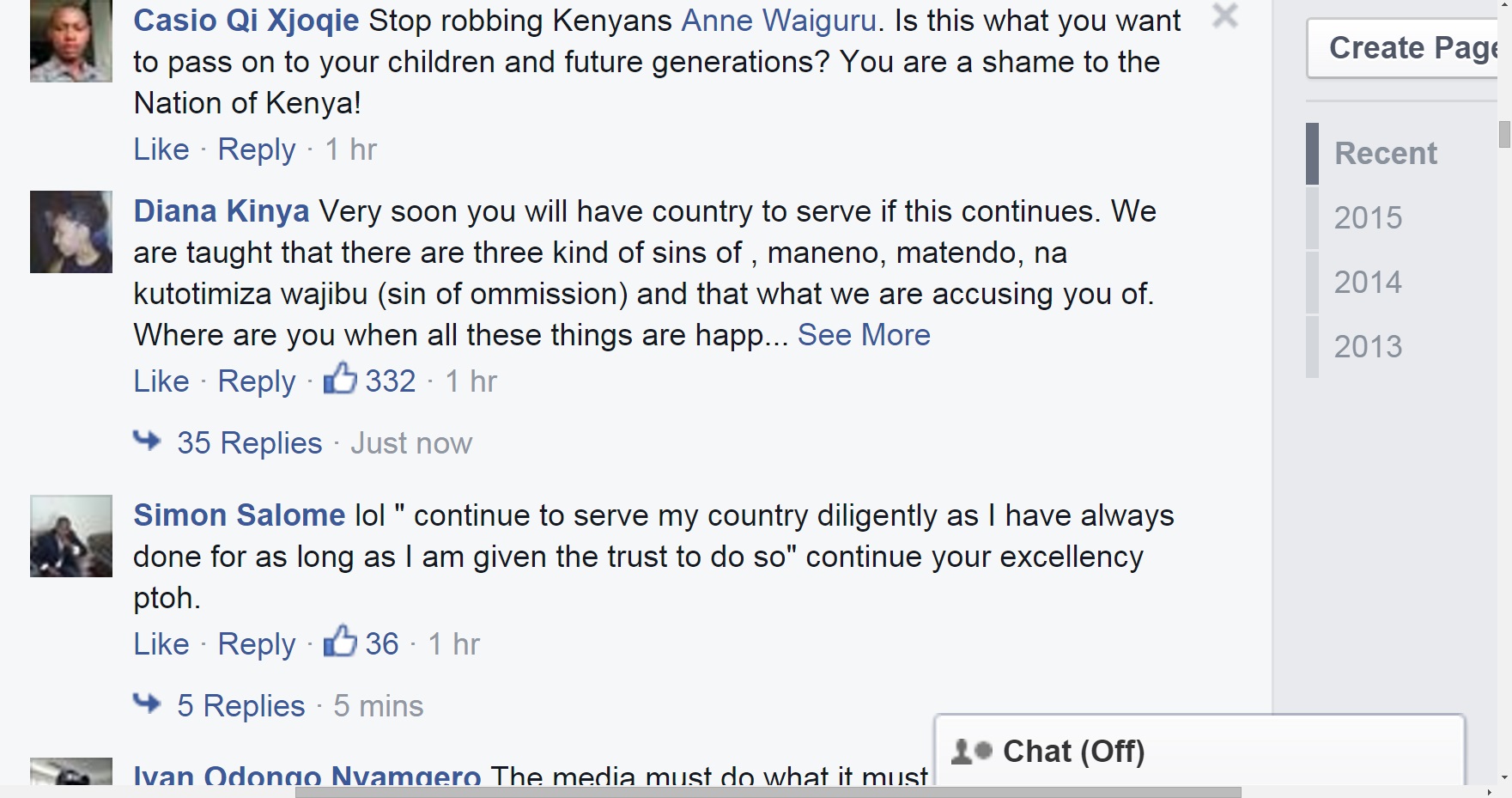
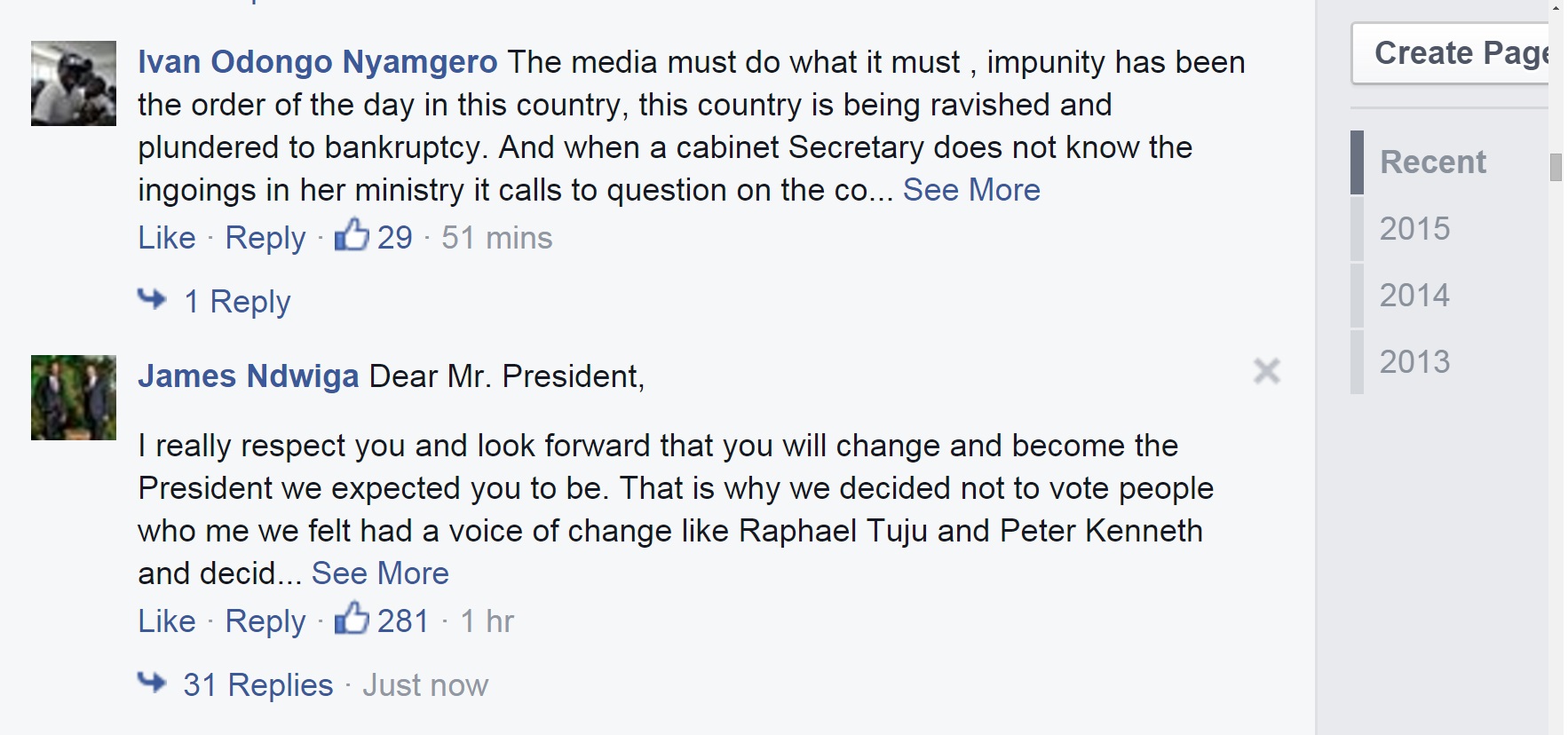
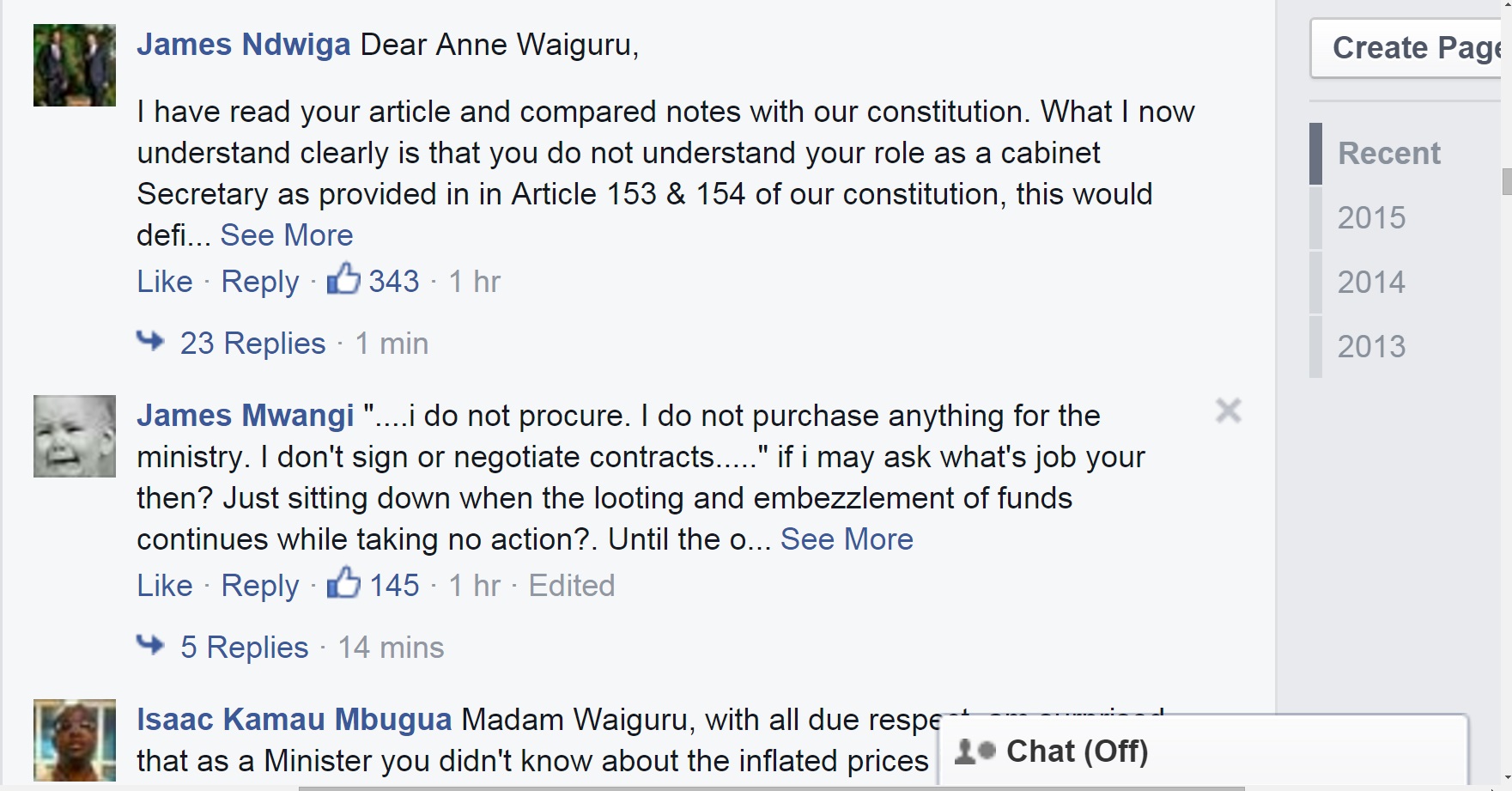
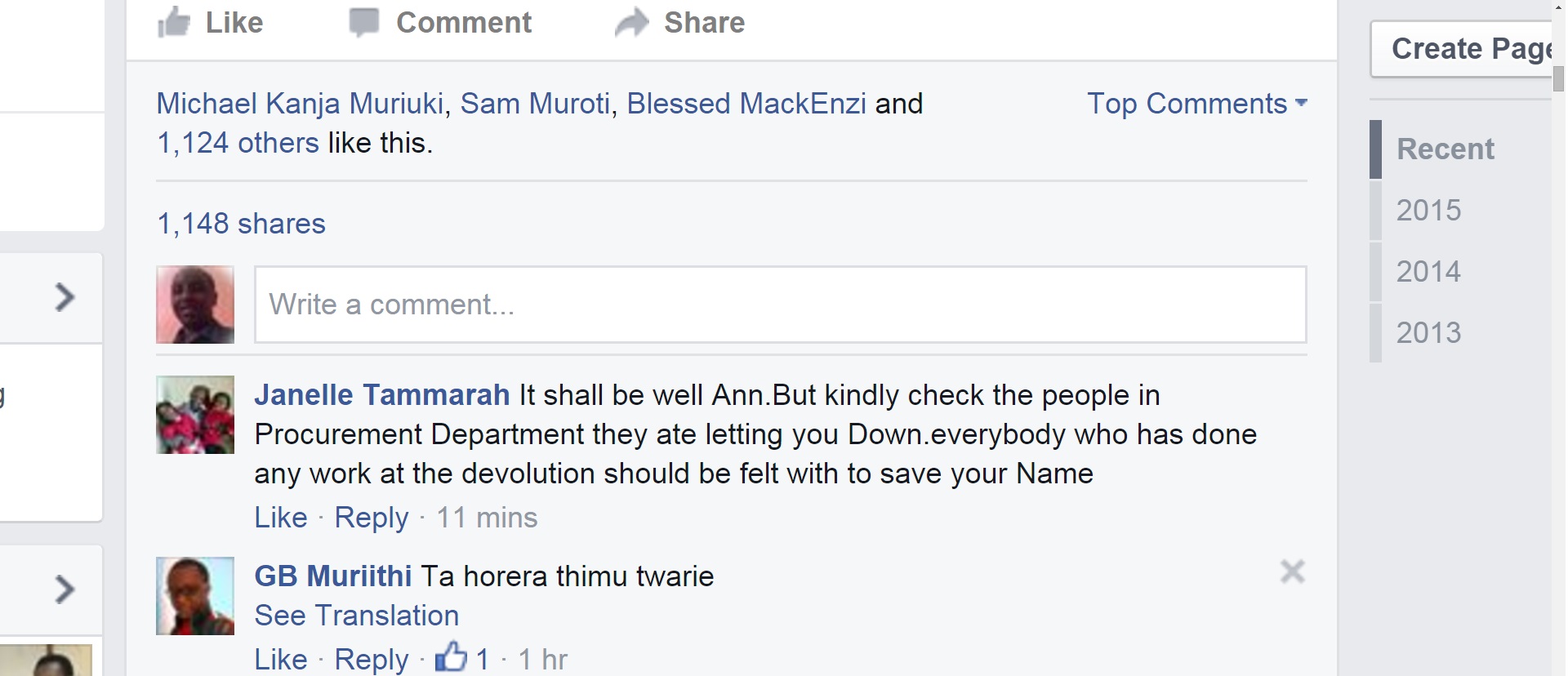
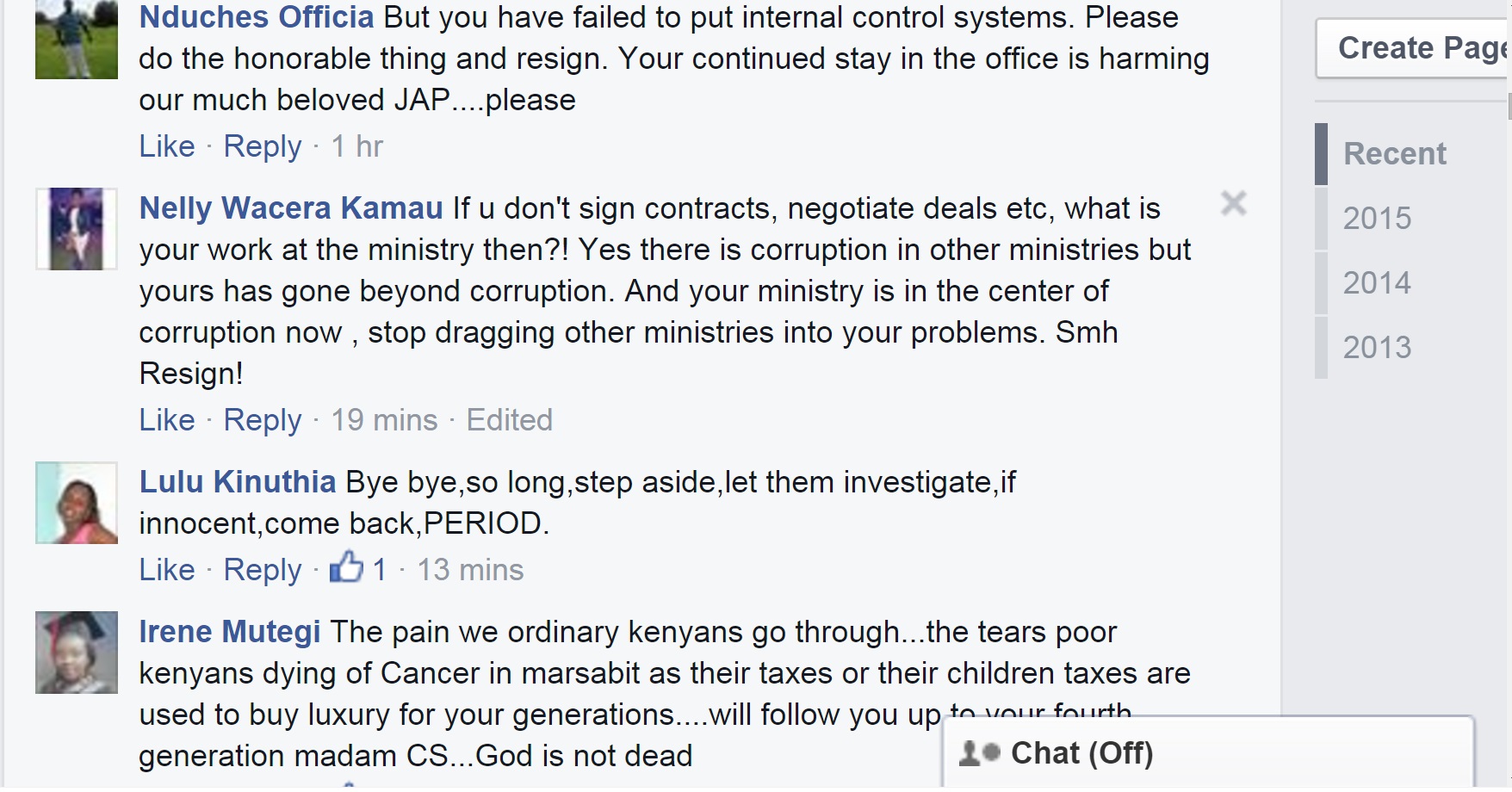
The statement has attracted thousands of comments on her Facebook page with some supporting her while others push her to resign.
Waiguru1

Waiguru2

Waiguru3

A screenshot of the comments. They were given after the CS issued the statement.

From the mood of the public, it seems like many more questions have not been answered as Kenyans push for more accountability.

The comments after the statement was issued. [Photo: Njenga H]
Waiguru5

The CS has been issuing several statements regarding her ministry and this becomes the latest. It however does not seem to quell the push for her to resign to pave way f0r investigations.

A number of CSs have stepped aside over corruption in the last few months but Waiguru has opted to stay put. She has defended her integrity saying that if there is any link to her misconduct, then she will be willing to step aside.

Only time will tell if the statement on Wednesday will suffice to have her stay in office.
Nakuru is Kenya’s third most dangerous county for journalists

0

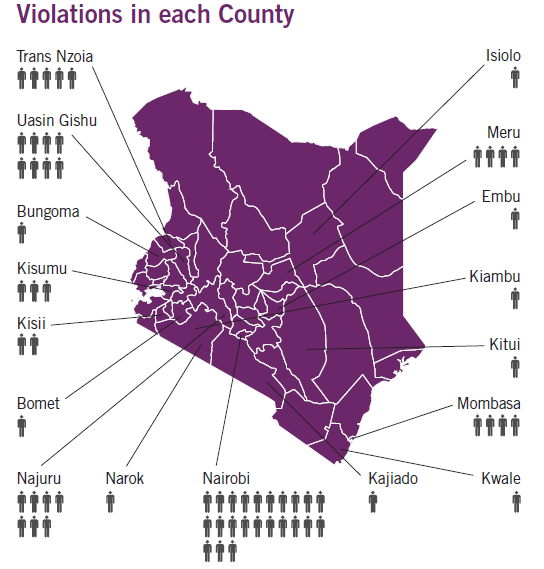
At least 7 cases of violence against journalists were reported in Nakuru county between January and September this year. This, according to a report by Article 19 makes the county the third most dangerous county for journalists to work in.

The report titled ‘Silenced and Intimidated: Attacks on Freedom of Expression in Kenya’ and which was released on Monday November 2 reveals that Nairobi is the most dangerous county for journalists to work in in the country.  At least 23 incidences of violations were reported in the city county between the same period. The county of Uasin Gishu in which a journalist, John Kituyi, was killed in April this year is second. It recorded 8 cases in the same period.

Among the cases that made Nakuru appear in the top three slots is an incidence in which Peter ole Sono, a politician, shot at journalists who were covering a protest following allegations that he had grabbed public land in Gilgil in May.
The report also cites a summon by detectives against Nakuru Standard Group Bureau Chief Alex Kiprotich in the same month to reveal sources of a security story he had reported.

The report comes at a time when the county was just settling down on a case against a Citizen T.V cameraman Evans Asiba who in the month of September was assaulted by police while covering a story at Lions Primary School.

Apart from Asiba, long time journalist Elijah Kinyanjui was also summoned by detectives and later charged in court on information he posted on a social media platform he runs about allegations that a local politician was involved in grabbing land.

Suleiman Mbatia and Boniface Thuku who work as photographers with Nation Media Group and Standard Group respectively in the county have also been attacked by the police in the past.

In total 65 attacks were reported during the period but only 42 were “officially reported or recorded”.

“Attacks were carried out by government officials, security agents and organized mobs – including college or university students in a manner which clearly demonstrates a sustained crackdown – to stifle and control the press, and limit the free flow of information,” the report says.

The most dangerous stories for journalists to cover according to Article 19’s findings are: corruption, protest, the International Criminal Court (ICC) and devolution.

“Introduction of devolution has also opened journalists to a barrage of new sensitivities and security challenges: they are being forced to grapple with competing political and inter-ethnic interests, hindering objective reporting on complex local politics,” the report adds.

The report calls for the need to prosecute those responsible for the attacks.

“Failure to bring those responsible for attacks on journalists to account sends the signal that the media can be silenced through violence, and will ultimately lead to many journalists resorting to self-censorship, hampering the realization of the right to free expression.”

“The Kenyan government must take the necessary steps to ensure that journalists are free to carry out their work. A free press cannot thrive in an environment in which journalists are under severe and constant attack: this undermines freedom of expression, and democracy, in the country,” the report further reads.

History made as Egerton University appoints first woman Vice Chancellor

0

By Olanga Nyamamu

Egerton University has a new Vice Chancellor (V.C.). In an appointment that was made public on Thursday 29th October 2015 Prof. Rose Mwonya will become Egerton’s 5th V.C taking over from Prof. James Tuiotoek who has been at the helm since 2006.

Her appointment will take effect from 13th January next year when she will become the first woman to hold such a position in the history of the institution. Apparently Prof. Mwonya who is also the University’s Deputy Vice Chancellor in charge of Academic Affairs (DVC-AA) is also the first and only woman to hold such a position (that of a DVC) at the institution that was started 76 years ago.

Prof. Rose Mwonya holds a Doctorate in Philosophy (PhD) in Agriculture and Home Economics from Iowa State University in America where she also studied for her Master and Bachelor’s degrees. She is credited for being the founding Director of the Center for Women and Gender Analysis (now Institute for Women, Gender and Development Studies) at the University which was the first center of its kind in the Sub-Saharan Africa.

Apart from serving as a Chairperson of the department of Agriculture and Home Economics, Prof. Mwonya has also served as a Dean of Students at the institution’s Njoro campus.

Coincidentally, as she assumes office as the fifth V.C at Egerton University she will become the fifth woman vice chancellor in the country. Other women V.C’s in the 31 public universities in Kenya are: Prof. Olive Mugenda (Kenyatta), Prof. Mabel Imbuga (JKUAT), Prof. Mary Walingo (Maasai Mara) and Prof. Teresa Akenga (Eldoret).

Recognized as the oldest institution of higher learning in Kenya, Egerton University was started in 1939 as an Agricultural college with only 3 students. Its founder Lord Maurice Egerton is said to have had a dislike for women after a lady he had courted for marriage let him down even after he built her a castle of its kind with more than 50 rooms.

History has it that he never wanted to meet any woman, let alone make the college a no-gone zone for women. He is said to have had the tradition of sending information, two weeks in advance, to his male workers at the college to hide their wives and daughters prior to his visit. It was not until Mama Ngina Kenyatta (the wife of Kenya’s founding father Jomo Kenyatta) visited the university one day that the tradition was broken as she gave a directive that women be given equal opportunity.

With Prof. Mwonya’s appointment it would be interesting to see how he (Lord Maurice) would react, had he come back to life today to find a woman at the helm of the institution.

Why casual sex among teenagers is not news anymore

By Njoki Maina

About five decades ago, cohabitation in institutions was unheard of. Marriage those days was treated as a sacred union between man and woman and no one would easily think of starting any union without following the due procedure.

Because of that, cases of students living together as man and wife were a taboo. So scandalous were they that when in 1968 Linda LeClair moved in with her boyfriend while both of them were university students, she made headlines.

LeClair was then a second year student at Barnard College while Peter Behr, the boyfriend she moved in with was a junior at Columbia College.

The story was so weighty that The New York Times ran a front page story about her struggle with the Institutional management. The Time magazine also ran a story about her in which they described her as ‘Linda the Light Housekeeper’.

But today, things have changed. Casual sex, among teenagers leave alone cohabitation has become the norm with experts saying media is to blame.

“The media has romanticized sex particularly through the adverts,”

says Ann Kamau, a student Counselor at Egerton University Nakuru Town Campus College (NTCC).

Kamau told Kenya Monitor that curiosity is another strong motivator for casual sex among teenagers particularly because adolescence is said to be a time for various experiments including sex and drugs.

In the last 3 months there have been reports that teenagers in different parts of the country have been caught engaging in casual sex at the dismay of the whole nation.

It started in August when more than 30 high school students traveling to Nairobi from Kirinyaga County were busted in a bus while high on drugs and having sex. Then in October more than 500 teenagers were arrested in Eldoret doing the same during what was reported as a ‘back to school’ party days before another group of teenagers were arrested in Nairobi on a similar offense.

According to Ann Kamau culture plays a big role in the society in shaping sexual behavior among the youth.

“Culturally people feel it’s not good to talk about sex. There is a lot of ignorance when it comes to sex and relationships,” she said.

She feels that parents should be more involved in shaping their children on matters related to sex as well as have policies formulated to address sex relationships in schools including the introduction of sex education.

Two years ago a 14 year old girl Mwanaharab Wamukoya delivered triplets in Bungoma. Her 16 year old teenage boyfriend was said to be responsible for the pregnancy proving that more teenagers are engaging in sex while still very young and that the country needs to take structural measures to curb the issue.

Catholic Bishops warn of ethnic hate ahead of Pope Francis visit

0

Catholic bishops in the country have called on Kenyans to avoid discussions that might stir the country towards  ethnic animosity ahead of the Pope’s visit.

Pope Francis is expected in the country on 25-27 of this month in a historic tour that will see him celebrate mass at the University of Nairobi grounds. The Pope will also have mass in Kasarani with young people as well as visit a slum in Nairobi.

On Sunday November 1 the bishops sent a message that called upon Kenyans to get into a prayer mood as the visit drew closer.

The message read

“We declare and demand an honest ceasefire and end to the incessant name calling among our politicians. We urge an end to the ethnic undertones and inciting remarks by leaders who were elected to protect the welfare of all people.”

“We call for national prayers and conversion. Let us take this opportunity to seek a new life and anew beginning in our country, our families and our places of work,”

the message read by Bishop Alfred Rotich during a press briefing at State House further read.

Below is the full Press Statement:

Dear Brothers and sisters in Christ, fellow Kenyans and the entire family of God.

Today we celebrate All Saints day. On the solemn and important occasion being celebrated everywhere in the world, the secretariat responsible for the preparations of the forthcoming landmark visit to Kenya by His Holiness Pope Francis, brings you greetings of peace and good will.

In exactly 25 days, The Holy father Pope Francis will arrive in Kenya on his maiden visit to the African continent. His Apostolic Voyage to Africa begins in Kenya on 25th November for three days after which he will tour Uganda and the Central African Republic respectively.

We wish to call on all Kenyans to join in prayer ahead of the visit and further invite all Kenyans of all walks to join us for the Papal mass on 26th November that will be celebrated by the Holy Father.

We continue to urge all Kenyans to seek peace and tolerance in difficult times. Our Nation is facing great trials that threaten to tear it apart. The recent political name calling, ethnic incitement lack the good taste on expected decorum by our leaders who were elected to steer us to unity and peace is worrying.

Our country and the people of Kenya already have to contend with many afflictions such as the escalating economic challenges of modern day living, and cannot contend with disunity at the leadership level. It only serves to further compound our problems and we must work together to seek solutions. We call on all leaders to lead.

Proverbs 28:25 reminds us that the greedy stir up conflict, but those who trust in the Lord will prosper. Our country has been called to peace and prosperity and with this knowledge we should steer clear of paths that lead us in the wrong direction. As the Holy father visits our great nation, let us join together and humbly seek redemption together and set an example for generations to come by always seeking God first in times of challenges and also in times of prosperity.

On This solemn occasion of all saints day as we begin the final countdown to the arrival of the Holy Father, we declare a moratorium;

1. We declare and demand an honest ceasefire and end to the incessant name calling among our politicians.

2. We urge an end to the ethnic undertones and inciting remarks by leaders who were elected to protect the welfare of all people.

3. We call for national prayers and conversion. Let us take this opportunity to seek a new life and anew beginning in our country, our families and our places of work.

In conclusion, dear Kenyans, We are happy to inform you on the progress of Hosting the Holy Father. The joint committee is glad to report that preparations for the Altar and podium for the mass and all venues to be visited by the Holy are on course.

The choirs that will sing during the papal mass are practising in different parishes and registration of the young people who will spend time with the Holy Father is almost concluded.

We urge our Christians to continue registering in their parishes to come receive the Holy Father. Every catholic parish is Kenya is requested to send 3 buses of pilgrims for the main mass on November 26th.

We also urge you all to continue making contributions to the MPESA paybill number 405060 for support towards the preparations of the visit and the special papal legacy projects to be initiated.

Please continue praying for our country that Justice and Peace founded on the Love of God may prevail.
On behalf of all Catholic Bishops of Kenya,

Rt. Rev. Alfred Rotich
Chairman – Pope’s Visit Secretariat, Kenya Conference of Catholic Bishops
November 1, 2015.

Makueni MCAs adopt motion to train residents on human-wildlife conflicts

Daniel Kituku

Members of the Makueni County Assembly (MCAs) have adopted a motion to train people on animal behavior in order to minimize human – wildlife conflicts across the county.

The motion tabled by the chairman Wildlife and Tourism Committee and MCA for Mbitini ward Dickson Mutaiti aims at creating a partnership between the County Government, County Wildlife Conservation and Compensation Committee and other relevant stakeholders to have people living in human-wildlife conflict prone areas trained on animal behavior in order to reduce human-wildlife conflicts.

While supporting the motion, Mtito Andei MCA Shadrack Mwau lauded the initiative and underscored the need to equip residents with the necessary skills and techniques on how to handle attacks by wildlife.

‘That the committee in charge of County Wildlife Conservation and Compensation has come up with survivor tactics to sensitize public on how to react when attacked by wildlife is commendable,” said Mwau.

Mavindini MCA Martin Mutuku noted that wildlife conflict had led to loss of lives and property worth millions adding that lack of awareness on how to deal with the human –wildlife conflict has further complicated the crisis.

Mutuku whose ward is prone to attacks from wildfire especially elephants and hippos due the region’s proximity to the Athi river said residents had suffered a great deal and nothing tangible had been done to curb the menace.

“Farmers in my area count losses almost every year due to the invasion of their farms by elephants and hippos,” he said.

His Kithungo-Kitundu counterpart Keli Musyoka said with the implementation of the motion, the rate of deaths and property destruction by wildlife will reduce drastically as well as promote a peaceful coexistence between the residents and wildlife.

Keli called for a speedy implementation of the motion.

Incidents of human-wildlife conflict in Makueni county are very rampant especially in Kibwezi, Makindu and Mtito Andei areas that border the Chyulu National park.

Since late last year close to eight people including a 12- year- old lost their lives due to wildlife invasions especially from elephants that escape from the park in search of pasture and water.

The latest death related to animal wildlife conflict occurred mid this year after a Kenya Wildlife Service officer shot and killed a man while rescuing an elephant that had stuck in a well.

The elephant was part of a herd that had invaded farms and destroyed crops running into thousands of shillings.

Most of the residents do not know how to handle the wildlife invasions and in most cases anger the animals leading to further destruction and the training will go a long way in managing the conflicts.

Corruption is the Kenya government’s lifestyle

By George Githinji

Corruption in Kenya is rife from the top echelons of government to the grassroots level of public service and other organs of government. It affects all ministries of national government (and recently ‘devolved’ to the county governments). The National Police Service (NPS), for example, is often declared the most corrupt institution of government. It has been accused of taking bribes and kickbacks from offenders (the wealthy and the poor alike) in order to subvert the course of justice.

The Auditor General for every financial year makes staggering findings on how government budget is unaccounted for, leading to huge loss of public funds. These ominous findings by the Auditor General are nevertheless never acted upon or followed up by the government.

The perpetrators of the multi-million Goldenberg and Anglo-Leasing Scandals are still at large and none (if any) has yet to be sentenced or forced to pay reparations. What we had with Goldenberg trials was some sort of a near ‘kangaroo court’ where the ‘not guilty’ verdict was pre-determined by the ‘powerful’ repute of the defendants.

The police service is yet to be uncluttered of its dreadful fiend of corruption because the political forces in government do not want to accelerate police reforms. In fact, to the government, accelerating police reforms to ensure the independence and sanctity of the force is equivalent to committing political suicide!

In a bid to pull the wool over the masses’ eyes, the presidential team unveiled a website where Kenyans ‘could report corruption incidents directly to the president.’ The presidential spokesperson Manoah Esipisu had been quoted as saying that “The president is committed to clean government and this site advances his intention to act strongly against corruption.” However, it cannot be established yet how effective this scheme has been since no impact assessment was made public to ascertain how effective the method is. In fact, the site is no longer accessible at all.

Both Goldenberg and Anglo-leasing corruption scandals severely incriminated the Moi and the Kibaki governments as being the major perpetrators of the vices. Most of the government officials mentioned in the reports have been shielded by the present and previous governments from prosecution, although some have had prolonged court cases on the same. The beneficiaries of these scandals are still ‘eating with a big spoon’ whereas Kenyans still grapple with the myriad circumstances under which their hard-earned and hard-paid tax was embezzled without remorse.

We recently also had the infamous ‘Chicken gate’ Scandal where top officials of the defunct Interim Independent Electoral Commission (IIEC) and the Kenya National Examinations Council (KNEC) were accused of picking bribes from Smith and Ouzman (S&O) executives in order to secure deals for the S&O. Two top officials from the Smith and Ouzman company in the United Kingdom have been prosecuted by UK’s Serious Fraud Office (SFO) and sentenced for this crime, but it remains to be seen if Kenya’s Ethics and Anti-Corruption Commission (EACC) will prosecute the Kenyan culprits, since it has been known to be the infamous ‘toothless’ bulldog.

All these infamous cases show that corruption is part of the Kenya government lifestyle and it continues to thrive because the government and the public recognize but accommodate and lack the goodwill to end corruption.

The writer comments on political issues in Kenya – blogs at Politics Kenya

Bankers Association says house prices have increased modestly in the third quarter

Average house prices in Kenya increased by 1.26 per cent during the third quarter of 2015 representing a relatively faster increase compared to the previous quarter’s 0.2 per cent increase.

According to the Kenya Bankers Association Housing Price Index (KBA-HPI), the observed modest price movement signals the softening of the overall house prices in line with the demand and supply conditions.

As observed during the first two quarters of 2015, apartment prices appear to be moving more than those of bungalows and maisonettes, reinforcing the rising middle class’s preference for the relatively more affordable apartments over bungalows and maisonettes. Similarly, the demand for units was influenced by the location and available social amenities, and a preference for gated communities was observed by the KBA-HPI, implying the importance of convenience and security.

Demand for houses on offer continued to be influenced by the location of the house (therefore the kind of social amenities available such as proximity to good roads, shopping malls and centres, schools, health centres among others), a preference for gated communities (implying the importance of convenience, scenic value from uniform house designs and security), and the characteristics that will be appealing to the increasingly discerning households.

Consistent with the previous quarter, the size of the unit was especially a key price driver; this can be inferred from the demand that was influenced by their sizes more specifically the plinth area, number of bedrooms, whether the house has a balcony, master ensuite and to a lesser extent whether a house has domestic staff quarters.

According to KBA Director of Research and Policy, Jared Osoro, the house prices responded to foreign exchange volatility and rising interest rates.

“As the economy entered the third quarter of 2015, there was an inevitable tightening of monetary policy on the back of volatility in the foreign exchange market. As would be expected, there was a shift of expectations towards a high interest rates regime that is shaping the decision making of households seeking to take mortgages towards home acquisition,” said Mr. Osoro.

For a given level of supply of housing units, demand seems to be responding according to both the prevailing and expected overall economic conditions. The economy’s real output growth of 5.5 per cent during the second quarter of 2015 represented a slowdown from a 6 per cent real growth realized during last year’s corresponding quarter.

The KBA-HPI regions are based on clustered price ranges across several counties. He added that houses situated in the high-end localities of the greater Nairobi area, Milimani (Kisumu), and Milimani (Nakuru) witnessed faster price movements on a quarterly basis. This could be an incentive for skewed market in favour of such regions given the high-profit margins likely to arise from them.

To better guide policymakers and investors on the trends in the housing sector, the banking industry’s umbrella body Kenya Bankers Association (KBA) launched the KBA-HPI in February 2015. The Index has quickly been recognized as a credible analytical tool that is useful for tracking housing sector dynamics and price movements.

“We are very pleased with the increased interest the KBA-HPI has received from not only the financial services players but also the sector regulators, which have begun to utilize the KBA tool to inform policy,”

said KBA Chief Executive Officer, Habil Olaka.

Published on a quarterly basis by KBA’s research centre, the KBA-HPI analyses industry’s housing data based on the location, qualitative and quantitative characteristics that influence pricing.

Okiya Omtatah stokes Eurobond fire as Kenyans seek answers

The Eurobond controversy has refused to go away.

This is despite the government giving all manner of assurances that the country is doing well financially.

The topic which has been on the lips of many Kenyans, on and off social media platforms, has been one seeking answers which have not been forthcoming.

In an editorial cartoon in one of the newspapers, Kenyans feel that the money which was acquired from the floatation never served the purpose it was meant to.

Consumer movement Cofek also weighed in bringing in a spin on the burden the country was taking on.

Questions abound over the controversy but no satisfying answers, from the government or Treasury for that matter, seem to be forthcoming.

Where is Sh122.8bn #Eurobond fortune? #Changamka @GhettoRadio895 — Ghetto Radio (@GhettoRadio895) October 24, 2015

Where is the #Eurobond cash? https://t.co/5SHDNMcYhx — mmnjug™ (@mmnjug) October 23, 2015

Some members from the opposition have sought to enlighten Kenyans on the impact:

And some advice which should have been considered in making Kenyans bear the burden.

During an interview on KTN on Tuesday, Finance CS Henry Rotich was at pains trying to explain how the money has been spent. He said most of it has gone into development projects. Kenyans feels that ‘development projects’ is a guise to misuse taxpayers and their hard earned money to support the lifestyles of corrupt but well connected officials.

At the same time, Rotich said that devolution was taking a lot of the resources as it was expensive to implement. He also decried that the Kenya Revenue Authority (KRA) was not collecting enough as there were still many loopholes which needed to be sealed.

@ktnnews @jageyo @lindahoguttu #askRotich, could the cash crunch be a way of compromising courts not rule in favour of teachers?

— joseph (@josephndungu986) October 27, 2015


And on Wednesday, the controversy got deeper as human rights activist Okiya Omtatah, in a letter to different personalities and government offices sought clarification over the matter. Among those addressed is President Uhuru Kenyatta and his deputy William Ruto as well as Finance CS Henry Rotich.

Letter demanding full disclosure on the Eurobond from the GovernmentOKIYA OMTATAH OKOITI &NYAKINA WYCLIFE GISEBEROOM…

A screen shot of the letter. Omtata is seeking answers on the Eurobond saga. [Photo: Njenga Hakeenah]

A screen shot of the letter. Omtata is seeking answers on the Eurobond saga. [Photo: Njenga Hakeenah]

Already, Omtatah is gaining support for the move with those on Facebook backing him.

Those copied in the letter and the response from Kenyans on Facebook. The letter is bound to make heads roll. [Photo: Njenga Hakeenah]

Paynet Group rebrands to Interswitch unveiling new corporate identity

Interswitch, an integrated digital payments and commerce provider focused on Africa on Wednesday launched its brand new corporate identity in Kenya.

This marks a new phase in Interswitch’s expansion across Africa and follows the completion of merger with leading East African e-payments provider Paynet Group.

Effectively, Paynet Group – East Africa’s multi-institutional payments provider and owner of PesaPoint brand now becomes Interswitch East Africa.

Paynet started in Kenya in 2003 and is the first and only business in Kenya to achieve PCI-DSS certification, the global card industry security standard. It is best known for a number of innovations including building the extensive PesaPoint network of ATMs and agents in Kenya, linking ATMs with M-Pesa and driving the adoption of EMV Chip cards.

Following the announcement and official opening of new offices for the business, Kenya becomes the second country where Interswitch has rebranded its operations, after it unveiled a new logo in Nigeria last month seeking to establish uniform brand values and identity across Africa.

Interswitch operations in Uganda and Gambia will also rebrand before the end of the year.

Speaking during the launch held at Interswitch’s new Nairobi offices at Orbit Place, Westlands – Nairobi, Interswitch Group Managing Director Mitchell Elegbe said the new brand is a statement of Interswitch’s leading position in the market and reflects its ambition to continue to grow its world class service across the African continent.

“Interswitch’s new logo and brand is a confident statement of our leading position in the market and sets us apart from the competition. The bold design clearly reflects the best-in-class service we provide our customers, our ambitious pan-African expansion plans and our relentless pursuit of new and innovative e-payment solutions for the African market,” Elegbe said.
He added,

“Our future at Interswitch is increasingly bright as we continue to push the frontiers of not just digital payments but commerce as a whole.”

The new identity celebrates Interswitch’s continuous drive to innovate e-payment solutions tailored to the African market with the aim of delivering ‘intuitive exchange’, where transactions happen at the speed of thought.

Bernard Matthewman, CEO – Interswitch East Africa commenting on the launch said the new bold yet simple design encapsulates the personality, drive and values of integrity and trust that are central to the Interswitch brand.

“For our customers, partners and stakeholders, re-branding of our business to Interswitch comes at a time when we are investing heavily in people, training and technology to ensure we position the business to deliver a greater range of services and enhanced service levels. We now have an unrivalled, truly borderless pan-African payment infrastructure under Interswitch which we will leverage to enable faster transactions, innovation and even greater value for our partners,” he said.

Since launching in 2002, Interswitch has grown rapidly and consistently, resulting in a current transaction volume of over 350 million transactions per month and more than US$32 billion a year across its platforms.

Interswitch runs one of Africa’s leading payment card brands ‘Verve’ and according to Deloitte is the fastest growing tech company in Africa with revenue growth of 1,226 percent in the last five years.

Verve International launches in East Africa from Kenya

Verve International (‘Verve’), an African payment card brand, has announced its official entry into the Kenyan market.

The launch in Nairobi included the announcement of a strategic partnership with Kenya Commercial Bank (KCB) to expand card acceptance and payment services in six key East African markets.

Verve, which is also the biggest payment card brand in Nigeria with more than 30 million payment tokens, is rapidly expanding issuance and acceptance across the African continent. It is now issued by over 40 banks in Africa.

The launch of the Kenya operation will extend the Verve network into Kenya, Tanzania, Burundi, South Sudan and Rwanda and integration into existing operations in Uganda.

It also opens the way for Verve card users to enjoy services in Kenya and key East African markets. Verve also intends to begin issuing branded cards to Kenyan and East African customers in the near term.

Verve International is pursuing acceptance of the Verve card around the world. In 2013, the company signed a partnership agreement with Discover Financial Services (DFS), the owners of Diner’s Club, which will give Verve cardholders access to the Discover global network of over 185 countries and territories across the world.
Verve International Chief Executive Officer Charles Ifedi said,

“East and West Africa are host to some of the fastest-growing economies on the continent. We are also seeing rapidly expanding trade flows between the two regions, and with that increased travel. Expansion of Verve acceptance across Africa and around the world is part of the long-term strategic vision for our business. It will also foster closer business partnerships between East and West Africa and improve the ease of doing business on the continent, thereby encouraging even stronger growth. We have created Africa’s first truly global payment card brand and an important symbol of Africa’s economic power.”

He added,

“Verve’s commitment and drive is to always go the extra mile to satisfy its customers everywhere in Africa with a convenient, safe and secure payment platform.”

Verve has been used in Africa for six years helping customers conduct millions of transactions safely, securely and hassle-free. The brand boasts of a system which is built and maintained by Africans to serve the African market and to connect it to retailers across the world.

Its expansion is enhancing intra-African trade and promoting strong and sustainable economic growth on the African continent.

Nakuru CSO’s to petition Governor Kinuthia Mbugua over misuse of public funds

By Lorna Abuga

A section of Civil Society Organizations based in Nakuru have vowed to petition Governor Kinuthia Mbugua next week over the alleged misuse of taxpayers funds by county officials.

Mbugua has been on the spot since the release of the report by the Auditor General, Edward Ouko, which revealed massive embezzlement of taxpayer’s funds in the county executives expenditure for the year 2013/2014.

Among the issues that the Auditor General had questioned in the report was the low expenditure on development. He cited that only 10 percent (841 million) of the total revenue was spend on development project compared to 54 percent (4.4 billion) spent on recurrent expenditure. This he said posed a bleak future for the county.

“Failure to allocate adequate funds for development may lead to slow economic growth,” read the report.

It is partly because of this that the CSO’s want to petition Kinuthia who prior to his assumption of office as Nakuru Governor was a Commandant of the Administration Police (AP) in the country.

In meeting convened on Tuesday this week at the ACK Cathedral hall Secretary General of the Urban Local Forum Sangale ole Nasieku said that the organizations were not happy with the activities of county government and that there was need to exert pressure on the executive to respond to the issues cited by the Auditor General in his report.

“Non governmental organizations have decided to take the oversight role since the entrusted watchdogs are sleeping on their roles ,”

he said while hitting at the County Assembly.

He added that if the issues raised were not addressed they could send away investors.

“Which investors can be attracted to a county which does not development priorities. The county assembly has been greatly compromised because it has been dragged into corruption and that is why up to now they have not summoned the county executive over the misuse of public funds.”

He added that failure of the county legislators to hold the executive accountable made them share in the blame.

“The MCA’s have failed to exercise their powers and this is a clear indicator that they lack leadership and integrity,” he said.

Apart from the Auditor General’s report residents have in the resent past been questioning how the county executive appointed some individuals into some positions which were not formally advertised for. Besides, the county government has also been on the spot for hiring 80 ward administrators instead of 55.

“Taxpayers money was used to pay ghost casual workers and yet their job description and whereabouts were not clearly defined,” he lamented.

He added that most public officers had already expressed interest in politics alleging that they had already began campaigning

“We are afraid that these people are using our money to do political campaigns and that is very unethical,” he said.

The Programmes Manager at the Center for Enhancing Democracy and Good Governance (CEDGG) Masese Kemunche urged citizens to exercise their constitutional rights in making leaders accountable for the positions they hold.

“The Constitution has given the public the mandate to question all the activities of the county government,” he said.

Parents advised to embrace family planning for better education

By Malachi Motano

Parents have been advised practice family planning in order to offer quality education to their children. Teachers must also enhance good teacher-pupil interaction so as to create a good environment for learning and allow the students to open up to them.

Vihiga MP Yusuf Chanzu speaking at an education forum organized by Uwezo Kenya Educational researchers at Mbale Primary School challenged parents to be on forefront in championing for their children’s education.

“I am calling upon parents to practice family planning in order to offer quality education to their children. Many parents could not pay fees for their children due to the large families they are raising up. Let us be realistic and ensure we have a family that we can take care of by providing basic necessities to them.”

The Member of Parliament says that the bursary the government provides is not enough to all these children and therefore a small family that someone can provide for is the best, that every parent must take education seriously to achieve sustainable development and reduce inter-dependency ratio.

He says local leaders they will team up and ensure the education levels are improved and maintained by first looking at their main challenges.

“The problem of low performance in our schools is that leaders and education officers are not working at their best,” he laments.

The legislator also challenges teachers to enhance teacher-pupil interaction so as to create a good environment for learning and allow the students to open up to them.

Fridah Chahale, the Executive Member for Education Science and Technology in the county says the county government has come up with measures that will help improve education standards. She revealed that they had set aside Sh25 million as bursaries for the 25 wards in the county.

She added,

“Most of the bright students from this region come from poor families. That’s why we created this kitty that is managed and coordinated by ward administrators and MCAs to make sure only bright and needy students are the ones benefiting.”

Chahale says there is need for village polytechnics to be refurbished and well equipped with enough instructors as a measure of dealing with the students who fail to get a chance in universities.

“At the moment we have visited all polytechnics in the county and identified those in dire need of refurbishment and the renovation of some is ongoing as we are looking for ways of staffing them while making sure they are well equipped,” she revealed.

She adds that admission of students at the Kaimosi University College, a constituent of Masinde Muliro University, is ongoing.

“The county government is determined bring higher education close to the people and we are closely working with the National Government to achieve this,” she said.

Nakuru KDF officer in court over rape

0

By Lorna Abuga.

A Kenya Defence Forces (KDF) officer has been arraigned in a Nakuru court to face rape charges. Before Principal Magistrate Liz Gacheha the court was told that the officer, Evans Ochieng Okello, allegedly committed the offence on 22 October 2015 in Lanet estate against a 20 year old university student.

Area OCS John Njue said that on the material day the accused person was accompanied by the complaint to his house after spending time together in a local bar. It is then that he is said to have committed the offense before.

“When the accused returned to his house to rest on that day, the young lady was in his company,”

said Njue who confirmed that the KDF officer was arrested on the same night after the complainant lodged a complaint.

However Akello denied the charges and was released on a bond of sh200,000 or a cash bail of sh100,000 with the surety of a similar amount.

The magistrate ordered medical examination to be conducted on the complaint to ascertain the rape allegations.

“Ensure that all the medical documents in support of the case are availed in court before the mention date,”

she said while moving that the case be mentioned on November 12 and be heard on December 10.

According to the Sexual Offenses Act, for a crime of rape to be proved the prosecution has to show that an accused person penetrated the genitals of the complainant without their consent.

“A person commits the offense termed rape if he or she intentionally and unlawfully commits an act which causes penetration with his or her genital organs,” the act partly says in Article 3.

The Act says that such a crime can even be punished by life imprisonment.

“A person guilty of an offense under this section is liable upon conviction to imprisonment for a term which shall not be less than ten years but which may be enhanced to imprisonment for life.”

But apart from being charged in normal courts KDF officers can be charged in a court martial if suspected to have brought the integrity of the force to test.

According to the Armed Forces Act officers can even be charged on offenses such as drunkenness.

“Any person subject to this Act who is drunk, whether on duty or not, shall be guilty of an offense and liable, on conviction by court martial, to imprisonment for a term not exceeding two years or any less punishment provided by this Act,” the Act says in Article 36(1).

“For the purposes of this section, a person is drunk if owing to the influence of alcohol or any drug, whether alone or in combination with any other circumstances, he is unfit to be entrusted with his duty or with any duty which he may be called upon to perform, or behaves in a disorderly manner or in a manner likely to bring discredit to the armed forces,” the Article further states.

Such officers

“shall be guilty of an offense and liable, on conviction by (a) court martial, to imprisonment for a term not exceeding two years or any less punishment provided by this Act.”

However it has not been stated whether Akello’s case will also be heard in a court martial.

Is nyama choma consumption exposing Kenyans to cancer?

Did you know that each 50 gram portion of processed meat eaten daily increases the risk of colorectal cancer by 18 percent?

In a recent report, the International Agency for Research on Cancer (IARC), the cancer agency of the World Health Organisation (WHO), has evaluated the carcinogenicity of the consumption of red meat and processed meat and for meat lovers, it is not good news.

Did you also know that high-temperature cooking methods generate compounds that may be carcinogenic?

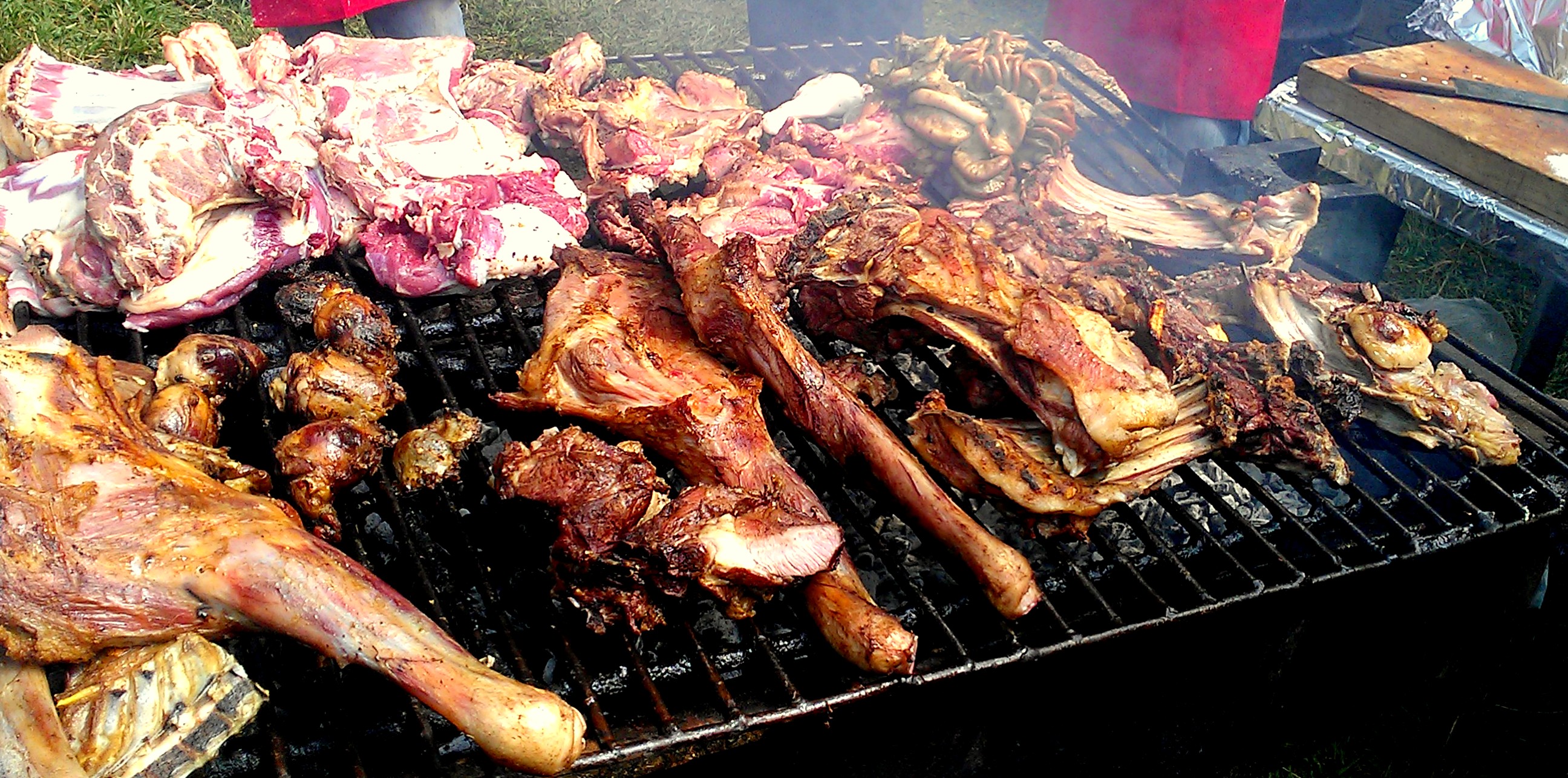
For Kenyans, an event without ‘nyama choma’ may as well pass with no attention but, cooking at high temperatures or with the food in direct contact with a flame or a hot surface, as in barbecuing or pan-frying, certain types of carcinogenic chemicals (such as polycyclic aromatic hydrocarbons and heterocyclic aromatic amines) are produced.

The good thing is, there were not enough data for the IARC Working Group to reach a conclusion about whether the way meat is cooked affects the risk of cancer. So, Kenyans may enjoy the barbecue while the dangers are not yet known but bear in mind that ignorance is no defence.

After thoroughly reviewing the accumulated scientific literature, a Working Group of 22 experts from 10 countries convened by the IARC Monographs Programme classified the consumption of red meat as probably carcinogenic to humans (Group 2A), based on limited evidence that the consumption of red meat causes cancer in humans and strong mechanistic evidence supporting a carcinogenic effect.

This association was observed mainly for colorectal cancer, but associations were also seen for pancreatic cancer and prostate cancer.

Sausages have been associated with an increased risk of getting cancer. [Photo: wutheringbites.co.uk]
Processed meat was classified as carcinogenic to humans (Group 1), based on ‘sufficient evidence’ in humans that the consumption of processed meat causes colorectal cancer.

The consumption of meat varies greatly between countries, with from a few percent up to 100% of people eating red meat, depending on the country, and somewhat lower proportions eating processed meat.

The experts concluded that each 50-gram portion of processed meat eaten daily increases the risk of colorectal cancer by 18 percent.

“For an individual, the risk of developing colorectal cancer because of their consumption of processed meat remains small, but this risk increases with the amount of meat consumed,”

says Dr Kurt Straif, Head of the IARC Monographs Programme.

He added,

“In view of large number of people who consume processed meat, the global impact on cancer incidence is of public health importance.”

The IARC Working Group considered more than 800 studies that investigated associations of more than a dozen types of cancer with the consumption of red meat or processed meat in many countries and populations with diverse diets.

The most influential evidence came from large prospective cohort studies conducted over the past 20 years.

“These findings further support current public health recommendations to limit intake of meat,”

says Dr Christopher Wild, Director of IARC.

“At the same time, red meat has nutritional value. Therefore, these results are important in enabling governments and international regulatory agencies to conduct risk assessments, in order to balance the risks and benefits of eating red meat and processed meat and to provide the best possible dietary recommendations.”

IARC Monographs evaluate consumption of red meat and processed meat.

Red meat refers to all types of mammalian muscle meat such as beef, veal, pork, lamb, mutton, horse, and goat.

Processed meat refers to meat that has been transformed through salting, curing, fermentation, smoking, or other processes to enhance flavour or improve preservation.

Most processed meats contain pork or beef, but processed meats may also contain other red meats, poultry, offal, or meat by-products such as blood.

Examples of processed meat include hot dogs (frankfurters), ham, sausages, corned beef, and biltong or beef jerky as well as canned meat and meat-based preparations and sauces.