Saturday, December 20, 2025
Home Blog Page 19

Human rights defenders urged to monitor, document human rights abuses

By Wema Fadhili

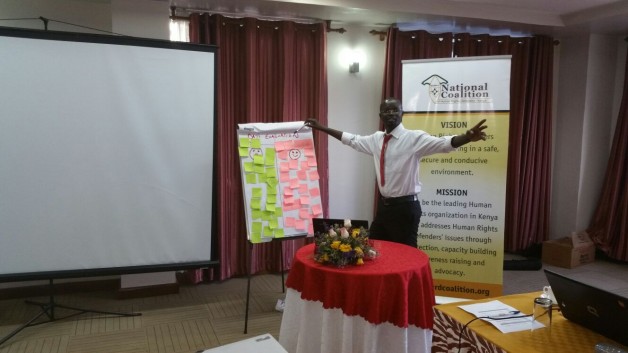
As the country gears towards the 2017 general elections, actors dealing in human rights issues have been urged to be on the lookout in documenting human rights violation while doing monitoring.

“Documentation holds key to accuracy, accountability and transparency. Lack of documentation has contributed to those committing atrocities get away with it,”

said Otieno Aluoka from the National Coalition of Human Rights Defenders in Kenya (NCHRD-K).

Aluoka said with non-documented decision, it is difficult to hold one accountable and urged all human rights defenders in the country to put more emphasis in documenting evidence.

“Through documented evidence, those dealing with protection of human rights have been able to hold accountable those who commit violations such us extra judicial killings, and corruption. Similarly, documentation gives credibility of the evidence gathered,”

he added during a two day training workshop for human rights defenders on documentation and monitoring that is taking place in Nairobi.

Yvonne Wamari from the coalition said evidence documented can be shared with international organisations for proper action to be taken.

“Opportunities for civil society engagements are in the Human Rights councils and the treaty bodies. This international legal framework ensures human rights are protected and whereas there are violations, appropriate action is taken,” Wamari said.

“Since the government won’t incorporate CSO’s in preparation of human rights report when Kenya is being reviewed, CSO’s can prepare shadow reports and write open letters which they can share with human rights councils and the United nations rapporteur on human rights,” she added.

Her colleague Kimutai Birech urged the defenders to always be on the lookout to monitor and properly document human rights abuses in the country in order to enhance their work effectively.

Boost for SMEs as information handbook launched

By Maurice Momanyi

Players in the Micro and Small Enterprises (SMEs) sector in the country and the region at large are set to benefit more from an updated sector booklet on services and products offered by the small business owners.

The launch of the second edition of the Medium and Small Enterprises (MSMEs) Handbook is a project of the SME Support East Africa (SME S-EA) and the SME Handbook Secretariat, collaborating with a technical team from key public and private sector stakeholders.

The comprehensive information handbook is developed with the knowledge that SMEs, especially those in the rural areas experience major challenges accessing business services as a result of little awareness of what the market is offering.

In recent years, the SME sector has been cited as a key driver of the economy, providing the bulk of jobs for not only the country’s, but also the region’s youth population.

At the launch of the second edition of the MSME Handbook at a Nairobi hotel today, the Cabinet Secretary for Industrialization and Enterprise Development Adan Mohamed who was the chief guest, said the government was sensitive to the important role SMEs and the private sector in general play in the country’s economic development.

“The government fully recognizes the critical role that the private sector, development partners and other stakeholders are playing in ensuring appropriate products and services are available to the SMEs. This is why my ministry has collaborated with the SME Handbook (Secretariat) which is in line with the national goal of developing this sector as government continues to support similar initiatives that help in reaching our objectives for the sector,” CS Mohamed said.

This second edition of the SME Handbook will be distributed through the national and county governments’ information centers, various apex business member organizations in the MSMEs, women and youth entrepreneurs sector, national and county government information centers, among other outlets.

The first edition of the handbook, produced in 2011, was adopted by the then Ministry of Trade and other key institutions as a reference publication in the Business Information Centres (BICs) spread across the country.
Speaking at the same function, the SME Sector Handbook Project Team Leader Richard Muteti, expressed gratitude to the government’s recognition of the SMEs sector in the country’s development, adding that the launch was a concerted effort made to empower small business owners with timely and relevant information.

“The SMEs sector is the largest employer and incubator for new business and budding entrepreneurs in Kenya. This sector covers all areas of the economy and is a key driver of the country’s industrialization agenda,” Muteti said.

“Creation of a platform that can help the SME sector share information and attract business is one of the means that can be used to achieve growth and expansion in the sector.”

Mr Muteti added that the SME Handbook is specially developed by industry players with support from various government institutions to close up on the information gap. He went on to say that information sharing on innovation, technology, finance and a budget is essential, terming it “an idea whose popularity has been felt in the sector and beyond.”

Speaking to the media on the sidelines of the launch event, Mr Muteti explained that emergence of new products, services and advances in technology introduced into the sector necessitated the development of the updated SMEs Handbook.

Mr Muteti went on to say that the handbook will provide a road-map to sector players in Kenya on what is available for them in the public and private sectors to assist them in growing their businesses, adding that it also provides a wealth of information on how to run their businesses and empower them to become better business people.

Mr Muteti, who is also the Chief Executive of the Kenya National Federation of Jua Kali Associations (KNFJKA) and the chairman of COMESA Business Council SMEs Work Group, said the SMEs Handbook’s countrywide distribution network will ensure that the book reaches all small business people throughout the country hence effectively mitigating to a large extent the the problem of access to important sector information.

Another lead player, the East Africa Confederation of Informal Sector Organizations, added its voice to the launch through its Deputy Patron Keli Kiilu, saying it will go a long way in creating awareness of the potential inherent in the sector. Kiilu said the presence of leaders from different institutions involved in policy formulation, regulation and diverse support to the sector is clear manifestation of its key role in social and economic development of our nation.

“Suffice to sate that this handbook encompasses various sub-sectors in Kenya which has about 15 million players, with the ultimate goal targeting the entire East Africa region with over 45 million operators,” Kiilu said.

“This launch is yet another milestone propelling the SMEs as a key driver of the regional integration process as well as a major base for industrialization and entrepreneurship.”

Some of the sponsors of the Handbook Project are Kenya Power, Kenya Bureau of Standards, MSE Authority, Mount Kenya University, Commission for University Education and Association of Micro-finance Institutions among others.


How to impeach a Governor in Kenya

Two Governors have so far been impeached, Murang’a and Embu Governors and while none has yet to lose their seats, the process and what happens next is a discussion George Githinji shares in this post.

Grounds for the removal of a county governor

Article 181 of the Constitution provides for the removal of a county governor. A county governor may be removed from office on the following grounds:

  • Gross violation of the Constitution or any other law.
  • Where there are serious reasons to believe that the county governor has committed a crime under national or international law.
  • Abuse of office or gross misconduct
  • Physical or mental incapacity to perform the functions of the office of the county governor.

Article 181 also mandates Parliament to come up with legislation providing the procedure to remove a county governor from office on any of the grounds provided above. The 10th parliament hence incorporated this procedure in the County Governments Act.

Procedure for the removal of a county governor

Section 33 of the County Governments Act contains the procedure for the removal of a county governor.

A member of the county assembly (MCA) by a notice to the speaker may move a motion for the removal of a Governor under article 181 of the Constitution. However, the member must be supported by at least a third of all the members of the county assembly to move the motion.

If two thirds of all the members of the county assembly support and pass the motion to have the county governor impeached, the speaker of the county assembly informs the speaker of the Senate (in writing) about that resolution within two days. The Governor, nevertheless, continues to perform the functions of the office pending the outcome of the impeachment proceedings.

The speaker of the senate then convenes a meeting of the senate to hear the charges brought against the governor by the county assembly. The Senate, by a determination, then appoints a special committee comprising of eleven of its members to investigate the matter. These two actions should take place within seven days after the speaker of the senate receives the notice of the resolution to impeach the governor from the speaker of the county assembly.

The 11-member special committee of the Senate should then investigate the matter and report to the House within ten days on whether it finds the charges brought against the governor as being substantiated. The governor has the right to appear and to be represented before the committee during the duration of its investigations.

If the special committee reports the allegations or particulars of the allegations against the governor have not been substantiated, further proceedings shall not be taken in respect to the allegation. However, if it reports that the allegations or particulars of the allegations are substantiated, then the senate shall vote on the impeachment charges, but only after ensuring that the governor has been given a fair opportunity to be heard.

If a majority of the members of the senate vote to uphold the impeachment charge, the governor shall cease to hold office. Nevertheless, if the members of the senate vote to reject the impeachment charge, then the speaker of the senate shall notify the speaker of the concerned county assembly accordingly. The impeachment motion on the same charges may then be introduced again before the county assembly only after the end of three months from the date of such a vote by the Senate.

The procedure for the removal of the President on grounds of incapacity under Article 144 of the Constitution shall apply, with necessary modifications, to the removal of a governor.

Vacancy in the office of the County Governor

Article 182 of the constitution provides for the procedure to fill a vacancy in the office of the county governor. When the governor is impeached, the deputy governor shall assume office as county governor for the remainder of the term of the county governor.

However, if the deputy speaker cannot assume the office of the governor as contemplated above, then the speaker of the county assembly shall act as the county governor. Elections for the office of the county governor shall then be held within sixty days after the speaker assumes the office of the county governor.

The writer comments on political issues in Kenya – blogs at Politics Kenya

Water project puts a smile on faces of community members in Narok County

By Florence Gichoya

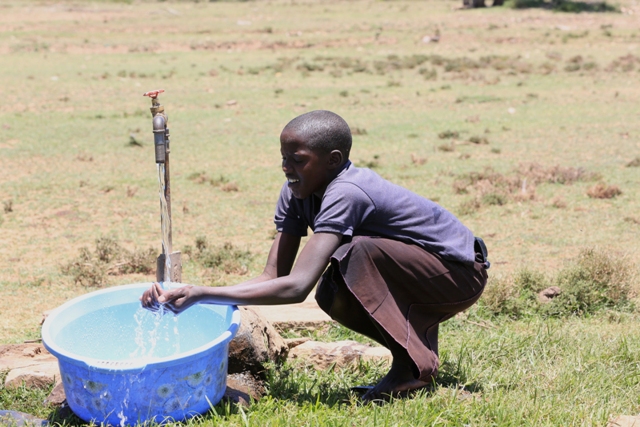
Twelve-year-old Faith Sei broadly smiles. She draws clean water from a point that is connected from a natural spring, about 200 metres away; then drinks it. Faith is from Eluai Village, Mara Division, Narok County.

“I live there. It takes me about five minutes to walk to this water point,”

the Standard Four pupil, at Endoryo Erinka Primary School says, as she points at her parents’ homestead, about 400 meters away.

The teenager is among close to 2000 community members benefiting from Ochorro Le Koiyiaki Water Project. In 2009, Action Africa Help (AAH) Kenya protected a natural spring and put up a 15, 000-litre water tank. The organisation also set up three water points at 200 metres, three and six kilometres, from its source.

The local community is appreciative of the water and says it never dries up.

“The spring has never dried up, although the water can substantially reduce when it is very dry,”

says Olekisotu Olesitany, chairman of the water project.

The water tank started leaking a year after it was put up, due what locals say was poor workmanship, and as a result it is not being used. However, the residents have made the project sustainable. For example, Nkirimpa Sitany, 44, has constructed two water points to serve his family- the water points are situated in his land, near his homestead.

“I decided to have water close to my homestead; my three wives do not have to walk for long distances to fetch water,”

says the father of 18 children. He says before the protection of the spring and creation of the pipeline, they used to access water, three kilometres away. Sitany’s 600 herd of cattle drink water from a trough, next to one of his water point

A neighbor of Sitany, Naisula Naurori, 28, excitedly fetches water from one of the water points, which is about 200 metres from her home.

“The water is clean. I do not have to walk long distances. I have time to take care of my children, and do other household chores,” says the mother of six.

The water project is under basic services theme undertaken by AAH Kenya – that has been working in Narok County since 2005. The projects were under Water Sanitation and Hygiene (WASH), education and health sectors.

The interventions were carried out under the flagship ‘Improving the Standard of Living of Pastoralist Communities in Mara Division’ programme in the 14 sub-locations of Mara Division. The programme utilized a strong community-based approach, working with local community development committees and the Mara Division Development Programme (MDDP), a Community Based Organisation.

Currently, AAH Kenya is implementing the Kakuma Refugee Assistance Programme (KRAP) that aims to enhance self-reliance and sustainable livelihoods for 4,080 refugees in Kakuma Camp, Turkana County. This is through development of models that will address resilience, safety net and consumption; skills enhancement, employment opportunities and enterprise development.

Through the Mara Entrepreneurship and Market Development (MEMD) project that started in January 2015, in Narok County, AAH Kenya will build on previous engagement with the communities and the county government. The two-year project, aims to develop an ‘entrepreneurial mind-set’ in community members, in order to strengthen their resilience and capacity to lead their own development.

Kakuma Refugee Camp to benefit from EU’s financial boost to UNICEF

The European Commission has signed two agreements with the United Nations Children’s Fund (UNICEF) to fund humanitarian programmes for children and women in Kenya worth €895,000 an equivalent of Sh100 million.

The Commission will provide €545,000 (sh61M) in support of UNICEF Kenya’s preparedness and response to the ongoing cholera outbreak. A further €350,000 (sh39M) will support protection measures for children in Kakuma refugee camp.

“This contribution is timely. We need to expand prevention measures in order to bring the cholera outbreak under control before the rainy season starts in October, especially in high-risk areas where children are particularly vulnerable,”

says UNICEF’s Representative Pirkko Heinonen.

UNICEF has developed a Cholera Preparedness and Response Plan in collaboration with the Ministry of Health. The EU funding will support the implementation of this plan over a six-month period in order to reach the most vulnerable children and women with targeted life-saving interventions.

The second funding agreement is being implemented over a 12-month period, as of July, to address the needs of separated and unaccompanied minors entering Kakuma refugee camp in north-western Kenya, and other children with acute protection concerns.

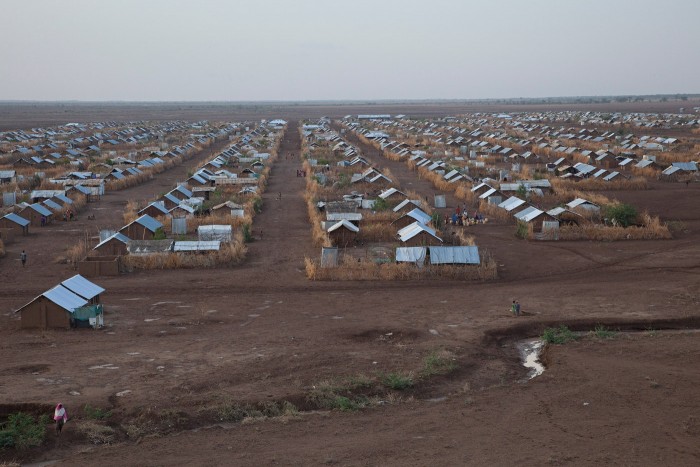
An avenue within Kakuma Refugee Camp. The funds will also be spent on reuniting children with their families. [Photo: Kakuma_kanere.org]

“Children, especially those who arrive in the camp alone or separated from their family, are vulnerable to exploitation and abuse. This EU funding aims to ensure that the children are well taken care of upon arriving in Kakuma,”

says Jean-Marc Jouineau, Expert for Kenya and Somalia at the European Commission’s Humanitarian Aid and Civil Protection department.

“Having escaped extreme violence and hardship, we need to support the children as best we can so that they can finally feel safe.”

Since December 2013, Kakuma refugee camp has seen its population grow to over 180,000. 67 per cent of the 53,000 new arrivals are under 18 years old and 15 per cent fall into the category of unaccompanied and separated children. UNICEF in partnership with UNHCR and the Lutheran World Federation (LWF) have worked to scale up Kakuma’s Case Management System targeting 24,000 children.

The funding from the European Commission will help to ensure that refugee children are protected from violence, abuse and exploitation, and are reunited with their families. Children with no family are placed with foster parents.

Unilever ranked top employer in Kenya

The Top Employer Institute, an international certification institute, has ranked Unilever as the number one employer in Kenya in 2015/16 for the third year in a row.

The institute based in the Netherlands, benchmarks companies against global human resource best practices and its certification is recognized internationally. It certifies excellence in the conditions that employers create to ensure that employees develop themselves fully, both personally and professionally.

“The ‘Winning with People’ agenda is fundamental to the success of our business strategy,”

said Marc Engel, Unilever CEO for East Africa.

He added,

“This is why there is unwavering focus on co-creating a culture and organisation that enables our people to grow and develop as leaders with purpose.”

Unilever achieved top scores after going through stringent validation and external audit processes which involved a research procedure commissioned to critically assess HR management and employee welfare in the organisation.

Salome Nderitu, the Unilever HR Director for Unilever East Africa said,

“This is the payoff on the focus the company has given to staff and their wellbeing; it’s also a recognition of our efforts in building a strong Employer Brand and a culture of excellence in HR policy and practice.”

The Top Employer Institute also ranked the leading consumer goods manufacturer as best employer in Africa for the second year running.

Overall, Unilever swept the top employer board, picking up a certification in Côte d’Ivoire and No.1 slots in Kenya, Nigeria and Ghana, as well as South Africa where the team also took top place in categories like consumer goods and manufacturing for an unprecedented third year running.

Posta Kenya, Kilimall partner to enhance logistics services for online buyers

The Postal Corporation of Kenya (Posta) and online shop Kilimall have signed a Memorandum of Understanding (MoU) to enhance the logistics service experience for online buyers. The partnership will allow Kilimall to use Posta outlets across the country.

The arrangement allows Kilimall to use post offices as a collection points from which online shoppers can collect their ordered goods.

Customers will also be able to place their orders at any post office branch.

Speaking during the signing ceremony at Posta Kenya headquarters, Postmaster General Dr. Enock Kinara said,

“E-Commerce is the next big thing and fast growing in Kenya and, therefore, we are excited to partner with Kilimall to deliver innovative logistics solutions that will enable consumers across the country enjoy the convenience and benefits of e-commerce.”

Kilimall logistics manager Chris Nyaga said that the move will enable his organisation increase their rural reach through Posta Kenya’s network across the country.

The online shop targets to empower 40 million Kenyans with cost effective products and services as well as support over 100,000 local businesses in a free online market place.

On postal services, post offices opened in Mombasa and the island of Lamu in May 1890 in the then British East Africa.

Two years later, offices were opened at Malindi and Wasini and by 1897 an office was to open at Kilindini, necessitated by the construction of the railway.

On July 1, 1895 control of the territory in British East Africa was transferred from the company to the imperial government.

The Postmaster of Mombasa was responsible for running the postal service in the territory and in 1901 the Postal Services of British East Africa and Uganda were amalgamated.

Kilimall joins a host of other online shopping platforms in what is seen as a move to have a piece of the market share in the business. Among the well-established platforms is Pigiame, OLX, Mimi and many others. Several online businesses are also being conducted on social media platforms like Twitter, Facebook and Instagram.

And in a report early this year, ‘Lifting barriers to internet development in Africa’, Kenya was reported to have the highest bandwidth per person in Africa, the fastest speeds and with one of the lowest internet rates.

Liquid Telecom Kenya CEO Ben Roberts said during a presentation on the report,

“Investment in the continent’s connectivity is creating multiple benefits that Kenya demonstrates as a clear example of a virtuous circle, where each investment accelerates the next, with an ever increasing footprint of beneficiaries.”

The Communications Authority of Kenya (CA) said early this year that internet penetration in Kenya stands at 52.3 per cent, placing it in the lead board in the region.

“Kenya has achieved a confluence of infrastructure and provision that has positioned it with the highest growth in internet take-up compared to income per capita in Africa. It has effectively become an outlier in its internet take-up, and seen Nairobi join Johannesburg as one of Africa’s two regional internet hubs,” said Roberts.

CNBC Africa said that Kenya boasts of a 20-fold increase in international bandwidth in the country to 20 gigabytes per second.

Illegal sand harvesting rears its ugly head in Kasikeu, Makueni County

The ugly face of illegal sand harvesting in Makueni County reared its head once again over the weekend after one person was killed and nine others seriously injured when two vigilante groups from opposing camps clashed over the illegal activity in Kasikeu.

The Saturday afternoon incident that took place in Kaseve and Musaani villages saw the two groups armed with arrows and petrol bombs engage in fights that left one of them dead and several others nursing arrow and burn injuries.

The injured are recuperating at Sultan Hamud and Makindu Subcounty hospitals.

A lorry believed to have been ferrying sand was also razed down in the scufffle before police were called in to stop the chaos that erupted after the vigilante group supporting sand harvesting attacked those against the activity that has led to wanton destruction of rivers and environment in the region.

The incident has angered Makueni residents including the Governor Kivutha Kibwana who has pointed an accusing finger to a senior police officer for the sand harvesting.

In his Facebook account, the governor sensationally claimed that the Deputy Officer Commanding Station (OCS) at Sultan Hamud was the one responsible for the scooping of sand in Kasikeu and took to Facebook to lament the County Government’s inability to stop the menace due to the cartels enjoying protection from the police.

“One of our county employees implementing the sand conservation act has been waylaid twice in his residence.Security is a national function and the security forces in Makueni are not helping us.We are now relying on the Interior Minister to help us,” read the post in part.

In the lengthy Facebook post the governor regretted how sand harvesting was rampant in Kibwezi and Kilome saying that the youth involved in scooping of the sand had invaded people’s farms destroying irrigation schemes with impunity.

“These young people are supported by police and a few provincial administrators together with cartels in Mlolongo. We have discovered that many lorries belong to the police,” said Kibwana in the Facebook post.

However, in a quick rejoinder the police have denied the allegations with Nzaui OCPD Andrew Mbogo saying that police are not involved in sand harvesting.

The governor also blamed the China Bridge and Road Construction Company (CRBC) for illegally harvesting sand in the county noting that the environmental degradation caused by the uncontrolled sand scooping will take years to reverse.

“The China Company has taken millions of tons of sand without doing anything to conserve the environment. They take water from the common sources instead of doing their boreholes. They take stones for ballast for free. They have destroyed roads. They have made several rivers dry.They are reversing our economic growth by seriously hampering our food security. The effects of the environmental degradation will be felt many years to come,” lamented the governor.

Incidents of residents killing and maiming others in areas where sand harvesting is carried out are not new with Kasikeu being most prevalent with such occurrences. A few months ago two lorries caught harvesting sand in Kaluku river in the same area were reduced to ashes after irate residents opposed to the activity burnt them. The drivers of the lorries escaped death by a whisker.

Despite the far reaching consequences of sand harvesting including drying rivers and death the activity continues unabated especially in Kasikeu and some parts of Kibwezi where sand cartels and unemployed youth who have organised themselves into vigilante groups carry out the activity undeterred.

Most of the sand is ferried to Athi river and Mlolongo where a lorry goes for between Sh30,000 and Sh40,000. However the youth who scoop and load the sand are paid a paltry Sh2,000 per lorry.

The Sand Conservation and Utilisation Act 2015 that came to effect early this year seems not to have achieved much and residents have been left to their own means to protect the resource hence the formation of vigilante groups to curb the illegal businesses.

Chairperson Sand Conservation and Utilization Authority Charles Mutuku in a press release condemned the incident and retaliated that sand harvesting was banned in Kilome and Kibwezi among other regions.

He blamed unregulated sand harvesting and the violence on unscrupulous business people and called on the police to arrest those responsible and promised that the County Government will do what ever it takes to protect and conserve the environment.

Makueni County is classified as an arid and semi arid region with erratic rainfall and most residents rely on rain fed water for both subsistence agriculture and domestic use. Sand harvesting therefore poses a great risk to the water sources that the residents rely on.

With the current climate change, all stakeholders and especially the National and the County government should stop the blame game and chat a way forward to protect the environment and regulate the activity that can be a reliable source of income for the County Government.

Kenyans want President Uhuru to enjoy his 54th birthday but work

President Uhuru Kenyatta should obey court orders, pay teachers and put sense into the heads of legislators Moses Kuria, Aden Duale, Kithure Kindiki, Kipchumba Murkomen and the 36 bloggers!

These are some of the recommendations by Kenyans on Twitter well known as #KOT regarding the downward spiral the country is in and as President Uhuru Kenyatta celebrates his 54th birthday.

In the usual #KOT style, there were no hard feelings but just a call on the head of state to have the country back on track.

And on a lighter note:

Others felt that health matters deserved the president’s attention.

Others had political advice as well.

Human rights activist Boniface Mwangi said,

One thought that maybe the president needed to be reminded of his horoscope.

These calls on the president come as runaway corruption, skewed tendering processes leading to massive losses of public resources and a leadership that seems immune to Kenyans’ calls for improved service delivery continue impoverishing citizens.

From what has been a muted debate for over a year now, Kenyans are speaking out loudly against corruption and non-performance by a bloated governance system. Instead of devolution working for Kenyans, it seems to be working against them by increasing the burden on the taxpayer but having nothing to show for all the billions being released by Treasury every year.

President-elect Uhuru Kenyatta (R) greets his supporters with his running mate, William Ruto after attending a news conference in Nairobi on March 9, 2013. The two have been indicted by Kenyans for not doing enough to fight corruption. [Photo: REUTERS/Siegfried Modola]

Also, in what seems to be a breach of Jubilee government’s manifesto before their 2013 elections, most of the pledges have not been honored.

In what the manifesto calls ‘The Third Pillar of the Coalition: Openness (Uwazi)’ on page 63 it says,

“The Coalition believes in a new brand of politics; one where the national interest is placed above personal gain or tribal advantage. We are committed to fostering an open, tolerant, forward-looking Kenya with modern institutions that serve the people rather than narrow sectional interests. We are dedicated to implementing the new constitution quickly and effectively, as it is the paramount guarantor of the peoples’ rights and freedoms. Besides, power must be decentralized from Nairobi to the 47 new counties, bringing it closer to the people so that they can hold those who take decisions about their day-to-day lives to account.”

However, this seems to have been thrown under the bus and now Kenyans feel that the government is failing this country fast.

On corruption, the manifesto talks of cleaning up the mess on page 64 thus:

  • “The Coalition Government will: Give the Ethics and Anti-Corruption Commission (EACC) the power to prosecute corruption cases as happens in other African countries.

  • Set up local anti-corruption boards at county level with the power to refer cases to the EACC or to the Director of Public Prosecutions.

  • Ban anyone convicted on corruption charges from working in Government, in any public sector job.

  • Enact the necessary legislation so that Kenyan companies found guilty of corrupt practices will be liable to have their assets frozen by the courts.

  • Ban foreign companies found guilty of corrupt practices from operating in Kenya.

  • Introduce an automatic freeze on the assets of anyone indicted on corruption charges (with appropriate judicial approval).

  • Introduce the automatic suspension of any official indicted on corruption charges.

  • Put an end to Parliamentary immunity from corruption charges.”

But apart from being good on paper, nothing much has been done to assure Kenyans that corruption is being fought wholeheartedly by the two Jubilee leaders at the helm of steering the country forward. It is an indictment of a government that got into power on the promise that it would restore the confidence of Kenyans in public institution and governance.

And with the mystery surrounding the much acclaimed Eurobond success, corruption seems to be getting out of hand.

With such, good governance which the Jubilee Coalition promised Kenyans may just be another pipe dream.

Will these shortfalls by the government cause Kenyans to vote in issue-based politics or will it remain the tribal push for our man at the top?

Nakuru MCA’s meet Governor Mbugua over El-nino funds

0


By Lorna Abuga

Members of the Nakuru County Assembly (MCA’s) met Governor Kinuthia Mbugua on Thursday over sh500 million that the county has set aside to mitigate effects the El-nino rains.

During the Mashujaa Day celebrations, the Governor announced that the county government had budgeted to use the funds in various areas that the county had identified as hot spots should the rains fall as forecasted by the country’s weather man.

But a section of the MCA’s were not amused by the announcement with was also read by County Ward Administrators in various sub counties. This prompted Visoi Ward MCA Gitau Kamau to bring a notice of motion to the house asking the governor to appear before the house to explain the budget.

While presenting the motion the MCA alleged that the county government had sidelined them in the plans for the Elnino rains.

“We (MCA’s) were subjected to public ridicule on Mashujaa day when members of the public started accusing us for misusing the funds set for the disaster yet there were no ongoing projects meant to mitigate the effects of the rains.”

He told the house that while the public wanted them to give a breakdown of the funds they knew nothing about the funds.

“How can we give an account of funds which were not approved by the county assembly?”

he asked while claiming that already some members of his ward had been affected by the rains.

While delivering his Mashujaa Day speech governor Mbugua had stressed that the county was targeting areas that are historically known as high risk areas for mudslides among others.

“In some urban areas in Nakuru county, storm water is a source of health hazard and these areas are being mapped and are monitored closely for rapid interventions. We are almost though with the enhancement of drainage,”

he said. However MCA’s insisted that they were not aware of the existence of the funds with Beatrice Nyawira a nominated MCA faulting the executive for leaving out on the issue that she termed as a public interest issue.

“The ward administrators should not be allowed to mascaraed and play our roles yet we were duly elected by the public,” she said.

The MCA’s also blamed Kinuthia’s government of not involving them in the planning of a recent event that targeted the youth.

“The assembly did not approve the money that was used for the youth week and most of us were unable to give an account to the youth from our respective wards because we lacked information pertaining the function. We have turned out to be a laughing stock because the public are beginning to dismiss us since when they pose questions to us we are unable to respond to appropriately,” added Nyawira.

Irene Paul, a nominated MCA told Kenya Monitor that they met with the governor on Thursday

“but he had not been summoned.”

“We agreed to form a committee to look into the issues,” she added.

Strathmore University becomes first in Africa with IBM MainFrame z technology

IBM and Strathmore University’s Research Institute with a focus on ICT, Innovation, Entrepreneurship and business development @iLabAfrica have signed an agreement to expand their partnership into training for the IBM mainframe z technology.

This agreement makes Strathmore the first university in Africa with the IBM mainframe z technology.

IBM said it will install the technology infrastructure at @iLabAfrica and impart transferable skills on the same to senior lecturers at Strathmore’s Faculty of information technology.

Announcing the development, Dr. Joseph Sevilla, Director of @iLabAfrica said the university recognized that the new mainframe technology was fast becoming the backbone of business critical applications and training professionals with skills in mainframe z technology was aligned to both Strathmore University’s policy of training relevance to industry needs and Kenya’s ICT Masterplan.

“Strathmore @iLabAfrica is honored by IBM’s decision to expand our partnership that will expose our faculty and students to the latest mainframe z technologies. Being the first in Africa with this IBM mainframe technology puts Strathmore University and @iLabAfrica at the top of technology training in the continent.”

IBM has had a direct presence in Africa for more than 60 years that today spans 20 countries, including Egypt, South Africa, Nigeria and Kenya. This new academic initiative advances IBM’s leadership and commitment to closing the skills gap between higher education curricula and industry needs and is just one of many ways in which IBM is investing in Africa and helping develop economic capacity.

Speaking at the event, Suresh Ramakrishnan, Business Area Manager, System z Ecosystem Development at IBM Philippines said the partnership is hinged on helping faculty strengthen their educational programs so their students can compete in the job market of any industry.

“Mainframe z Systems seeks to provide computing infrastructure to companies and governments around recent mega-trends including big data, Cloud, Social, mobile & security trends. Our partnership with Strathmore University will see growth of skills to support this computing infrastructure for the new app economy — enabling organizations to transact at the scale and speed of mobile, bring right-time analytics to every transaction, and ensure the highest levels of security and trust in the cloud,” said Suresh.

Strathmore and IBM said they will jointly introduce training curricula on mainframe z system technology which will be part of the Information Technology undergraduate degree program. @iLabAfrica is a Centre of Excellence in ICT innovation and Development set up by Strathmore University in January 2011.

It is an independent entity in the Faculty of Information Technology. It was established to address the Millennium Development Goals (MDGs) and to contribute toward Kenya’s Vision 2030.

The research center is involved in interdisciplinary research, students’ engagement, collaboration with government, industry and other funding agencies.

Generation Kenya Programme giving lifeline to disadvantaged youths

As the clamor for employment in a shrinking economy continues, some initiatives are seeking to bridge the gap by offering training to enhance suitability for the job market.

This will help make bright futures by offering alternative training for on-demand products and services which are usually ignored by mainstream training.

One such initiative is Generation Kenya’s Youth Employment where already, 130 young Kenyans celebrated their graduation in September from a training programme designed to advance employment opportunities for disadvantaged youths.

The graduates will be taking the next step towards careers in the fast-growing financial services sector.

The graduation is the second for the new Generation Kenya programme, which currently has three sites-Buruburu, Kangemi, and Dagoretti. Generation is a non-profit programme targeting young workers, particularly those from disadvantaged backgrounds.

Together with a range of partners, including employers, non-profits, and funders, Generation Kenya’s first classes are providing young adults accelerated training as financial services sales representatives. Those who complete the programme successfully are guaranteed two interviews with Generation’s employer partners who are Barclays Bank, Bank of Africa, Britam, Liberty Insurance, and Old Mutual insurance. The programme is run by McKinsey Social Initiative.

Building on the success of the first classes, Generation Kenya Programme plans to expand into other locations and other fast-growing professions in the coming year.

“There have been many great partners involved in launching this programme, and we’re looking forward to expanding Generation in Kenya to reach many more young people,”

said Mehdi Sinaceur, Generation Kenya Programme Director.

In partnership with CAP Youth Empowerment Institute, Generation offers a six-week ‘boot camp’ training programme geared towards low-income, 20- to 30-year-olds who achieved a minimum of a D+ in KCSE, and who are currently unemployed or underemployed.

The graduation ceremony of the 131 youths. [Photo: McKinsey Social Initiative]
The programme gives students who did not have the opportunity to attend university the chance to enter formal employment.

“Of the 263 interviews that our candidates had, 60 percent resulted in two offers. Generation students prove themselves through their ability to demonstrate the skills needed for the roles, something they learn by spending 70 percent of their programme time on fieldwork and interactive sessions,”

Ndung’u Kahihu said, the executive director of the CAP Youth Empowerment Institute.

He added,

“Their success is a testament to what’s possible when hardworking Kenyans are given the opportunities to make the most of their talents.”

Generation Kenya launched in May 2015 with the first graduating class on July 10, 2015 of which 50 students saw a 100 percent job placement rate, and their on-the-job performance has been excellent to date.

“I joined Generation Kenya because it was an opportunity to improve my future. I had a hard time finding employment before, but now I’m excited about my new sales role and I am looking forward to working my way up through the organisation. Not only has the programme given me confidence in my own abilities and the skills I need to be successful in sales, but it has also helped me change the direction of my life,”

Eugene Kongondo, a beneficiary said.

The Generation Kenya Programme integrates technical training in the classroom and at job sites, along with behavioral and mindset skills, which help students prepare overcome both workplace and personal challenges.

Mentorship is available to all students throughout the full-time course to enable even the most vulnerable young people to be successful. Generation Kenya ensures that graduates continue to have access to support and regular follow-up contact for the first months of their employment.

Generation Kenya Programme has the global goal of connecting one million young adults to jobs and skills in five years across five countries—India, Kenya, Mexico, Spain and the United States. Generation Kenya will be recruiting additional classes to start later in the year, with recruitment currently open for the next class having begun in October. The programme is currently funded by USAID and McKinsey & Company.

Chief Justice Willy Mutunga, Boniface Mwangi and Ory Okolloh team up to recognise Kenya’s heroes

What does Chief Justice Willy Mutunga, activist Boniface Mwangi and Ory Okolloh have in common?

Well, in an exhibition that has been ongoing for the past three days along Tom Mboya Avenue in Nairobi, the three personalities have ‘teamed’ up to communicate to Kenyans what being a true hero is.

In the exhibition detailing Kenya’s struggles from independence till now, Dr. Mutunga, Mwangi and Okolloh have aroused curiosity and interest going by the numbers flocking the exhibition where the statue of the iconic Tom Mboya stands.

The three have their own views of who a hero is with Okolloh saying:

Some of the heroes from pre-independence Kenya to those who fought valiantly for the motherland have been carefully cataloged to portray the true essence of being a hero. Some of them were raped, tortured and others had their lives cut short as the country fought to free itself from the stranglehold of slavery under colonialism.

There are moving pictures of Kenyans from all walks of life who are signing on the board what their acts of courage are and what it would take to propel this country to great heights.

Mwangi, well known for his unflattering approach to matters human rights abuses, says that the exhibition- #TeamCourage- which closes on November 20 is still looking for images from the 90’s struggle (2nd liberation) which will be put up in the heroes exhibition.

CJ Mutunga quotes renowned writer Ngugi wa Thiong’o as having described perfectly who a hero is.

The exhibition has featured the likes of Mzee Jomo Kenyatta, Oloitiptip, Pio Gama Pinto, Syokimau and others who fought to liberate the country from the colonialists.

The exhibition detailing Kenya’s struggles has Kenyans from all walks of life sharing their sentiments regarding Kenya's peaceful co-existence and growth. [Photo: Njenga Hakeenah]
The exhibition detailing Kenya’s struggles has Kenyans from all walks of life sharing their sentiments regarding Kenya’s peaceful co-existence and growth. [Photo: Njenga Hakeenah]
It has also not left the dark period between 2007 and 2008 when Kenya descended to a new low when Kenyans turned against each other. In the period, more than a thousand Kenyans died while hundreds of thousands were displaced from their homes.

The pain is still being felt today.

One of those manning the exhibition says that chronicling the events that have marked transitions in the country will give Kenyans a better perspective of how standing up for something can help change the course of the nation.

During the launch, organizers said it was for those willing to walk the talk, to be the change they want to see.

//

Photos from the ongoing #TeamCourage event. Boniface Mwangi has unveiled the upcoming ‘Heroes Project’ and #TeamCourage…

Posted by PAWA 254 on Tuesday, 13 October 2015

And when all is said, will Kenyans finally stand and do what needs to be done?

A senior banker in the country says that Kenya is an independent minded country but there is a twist he fails to understand when it comes to politics.

He decries that the euphoria in politics renders Kenyans to be empty heads even though they consciously choose not to buy endorsed products despite their recycling poorly-performing politicians over and over.

Boniface Mwangi, Ory Okolloh and Chief Justice Willy Mutunga have defined who a real hero is. The question is, will Kenyans ever be the heroes they want to see?

Makueni County to receive Sh50M to mitigate climate change

Makueni County Government is set to benefit from Sh50 million for climate change adaptation after the county government became the first local government in the Africa to pass the County Climate Change Fund Regulation (CCCF) 2015.

The CCCF which was passed by the County Assembly in September is the first of its kind in the entire continent and will provide a mechanism through which the county can access and use financial resources to build resilience to the changing climate.

The Sh50 million kitty is part of seed money provided by the Department for International Development (DFID)-UK through the Adaptation Consortium which consists of Christian Aid, Anglican Development Services (ADS-Eastern) a local organisation working in Kitui and Makueni counties and the National Drought Management Authority (NDMA) among other implementing partners and will be used to mitigate environmental degradation and desertification through rehabilitation of water catchment areas and forests.

Speaking in Wote during a climate change forum Nicholas Abuya from Christian Aid said the initiative is a pilot project and will be replicated in other four counties which include Isiolo, Garissa, Wajir and Kitui before it’s rolled out to the rest of the country.

“The program will also be implemented in these counties which are expected to put in place similar structures like Makueni which will enable them to access finances from diverse sources including their own budgets,” said Mr. Abuya.

He noted that Makueni just like other arid and semi arids regions in Kenya experience erratic rainfall leading to perennial food and water shortages hence the need to combat climate change for sustainable livelihoods.

“Food insecurity and acute water shortages are permanent features in Makueni and the current climate change has had adverse effects on the social economic status of the residents hence the need for building resilience,” said Mr.Abuya.

Governor Kivutha Kibwana speaking at the same forum welcomed the initiative saying that with the CCCF and the kitty the county can effectively address climate change and retaliated his government’s commitment to support such programs aimed at helping vulnerable communities.

Kibwana raised fears over the rampant environmental degradation in the county caused by sand harvesting but expressed his hope that the activity will soon come to an end

“Rivers are drying up due to the uncontrolled activity while the sand harvesters exploit our youth who load the sand by paying them peanuts,” said the governor.

Water, Irrigation and Environment Executive Douglas Mbilo said the department has already established structures at the ward level to combat climate change and that the kitty will go a long way in reversing human activities that have impacted negatively on environment besides creating awareness on the need to conserve the environment.

Mbilo added that the department was also keen on partnering with other stakeholders and source for funds to combat climate change.

“We welcome the initiative and we shall support it for the benefit of the residents,” he said.

Mbilo’s Finance counterpart Mary Kimanzi assured that the fund will be well managed to secure sustainable livelihoods through environmental conservation.

‘We shall ensure prudent spending as well as  transparency,” she said.

Anglican Church of Kenya Makueni branch Bishop Joseph Kanuku underscored the role of church in development including mitigating climate change and cautioned residents against deforestation.

Bishop Kanuku said the Anglican Church will lead the fight against climate church through supporting programs that will promote environmental conservation.

James Muema a resident from Kilingu lauded the initiative saying that the people of Makueni were more than willing to implement the project.

“In Kilungu rivers and water towers have dried due to climate change and quick interventions are required,” said Muema.

The passing of the regulation is a very significant move for Makueni County as it strategically places the county in a position where it can access and use climate finance including the Green Climate Fund (GCF) which is set to raise to $100 billion.

Tobiko orders investigations after Twitter outrage on #ArrestAladwa

Kenyans on Twitter are a mad lot.

Well, at least for now before something else hot gets their attention.

A video that has been shared on social media showing one man alleged to be former Nairobi Mayor, George Aladwa, calling for some ‘action’ is all it has taken on Thursday to drive #KOT rabid.

In the video, the speaker is on record saying that Kenya will burn (translated) if Raila Odinga’s win in the 2017 elections is stolen.

And acting on the outrage, Director of Public Prosecutions (DPP) Keriako Tobiko has ordered interrogations and investigations and the subsequent outcome forwarded to his office.

Following the order, Kenyans hailed the move saying that at least something will be done to curtail such offensive utterances.

Earlier, those on twitter and Facebook were calling for the arrest of Aladwa saying that the careless talk was bound to re-open wounds that were healing.

The utterances were condemned from all quarters with those against Aladwa saying tha he was spewing words that could kill.

And when all fails, turn to God. This was by some who felt that Kenya was on a fast, downhill spiral where ordinary citizens were bound to die either from corruption or from careless politicians.

The video which surfaced early on Monday shows the politician addressing a crowd which can be heard cheering from the background.

And in what seems to be a response to the ‘accusations’, Aladwa was quoted thus:

Some of those who weighed in on the debate compared Aladwa to Gatundu MP Moses Kuria.

Sadly, the issue surrounding the choice of leaders by Kenyans also came up showing that politics, however bad, always wins. Some however called for sobriety in addressing the matter conclusively.

There was also some mockery with some asking if the accused would lead by example.

Others laid the blame squarely on Aladwa saying he should bear his burden.

While it is a sad situation, some felt the utterances compared to the calls in 2007 which led to the bloodbath that followed.

And with the never fading memory of the internet, Aladwa, if proven guilty, will have entered the annals of the most infamous Kenyans when it came to dancing over dead bodies.

It remains to be seen what the responsible bodies will do to make sure that such utterances are curtailed.

Already, Bahati MP Kimani Ngunjiri has issued a statement saying that Aladwa must be arrested for the utterances but said the responsible commission, NCIC, remains a toothless dog in the face of such politicians.

Cases against Johnstone Muthama and Moses Kuria are still in court but it seems that justice for the ordinary Kenyans keeps crawling while the high and mighty continue enjoying immunity which makes the abuse the laws with impunity.

Now, it is a watch and wait game to see what next after Tobiko’s move.