Thursday, December 18, 2025
Home Blog Page 48

Is Mombasa in the tight grip of druglords?

1
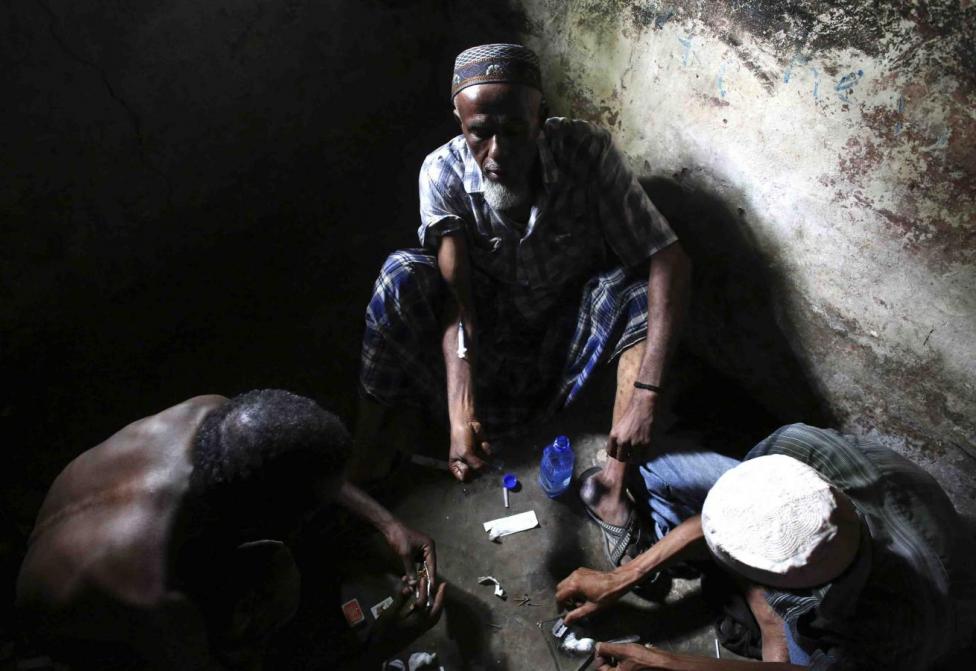
A heroin addict injects heroin  (http://www.reuters.com/ Goran Tomasevic)
A heroin addict injects heroin (http://www.reuters.com/ Goran Tomasevic)

That Mombasa and by extension the coast of Kenya has become a hotbed of drug trade is no longer a secret. A corrupt police force, powerful cartels and political links all contribute to increased drug trafficking in Mombasa.

They  own flashy cars, live in posh houses and splash their money around the city. If word on the street is to be believed, they have the police in their pocket. Former Inspector General of Police Kimaiyo must have been frustrated with his officers to the extent that he disbanded the Anti Narcotics Unit, transferred all the officers and shut down its offices.

The drug problem is so rampant, residents even accuse some of the County Askaris of being “Maunga” a  term used to describe addicts due to their flour like substances they use. In places like Kisauni, Shanzu, Likoni and Mtwapa, the number of Maunga has gone up. At the Shanzu stage, frequent fights between the addicts and Matatu crew breakout due to the “stage levy” the addicts are charging.

During a recent crackdown on drug peddlers in Bondeni and Tudor, 36 suspected peddlers were arrested among them an Administration Policeman. Mary, a resident of Bamburi blames most of the crime in the neighborhood on the Maunga said,

“They will snatch your bag, break into your house and they even steal from school children”.

#MOMBASA #kisauni Happening now , Person slashed by a drug addict and robbed his Samsung S2 phone.

Posted by Mombasa County Government Watch on Wednesday, April 8, 2015

From the look of things, the masters of the trade are not relenting. They have now gone for the county commissioner who intimated that there’s a plot to drag his name into the trade and ruin his credibility. A man who had been arrested on suspicions of drug peddling claimed he was Mr. Marwa’s son.

“The man was prepared on what to say. He was funded to intimidate me by involving my name. He was giving contradictory information at the police station. At one time, he said he was my son but later said he was my brother.”

Politician Farah Maalim also threw a spanner into the debate by claiming that high ranking leaders in Kenya were drug barons.

“I was with Nacada boss Mututho who told me that five governors and 37 MPs could be involved in the trade. Where are we heading?” asked Mr Maalim

This brings into focus the task we have when it comes to dealing with the drugs menace. It is a difficult task that has got even the police killed. It is a business that has deeply entangled law enforcement and the leadership.

In cognizance of the high number of drug addicts in the county, Mvita MP Abdulswamad Nassir and County Governor Ali Hassan Joho have set up a trust fund at the Reach Out Rehabilitation center in Likoni. The fund will ensure that all drug addicts from Mvita get free treatment and further support post rehabilitation. Rescuing the youth from drug addiction will have an overall positive effect on the security and productivity of Mombasa.

However, the efforts of many will not realized as long as drug lords live and thrive within Mombasa. Over to the law enforcement.
Tourism slump hurts low income earners

0
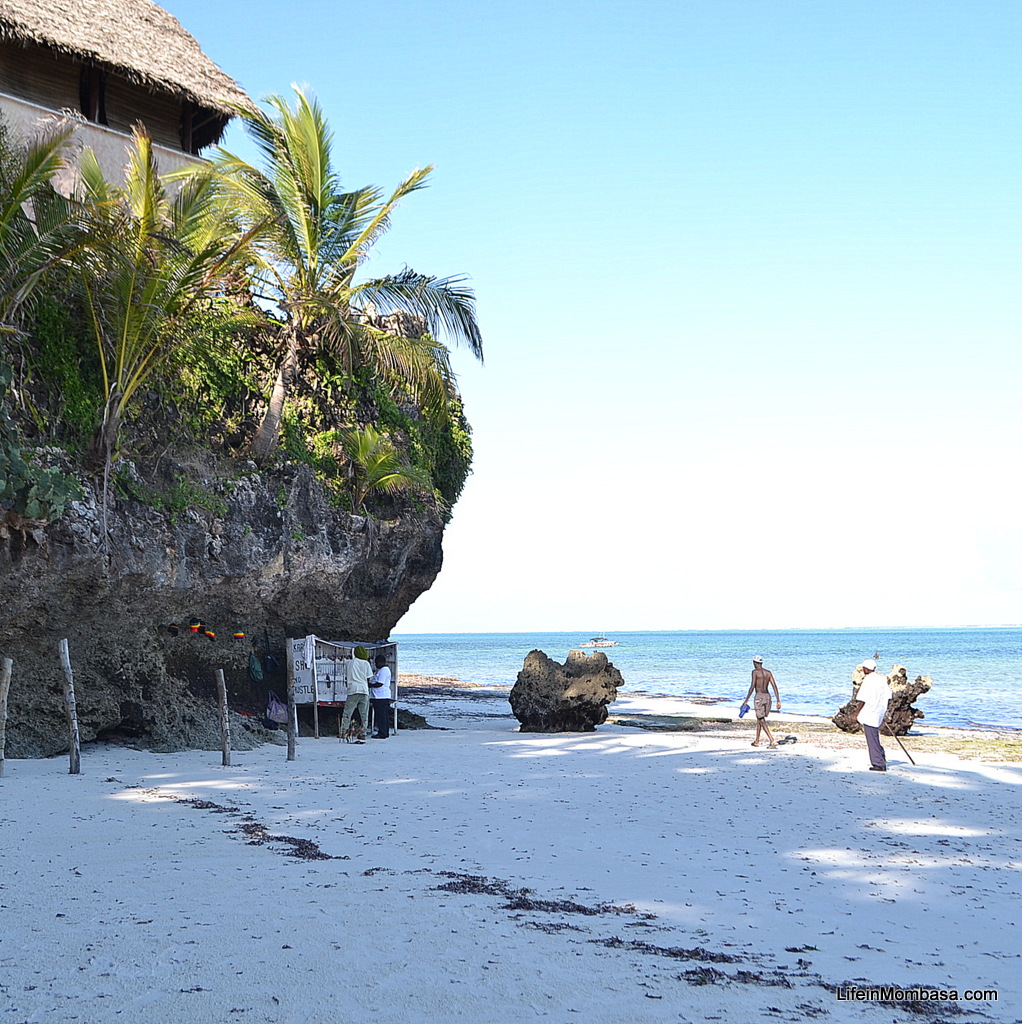
Empty Beach Mombasa
Empty Beach Mombasa

Tourism Slump has had a devastating effect on low income earners leaving many mouths dry and pockets empty, hearts broken, and people worried. Mr. Matira sells sea shells on the cliffs just behind Fort Jesus. He has had only two customers in a week, who bought two shells each costing sh80 (about US$1). He has three children and his wife sells shell necklaces outside the fort.

“This is bad for me and my family. Usually, at least three people came daily but now, no one is even stopping by,” he explains dejectedly.

Mr. Matira is not alone in this. Many of the small business people have been hit hard by this decline in tourism activities. They include tour guides, snack vendors, dancers, artists and food outlets.

In a desperate measure to keep his stomach full, Salim turned into an ‘easy job’.

“I used to be a tour guide. I would show tourists the good places around and the good food courts.”

Unfortunately, this slump in tourism has left him high and dry. He turned to pick pocketing and learned that it was an easy job, until an angry mob busted him and clobbered him, nearly killing him. He spots hideous marks from the ordeal.

Young women who made bead necklaces, shell earrings and other house decorations have also quit. Tired of sitting out in the sun for weeks with nothing to show for it, they have decided to look for greener pastures. Shariffa, a pretty girl aged 21 tells her tale of how a man approached her and showed her a ‘better living’ all she had to do was “work” at night in a club. On a good night, she makes sh2000.

The small cafes that made sweet food and entertained visiting tourists have long shut down. The hawkers who walked around with African art all over them have been reduced to vending water and handkerchiefs. Painting shops and antique stores are also running at a loss.

The beaches are empty and the people who rent out floaters and skis are sleeping hungry. A man with a glass bottom boat sits sorrowfully in his boat by the shore, occasionally glancing up hopefully, only to be disappointed.

Duba, a camel owner who works along the Bamburi and Shanzu beaches tells of nights when he sleeps hungry as he can go for days before selling a camel ride. Even when he gets a customer, the prices are bad.

When these low income earners suffer, the whole county suffers. Since they form a large part of the consumer party, they are unable to buy basic commodities which in turn leads to a slump in exchange of goods and services hence little money flow hence slow economic growth.

Additionally, the low income earners are most likely to turn to vices due to their low skill base and fewer employment options. Already, the crime rate in parts of Mombasa has shot up in areas that were previously deemed safe such as old town. Also, desperate youth will easily fall to manipulations of extremists and further exacerbate the radicalisation problem. Of the 30, 000 jobs lost due to the tourism slump, a majority are in the semi skilled cadres. This will push more into poverty and endanger the lively hoods of entire families.

Already, the Kenya Tourism Board (KTB) has set aside sh140 million for a global advertising campaign that will see Kenya advertised to markets in Europe, America, Asia and Africa.

To revive numbers in the coast market, Kenya Tourism Board intends to boost charter flights to Moi International Airport.

“We shall partner with tour operators, charters and airlines for special offers with a view to creating interest for visitors to travel to Kenya,” said Muriith Ndegwa, KTB Managing Director.

In the meantime, more people slide into desperation and what is left is a little hope that these efforts will bear fruit as soon as possible.

Photo Credit 

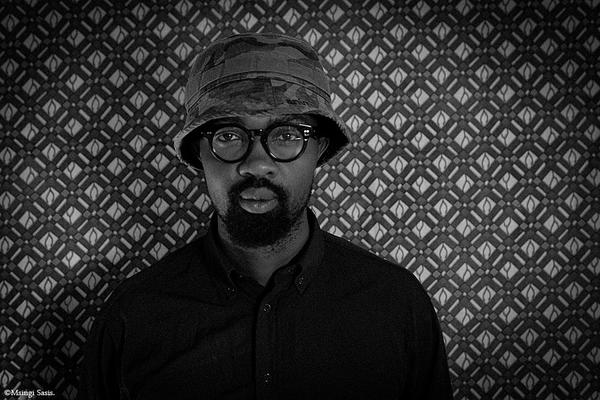
Kenyan photography blogger Msingi Sasis arrested as a terror suspect

Kenyan Photographer and Msingi Sasis currently in Police Custody as  terror suspect
Kenyan Photographer and Msingi Sasis currently in Police Custody as terror suspect

Kenyan blogger and photographer Msingi Sasis Bekko was yesterday arrested at the Galleria Mall in Karen for taking pictures and taken to Langata Police station where he was booked in as a terror Suspect.

Msingi Sasis runs www.nairobinoir.com, a photography blog on Nairobi at night capturing the many different activities that take on in most parts of Nairobi after dark.

According to his brother Victor Bekko who wrote to Boniface Mwangi, an activist and an award winning photographer, Msingi  looked traumatised when Victor was finally allowed to see him in custody. Msingi slipped a note to his brother and gave clear instructions that he (Victor) should get in touch with Boniface.

Boniface Mwangi has now taken  to Social media sharing information regarding his arrest and informing Kenyans that Msingi did not appear in court today as should be procedure according to Kenyan Laws on arrest of individuals.

During a recent African Photo Magazine launch organised by House of Fotography and hosted by the Kenyan Bloggers Association,  one photographer shared his concerns regarding the arbitrary arrest of Kenyan photographers taking photos within Nairobi’s Central Business District. In a question to the Kenya Cabinet Secretary for Planning and Devolution Anne Waiguru, the photographer sought intervention and a solution to the constant harassment of Photographers who engage in street photography by the police.

The CS urged Kenyan Photographers through their association to accredit their members for easy identification.

Barely a week after that discussion with the CS, Msingi Sasis now finds himself behind bars labeled as  a terror suspect despite his marketing of Nairobi life and his continued efforts of giving a different story, through his photography of Nairobi and Kenya to the world through his Camera and his blog.

It is not yet clear if Msingi is still being held at the Langata Police Station or he has been transferred to another location or what is happening to him as he is being held in custody.

We will continue to provide updates on this situation as it develops.

Kenyan Presidents don’t inherit chairs

IMG_8393
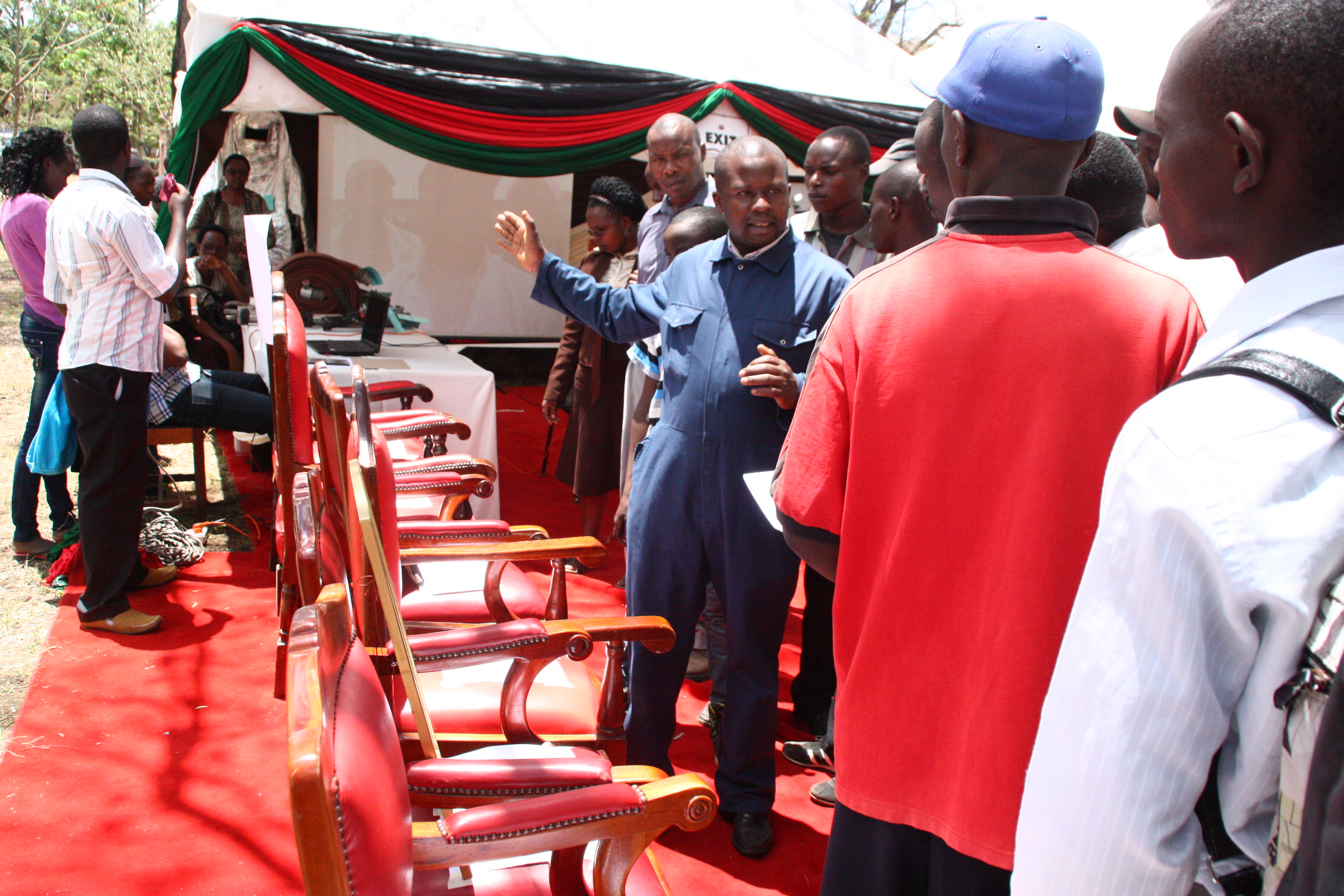
A staff of the Public Works department in Nakuru narrates the history of the chairs to the public at a recent public event (Photo: Kioko).

Did you know that Kenyan Presidents don’t inherit the chairs of their predecessors? In a resent exercise by the County Government of Nakuru the department of Public Works shared this uncommon fact while exhibiting the chairs that have been used by Kenya’s Presidents since independence.

According to Maina Muchemi, the Director of Public works in Nakuru, the chairs keep on being changed with the entry of a new President due to their different body postures and the specifications that each President gives. The second reason is they have to be new.

Because of this the chair that Kenya’s founding father Jomo Kenyatta sat on is different from the one that was used his successor Daniel Moi. Different too is the chair that the third President Mwai Kibaki sat on as well as that is being currently used by Uhuru Kenyatta. So to date there are four chairs.

Muchemi explained that every region usually has its own chair which is usually flown to a venue whenever the President is expected to attend. All chairs have the government seal and because of this he said it was forbidden to sit on them or to take photos of them. So again going with the former provinces in which Kenya was divided into, we have eight chairs at a given time, which are literally the seats of power.

The chairs which are part of Kenya’s history, are usually made by the Prisons Department in the country. In fact looking at them one sees a close resemblance with the chairs that Parliamentarians use in the August House which are also made by the Prisons Department.
Kenya’s first two Presidents were known to have a unique identity about them. Jomo Kenyatta had a fly whisk while Daniel Moi always waged a small baton.

However Mwai Kibaki did not use any unique regalia during his Presidency, and so is Uhuru Kenyatta.

Kenyans urged to rethink elections management before 2017 polls

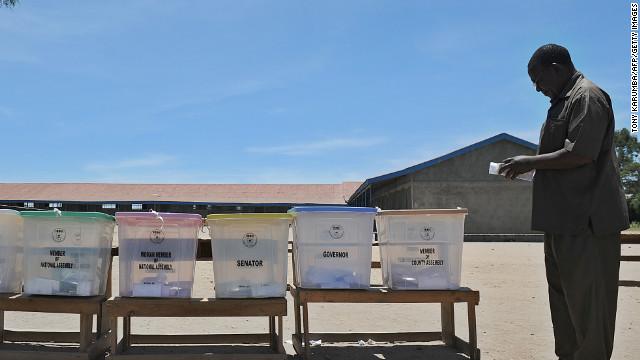
A man votes during the March 4th 2013 general elections. (Photo: Tony Karumba/AFP)

A group of local NGOs that were involved in the 2013 Supreme Court presidential election case have urged Kenyans to use the lessons from that the last polls to improve how the country conducts and monitors elections in future. The NGOs made the suggestions at a debate held today at Hilton Hotel headlined “Rethinking Election Management in Kenya.” The debate organized by Kenyans for Peace with Truth and Justice (KPTJ) and AFRICOG was held on the second anniversary of the Supreme Court of Kenya’s ruling on the 2013 presidential election.

The debate attracted participates from across the political divide among them James Orengo of the Coalition for Reforms and Democracy (CORD), Moses Kuria of the ruling Jubilee coalition and Martha Karua who ran for president in the 2013 polls on a NARC-Kenya ticket.

Speaking at today’s event Willis Otieno and Gladwell Otieno highlighted the lessons that Kenyans can learn from the 2013 polls among them treating elections as a “process” instead of a one-off event:

Besides faulting the Independent Electoral and Boundaries Commission (IEBC) for its many errors in the elections, the two also picked issues with the Supreme Court’s ruling in 2013 presidential petition arguing that the court made several fundamental mistakes.


Looking ahead to the 2017 elections, Willis Otiteno made several suggestions on how Kenya can improve how the IEBC functions and the ways in which it can be more accountable to the Kenyan people.


Martha Karua for her part said that it’s necessary for Kenya to learn from the mistakes of the past to have better elections. The NARC-Kenya leaders also said that the most important sticking point for the next elections is who will announce the results:

Moses Kuria, predictably, played the role of “non-believer” in the debate. The Gatundu South MP was present to make the case that the Jubilee coalition’s win in the 2013 presidential poll was squeaky clean. According to Kuria Jubilee won the election as early as December 2012.

The ‘Joseph factor’ in Kenya’s security docket

Nkaiserry Snip
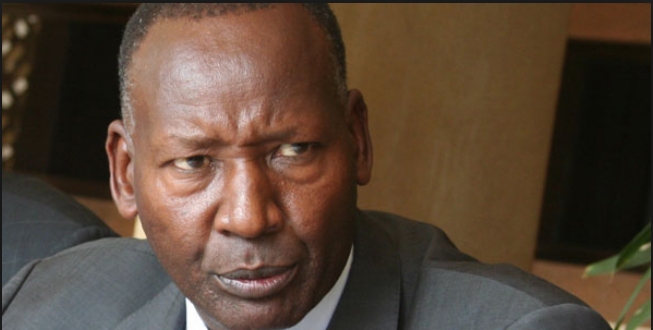
Cabinet Secretary for Interior and Coordination of Government, Joseph Nkaissery. He shares a name with Inspector General of Police, Joseph Boinet.

What is in a name, asked William Shakespeare once. A rose in another name may smell as sweet he posed. But what is in a name when all key people picked for a particular job share a name? Could there be something more to that name?

That is what we might need to ask about Kenya’s security docket which only seems to attract people named ‘Joseph’.

The current Cabinet Secretary is called Joseph Nkaissery. The former Member of Parliament for Kajiado Central took over from another ‘Joseph’ – Joseph ole Lenku – a hotelier.

The current Inspector General of Police is also a Joseph – Joseph Boinett – a career police man. And as if that is not enough with the Joseph’s involved in security issues we have another one, Lt-Gen Joseph Kasaon the army man, was just recently been appointed to be Vice Chief of Defence Forces.

There is a possibility that Kasaon will be Kenya’s next Chief of Defence Forces once Gen. Samson Mwathethe retires. If that happens, Kasaon will be the second ‘Joseph’ to lead the Defence Forces after Joseph Kibwana who led during the regimes of Daniel Moi and Mwai Kibaki.

But who is Joseph in the Bible?

In the old testament, the book of Genesis tells of Joseph the interpreter of dreams who was sold to slavery by his brothers out of the envy they had of him. This Joseph was one of the sons of Israel and was beloved of his father and God. He became famous after interpreting the dream of Pharaoh of the seven years of rich harvest and seven years of drought.

And there is Joseph the son of David and the father of Jesus Christ. He was a Carpenter and he played the role of the foster father of Jesus. Not much is said about him as the scriptures do of Mary the mother of Jesus. Then we have Joseph of Arimathea, the man who asked to bury the body of Jesus Christ.

Well those are the Josephs who are handling our security and their predecessors and the role they played.
Meanwhile note that there was also a Francis factor in the office of the Secretary to Cabinet since after Francis Muthaura retired the office was assumed by one Francis Kimemia who has since been relieved of his duties by President Uhuru Kenyatta.

Governor Joho denies being corrupt

Mwembe Tayari Market (www.youtube.com)

Mombasa Governor, Ali Hassan Joho honored the summons by Ethics and Anti Corruption Commission (EACC) hearing today. He was expected to answer to allegations regarding the transfer of the Mwembe Tayari market to individuals name as Zubedi and Bawazir, which the commission alleges was illegally done.

Mwembe Tayari market fell into disrepair and became a solid waste dumping ground and a home for street urchins, drug addicts and criminals. Questions were asked about the then municipal council and the inability to repair it and turn it around. The last intervention was when the county government forcefully removed the urchins and addicts living in the building. After that, it was fenced off and pulled down.

Joho said,

“We demolished this market because it was being used as a drug den and since then nobody has stepped on it. How then did I facilitate these people to take it over.”

Land grabbing in Mombasa Island has reached alarming levels. Rift Valley Railways land has been a targeted by private developers. Last year, it was revealed that land belonging to the statehouse was grabbed and is now the site of an upcoming hotel.

His appearance at the EACC comes hot on the heels of Nairobi governors Evans Kidero. Kidero appeared at the EACC to answer allegations of corruption flanked by hundreds of his supporters. Will Joho follow Kidero’s example? Joho is the second of the seven Governors who will be quizzed by the EACC in the coming weeks about corruption.

In his defence, the governor has completely dissociated himself from the transfer of the market which he alleges happened before he was governor of Mombasa and whose transfer was sanctioned by the then minister of local government William Ole Ntimama. He also alleges malice in the accusations which he termed as unfounded.

“There is nothing like resigning. They have been trying all means to bring me down, but they have failed again. They said I am a drug baron, land grabber and that I possess fake degree certificate.”

In addition, the Mombasa Governor took great exception at being named by the EACC and has been on record threatening to sue the commission for defamation.

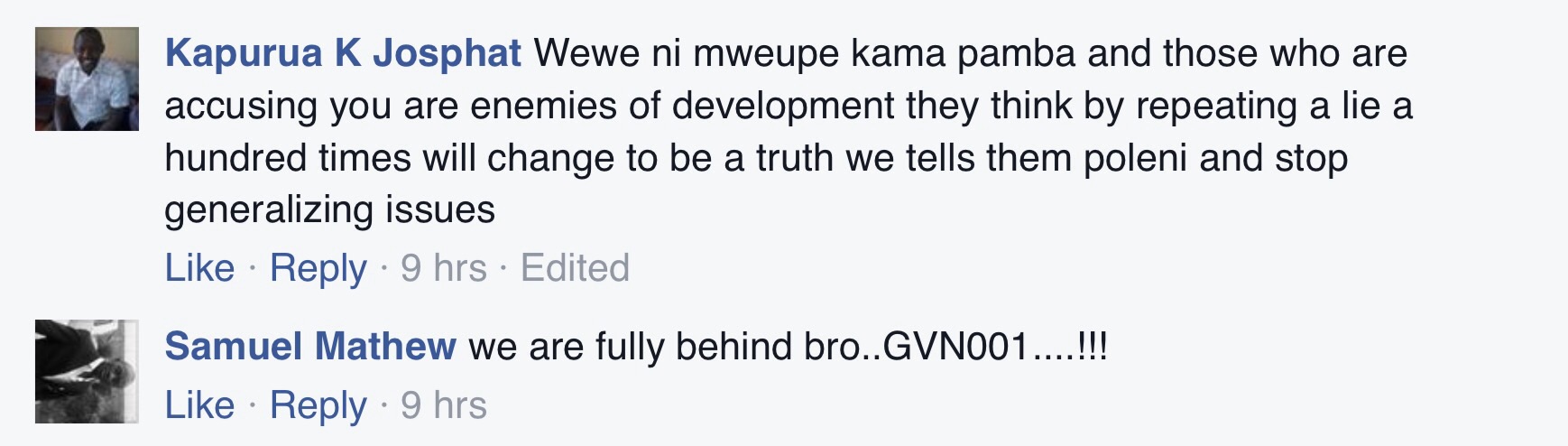
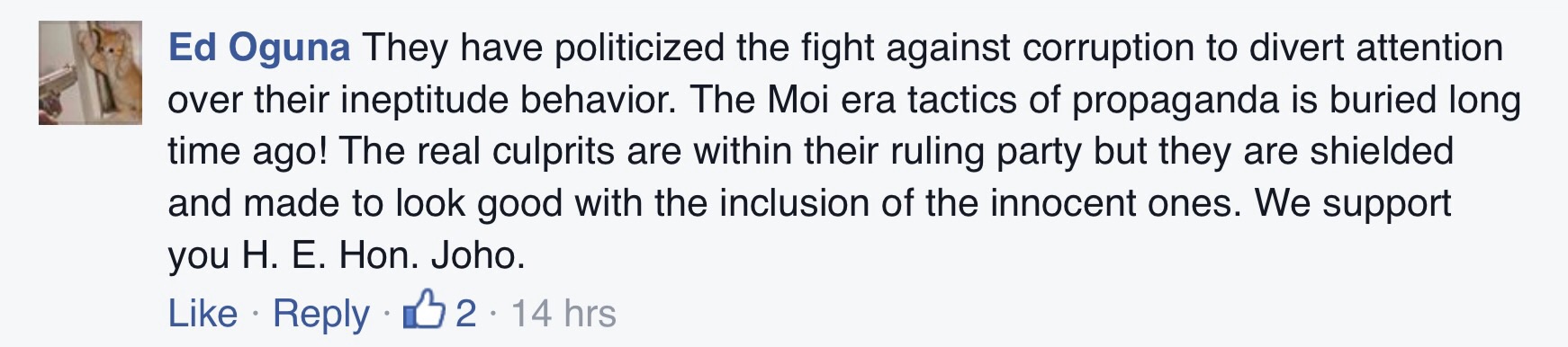
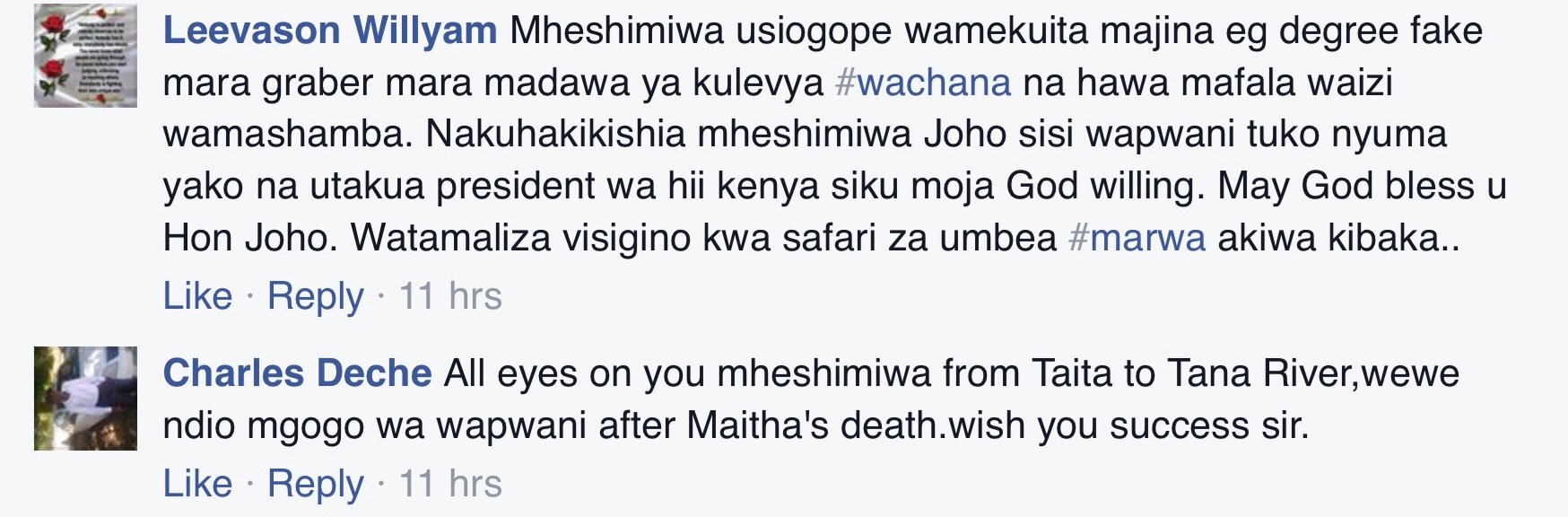
However, Joho’s supporters have expressed their support for the governor and have posted messages on his facebook page encouraging him to soldier on and expressed their confidence in his performance.

Hassan Joho Facebook post
Citizens express support for Governor Joho
Governor Ali Hassan JOHO facebook post
Mombasa citizens express support for the governor
Hassan Joho facebook post
Mombasa citizens express support for the governor.

Nakuru aspiring police recruits vow to fight Al-Shabaab

Alshabab
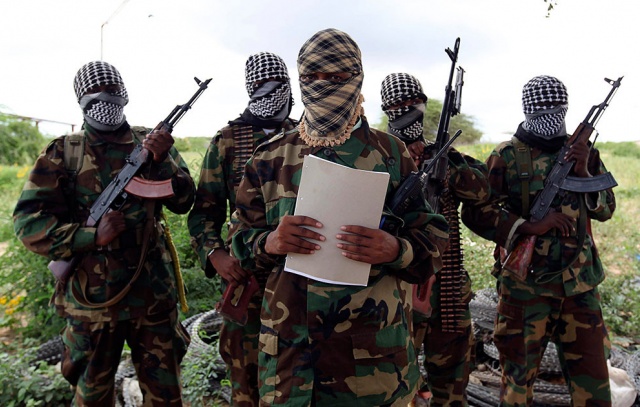
Al Shabab Millitia Men. Two youth from Nakuru hoping to join the police service said they were ready to fight the terror group should they be picked. (http://www.garoweonline.com/)

Two Nakuru youths who turned at the Afraha stadium for the police recruitment that took place on Monday have told the Kenya Monitor that they are not afraid of being involved risky situations should they picked in the service.

Paul Maranga and James Waweru who had also turned up for the earlier recruitment that was later called off on allegations of corruption said they were not even afraid of the Al-Shabaab terror group.

“Al-Shabaab are also men like us,”

an expectant Paul Maranga said moments after taking part in the recruitment exercise for the Nakuru Town East Constituency.

“I am aware of the insecurity and terror scare in our country at the moment and I am ready to serve,” he added.

Monday’s recruitment exercise will see at least 10,000 police recruits join the force amid rising terror attacks that are committed against civilians by the Al-Qaeda linked group.

On April 2 the group attacked Garissa University college killing at least 147 people most of whom were students. President Uhuru Kenyatta then directed that the recruits that were picked in last year’s exercise report for training. However his direction was criticized and he later changed his decision.

Maranga and Waweru said they wanted to join the force as a show of patriotism.

“I love my country. I would love to protect it,” said Waweru.

The recruitment exercise at the Afraha Stadium was led by Jackson Mulupi, an Assistant Superintendent of police. There were other centers in the 11 constituencies (also Sub Counties) in the larger Nakuru county.

At the Afraha Stadium a total of 110 recruits turned up out of which 88 were male and 22 were female. Of these 14 will be picked to join the general police and 12 will join the administration police. Of the 26 that will be picked only 5 will be female, 4 as general police and 1 as administration police.

Moses Kuria gets a dressing-down from George Kegoro

Moses Kuria speaks at a past press conference. The MP has received criticism for making ethnically divisive comments (Photo/www.mediamaxnetwork.co.ke)

Gatundu MP Moses Kuria today got a public dressing-down from vocal Kenyan human rights lawyer George Kegoro over his “sycophantic” defense of the Jubilee administration. Kegoro gave Kuria a severe reprimand during a debate held at the Hilton Hotel earlier on Tuesday to take stock of the Supreme Court of Kenya’s ruling on the March 4th presidential election petition.

Kegoro and Kuria are both columnists for local newspapers and have often thrown veiled barbs in each other’s direction but this was the first time that they were sparring in such a public forum. When Kuria took to take the stage and, channeling the familiar “accept and move on” rhetorical stance, said it was time to stop whining and move forward as a country.

Then Kegoro responded.

By all accounts it appears to have been quite the tongue lashing.

Martha Karua, a panelist on the day and a presidential candidate in the 2013 polls, also piled in on Moses Kuria although her critique wasn’t nearly as caustic as Kegoro’s.

Given his penchant for making ethically charged and divisive comments, some Kenyans were against Moses Kuria’s attendance at the event.

The consensus is hard to ignore. Moses Kuria is in to danger of wining a popularity contest in Kenya any time soon. That said, it’s important to hear out people like Kuria so that their opinions can be subjected to public scrutiny and debate.

Egerton V.C announces his departure

Egerton Uni Snip
The main entrance of Egerton University. Vice Chancellor Prof. James Tuitoek will be leaving office in January next year.

The Vice Chancellor of Egerton University has announced his departure from the helm of the Njoro based institution. Prof. James Tuitoek told staff and students on Sunday that he will resume his duties as a lecturer in the department of animal sciences once his second term as the Chief Executive of the university ends in January next year.

“The vacancy will be announced in August this year,” he told staff students attending a thanks giving service to bid farewell to finalist students.

“All my three deputies qualify for the position and I will encourage them to apply for the position once it is announced.”

Prof. Tuitoek took over from Prof. Ezra Maritim in January 2006. Before that he worked as a Deputy Vice Chancellor in charge of Administration and Finance.

He said he was proud of the achievements he had achieved since he assumed office. These he pointed out as managing to cut down the long time it took students to finish their programmes as well as finishing stalled projects at the university some which dated to the start of the 1990’s.

“We are not yet there but we will get there,” he said.

He announced that the university was working towards ensuring that students could register online from September this year.

In response to the security threat facing universities in the country at the moment he said, the university would set up a perimeter wall that would be done by July this year.

“We will have only three official gates at which everyone will be scanned. We are committed to improve standards and I request you to give the administration cooperation. To improve your security report any suspected strangers,” he requested.

Reverend Eddie Kakande a lecturer at Daystar University who gave the homily told congregants to improve on their relations with all the people they interact with.

While the post of the Vice Chancellor at any public university is usually assumed after a competitive process, other considerations such as regional balance are known to influence the selection.

Being at the Rift Valley region, Egerton University for instance, is known to have Vice Chancellors from the Kalenjin community.

Prof. Ezra Maritim who handed over to Prof. Tuitoek took over Prof. Japheth Kiptoon. All three are from the Kalenjin community, and this means, the University which is usually feted as the oldest institution of higher learning in Kenya, has been led by people from one community in at least three successive terms.

Thus in the upcoming search for a new Chief Executive of the University, one might expect to see a change on this, perhaps for a change or perhaps for a new interpretation of what regional balance on taking up lucrative parastatal jobs means.

Leaders in Mombasa vow to stem youth radicalisation

0


Alshabab
Al Shabab Millitia Men (http://www.garoweonline.com/)

Said Swaleh Said Awadh, a young man from Mombasa, shocked his family when he was arrested trying to cross into Somalia and become an Alshabab fighter. He was in the company of others among them a Malindi born female University student. His family was to learn that he was suspected of many terror activities among them the killings of moderate clerics in Mombasa. The case of the young lawyer that led the Garissa attack is also still fresh in the minds of many.

A recent press conference by Muslim leaders in the country had them admitting that there were indeed religious leaders who were in the business of inculcating extremist ideologies in their congregations. This, they said, took place in mosques, madrasas and other religious establishments.

But radicalization is not limited to the places of worship or religious establishments. If there is anything we have learnt from the Garissa massacre is that the long standing image of a poor, desperate and under-educated youth as the prime risk for radicalization, is fading. Now, even the most educated can just as easily be brainwashed as the next young man on the street.

“It is funny. In the past, we thought only desperate and unemployed youth signed up to join Al-Shabaab. Recent activities have however shown us differently. Now,  even educated young men with promising futures can join.” says Idris Dekow, a former student leader in Mombasa.

“It is worrying that people I have studied with for years in the university have as much chance of joining as the jobless youth out there in the streets.” he adds.

Mombasa Governor Ali Joho hinted that Coastal leaders are looking at ways to minimize radicalization through extremist religious teachings. His Lamu counterpart, while agreeing that radicalization is a problem affecting the whole coastal region, added that it was upon the counties to come up with ways of motivating the problem. Mvita MP Nassir said rehabilitation is in order.

“We will do everything within our means to ensure an end to this menace. Those youths who need rehabilitation we will rehabilitate them for free.”

He was speaking during the rewarding of Lamu County’s Traffic Inspectorate officers at the Mombasa County Stadium in Tononoka.

As it stands, the government has granted amnesty to Alshabab members that surrender. The county commissioner has already hinted there will be surrenders soon.

“We are expecting a big number of youth to surrender; currently we have a figure of about 49 whom we expect to surrender within this week,” he said.

It isn’t clear yet how the amnesty will work as Sheikh Mohamed Osman, a cleric from Eastleigh was quoted saying

“Instead of going to the government – which I believe they will not do – we want them to come to us and we start rehabilitating them, cleansing them, giving them the right religion.”

However, some of the youth are not amused with the government’s offer. They harbour deep grievances from past events. One youth said,

“whenever there is a crime in Mombasa or a terror attack, they park police lorries in Kibokoni and Bondeni then arrest all the young in sight indiscriminately. After that we have to look for money in order to get out.”

“How would you feel to see your old widowed mother struggle to raise money to get you out? Will you then leave the cell and embrace the police?” , he asks.

As the government works with Muslim clerics to counter the radicalization surge, Mombasa residents are hoping for better. Ally, a small business owner blames radicalization for the woes in the Majengo area.

“I have lived here for more than 25 years and this was one of the most peaceful areas in Mombasa. Now, we hear of people being knifed as they walk in the street by youth.”

Image Credits 

Commission of Inquiry on Dissolution of Makueni County to Start its Work on April 23

Commission of Inquity on dissolution of Makueni County pose a photo with Chiev Juctice WllY Mutunga after being sworn in Photo:Twitter
Members of the Commission of Inquiry on dissolution of Makueni County pose a photo with Chief Justice Willy Mutunga after being sworn in
Photo:Twitter

The Commission of Inquiry appointed by President Uhuru Kenyatta to look into the possible dissolution of Makueni County will commence its work on April 23.

The Mohammed Nyaoga- led commission which has already set up its offices at the Kenyatta International Conference Center (KICC) and will begin receiving views from the public next week on Thursday at the Aberdares hall in KICC. It will also schedule hearings in Makueni County in order to encourage public participation as required by the law.

In a press statement released by State House this week, the commission will inquire into circumstances leading to the allegations that the County Government of Makueni has irretrievably broken with two governments operating parallel to each other.

The commission will also look into allegations that the county government is completely dysfunctional and cannot discharge its constitutional mandate after which it shall recommend legal or administrative measures that may deem necessary.

The commission has six months to perform its work and present the report findings to president Uhuru who will forward it to the senate for adoption or rejection.

More than 50,000 residents from the county last year presented a petition to the president to dissolve the county government owing to persistent wrangling between the Governor Professor Kivutha Kibwana and the Members of the County Assembly (MCAs) that almost brought the operations of the county government to its knees.

A shoot out at the county assembly premises that left six people injured including the County Chief of Staff Douglas Mbilu and the governor’s bodyguard William Kinoti further heightened the wrangling prompting the governor to call for the suspension of the county citing irreconcilable differences between him and the MCAs.

The commencement of the commission’s work marks a very crucial stage in the dissolution process and residents on social media have expressed varied opinions.

Proponents of dissolution including the governor argued that the leadership crisis in the county had gone beyond reconciliation and the only way to end the impasse is to grant the petition filed by the 50,000 residents.

d8

d7

d6

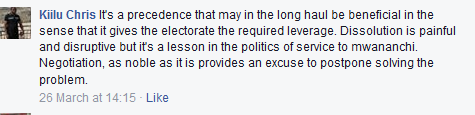
Others urged the commission to expedite the process, noting that even if dissolution is disruptive and painful,the die is already cas .

d1

d3

d9

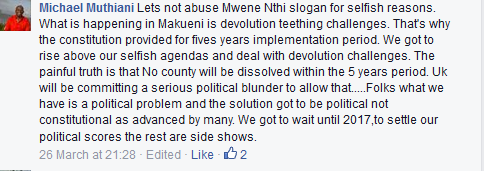
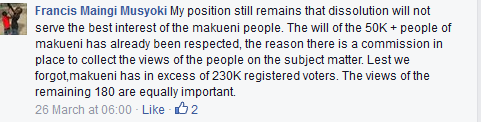
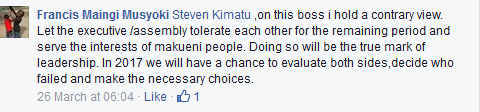
However,those opposed to the process said that dissolution will not serve the interests of the common man.They accused those clamoring for dissolution of using the process to pursue selfish interests and urged the warring factions of the county government to reconcile.

d10

d2

d12

d13

Whether Makueni will be dissolved will depend on the findings by the commission and the Senate’s approval of the same. If County is dissolved, it will be the first in the devolved units dispensation under Article 192 of the Constitution.

War Memorial Hospital contravened Baby Jeremy’s rights – Nakuru Lawyer

Jeremy snip
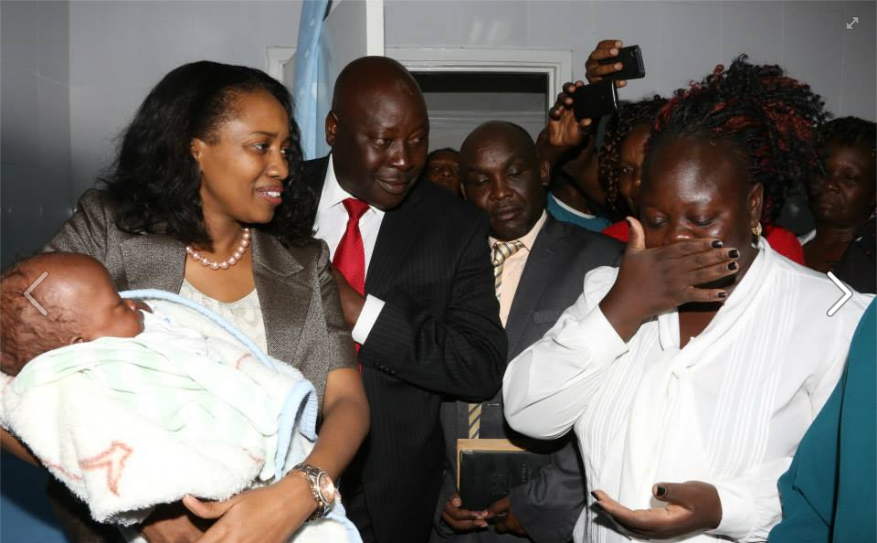
Nakuru Speaker Susan Kihika holds the child after the Nakuru County government cleared the hill for his discharge on Tuesday. A lawyer has argued that it was illegal for the hospital to detain the child. Photo: County Government of Nakuru/Facebook.

The War Memorial Hospital that detained a child because his mother could not pay his medical bill went against his rights, a Lawyer has argued. The private hospital in Nakuru County detained a child named Jeremy for more than three months as his mother could not clear a bill for medical services the child received in its intensive care unit (ICU).

It was not until the County Government of Nakuru came to the rescue of the child and paid the bill that the baby was discharged. By then the bill had risen to close to sh600, 000.

It is reported that the hospital had initially declined the baby mother’s offer of presenting a title deed as security for the bill. But even though the child has finally been discharged, a Nakuru Lawyer argues that the hospital should be charged for “illegal detention” of the child.

Posting on a Whatsupp page dubbed ‘Nakuru Analysts’ Njenga Mwangi has said that the hospital contravened the baby’s fundamental rights as enshrined in the constitution.

“The owners of the hospital were in clear breach of the constitution and Baby Jeremy can institute proceedings against the hospital for wrongful detention.”

However for this to happen the mother has to initiate the legal process as the baby’s “next friend” he says.

“Under the hypocritical oath medical and health care givers swear that their primary duty is to save lives.”

According to the lawyer who told Kenya Monitor that he is a member of medico-legal committee of the Law Society of Kenya (LSK) the hospital is not allowed to detain the child as it is neither a “prison or a remand facility.”

“You can have a person detained in prison for a period not exceeding six months for a civil debt but only the court can commit the debtor and only if the creditor can proof that the debtor has the capacity to pay and is deliberately refusing to pay or he is about to flee from the jurisdiction of the court.”

A human rights defender in the county has however observed that while the child had the right to be released from the hospital pending the payment of his medical bill, the hospital too had the right to demand for its payment. David Kuri is who is commonly known as Western in Nakuru says that such cases can only be solved through negotiation.

“I have intervened in such cases at several hospitals in Nakuru and we have had to negotiate since the hospital’s administrators need to have good ground to release the patient.”

He said dishonesty is to partly to blame for the hard stand that medical facilities make against patients.

“The hospital should however have done investigations to ascertain whether the child’s mother was unable to pay the bill.”

“As long as the child was not discriminated during the time he was detained at the hospital, what we need to do is to that the well wishers for clearing his bill,” said the award winning human rights defender.

Meanwhile lawyer Njenga Mwangi has said he is ready to offer pro bono services should the child’s mother institute a legal process against the hospital.

Broke Makueni County Assembly Closes Down

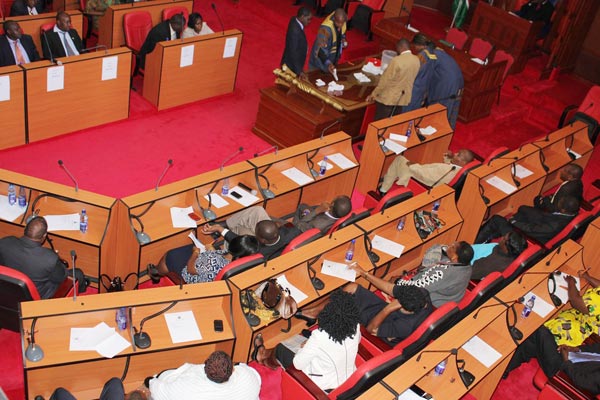
Makueni County Assembly in session Photo:Assembly Communications Unit
Makueni County Assembly in session
Photo:Assembly Communications Unit

Makueni County Assembly on Wednesday 15 April, closed down its operations indefinitely due to a financial crisis.
The assembly procedures were brought to halt after the assembly spent all the funds for its 2014/2015 operations, one quarter before the closure of business for the financial year.

The assembly Budget Committee Chairperson Francis Mutuku told journalists in Wote, town that the assembly has a cash deficit of Sh155M occasioned by budget ceilings set by the Commission of Revenue Allocation (CRA) last year and could therefore, not continue running, prompting the closure.

“Our original budget of Sh674M was rejected after we lost a case on ceilings in which the County Assemblies Forum (CAF) had gone to court to seek an interpretation,” said Mutuku who also doubles as the Majority Leader.

The majority leader said that the county assembly would remain closed until such a time when the Sh155M will be available to enable the house to resume and carry on its operations until the end of the 2014/2015 financial year in June 30th .

Mutuku said following the cash crisis, the assembly has already started receiving a backlash from contractors and suppliers who owe the county assembly money for works already done in the financial year.

“They have threatened to go to court because of the money they owe the county assembly,” he added.

Nzambani/ Ivingoni Member of the County Assembly (MCA) Cosmas Nzilili regretted the closure but said it was unavoidable adding that MCAs cannot conduct house business without sitting allowances.

“We cannot perform our oversight role if we lack essential services like supplies of stationery and water among others,” said Nzilili.

Nguumo MCA John Mwenze took to his Facebook page to lament the closure of the house and underscored the need for the assembly to scale down on certain vote heads to provide funds to the assembly.

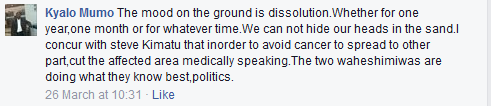
The move to close the county assembly has prompted a slew of reactions on Facebook, from residents of Makueni.
Some have read mischief in the move and now accuse the Speaker, Stephen Ngelu whose name made it to the infamous list of shame of 175 corrupt officers, for closing the assembly for selfish reasons.

Majority chided the MCAs for taking the residents for granted and constantly engaging in money making battles at the expense of development.

c3

c6

But there are some who supported the the move

While there are also those who struck a re-conciliatory note and urged the two arms of executive to serve the common man regardless of the crisis.

Makueni MCAs were embroiled in a budget standoff with the Governor Kivutha Kibwana and the closure of the county assembly adds a new twist to the stalemate that saw the county pass its budget early this year, several months after last year’s June 3oth deadline. The assembly is however not alone, other 27 county assemblies are facing a similar cash crunch after they declined to heed to the ceilings by the CRA.

It will be interesting to see how the Makueni county assembly will wade through the murky waters of the financial crisis owing to the fact that the MCAs and the governor who would be expected to come to their rescue in this matter, do not see eye to eye.

Jukumu Letu heads to Nakuru

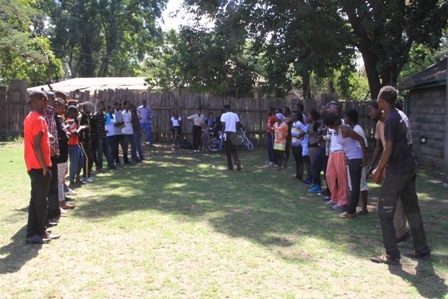
Artists who turned up for the auditions at the arts threatre in Nakuru town

Nakuru artists will this coming week converge to discuss their issues and ways in which they will highlight and inform their residents about the Constitution. Jukumu Letu, an initiative that seeks to inform Kenyans about the Constitution through art, will be in Nakuru, after holding successful events in Mathare, Nairobi County and Wote, Makueni County.

Some of the types of artists involved in the initiative include musicians, dancers, bloggers, puppeteers and Disk Jockeys (DJs). These creatives who, Jukumu Letu partners have identified are energetic and have abundance talent.

“Their potential is in the creative and economic areas but they are bogged down by stereotypes entrenched by politicians coupled with other cultural fears,” asserted Mathew Ondiege, a director and artist with Dance into Space.

The stereotypical challenges in Nakuru are at the heart of Jukumu Letu. The artists will be enlightened not just about the Constitution and their rights but also how to explore them into meaningful messages for society.

Nakuru County also has abundance of issues which through the right ways, can be better narrated to people. Areas like Molo have had perennial conflicts in successive elections since 1992 up to 2007. Naivasha is also politically volatile and on the new for bizzare news from time to time.

Beyond these governance issues, the county being agricultural has on the one hand flourishing large scale flower industries while on the other hand, small scale farmers of maize, vegetables and potatoes have challenges of poor road network which inhibit their ability to get products to markets, diseases which affect crop yields and inability to buy fertilizers that will increase crop yields.

From Monday 20th of April to Friday 24th, 2015, these issues will be organically explored by the trainers and trainees in various art spaces in Nakuru town including at the Nakuru players theatre. On the 24th, bloggers will also be trained on how to tell these stories through the various social media platforms for the consumption and input from interested parties around the world.

These trainings will culminate in a launch of the Jukumu Letu initiative at the Nyayo Gardens, Nakuru town on the 25th of April, 2015.