In about 4 months, Kenya will have a new tech hub in Swahili Box. A place to bootstrap start-ups, work, share knowledge and create. Here technology, networking, business and art will thrive.
Swahili Box looks out to the Indian Ocean in the vicinity of Fort Jesus and Seacom’s landing point. An old building at the Swahili Cultural Centre will come to life as a result of the revolution brought about by Seacom undersea fiber cable.
Swahili Box is an M-Power project. A Community Based Organisation (CBO) with the aim of;
Providing co-working Space with acceleration support
Quickly spawning startups
Providing training and mentorships
Becoming a research center
Acting as a creative hub for artists
This hub hopes to prove that technology can indeed thrive away from the center (Nairobi). Swahili Box will maintain the Swahili themed architecture, incorporate an outdoor working area and a rooftop. The hub will allocate 20 percent of the space to its community, 60 percent will be co-working space with the rest of the space remaining for Swahili Box’s use. Swahili Box could become the most exemplary tech hub in Africa, in terms of location and innovation.
From this tech-hub, entrepreneurs and innovators will have access to an affordable and accessible work space among like minds. According to Swahili Box’s Executive Director Ahmed Maawy, Swahili Box will put Mombasa on the technology map and change perceptions of the coastal city as a tech hotspot. It will become a place where start-ups have access to networks, tap into locally available talent in Mombasa and compete locally and globally. In addition, this space will provide access to training, support, professional mentoring and coaching.
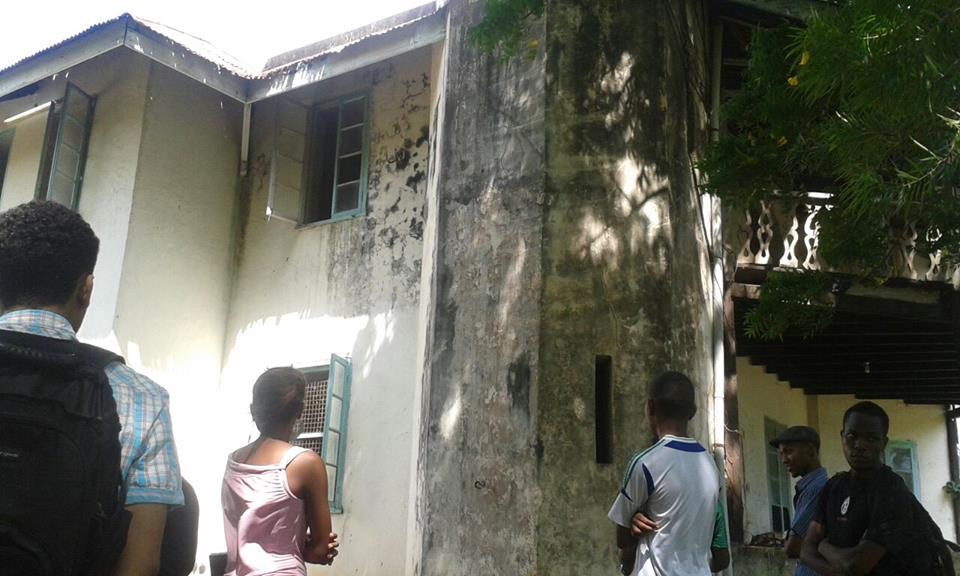
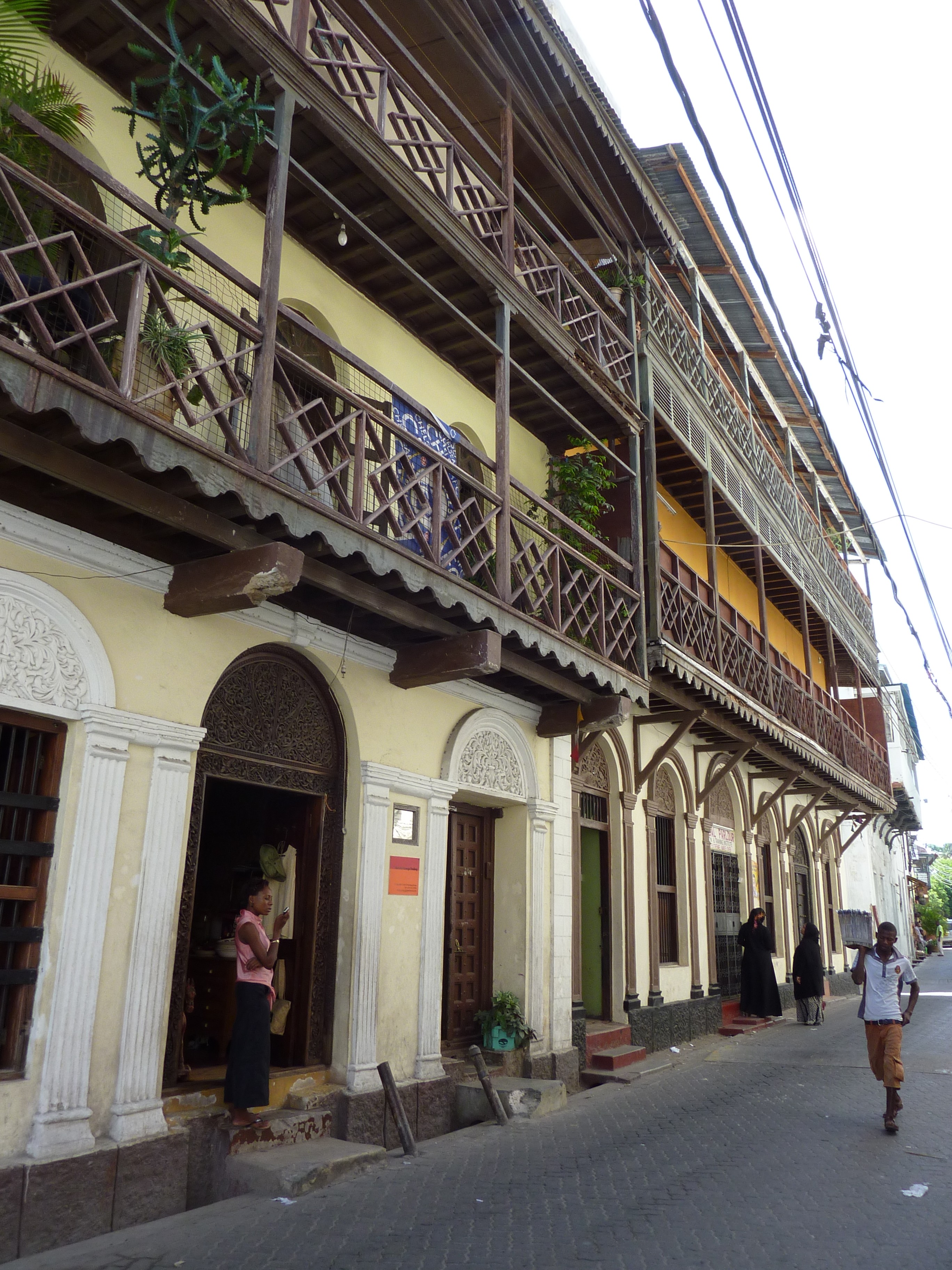
Swahili Box Building being restored at the Swahili Cultural Center Mombasa.
Ahmed Maawy has a colorful history. He grew up in Mombasa before ending up in Nairobi where he worked with 3mice and Ushahidi. As one of the first green members of iHub, he imagined what it would be like if Mombasa had a thriving hub of its own. He returned to Mombasa and started building a tech community, gathering like minded people together. Now thanks to a £26,000 grant from the Indigo Trust, work on Mombasa’s own space has began and this will be a reality soon.
More support partners have come on board. Seacom is providing the hub with hyper-fast broadband for the first year while others like iHub, Camara, Angani are providing support in various ways. It is just a matter of time before Swahili Box puts Mombasa on the map as a technology hub.
Once Swahili Box opens, the community will be the drivers, spearheading initiatives and using the hub as a launchpad. Community adoption and involvement will be important in making Swahili Box a success. Once the community takes ownership of the hub, they will utilize and grow it.
“We intend to be part of the Silicon Savannah”, Ahmed Maawy closes with a determined look.
Dancer entertains revelers at a Mtwapa club. (www.tripadvisor.com)
Mtwapa has over the years been dubbed Kenya’s sin capital. Lying just 15km outside Mombasa City this is the place people go to party and have fun. Mtwapa is alive at night; young women bickering, children begging, men cat-calling at women, and music blaring from clubs announcing the dawning of party morning.
There are ‘organizations’ of sex workers and anyone wishing to earn money must join one or risk being attacked later. These groups keep to themselves and have territories. The women looking for men who will pay for sex are scantily dressed – almost to the point of nudity. Some of these women are unemployed mothers, university students or people from bara (upcountry) who have come to Mombasa to look for work, found none and ended up here.
Tabby (not her real name) came from Kiambu two years back. It has been a long walk looking for proper work to do, an endeavor in which she had despaired until her cousin showed her how to earn a quick buck. Tabby likes to refer to herself as an escort.
“Sometimes it is really difficult to get a client and beggars can’t be choosers.”
At such times, she says, she will settle for whatever is available. Her friend, Salma, on the other hand,caters exclusively to foreign clients, white tourists holidaying in the area.
“They have the money. I want nothing but the money.”
A review from a website telling tourists what to expect from a Mtwapa club
Old white men with paunchy stomachs, sallow skins and countless wrinkles are the most popular clients here for these sex workers. The girls are either recruited by “agencies” or are forced into the trade by circumstances. They have formed a kind of network so strong that there are dedicated places where a tourist can easily find a minor for sex. This happens in very secluded places known only to the involved parties.
Large mansions and houses masquerading as guest houses and spas are hideouts for these sex businesses. Recruited women and men work here and are paid on commissions. A reliable source recently confirmed that even those women who are seen as ‘clean’ due to their buibuis are paid more.
A review from a website tells of professional friends in Mtwapa. Both men and women.
UN statistics show that about 15, 000 girls below the age of 18 are engaged in sexual activities with majority of their clients being European men. Young men and ‘beach boys’ are also paid to appear in gay films which are later shipped to overseas pornography vendors.
One can almost readily blame the authorities for not doing much to prevent such practices from taking place. Poverty, however, has its fair share of the blame for this. Families need to put food on the table, pay fees and clothe their children. Reports by the media have revealed a shocking truth that the law enforcement officers in Mtwapa have decided to overlook.
Child sex tourism has been on the rise. The tourists ‘hire’ the children and take them out to sea in rented boats, where it is safe to carry on their business. With bodaboda (motorbikes for hire) use on the rise, transportation of these people and the children is not a challenge. Astonishingly, some parents are the ones giving their children out in order to get some money.
“As poor as most of the residents here are, we have those situations where parents force their children into having sex with tourists so their families can sustained. It is a sad state of affairs that needs to be urgently addressed, before a whole generation is lost.”
Envelope journalism is not a subject that, understandably, gets a lot of attention in the press (Photo/http://weekly.donga.com)
President Uhuru Kenyatta’s unprecedented decision last Thursday to call on public officials mentioned in a corruption report by the Ethics and Anti-Corruption Commission (EACC) to step aside has whipped the local press into a frenzy. At present 27 percent of the Cabinet has heeded the president’s call and media outlets are currently leading with reports of who has and who hasn’t “stepped aside.”
Is there another sinister angle to the media coverage? In this piece Capt (Rtd) Collins Wanderi, the Chairman Kenya Institute of Forensic Auditors, weighs in with his experience of how embattled government officials have in the past relied on corrupt journalists and members of the civil society as their first line of defense against corruption allegations.
*******************
On 10th March, 2015 I wrote on my Facebook wall;
“Some infrastructure projects in Kenya began when somebody was the Chief Engineer Roads. He was later promoted to Permanent Secretary. Then the projects stalled and remain incomplete to date but the contractors were paid. He was promoted to something bigger by this regime and those projects are now buried and forgotten………This person may be a blue-eyed boy of the regime, but also its weakest link as far infrastructure projects are concerned. Due to the entrenched culture of “protectionism” and “I owe you; you owe me” in the public service, this person can never discipline juniors who worked with him before he was promoted, they know him, he owes them! Now you know why almost all infrastructure projects have virtually stalled; and, the cow-boy contractors are back in business!”
Only the most discerning of you got the drift of how this war on graft is being fought. The seemingly politically correct home boys and girls MUST be the first ones to go! The full list of 175 names, now public has already seen some suspects fighting back with the full support of the minority opposition, journalists and civil society activists on hire. Rogue journalists in local media are now abusing editorial privilege to question and attack the Presidency while tacitly glorifying corruption and defending the suspects who have stepped aside to await investigations. This is nothing but #BrownEnvelopeJournalism which reigns supreme in the so called “independent media houses” in Kenya.
In October 2005, the Kenya Anti-Corruption Commission wrote a confidential report relating to #CorruptionInGovernment. The report named 115 senior public officers, including Senior Security Officers (Army Generals & police officers) suspected of corruption; fraud, embezzlement & abuse of office. Some were taken to court; the rest fought very hard and were actively helped by corrupt Journalists, tribal warriors, human rights activists and Judges of the High Court to “sanitize” their names. About 30 percent of the people who appeared in the 2005 report are now members of the current Parliament; Senate & National Assembly. A few of them are serving Governors. Tribal warriors in the mainstream and social media are now busy defending them!
The war against corruption in Kenya will never be won unless and until media houses deal with #BrownEnvelopeJournalism. Human rights, freedom of the press and independence of the media cannot be a justification for glorifying corruption and defending criminal suspects! When the dust on the current debate settles, we will embark on something even juicier: naming and shaming corrupt journalists. Having spent over 15 years in public service either prosecuting or investigating corruption and economic crime, I know far much more than the devious fellows defending and glorifying corruption in the name of press freedom will ever know. I will name and shame some, right here!
The author is an Advocate of the High Court of Kenya and the Chairman Kenya Institute of Forensic Auditors. You can follow him on Twitter @DecaptainCFE.
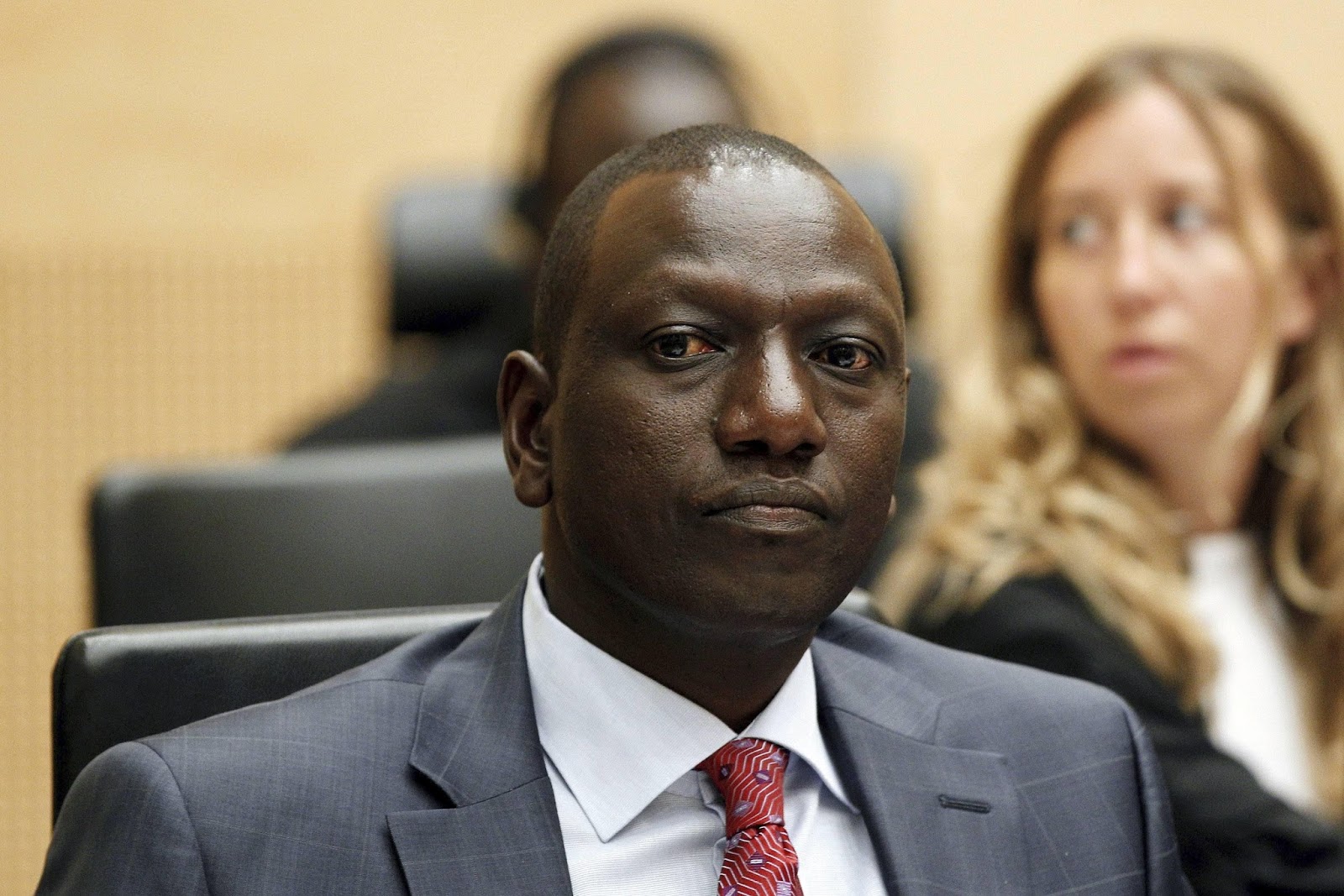
Deputy President William Ruto. Photo courtesy of Reuters.
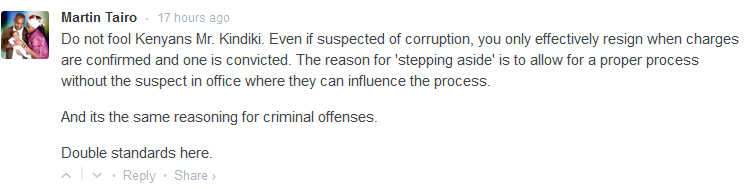
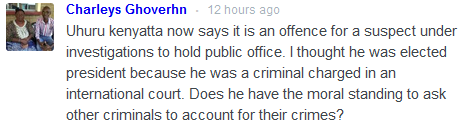
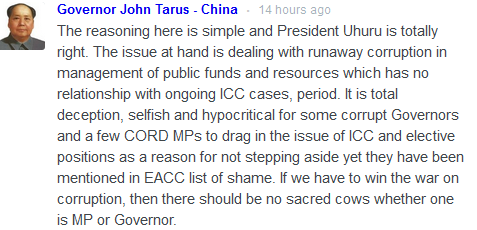
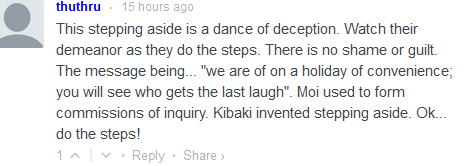
Is corruption a criminal offense and can it be compared to the ongoing case against Deputy President William Ruto at the International Criminal Court (ICC)?
Besides, does President Uhuru Kenyatta have the moral stature to ask persons holding public offices to step aside or even resign given that he was faced with charges against humanity at the same court until recently?
These are the two key questions that Kenyans seem to be asking as they respond to the Presidents stand that the crimes his Deputy is facing at the ICC should not be dragged into the ongoing debate on the war on corruption.
On Thursday last week Kenyatta asked all officers holding public offices who have been mentioned in a report on corruption by the Ethics and Anti Corruption Corruption (EACC) to step aside for 60 days pending investigations. So far 5 Cabinet Secretaries have stepped aside, the latest being Lands Cabinet Secretary Charity Ngilu and his Labour counterpart Kazungu Kambi.
However governors who have allegedly been mentioned in the report have declined to step aside. While arguing that the President does not have the mandate to ask them to resign some governors have accused the EACC of witch hunt.
But it is a reaction by State House to calls that Deputy President should resign due to his ongoing case at the ICC that has attracted mixed reactions. Spokesperson Manoah Esipisu dismissed the calls saying the case was not related to corruption, a view that was also held by Senate Majority Leader Kindiki Kithure.
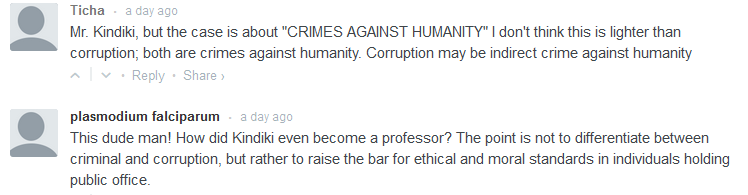
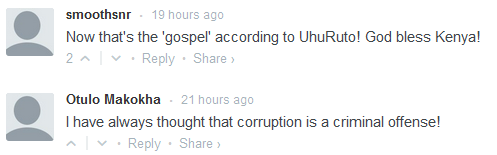
Kenyans reacted to this by asking which among the two is grave, corruption or the charges against humanity faced by Ruto at the ICC.
The responses were posted as comments to online articles published by the Standard and Daily Nation. Some of the responses had that there is no lesser crime between the two and everyone should be responsible.
This is not the first time that the ICC cases have been used as a gauge of whether Kenyatta and Ruto are fit for office. During their campaign the debate attracted a lot of reaction with the international community threatening Kenya of consequences should they elect the two.
And during the withdrawal of Kenyatta’s case a leading lawyer in the country argued that given the claims by Bensouda that the case was interfered with then its process did not ultimately give the President a moral standing. Seemingly similar responses have also been posted.
Although the Constitution is clear on how those holding state offices should conduct themselves either in public or in private, politicians have not been keen in following the law as outlined in Chapter Six of the Constitution. In many occasions elected leaders have been seen to go slow whenever their integrity is questioned. Those supporting the President feel he is right on the war against corruption.
Some however feel that while the President might be right, his call for those accused to step aside may not bear any fruits and that it is only rhetoric.
It is easy to be tempted to laud Uhuru Kenyatta for asking those accused of corruption allegations to step aside until investigations are concluded. But the President will only score highly if the investigations are done in a transparent manner and those found capable finally held responsible by having charges opened against them in court.
Allan Wadi Okengo, A 25 year old University Student Jailed for 2 year for Hate Speech on Social Media (image Source: Daily Nation)
The Dean of students at Egerton University has advised students at the institution to use social media responsibly. Speaking during the commemoration of the cultural day at the university’s Nakuru Town Campus on Friday March 27, Dr. Janet Kirui told students not to use social media to create disharmony.
“Don’t use social media to propagate hate speech,” she said.
While advising students to have “unity of purpose” she called them to use to use social media for purposes of positive networking initiatives.
“Let us use social media to market ourselves,” she added.
In the resent years social media has experienced exponential growth in the country with many Kenyans using it for sharing information instantly. There is a reference of Kenyans on Twitter (KOT) which is usually an identity of Kenyans who actively use social media, especially Twitter.
And these days, every media house has a harsh tag (#) for every discussion and news bulletin they present.
But social media has also been misused.
Gatundu South Member of Parliament Moses Kuria has in the past been accused of using his Facebook page to propagate ethnic hatred. At one time he was asked to apologize for his conduct by the National Cohesion and Integration Commission (NCIC).
Gatundu South Member of Parliament Moses Kuria. He has been accused of using social media to propagate hate speech.
Allan Wadi, a Moi University finalist was jailed for two years in January this year after he was found guilty of propagating hate speech against President Uhuru Kenyatta through his Facebook account.
Apart from these claims, the International Criminal Court has blamed social media users for using it to interfere with the delivery of justice in the case against Kenyatta that was terminated on March 13.
During the withdrawal of the case on December 5, the courts Prosecutor Fatou Bensouda blamed what she stream of false reports that were partly shared through social media and that allegedly threatened witnesses.
The theme for the annual event which saw the crowning of two students as Mr. and Miss Egerton Nakuru Town Campus was cultural diversity for intellectual and talent development.
Dr. Daniel Auka, the Dean of the Faculty of Commerce who was also present at the event held at the Nakuru show ground called for tolerance in cultural diversity.
“We can only build a strong nation if we embrace the culture of togetherness,” he said.
Recruitment firms stand to lose out should a Bill by Hon. Johnson Sakaja be actualized. The National Youth Employment Authority (NYEA) Bill 2015, seeks to create an authority where any job seeker can upload their details and institutions looking to hire, both public and private can access it. The platform will be availed for free, while the institutions hiring will also not pay a cent, but even be offered incentives, especially private companies, for using the authority as their first option when recruiting.
The Bill that is still at a nascent stage, has attracted diverse views. Some are arguing that it is very idealistic, while others insisting that there is no need to create such an institution as one can amend laws on the current institutions in the Ministry of Labor like the Labor Institutions Act 2007.
Why the National Youth Employment Authority Bill is another ‘parking bay’ for Kenyan youth. http://t.co/tcMQkuQkz1 Interesting breakdown.
I have a sugar mill to sell to those youth who believe N’l Youth Employment Authority Bill will is a solution to unemployment in #Kenya. — Kwame Owino (@IEAKwame) March 18, 2015
Gone through the The National Youth Employment Authority Bill, 2015…why create an Authority for something even Huduma Centres can do?
One of the first concerns already expressed with the Bill is the perception, informed by the use of the word ‘youth’, that it will lock out people above the age of 36. It is however not the case and Sakaja also explained that using youth is fore emphasis purposes.
.@VictorAllan7 There’s no such bill by @SakajaJohnson that bars anyone above 36 or any other age from employment! Slap your source of info — The Makodingo® (@makodingo) March 25, 2015
Mzalendo, a parliamentary watch institution did an interview with Hon. Sakaja where he shares his thoughts that informed the Bill and hopes that it will be actualized.
The legislator is also seeking for more input from the public to ensure that once the law is enacted, it takes on board robust views.
.@SakajaJohnson: I’m happy we are discussing the National Youth Employment Authority Bill and I’m taking comments on how to improve it. — Nation FM (@NationFMKe) March 23, 2015
.@SakajaJohnson: I’m seeking ideas to improve the National Youth Employment Authority Bill; idea of job centres has worked in SA & UK. — Nation FM (@NationFMKe) March 23, 2015
As Kenyans continue to debate the Bill, recruitment firms will also be strategizing on how to engage on it. The Bill essentially creates a one-stop-shop for those seeking jobs for free. By providing this service, where both the potential employees and employers do not incur costs, including international jobs, recruitment firms have a reason to worry as they charge for this service to either or both parties.
Governors with President Uhuru Kenyatta at Statehouse. (www.cog.go.ke)
When the President called for all public servants mentioned in corruption scandals to step aside, there was as expected a lot of reactions. Cabinet secretaries and principal secretaries have already stepped aside to be investigated. Kenyans in general welcome this action albeit with some cynicism having seen people “reinstated” after stepping aside in previous regimes.
Corruption is the monster that keeps us poor, the reason why if you are diagnosed with cancer today, you have little chance of quality treatment at a government hospital. Corruption is the reason you don’t feel safe at night, why people walk for half a day in some parts of Kenya to find water. Corruption leads to poverty. Singapore, Malaysia and Kenya were somewhat comparable in terms of development in the early 1960’s, we grew our corruption while they transformed their economy.
There is a direct link to corruption and poverty. Corruption hordes taxes collected from millions of Kenyans into the hands of a few individuals who then buy apartments in London or open offshore accounts at the expense of service provision for the citizens.
As witnessed, corruption is now devolved. County Governments collect levies from wananchi, then find other uses for the money and fail to provide the services. Are county governments even remotely accountable to the people that pay for the services? Do county governments care that corruption is killing the devolution dream for Kenyans?
Governors have spent a lot of time touring Singapore and other places, fighting to fly flags on their expensive cars and demanding more money from the Central Government as evidenced in their pesa mashinani campaigns. We are yet to see that kind of energy dedicated to fighting corruption and ensuring wananchi get better roads, drinking water, markets or hospitals.
They, as public officers have a duty. As the constitution states.
CHAPTER THIRTEEN—THE PUBLIC SERVICE
Part 1—values and Principles of Public service 232.
(1) The values and principles of public service include—
(a) high standards of professional ethics;
(b) efficient, effective and economic use of resources;
(c) responsive, prompt, effective, impartial and equitable provision of services;
The response by the Council of Governors however, shows that a majority of these leaders do not consider themselves accountable to anyone. Not as public officers whose role is governed by the Constitution. Governors are in fact State Officers, a higher requirement and expectation in the Constitution.
The only acceptable statement from the Governors would have been to condemn corrupt individuals and urge them to step aside for investigations. They should show us that they have nothing to hide, that they love and welcome accountability even from themselves.
Instead they threw red herrings into the pond. Referring to the Deputy Presidents case at the International Criminal Court (ICC), blaming political witch hunt and referring to the proper impeachment procedure. This shows how little of a conscience they have in regard to public resources. Even without corruption; inefficient and uneconomical use of public resources is against the Constitution. How many of the County leaders would pass this test?
Despite all the noise the Governors are making to defend themselves and their perceived right to what is a public office. Alex Tolgos the Elgeyo Marakwet Governor has called for all those named to step aside to facilitate investigations. Perhaps he is the only one that understands what it means to hold a public office.
In the meantime, you and me will continue to suffer because our resources have been entrusted to people who do not want to be held accountable.
Artists impression of Dongo Kundu bypass. One of the major infrastructure projects that will touch Changamwe.
In a recent announcement, Mombasa County Governor, Ali Hassan Joho said that residents will witness major infrastructure expansion that is to take place between now and 2016. It will be an ambitious project that will see hundreds of residents in the Changamwe constituency evicted.
However he assured that those affected by that move will be compensated. This eviction will be paving way for the road connecting Moi International Airport and the Central Business District. The infrastructure expansion is a plan that will see a four-lane road from the airport to the CBD with a flyover. Recently, there have been chronic traffic jams along Makupa Causeway because of the lorries and trailers. The announcement could not have come at a better time.
Of course queries would arise from the local people with some supporting the project whilst others condemning it.
“It is a fine project but it will displace alot of people. The government should have thought about expansion years ago. Why now?” said Mutua, a kiosk owner along airport road.
Winnie, a resident in Changamwe had this to say,
“I am totally for it. Its about time this road was fixed. Imagine tourists coming from the airport and the first thing they witness about Mombasa is the long traffic jams accompanied by the scorching heat. Its a disgrace that we’ve been living like this. Change is good and it better happen fast.”
It is quite clear most of the residents who were interviewed feared being evicted. But in his announcement, Mr. Joho assured full compensation. He further insisted that this expansion project was irreversible and that he would do everything to see it through. When asked about the compensation, residents had this to say…
“It depends with how much they pay us. The money has to be equivalent to the value of the land and the lives of the people who live on it.” Musyoka, a hardware shop owner.
John, a resident in Changamwe said
“We are happy about the infrastructure change and if it means people being compensated for it to go through, then let the people get paid. After all this project is going to benefit both the residents and the county as a whole.”
As the debate gets heated up about the impending change, the local residents are hopeful it will be a change for the good of the county.
Tragic events recently dampen things around old town and obviously negatively affect the livelihoods of people relying on tourists to that area. An emerging trend of killers shooting people at point blank range and vanish into the alleys has worsened the security outlook in Old Town Mombasa.
The Old town of Mombasa is a magical and historical place. It is one of the reasons that people are drawn to the city Mombasa. The narrow streets, with ancient balconies overhanging, tell stories that go back hundreds of years. History that takes you to Asia, Arabia, Mombasa and Europe. It is after all next to Fort Jesus.
The streets are almost always shaded, being narrow and most buildings being at least two storeys high. A pleasant place to walk about, even in the Mombasa heat. To admire the magnificent Lamu doors, buy trinkets from one of the many shops or sit cross legged at a coffee house and sip some “thungu”. It is easy to see the draw of the Old town, a United Nations Educational Scientific and Cultural Organization (UNESCO) World Heritage Site.
In July 2014, two female tourists were shot dead in the area. A German tourist was accosted by young men who shot and killed her at point blank range in Kibokoni. Her Ugandan friend was also shot and injured in the incidence. In the same month a Russian tourist was killed on the spot at point blank in the same area.
After what felt like a lull, a well known Criminal Investigation Department (CID) officer was shot 3 times and killed on his way home on March 26th. Ibrahim Mohamed was walking home when 2 men stopped and shot him in the abdomen. He was pronounced dead on arrival at Mombasa hospital. Another officer, a high ranking District Criminal Investigations Officer (DCIO) survived an attempt on his life last year after he was shot by unknown gunman in the Tudor area.
The latest case shows how much of a challenge the Mombasa County security team has on it’s hands. The motive for Ibrahim’s shooting is yet clear. What is not in doubt, is he was targeted most likely because he is a policeman. Criminals have grown bolder and are attacking the people we expect to keep us safe.
The number of incidents happening around old town are unfortunate and risk becoming a permanent stain. It should not become a place where killers roam free, shooting people and disappearing into alleys. To keep the magic of Old Town, the police and the community should work hand in hand to clean up the neighbourhood of criminals. The killers should be brought to book once and for all.
If visitors stop coming, everyone will suffer and the magic of Old Town Mombasa will be lost.
Women entrepreneurs, designers, developers and technology enthusiasts in Mombasa came together this past weekend as the Women Techmakers Mombasa event held at Jaffery Institute on 28th March. The event was powered by Google Developer Groups (GDG) Mombasa whose theme for Women Techmakers””2015 is “Connect.Create.Celebrate” .
Women Techmakers is a Google initiative for women leaders in technology and hopes to inspire others to join the field. Women Techmakers hopes to provide women in Mombasa with visibility, community, and resources to drive innovation and participation in the field. Women Tech makers events are held worldwide and having one event in Mombasa should be a big plus for the coast tech community.
The primary objective of this event was to grow, and celebrate women developers, designers, and technology entrepreneurs. GDG Mombasa plans to do this by improving programs and increasing women GDG members by collaborations and raising awareness through social media.
The event was organised by Mombasa Tech, a community based organisation that addresses the challenges faced by communities in Mombasa through effective and practical use of technology. The 500 member community also works to promote, nurture and encourage more girls and women into Science, Technology, Engineering and Mathematics in Mombasa.
The event points at a growing Tech community with Mombasa Tech and Swahili Box emerging as the two rival tech hubs in Mombasa. Both are community based organisations that offer co-working space. Both have a shared history as Ahmed Maawy, Swahili Box’s founder was also one of the founders at Mombasa Tech four years ago.
Mombasa’s tech scene has come alive as these two hubs are buzzing with activities. Hackathons, talks, events, workshops are the order of the day. The convergence of so many Institutions of higher learning in the Island is also another big factor with University of Nairobi, Jomo Kenyatta University of Agriculture and Technology and Kenyatta University leading the way. Others are Moi University, Methodist and Mount Kenya University.
All these institutions are less than 2km apart. As a result Mombasa Island is teeming with youth who need spaces to create, innovate and collaborate. These two hubs will continue to see numbers grow as more join institutions of higher learning and others graduate.
The Women Techmakers event had an all women panel that included an entrepreneur, a trainer, a director and a cancer survivor. There were talks by invited speakers, a social hour, team building activities among other activities. It was an interesting time to interact with thought leaders, network and talk some tech stuff.
Makueni artistes during the launch of Jukumu Letu at Unoa grounds in Makueni
The launch of Jukumu Letu in Makueni could not came at a better time as the county is embroiled in a leadership crisis pitting Governor Kibwana at one end and Members of the County Assembly (MCAs) at the other.
For the better part of the last two years since the governor and MCAs took office, their tenure has been riddled by persistent bickering especially on budget related issues with the Governor declining to assent the budget for the two years in row almost bringing the operations of the county to a near halt.
The Governor has accused the MCAs of being greedy and selfish by demanding huge allocations of money at the expense of development while the MCAs have also pointed a finger at the governor for presiding over a corrupt government.
For example, in the last financial year the MCAs had allocated themselves close to sh912 million for operations out of a total budget of sh5.7 billion while abroad trips by the MCAs cost the taxpayer millions of shillings.
Questions about the benefits of the globe-trotting to the common man have been raised with Prof. Kivutha dismissing the trips as a waste of public resources.
On the other hand, close to sh80 million were allegedly embezzled by county executive officials during the 2013/2014 financial year in a tree planting exercise. Expenditure of sh 30 million allocated for civic education in the same financial year according to the Public Accounts Committee Chair and Kee MCA Jonathan Mutua is questionable.
However, the governor has since fired the County Secretary John Kennedy Muteti, alleged to have engineered the tree scam. Information, Communication and Technology (ICT) Executive Tom Luusa was also relieved of his duties after undisclosed amount of millions were lost in fraudulent procurement procedures in his department.
The infighting, between the two arms led to the impeachment of Prof. Kivutha and almost ended on a tragic note, following a shootout at the County Assembly chambers where six people were injured after the governor forcibly made his way to a leaders meeting which he had not been invited.
The shooting, it seems acted as an impetus to the residents who were tired of the wrangles that had adversely affected service delivery to invoke Article 192 of the constitution and dissolve the county government. The process has so far been successful and the county is at the verge of dissolution after the senate approved a six-member committee appointed by President Uhuru Kenyatta to look into the petition.
If dissolved, Makueni will go into the annals of history as the first county to be suspended under the devolved units.
Article 192 of the constitution outlines that a county can only be dissolved under two conditions; a state of emergency arising from an internal conflict or war and any other exceptional circumstances.
The article is however, silent on these exceptional circumstances and whether Makueni meets either or both thresholds is a subject of discussion that will depend on the findings by the commission of inquiry.
While many believe that the petition is the people’s will, there those who argue otherwise with some suggesting that a majority of the residents do not understand what is ailing the county leadership and therefore cannot be in a position to make an informed choice on whether to dissolve the county or not.
Makueni Parish Father in- charge Fr.Paul Munguti says there are deep-seated leadership issues that need sobriety.
Fr.Munguti further observes that there is need for civic education in the county to enlighten people on the constitution and participatory governance. He says the church as a unifying factor should be at the forefront to advocate for matters that benefit the common man adding that the catholic church together with other churches will soon source for funds to conduct civic education.
“Public participation is paramount and as a church we will pursue what is best for the people of Makueni and bring the residents on board,” says Fr.Munguti.
The cleric sentiments also resonate with the views of Kee MCA Mutua who says that public participation in the county on matters of governance and the Constitution is very low adding that civic education should be given a priority. The MCA observes that despite the residents filing a petition to dissolve the county many of them do not know the role of the county leadership.
“Most residents think that we are councilors and this misunderstanding has created a bad perception that has seriously affected how we operate.”
The PAC chair adds that the tag Makueni MCAs have been labeled by the executive as greedy and selfish further complicates the situation with most MCAs having frosty relationships with their constituents.
“The public see us in a very bad light, and it has been very difficult for us to redeem ourselves,” he says.
Mutua however observes now that political temperatures seemed to have cooled down the truth will soon be revealed. He however blames the media for fueling the wrangling in Makueni County.
“Almost all the 47 counties did not have a budget, the County Assemblies Forum (CAF) had moved to court seeking an interpretation after the Commission of Revenue Allocation introduced the ceilings but things in Makueni were thrown of out proportion,” he says.
But as the two arms of government continue to fight, residents continues to face the same problems they had hoped the devolved units will address. Perennial droughts and the high levels of poverty are a stark reality that the residents seems to have to terms with.
Photo courtesy of Capital FM
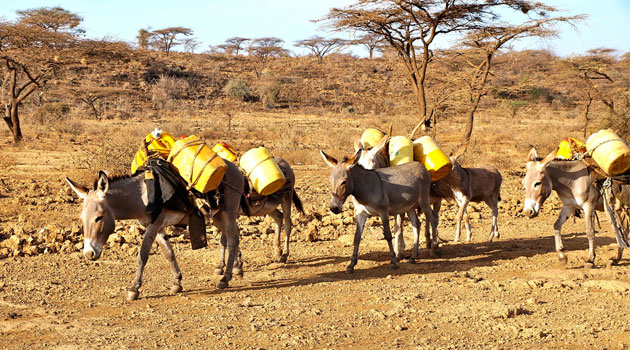
Georgina Musyoki is one frustrated resident of the county. She has to travel for close to five kilometers to fetch water in Kamunyolo dam for both domestic and animal use.
“The current government was elected on the platform of change, little has been achieved, water scarcity is still a problem and to make it worse the government does not involve us when it makes some decisions its no wonder that the leaders are always fighting,” she says.
Speaking during the Jukumu Letu launch Governor Kibwana, a strong advocate for public participation urged the residents to be proactive and put the county leadership to task on issues that affect them. He noted that the power of the people is vested in the Constitution and asked them to take advantage of their constitutional rights and demand for good leadership.
Stephen Makenzi a resident who attended the launch also lauds the initiative. Makenzi says that if the residents put into practice what Jukumu Letu advocates for Makueni will certainly be a progressive county.
Whether the residents of the county will take keen interest in matters of governance is a matter of time and with the dissolution of the county in the offing, time will tell if the residents will go back to the ballot and elect leaders who they hope will address the issues affecting the county or return the same leaders they have complained about.
The commission of inquiry appointed to look on the petition of dissolution is yet to embark on its works and time is of essence. Already residents have started casting doubts on the possibility of dissolution with some arguing that there is not time for another election.
The cost implications of the dissolution is still another issue that makes the dissolution seem like a farce. Putting up a campaign two years after office is no mean feat and most leaders in the county especially MCAs have crossed their fingers hoping against hope that dissolution will not happen.
Crops at a research and demonstration plot at the Egerton University, Njoro. A leading agriculturalist has asked researchers in agriculture to focus on developing technologies that meet the needs of farmers.
Do researchers in agriculture know what farmers want? That is the question that a leading agriculturalist in the country wants us to think and act on if we are to improve the sector.
Dr. Moses Siambi who is the Regional Director of the International Crops Research Institute for the Semi-Arid Tropics (ICRISAT) in Nairobi has challenged agriculturalists to come up with technologies that directly meet the needs of farmers.
In a key note speech he delivered yesterday at the opening of the 9th Egerton University International Conference at Njoro Nakuru County, Dr. Siambi said the technologies should enable farmers gain income from their farming.
“If they are not making money, why will they invest in agriculture?” he asked.
“Researchers need to work towards satisfying the needs of the farmer, especially the small holder farmer,” he said.
While agriculture is usually identified as the backbone of Kenya’s economy, the sector is always faced with a myriad of challenges making it difficult to achieve its potential. Lack of incentives and unreliable weather conditions are among those challenges.
“The cost of transporting fertilizer in Kenya is more than the real price of the commodity from the manufacturers,” he pointed out.
Dr. Siambi said farmers need highly productive crops and livestock, low input production systems and high prices for their produce.
He also said that what the farmers want are reliable markets and access to credit for both input and produce.
With the start of the long rains, the planting season is expected to kick off. It is in this season that most farmers plant crops such as maize, and most of the other crops that determine the status of food security in the country.
Although Dr. Siambi acknowledged that researchers may have an idea of what farmers want in the country he challenged them to do more.
“I think we know what the farmer wants. We have developed many technologies about agriculture.”
“As scientists we have a role in influencing the decisions of the farmers,” he added.
The conference whose theme is ‘Innovative Research and Technology for Global Development’ will end on Friday. Its participants are drawn from the Africa and Western Europe.
President Uhuru Kenyatta during his first State of the Nation Address in March last year. (Photo/www.president.go.ke)
Welcome to our live coverage of President Uhuru Kenyatta’s State of the Nation Address before parliament. This is the president’s third such address since taking office in April 2013. Uhuru will be addressing a joint sitting of the National Assembly and the Senate, the first time he has done so this year.
Yesterday the Presidential Strategic Communications Unit (PSCU) dropped some hints about the subject of the president’s speech today.
@President_KE will address the Nation tomorrow from Parliament on National Values&Ethics as the Constitution requires #TransformingKE#SOTN
It’s no surprise that the president is making “national values” the theme of his speech today. With revelations of sleaze by state officials coming out almost daily, the country seems to be in the throes of a moral crisis.
Hopefully @UKenyatta will give us good news regarding the corruption cases. The stalling by relevant authorities is infuriating.#SOTN
According to the Star, the president won’t only be talking about matters of integrity. He’ll also squeeze in a mention of his government’s achievements’ in the last few months and their agenda going forward.
“The President is also expected to appraise Parliament on the national development agenda and update the nation on what the government has achieved so far.
The President will also seek a bipartisan approach in pushing constitutional bills and other legislation that had an August 27 deadline.”
The President will seek the Senate’s support of the recent health equipment management programme, aimed at equipping two hospitals per county.”
Outro:
That’s all folks. Lets do this again next time. Visit our website (https://www.monitor.co.ke) for news, commentary and analysis.
The MAPACA Theatre actors performing the Play at Unoa Grounds during the Jukumu Letu Initiative launch in Makueni County
As Kenya marks three years of devolution, Makueni County is perhaps a typical example of the teething problems of devolution and a play staged at Unoa grounds, in Wote, Makueni during the launch of Jukumu Letu initiative sought to underscore the importance of public participation in the devolved system of governance.
The initiative geared towards creating a proactive population by creating awareness on the constitution and issues centered on governance through artistic works attracted hundreds of residents including Governor Kivutha Kibwana.
The play opens at a public venue, a politician has organized a home-coming party, one year after his election and has invited his constituents to celebrate the victory.
As usual, in such parties, food and drinks are in plenty and women with the best culinary skills have been hired, of course at the taxpayers’ expense, to cook for the hundreds of residents who turn out for the celebrations. However, as the partying progresses one of the attendants Mama Kathiani, dissatisfied with the local leadership demands for an explanation as to why their leader is spending public money on such a celebration instead of using the funds to initiate development.
The village is facing a myriad of challenges ranging from poor infrastructure, lack of quality health care to acute water shortages and Mama Kathiani undoubtedly cannot understand the leader’s choice of misplaced priorities. The lone voice of Mama Kathiani burdened by the task of walking for long distances in search of water is determined to awaken the conscience of her fellow constituents to demand for people centered leadership.
The play has a successful conclusion; Mama Muthiani single- handedly manages to mobilize the other residents in attendance to demand for proper leadership devoid of empty rhetoric much to the chagrin of the politician and his sycophants.
. @governorKibwana ‘s brief message to the people at the #JukumuLetu acknowledged that the artists have hit home in their msg on governance
While Wote residents were laughing and listening keenly to the play, it is hoped that they will internalize it and reflect on it, guided by the leadership wrangles affecting the County. In addition, this initiative needs to be done to all other sub-counties and even recorded to be distributed to all and sundry in the county so as to have a larger reach of citizens. Such will provide a critical knowledgeable mass on how their leaders treat them and use their resources.
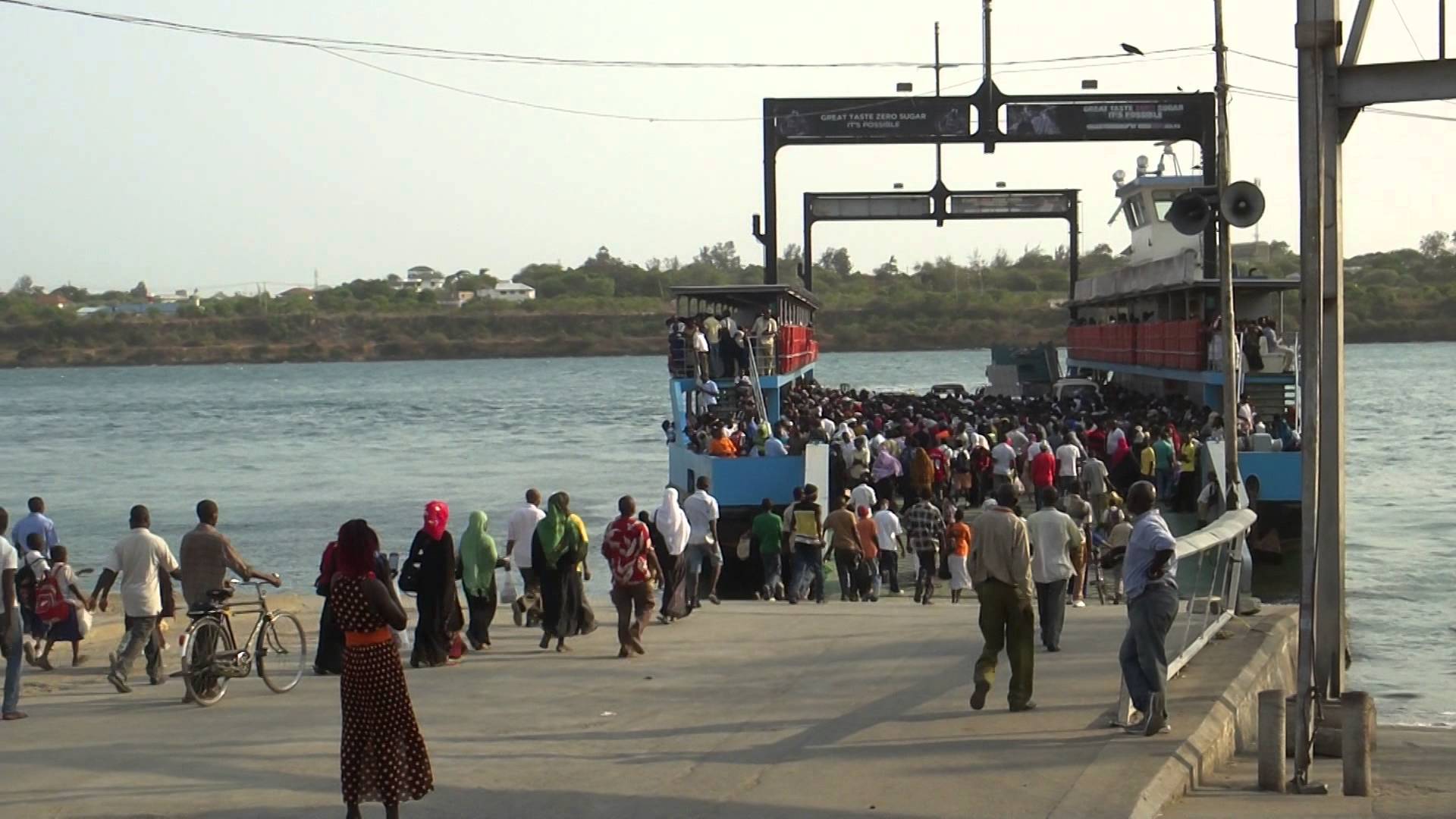
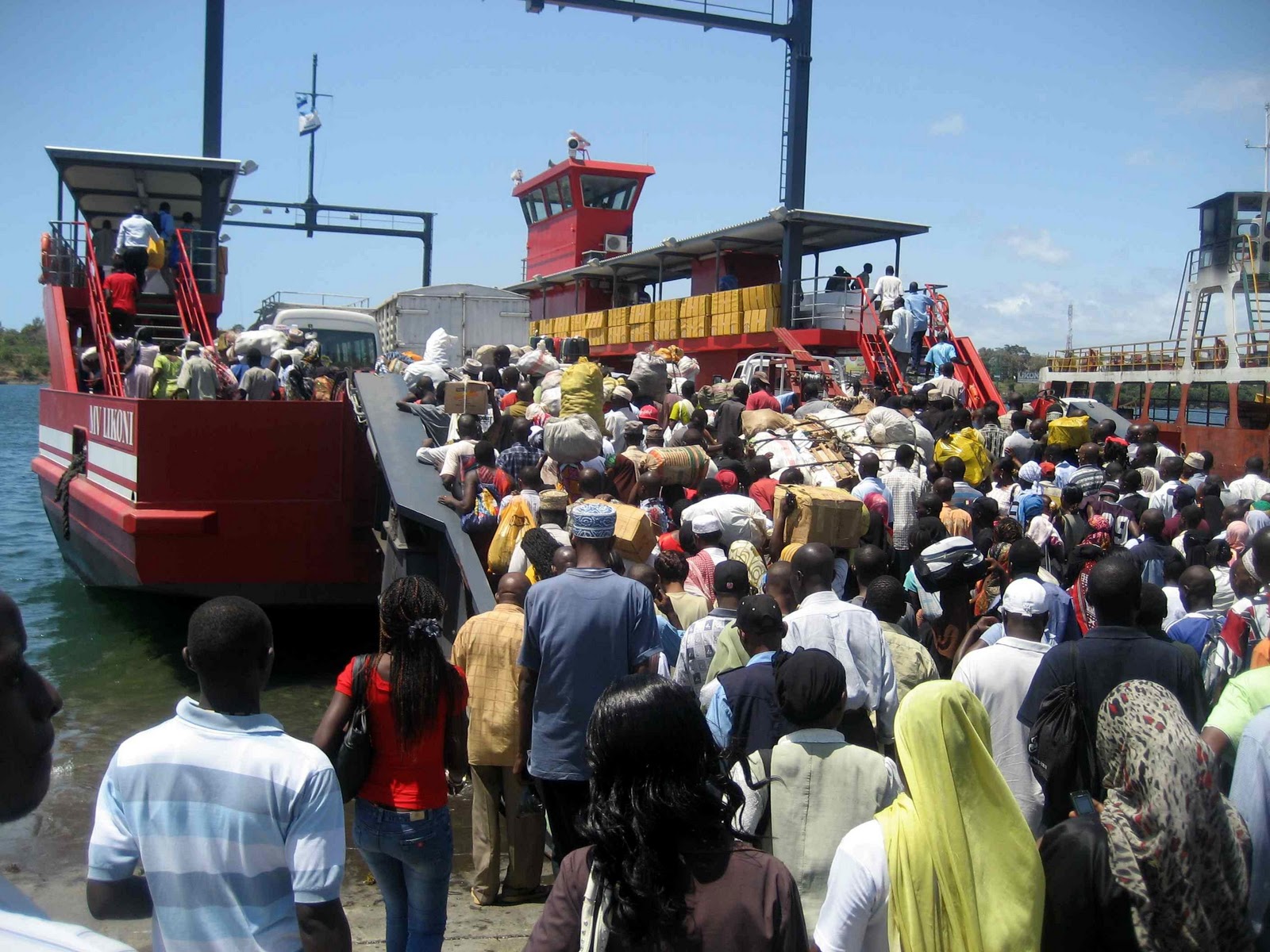
The Likoni channel connects Mombasa Island to the Southern Mainland and is serviced by 5 ferries; MV Mvita, MV Kilindini, MV Nyayo, MV Harambee and MV Kwale. This channel is at the center of not just differences in turf pitting the national government and county government, but also recurrent breakdowns which anger locals, delaying movements of goods and people. In 2012, Two ferries at Mtongwe were decommissioned due to decrepit ramps and landings, forcing Mtongwe residents to use the Likoni Ferries. This has immensely contributed to the congestion at the Likoni Channel crossing.
The channel handles approximately 6,000 vehicles and 200,000 commuters daily, and the numbers are expected to rise to about 500,000 in the next few years. Most commuters are however frustrated with the frequent breakdowns of the ferries.
Earlier this month, three ferries developed mechanical hitches and only MV Kilindini ferried commuters across the channel. This resulted in a massive traffic jam in the Central Business District (CBD) as vehicles queued to cross the channel. MVs Harambee and Kwale resumed operations late March, to the relief of many.
As if the frequent hitches are not enough, there have been constant squabbles between the national and county governments on who should run the ferry. When Tawfiq Balala was nominated as the new Mombasa County executive for Transport, his first sentiments during a press conference were that the national government should cede control of the ferries to the county government.
He said the county had its hands tied in matters pertaining to the outstanding issues that bedevil the ferry services, but would easily solve them within a month if it were granted management.
He was echoing sentiments expressed on several earlier occasions by both the county’s governor and senator. Mr. Hassan Omar has been on the forefront rooting for the transfer of the functions since, he says, they are considered by the senate as being under the Fourth Schedule section (ii) which details the various functions of county governments.
“It is simply a matter of following provisions of the law”, Hassan added.
Kenya Ferry Services Managing Director, Hassan Musa, announced that two new ferries would be acquired to help mitigate the conundrum. Turkish shipping yard company Ozata Tersanececik Limited has been tasked with delivering the new ferries by mid 2016. Whether that will happen remains to be seen.
“We have had the same problems with the ferry for very many years,” complains Mr. Jeremy Mwang’ombe, a Likoni resident, ” why can’t the government simply construct a bridge there?”
His sentiments are shared by many others, and there are indeed rumors of plans to construct a bridge to replace the ferry one day.
Should that happen, it will be the ultimate solution to the conundrum at the ferry.