Friday, December 19, 2025
Home Blog Page 12

Blogger Cyprian Nyakundi given a warning over contempt of court in Safaricom suit

Blogger Cyprian Nyakundi was yesterday let go with a warning against continuous contempt of court in a defamation suit in which Safaricom’s Bob Collymore and Michael Joseph have sued him for defamation.

Following a complaint on his contempt of court orders when the case was first mentioned, the petitioners filed an application for contempt. The court had given an injunction against him mentioning the two, directly and through his agents on any social media platform and his website.

The blogger had on several occasions breached the injunction by naming the two in various comments on his Twitter account especially touching on alleged corruption at the telco.

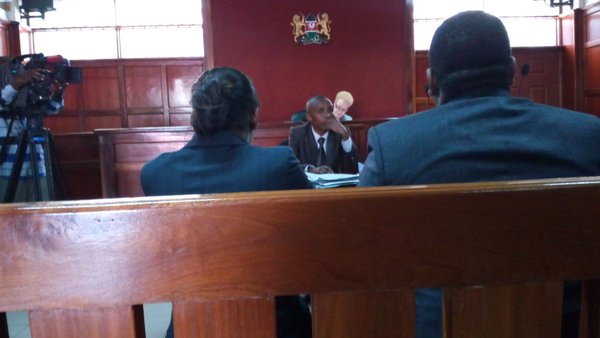
Nyakundi was summoned yesterday to appear in person before Justice Lucy Njuguna in civil suit no; CC.159/16.

His lawyer Anne Nderu however pleaded with the court for leniency affirming that he will abide by the court’s injunction until the case is heard and determined.

Safaricom CEO Bob Collymore and former chief executive Michael Joseph had sued the blogger for publishing defamatory information about them on his blog earlier in the year.

While the court had issued orders against him commenting on the two, the blogger had denied being given case documents on contempt-of-court proceedings against him over the matter.

Mark Mwithaga died on ‘day of 1982 coup’

0

On the night that Nakuru veteran politician Mark Mwithaga breathed his last, no one may have taken notice of how significant that night was.

It’s not because his death was poised to be historic. No!  After all, the shine of the fierce politician he was known to be during his hey days had waned in his last earthly lap. He would be seen in the town, walking, albeit quietly, and with no close resemblance of the archive he was on matters of the Kenyan nation.

Somehow, he had become insignificant and were it not for journalists who looked for him (mostly on national holidays) for his comment on the making of post-colonial Kenya, or the few chances he was honored as a speaker on the same days during the county celebrations at Afraha stadium, he mostly remained unheard of.

It was this insignificance that perhaps surrounded him as death engulfed and took him to the land on the other side, that no one quickly established that, the night he died, was so connected to the very Kenyan history he had been recounting, now and again. That night is the night of August 1st, the night whose day had ushered Kenyans into a coup in 1982.

“He woke up in a jovial mood on Monday 1st August, and called two of his daughters,”

an eulogy dubbed

“The life and times of Hon. Mark Mwithaga HSC, OGW”

and which was released on Tuesday in a requiem mass at the St. Monica Catholic Church Section 58, partly reads.

“At about 5pm, he started feeling unwell (and was taken) to the Cardiac Clinic (in Nakuru),” the eulogy goes on, further stating that “he seemed to realize his time was up.” It was at the hospital that he was attended to by a priest who gave “him his last rites” before “he succumbed to a massive cardiac arrest.” That, the eulogy further reads is “exactly 30 years after his father’s death on August 1st 1986.”

But 1st August 1982 was a day of its own in the history of Kenya. It was a Sunday and the night preceding it (July 31st) there had been attempts to over throw the government of the then President Daniel Moi, out of discontent with his style of his leadership.

As Babafemi Badejo writes in Raila Odinga: An Enigma in Kenyan Politics, Hezekiah Ochuka, the man identified as the coup leader confessed that some of the reasons for the coup “included the lack of proper presidential elections in Kenya since independence” and the feeling that “parliamentarians were not allowed to air their views as detention hovered over their heads.” Ochuka, so states Badejo, also complained of assassinations aimed at people who were seen to oppose the President.

All these and many other issues that impacted negatively on ‘Wanjiku’ (even at the time) are issues that were seen to define Mwithaga’s life, the man who at the age of 23 was elected as the first KANU (Kenya Africa National Union) Nakuru District Chairman.

He later on became a Member of Parliament and when in 1975 Josiah Mwangi (JM) Kariuki died in what has always been seen as an assassination, he was appointed a member of the inquiry committee and served as the committee’s Vice Chairperson.

Those who know his earlier life say Mwithaga was too close to JM, and thus, it would seem obvious that he would be too committed in the search for his killers.

“Mwithaga knows the people who killed JM,”

Koigi wa Wamwere, a former Subukia Member of Parliament and one of his close friends said during the requiem mass.

“He knows them because wherever he is now, he has already met JM and also met the killers,”

Koigi said while giving history of how Mwithaga and his team met Jomo Kenyatta (Kenya’s founding President and the President at the time) to present the JM report.

“Mwithaga told me that Kenyatta asked to have a photo with the committee, but he (Mwithaga) did not want to be in it,”

Koigi said as the photo was splashed on screens in the church.

Veteran politician Koigi wa Wamwere.

“He told me that he stepped aside. But Kenyatta called him into the photo and said “Mwithaga, come here, you know you are the mother of all this.”

“He was a legend, a hero and a prophet who was never recognized at his birthplace,”

Koigi went on stating that Mwithaga had mentored him into politics.

While speaking, one could read that Koigi was too close to Mwithaga. At one time he was so overcome with emotions, his eyes welled up, and his voice was choked.

“I am sorry,” he said after picking up. Later on he would say he still does not know how he almost crushed while giving the tribute.

“In my life I have been very close to three persons: JM Kariuki, Mirugi Kariuki and Mark Mwithaga,” all of whom are now deceased.

Mwithaga will be buried on Friday at the Nakuru North Cemetery. His eldest son Madaraka Mwithaga told mourners that is where he had chosen to be buried.

The burial will start with mass at the Christ the King Cathedral and is likely to be attended by hundreds of people. And apart from the political regime that may want to be identified with him, the church is expected to also claim a big share of him. He was a committed Catholic, so devoted that he not only appeared in most of the Church’s functions, he was a renown pianist.

“He has been a choir member for over 60 years. He is the only person around, who I know, with double skills of playing the piano while looking at the notes,”

Fr. Francis Mureithi a priest of the Catholic Diocese of Nakuru stated on Sunday.

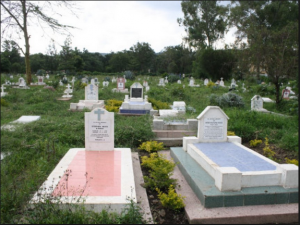
Cemetery Snip
A section of Nakuru North cemetery where Mark Mwithaga will be buried on Friday August 12. (Photo: www.the-star.co.ke).

“He was a Mary and a Martha,” another priest, Fr. Moses Muraya said of him on the same Sunday while describing his commitment to both the church and the community at large. Fr. Muraya was making reference to two biblical sisters who were once visited by Jesus at the their home and while one was busy serving Jesus the other was busy listening to his good news. According to Fr. Muraya, Christians ought to combine both the features of the two sisters to make it in the world, “like Mark Mwithaga.”

Mwithaga was the last surviving member of his family. He had buried his only surviving brother, Joseph Kaara, on 26th July this year. His eulogy traces his health complications to two days after the said burial.

Steps to follow when faced with a criminal case

By Gilbert Langat

Anybody can fall on the wrong side of the law anytime in the course of their life. When this happens most people get confused and may not know what to do.

And while ignorance of the law has no defense, ignorance of your rights as an arrested person can impact heavily on your ability to defend yourself effectively for fair administration of justice.

Police cells and court rooms instill fear in most people. The arrogance of the police and the intimidating presence of a magistrate or a judge coupled with the legal jargon used in the courts of law make things worse.

So, what is the most basic information you should have as an arrested person and what are the key steps to follow when you are labeled an accused in a criminal case?

Step 1: Arrest

Criminal cases, are cases in which the State is the main complainant. Such offences can include robbery with violence, assault, murder and rape. Such cases are thus initiated by the State through its law enforcement agencies such as the police and will in most cases start with an arrest. It is important to note that, you do not lose your fundamental human rights once you become arrested.

Article 49 of the Constitution states that an arrested person has several rights including the right to be informed “the reason of the arrest the right to communicate with an advocate, and other persons whose assistance is necessary as well as the right to not to be compelled to make any confession or admission that could be used in evidence against the person.” It also stipulates that an arrested person should be presented before a court if possible within 24 hours.

Step 2: Taking a plea

This step is a about accepting or denying the charges that are being leveled against you. It happens once you are presented in court for the first time. At this stage you are not required to defend yourself as this will come later. But any accused, including those accused of murder can be granted bail as this is provided for by the constitution.

Article 49 specifically ends by stating that

“at the first court appearance (the accused should be) charged or informed of the reason for the detention continuing, or to be released (or either) to be released on bond or bail, on reasonable conditions, pending a charge or trial, unless there are compelling reasons not be released.”

Step 3: Trial

The trial is the stage during which the facts of the case will be presented. This is usually done by the Prosecutor. The prosecution may call witnesses to testify against you as they support their case. When the prosecution closes their case, two things might happen. The magistrate or judge may rule on a no case to answer motion or the accused is put on their defense.

Section 210 of the criminal procedure code of Kenya states that

“if at the close of the evidence in support of the charge, and after hearing such summing up, submission or argument as the prosecutor and the accused person or his advocate may wish to put forward, it appears to the court that a case is not made out against the accused person sufficiently to require him to make a defense, the court shall dismiss the case and shall forthwith acquit him.”

Step 4: Defence

If the court finds that you have a case to answer, then you will proceed to the defense stage where you will need to present your facts to counter those of the Prosecution. This is your chance to refute the evidence against you. You can do this in three ways: sworn testimony that will be cross-examined by the prosecution; calling witnesses; using an unsworn testimony which is not subject to cross examination. It is also your right to remain silent at this stage and await the court’s judgment. Once this stage is closed, the magistrate or judge then proceeds to write the judgment.

Step 5: Judgment

During the reading of the judgment you can either be acquitted or convicted. Acquittal or conviction of an accused person is provided for under section 215 of the criminal procedure code. Once convicted, then the appropriate sentence is passed. The prosecution might bring forth your previous criminal records (if any) to help in passing out deterrent sentences. The law provides that you can mitigate before a ruling is delivered. During mitigation you can ask for leniency of the court by giving compelling reasons for the same. Such reasons include suffering from terminal illness, being the sole breadwinner or being a first time offender.

Step 6: Acquittal / Sentencing

In case you get acquitted, then you will walk scot-free. But the court can pass a sentence which may require you to pay a fine, serve a jail term or both. You can also be put on probation for a period of time during which you are surveyed closely so that you do not commit another offence.

Always note that, you are innocent until proven guilty. Thus unless otherwise proved you should never accept criminal responsibility until you are heard before a court of law.

Gilbert Langat is an Eldoret based journalist currently working as a journalism trainer with Moi University.

Why Jackson Njeru and Jackline Okuta were jailed for contempt of court

On June 14th 2016, Justice Mbogholi Msagha sentenced Jackline Okuta and Jackson Njeru to three months imprisonment or sh500,000 fine for failing to abide by a court’s restraining order against mentioning lawyer Cecil Miller on online platforms. The order, made on 12th April 2016 restraint them, their agents or servants from posting on Facebook or any other media platform including making general comments.

But the Judge noted that despite this court order, Jackline and Jackson

“caused to be posted and comments made on Facebook page Buyer Beware”

by various individuals.

The case came about after Cecil Miller sued Jackline Okuta on seven criminal grounds in case no. 992 of 2012. She was then convicted on all counts and sent to jail or pay fine of sh140,000 on March 31st 2016. However, Jackson fundraised for her on Buyer Beware and the amount was paid upon which she was released.

It is this criminal case, which was a private matter between Jackline and Miller than got Jackson entangled. In her attempt to seek public sympathy for her case having accused Miller of intimidation and abuse of court process, she got Jackson to help her by talking about the alleged intimidation and abuse of office through social media platforms.

Various alleged defamatory messages were made against Miller on Buyer Beware Facebook group that caused him to seek recourse to court. Miller was informed by his law firm’s partner and head of litigation Peter Wena that he was called

“corrupt, a wife beater and generally dishonest person”,

reads an affidavit signed by Miller to support his case.

Civil case 111 of 2016 was then filed. First Miller sued them for misuse of licensed telecommunications system which was a crime under section 29 of the Kenya Information and Communications (Amendment) Act 2013. But since it was declared unconstitutional by Justice Mumbi Ngugi, the lawyer changed to section 194 of the penal code.

The section reads

“Any person who, by print, writing, painting or effigy, or by any means otherwise than solely by gestures, spoken words or other sounds, unlawfully publishes any defamatory matter concerning another person, with intent to defame that other person, is guilty of the misdemeanour termed libel.”

Jackson Njeru is an administrator of the Facebook group while Jackline Okuta is a member and contributor of the group. In the comments touching on Miller, Ms. Okuta had been mentioned severally. It is against these comments that the two found themselves as guests of the state.

In the case, Jackline argued that she is just a member of the group and she has no control of what is posted. She however said that after the court order was given, she attempted to stop members from commenting on the case. But she did not give specific instances and dates she advised the group members.

On his part, Jackson denied posting anything concerning the lawyer. He added that he did not know the persons who made the posts on the group. He therefore felt he was not in breach of the court order. But when further probed on some postings with a name Nyako Maber, he confirmed this was in reference to Jackline Okuta.

Mr. Njeru further made postings on the group concerning a criminal case no 672 of 2014 which is pending before the Principal Magistrate Court when the two are jointly charged. After the posts were made, several comments were made.

The contempt of court ruling cites this instances as where it went wrong for the two. It says

“he did not post any caution to members restraining them from making any postings despite the fact that he is the administrator. He had not attempted to shut down the post to avoid the said postings.”

In making the ruling, Judge Mbogholi says

“I expected the two defendants to either purge the contempt or offer an apology. Instead a denial was registered.”

The judge says that the two knowingly read and watched the postings by their members. It is immaterial whether or not they knew those members. They both had powers to caution the members but they did not. They also had the power to bring down the platform but they did not. They allowed more comments to be made without due regard to the court orders and the rights of Miler.

In this regard, he ruled

“the two aided and abated the breach of the court order. They must therefore be punished for that breach.”

Ms. Okuta was able to raise the amount after three days and was released but Jackson has yet to secure the amount and is currently serving the jail term.

The gift Willy Mutunga should have given Kenyans before his retirement

By Kioko wa Kivandi

For years now Kenya has been holding discussions about the formation of a special division within the High Court with a local judicial mandate over crimes similar to the ones that were committed following the disputed 2007 presidential elections results.

The division, which has since come to be known as the International and Organised Crimes Division (IOCD) is to deal with human and drug trafficking, cyber-crime, terrorism and piracy as well as crimes against humanity.

This is a discussion that started in May 2012, approximately one year after Mutunga took over leadership at the Judiciary, and those who ever heard him talk about this division know that he was committed to its establishment – an attribute that can perhaps be linked to his background in human rights advocacy.

Mutunga however left without overseeing the real take off of the court. Choosing to retire one year before his formal time, Mutunga said he had done all he wanted to do at the Judiciary. He said he wanted to pave way for the next Chief Justice to acquaint himself with the judiciary early enough before the next election. And while leaving he promised to share his experience of the Kenyan judicial transformation with other countries in the East African region.

But he never saw the formal launch of the IOCD, a critical task he should have executed before leaving office. I will give two reasons why I see it so.

First, having been suggested following reflections on what Kenya went through after the 2007/2008 post election violence, the IOCD is to play a very important role on matters that touch on electoral reforms in the country. It is envisioned that the reforms that will come with the establishment of the IOCD will contribute, holistically, to reforms that will see the execution of electoral processes that Kenyans can trust.

Secondly, we are now done (at least on a general perspective) with the cases that we had at the International Criminal Court (ICC) and thus there should be a fall back plan, locally, should we find ourselves in the situation that we had in 2007/08. In the recent past we have witnessed scenes that shown us that we are still vulnerable to electoral violence. Should there be an eventuality next year, we need to have an institution that will guide us in judicial expeditions of electoral crimes that go overboard.

I know someone will say the IOCD can be launched even without the presence of Mutunga. I know they will say, the judiciary has life beyond Mutunga and thus as a branch within it, the IOCD will fall in place with or without Mutunga. On this I have my reservations.

Like I have stated above, the IOCD to me constitutes an electoral reforms strategy that Kenya has been longing for, for a long time. This is because, most of the atrocities we have gone through as Kenyans have been triggered by elections or issues surrounding the electoral process.

Because of this I feel, to have the IOCD launched we need to be inspired by some kind of reform agenda. Such an agenda is activist-like, and this is the reason why I feel Mutunga would have been key in bringing forth the IOCD. After all, he has had a reformist record, activist-like if you want. By leaving  the judiciary without seeing the real birth of the IOCD, I feel there is likelihood we will take long before we see its take off. Or we may never see it take off.

I will thus urge Willy Mutunga to see fit how he can still influence the establishment of the IOCD as he assumes his new roles. He could as well consider overseeing the entity. He is the best candidate to do so and the IOCD is one of the best gifts he can offer Kenyans, more so the victims of the post election violence of 2007/2008 and all those who have been victims of election related impunity.

The writer is a Nakuru based journalist studying for a Master of Arts in Communication at Egerton University

Jackson Njeru jailed for three months for contempt of court

Jackson Njeru was jailed for three months on Tuesday for contempt of court by a Nairobi Magistrate. Njeru was jailed alongside Jackline Ogutu aka Nyako Ber, both being Facebook administrators of the group Buyer Beware.

Their crime was that being group administrators, they did not bring down a post from a member of the group that mentioned prominent lawyer Cecil Miller, who has sued them for defamation. The lawyer had earlier gotten injunction against the two for mentioning his name anywhere online pending the determination of the cases he has against them.

Miller had sued Jackson Njeru and Jackline Ogutu first using the Section 29 of the Kenya Information and Communications (Amendment) Act 2013, for misusing a licensed telecommunications equipment (Facebook) but when the section was declared unconstitutional he switched to Section 184 of the Penal Code which criminalizes defamation.

In his prayers to the courts in Nairobi, he had gotten injunction against publishing his name in the group stating that the mentions had adversely affected his business.

What started as a private feud between Ms. Ogutu and Miller has over time embroiled Mr. Njeru.

In the ruling by the magistrate courts, the two were given an option of paying a fine of sh500,000. Ms. Ogutu was able to pay yesterday and released but Mr. Njeru has yet to secure his freedom.

Prior to this jail time, Ms. Ogutu had been convicted and jailed in lang’ata women prison in March this year but well wishes raised money to secure her release.

Their crime is what in law is described as crime of omission. While they did not individually commit the crime, being group administrators, they did not delete it, powers which they have, considering the injunction against publishing the lawyer’s name.

Efforts are being made to appeal the three months sentence and sh500,000 for Mr. Njeru at the High Court’s civil division.

Blogger Cyprian Nyakundi has been sued by NBK for defamation

3

Blogger Cyprian Nyakundi has in the last two years been sued by both Vimal Shah and Safaricom for defamation in separate incidents.

In the Vimal Shah case, he had posted on his blog and in a series of tweets about the plaintiffs have allegedly oppressed Ugandans. He had also alleged other human rights violations against Bidco’s violations against Kenyans.

In the case of Safaricom, he was issued with a permanent injunction barring him, his blog, agents or any other blog from publishing any posts on his blog on Safaricom that border on the litigation matters.

In his most recent brush with the law, Nyakundi has been sued by National Bank of Kenya (NBK) and has subsequently been served an interim injunction restraining him or any other contributors to his blog from writing anything about the bank. The bank served Cyprian by advertisement in today’s Nation (Download HERE).

Nyakundi is now barred from publishing or causing to be published any statements defamatory of the Plaintiff, its shareholders, directors and or employees in any nature, form and manner whatsoever on his blog, his twitter handle or any other of his social media accounts.

Why the Kenya government cannot legally regulate social media

The proposal by Dennis Itumbi, the State House Director for Digital and Diaspora Media that government is considering regulating social media cannot be realized without negating core constitutional provisions.

While speaking at Kiangima Girls Secondary School during a prize-giving day, he said the government is preparing a Bill seeking to regulate the use of the social media in Kenya. Itumbi added that bloggers and other social media users were misusing the platforms by spewing hate messages and maligning their perceived enemies as there are no proper laws to guide them.

In his view, the social media platforms are currently operating on self-regulation, with no laws to guard against misuse of the channels.

He was quick to clarify the modalities on how this could be realized by suggesting that the manner in which journalists are regulated under the Media Council of Kenya (MCK) should be used.


His suggestion will however be difficult to realize going by the reality of how social media operates, various case laws and constitutional provisions.

Kennedy Kachwanya, the Chairman of the Bloggers Association of Kenya said the laws are not necessary.

“The new regulations are not necessary because there are already laws that can remedy situations where there is hate speech and even defamation. There are however laws that are needed to make the online space safer especially for women and children and that’s what I feel the government focus should be”.

Victor Bwire, the Deputy Director of Media Council of Kenya said this is a conversation that has been going on for some time. He alluded to the media being in the same position prior to the Media Council Act of 2007.

People like Joe Kadhi and Wangethi Mwangi among others had already come up with self-regulating mechanisms. They however found it difficult to enforce them. This is how government came in to pass the law which is still self-regulating but backed by law.

In his view, the move is laudable so long as it also seeks to ensure self regulation is maintained.

The Bloggers Association of Kenya (BAKE) already have some code of ethics to inform its members. This is a good step that could lead to self-regulation backed by law, he added.

Currently, MCK regulates what media says both in the news channels and also social media accounts. The council has taken an issue with some journalists in leading media houses who have been overboard in their online messaging and written to them seeking to know whether the said journalists are still their employees since they are disregard laid down code of conduct for journalists. In addition, the letter seeks to find out whether the media houses have clear social media policies to guide journalists.

The legal position on freedom of expression provides a stop gap measure for any sort of freedom of expression regulation that does not conform to constitutional guidelines in Article 33 of the Constitution. It is a position affirmed in various judgments by the High Courts Human Rights and Constitutional Division on several cases.

During the Security Laws (Amendment) Act, section 29 of the Kenya Information and Communications Act (KICA) and the Judicial Review Miscellaneous Application 30 & 31 of 2014, Judges have been unequivocal, striking out sections of the law that infringe on article 33. Any limitation beyond the four stated in Article 33 have been declared unconstitutional. It is the same fate that any measure of regulation will face, should government make good its intention to regulate the online space, something it has said in the past three years.

Nairobi University’s School of Journalism Lecturer Dr. George Nyabuga scoffed at the Dennis Itumbi’s idea, saying Dennis is not alive to the reality of social media.

It cannot work. Regulation means offending constitutional provisions on freedom of expression. Kenyans are using the medium to express their issues, ideas and also challenge government and that is something you cannot just regulate. Social media has become a critical voice, challenging mainstream media and government that is today central to good governance in the country.

He added that any attempts to regulate the online world will lead to people going underground. They will still create the content the government feels uncomfortable with but the same government will not be able to trace their location because while they are within the country, they can route their location to anywhere in the world.

Amending any section of the Bill of Rights in the Constitution requires a referendum, something the government is unlikely to entertain, leave alone succeed.

The limitations set in Article 33 on freedom of expressions include propaganda to war, incitement to violence, hate speech and advocacy of hatred. In her Judgment on section 29 of KICA, Justice Mumbi Ngugi said that any limitation to freedoms cannot be beyond the recommendation limitations in Article 24, being open and democratic, reasonable, based on human dignity and freedom. The argument was also affirmed by Justices Isaac Lenaola, Mumbi Ngugi and Weldon Korir when they declared some sections of the MCK (Amendment) Act 2013 as unconstitutional because they had broad and vague limitations on freedom of expression.

Dr. Nyabuga added that while BAKE’s model is laudable, the code of ethics is voluntary and limited to its members. Achieving a universal or blanket regulation for all Kenyans online is unfeasible.

EACC Chief Executive Halake Waqo drops charges against Robert Alai

The Ethics and Anti-Corruption Commission (EACC) chief executive Halake Waqo has dropped against blogger Robert Alai.

Yesterday at the Milimani law courts, the prosecution said it had dropped the charge, but under section 87 (a) of the penal code which allows future re-arrest and prosecution.

Alai’s lawyer Mr. Edward Oonge told a magistrate that the high court had since declared Section 29 of the Kenya Information and Communication Act unconstitutional thus annulling the charge against Mr. Alai.

Blogger Alai was alleged to have claimed in a Twitter post that the EACC chief executive officer “faked a UoN degree which he used to ascend to office.” The prosecution said the offence was committed on November 18, 2015.

Mr Alai denied the charge and had been out on a cash bail of Sh30,000. He pleaded not guilty when he appeared before Milimani Chief Magistrate Daniel Ogembo on Tuesday 5th Janaury 2016.

He is alleged to have used the Twitter account Robert ALAI @RobertAlai to post a message that read:

“How do you expect EACC to arrest anyone for corruption when its head (Waqo) used a forged UoN degree certificate to get into his office”.

His lawyer however doubted the possibility of him being arrested under a charge that was declared unconstitutional by High Court Judge Mumbi Ngugi. He emphasized that Robert Alai’s acquittal is final as he cannot be charged under a non-existent crime.

The disappearance of Msingi Sasis

Photographer Msingi Sasis made a distress post on Facebook, 6th May 2016 about his troubled financial position ever since he was labeled a terrorist. He was arrested by the police last year when taking photos of Galleria mall, Nairobi.

Ever since that day, efforts to locate him have been futile. He phone is not going through, neither has he responded to various texts sent to his phone number, email and Facebook. People of all walks of life want to assist him but he is nowhere to be seen. For instance, the Photographers Association of Kenya (PAK) have already organized a camera and working space for him while creative writer Magunga Williams has offered to house him.

A background check to where he stayed reveals some inaccuracies in his distress message.

Msingi has been living with the mother at Osupuko Estate which is near Laiser Hill School, Ongata Rongai. Neighbours say that when he started having financial issues, he was unable to convince them of the link between the terrorism link and lack of work to be able to pay his obligations. The estate has both tenants who rent from individuals who bought the houses and owners of the houses. The rent range from sh35,000 to sh50,000, depending on how you negotiate with the landlord. The houses are 3 bedroom bungalow with a Servants Quarter. It is his mother who signed the tenancy agreement.

At 3am on 5th of May, 2016, neighbours were woken up by movements from Msingi’s house. When they went out, they found him exiting the house with all the belongings. They asked him whether he had authorization from the landlord and he could not answer. They then called the landlord who said he did not was not given a notice. He asked the neighbours not to allow him to leave with his household things. Everything was returned to the house, Msingi went back and left the following day (when he sent the distress message).

When neighbours asked him about his mother’s whereabouts, he told them that she disappeared in Europe. He said she had been supporting him but went silent and he is unable to trace her. However the neighbours did not buy this story because some of them had met her in Nairobi town a few days earlier hence they couldn’t add the dots.

The mother was last seen at the house in April.

Msingi Sasis was not evicted from the house, despite the fact that they had accumulated rental arrears.

Multiple individuals I interviewed say that there is a formal process that has to be followed before evicting a tenant. Nothing in his house has equally been auctioned because it is tied to the legal process. However it is this legal process that is currently being worked on, considering that he tried to disappear and he is unreachable.

Msingi’s brother confirmed that his dad has visited the house several times to no success. He said the family have filed a missing person’s report at Ongata Rongai police station.

The last one year has been tough for bloggers & journalists in Kenya

The last one year and part of this year has been difficult for media freedoms in Kenya. Journalists and bloggers have felt the wrath of power and influence when doing their job in a manner only closer to the old, darks days of Kenya.

Over 60 journalists have bloggers were silenced, intimidated, harassed and even killed, in a spate of violence against freedom of expression, freedom of the media and access to information. When Kenya promulgated the Constitution on August 27th 2010, with robust provisions for journalism practitioners, never was it imagined that these provisions will remain in paper.

April 30th 2015, three days before World Press Freedom Day, was the saddest of all. Kenyans woke up to shocking news of the cold murder of veteran journalist, John Njakusi Kituyi, the editor and owner of The Mirror Weekly, an independent regional publication published in Eldoret, Uasin Gichu County.

The 62 year old father of seven was investigating the network behind alleged witness interference in the case against Deputy President William and the former radio journalist Joshua arap Sang before the International Criminal Court (ICC) when assaulted by two unknown assailants and repeatedly hit in the head. He was walking home at 7.30pm. Before the incidence, he had received threatening messages and even reported to the police but nothing was done. To this day, no suspect has ever been arrested neither have police made any attempts to investigate and bring the issue to book.

Police, state officials, politicians and individuals have all contributed to silencing and intimidating of journalists. Each month, at least two journalists or bloggers are threatened. For instance, Article 19 East Africa last year documented that that from January to September 2015, every month had cases of intimidation.

The cases of threats against journalists and bloggers have been all over the country, with few incidences in the northern part of Kenya. Isiolo, Meru, Embu, Kiambu, Kitui, Mombasa, Kwale, Kajiado, Nairobi, Narok, Bomet, Kisii, Kisumu, Bungoma, Uasin Gishu and TransNzoia counties all recorded threats to freedom of expression.

In the same month of April 2015, journalists Nehemiah Okwemba of Nation Media Group and Reuben Ogachi Citizen TV were attacked and their cameras destroyed by paramilitary service men (General Service Unit), while investigating a complaint by local pastoralists regarding the confiscation of over 200 heads of cattle by the same officers near a state-owned Ranch in Tana River. The two journalists sustained serious injuries which caused bone fractures. One GSU officer told them they would have killed them had their commander not intervened.

Kenyans online have also not been spared the wrath of excessive force and impunity. The use of ‘improper use of licensed telecommunication gadget’ under Section 29 of the Information and Communications Act was rampant. It criminalizes publishing information online which is deemed unlawful by the authorities. The section has since been declared unconstitutional.

Others were charged with “undermining authority of public officer,” for criticizing government officials on social media pages, a charge under section 132 of the penal code (Chapter 63 Laws of Kenya), which was enacted in 1948 during the colonial rule.

In most of these cases, bloggers and Kenyans online were arrested and held for some days for questioning. They would then be released without being charged. The arrest is made on Friday and successful online engagements lead them to be released on Monday.

Last year, some of the Kenyans who have suffered this intimidation in the last one year include Abraham Mutai, Nancy Mbindalah, Robert Alai, Patrick Safari, Cyprian Nyakundi, Elijah Kinyanjui and Wahome Thuku.

In 2016, already several have not been spared the intimidations. Ezer Kipkirui was arrested and held for taking a photo of a long queue in a Huduma Center in Nakuru. Journalist Yassin Juma was arrested for sharing a Facebook comment showing a photo of one of the dead Kenya Defence Forces (KDF) members but when he was alive. Mbuvi Kasina faces six counts for misuse of licensed telecommunications system for questioning expenditure of Kitui South Constituency Development Funds (CDF).

Many other Kenyans online were arrested, some charged for expressing their opinions onlne. They include Martha Miano, Elijah Kinyajui, Patrick Safari, Judith Akolo, Martha Miano, Antony Njoroge alias Waime Mburu, Eddy Reuben Illah, Kalinga Mgandi and Harun Kongo.

Journalists Alphonce Shiundu and John Ngirachu were summoned to the Department of Criminal Investigations (DCI) for allegedly publishing classified information. They had reported mission millions of shillings from the Interior Ministry which details had been made available to the National Assembly’s committee by Interior Cabinet Secretary Joseph Nkaissery.

This trend follows last year’s one when Macharia Gaitho, Purity Mwambia, Bernard Namunane, Frankline Wambugu and Alex Kiprotich had also been summoned by the DCI and asked to reveal the sources of their security related stories. It is a cardinal rule in journalism that sources are sacred.

Some journalists and media houses have also been sued for defamation by various state officers for publishing some stories. Kurgat Marindany of Radio Africa was sued for defaming the Kajiado District Commissioner for writing that he cried in public. Nairobi Governor, Evans Kidero, sued National Media Group and Standard Media Group for publishing stories that linked him to the financial mismanagement of Mumias Sugar Company.

Furthermore, all Judges of the Supreme Court sued the Star newspaper owned by Radio Africa Group claiming one of its articles had portrayed them as corrupt judicial officers. The article is alleged to have said that they receive bribes to make certain key decisions. National Bank of Kenya filed a defamation case against Nation Media Group over newspaper articles it termed ‘malicious’.

Moreover, Nairobi Aviation College was granted an order by the High Court to begin Contempt of Court proceedings against Nation Media Group, over an article alleging that the institution issues fake certificates to students.

This year, blogger Cyprian Nyakundi has three defamation cases from Bidco, Safaricom and Nahashon Nyagah for publishing stories related to them. Nyakundi himself also sued journalist Larry Madowo for defamation for casting aspersions on his character in an article in his blog.

Allan Wadi has been exception in the last two years. He was arrested, arraigned in court and jailed for two years in 2015. He was charged with undermining the authority of a public officer and hate speech. Lawyer, Edward Oonge however appealed the sentence after eight months and he was released. He was however arrested again in March 2016 and charged with incitement to violence. The case is still ongoing.

In an unprecedented move, KENIC also pulled down a domain which stated whether the President was in the country or not. President Kenyatta has made most foreign trips than any other President and Kenyans were wondering the value of these trips. This led to a dormain name, isuhuruinkenya.co.ke being registered. When loaded, it either replied with a NO or YES depending with the location of the president. At the time of its launch in December 2015, the President was away attending a summit in South Africa. He had just come from Commonwealth Summit in Malta and Climate Change Summit in Paris. Trending hashtag #IsUhuruinKenya accompanied the online conversations. Pressure from Kenyans online saw the domain reinstated later in the evening after being off the whole day.


Why Justice Mumbi Ngugi declared Section 29 of KICA Unconstitutional

No Kenyan has suffered the wrath of Section 29 of the Kenya Information and Communication Act (KICA) like blogger Robert Alai. He has at least five active cases with these charge in court, dating back to 2012. His most recent case this year when the Ethics and Anti-Corruption Commission (EACC) CEO Halakhe Waqo took issue with him for questioning his undergraduate degree in a post on Facebook and Twitter.

The section reads

A person who by means of a licensed telecommunication system—

(a) sends a message or other matter that is grossly offensive or of an indecent, obscene or menacing character; or

(b) sends a message that he knows to be false for the purpose of causing annoyance, inconvenience or needless anxiety to another person

commits an offence and shall be liable on conviction to a fine not exceeding fifty thousand shillings, or to imprisonment for a term not exceeding three months, or to both.

People of all walks of life, especially those in positions of authority took advantage of the ambiguous section to sue others. They would then ensure the case stays in courts for long, with the accused being asked to make frequent trips to courts, only to be told the case will not be heard.

Every week, Jackson Njeru an administrator Buyer Beware Facebook group has been having a court case either in Kwale, Mombasa or Nairobi. Sometimes, he has two cases either in a day, or a day apart in these locations. But he still smiles, abiding by court requirements to appear, however much he knows they are flimsy charges, meant to silence him. He says he is not cowed by any.

The Judgement by Lady Justice Mumbi Ngugi came at an opportune time. It came at a time when Hon. Arthur Papa Odera, the MP for Teso North sued Peter O. Ekisa alias Shujaa Peter for making defamatory statement on Facebook about him. Ruling on 31st March 2016, Justice Mbogholi Msagha fined Peter sh5 million plus costs of the suit. Justice Ngugi alluded to the ruling, citing the use defamation laws as an appropriate piece of legislation.

When you study most of these cases, they merit a charge of defamation. Kenya’s jurisprudence has many cases in which Judges have given stiff penalties for defendants which one wonders why the plaintiffs using Section 29 of KICA do not consider riding on this, especially because they say their reputation is at risk. It only leads to credence that it much more of intimidation and muzzling of freedom of expression than seeking justice.

From penalty perspective, some defamation litigants have been awarded sh30 million and the recent Facebook case sh5 million. However, the maximum charge for Section 29 is three months in prison, sh50, 000 or both. Are these really damages worth loss of reputation?

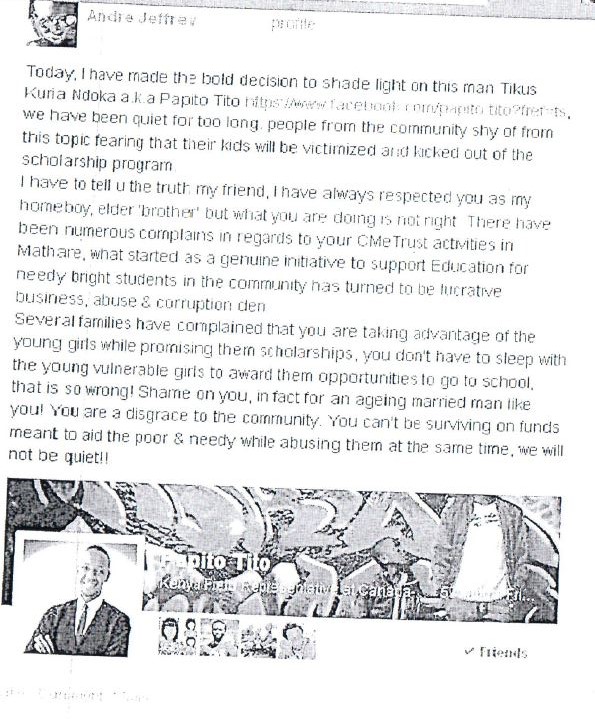
The case came about after Geoffrey Andare was sued by Titus Kuria for what he alleged was posting offensive messages about him on Facebook.

Andere-post

He specifically took issue with these words

“you don’t have to sleep with the young vulnerable girls to award them opportunities to go to school, that is so wrong! Shame on you”

Geoffrey Andare
Geoffrey Andare

It is after he filed the case that Geoffrey filed a counter suit, challenging the constitutionality of the charge.

Vagueness of wording

The Judge agreed with petitioner (Andare) and interested party (Article 19) in submitting that the words in the section are vague.

The section creates a chilling effect on the guarantee to freedom of expression. It creates an offence without creating the mens rea element (guilty conscious) on the part of the accused person.

She said that failure to define words like ‘grossly offensive’, ‘indecent’ obscene’ or ‘menacing character’ leaves them to the subjective interpretation of the court. She added that determining how a message causes ‘annoyance’, ‘inconvenience’, ‘needless ‘anxiety’ is also very subjective.

She said

It is my view, therefore, that the provisions of section 29 are so vague, broad and uncertain that individuals do not know the parameters within which their communication falls, and the provisions therefore offend against the rule requiring certainty in legislation that creates criminal offences

Limitation of the Right to Freedom of Expression

Both the parties to the case agreed that the section limits freedom of expression. However, the respondents, the Attorney General and the Director of Public Prosecution (DPP) said that the limitation in the section are in line with constitutional limitations in Article 33 of the Constitution

The right to freedom of expression does not extend to-

(a) Propaganda for war;
(b) Incitement to violence;
(c) Hate speech; or
(d) Advocacy of hatred that-

(i) Constitutes ethnic incitement, vilification of others or incitement to cause harm; or
(ii) Is based on any ground of discrimination specified or contemplated in Article 27 (4).

(3) In the exercise of the right to freedom of expression, every person shall respect the rights and reputation of others.

Justice Mumbi Ngugi however said that the limitation fails to abide by Article 24 of the Constitution which sets general provisions for limitation of rights that they can be limited;

only to the extent that the limitation is reasonable and justifiable in an open and democratic society based on human dignity, equality and freedom.

She added that the limitations do not conform to a free and democratic society as envisioned in the Constitution. She added that respondents failed to demonstrate the relationship between the limitation and its purpose, and to show that there were no less restrictive means to achieve the purpose intended.

Operating license

The learned judge looked into the purpose of the whole law, Kenya Information and Communication Act, Cap 411A

“to facilitate the development of the information and communications sector (including broadcasting, multimedia telecommunications and postal services) and electronic commerce”.

She said that section 24, which deals with the issuance of telecommunication licences did not intend to apply to individual users of social media or mobile telephony.

The Judge added that social media users are not given licenses by the Communications Authority of Kenya (CAK) to operate, warranting meriting of the law.

Individuals such as the petitioner and others who post messages on Facebook and other social media do not have licences to “operate telecommunication systems” or to provide telecommunication “as may be specified in the licence.”

Guilty conscience 

The Judge further discussed the issue of the guilty conscience, mens rea, of the petitioner to the crime. This principle in criminal law stated that the court must establish that the accused intended to commit the crime in the mind. She addressed the use of only one sentence by Titus Kuria in suing Andare, forgetting the whole context that the message was sent.

She agreed that failure to establish this guilty conscience means that the right to a fair trial in Article 50(2)(n), a right which cannot be derogated as enshrined in the Constitution was not fulfilled. The section says that you should not be convicted for a crime which is not recognized as a crime in Kenya and a crime under international law.

…as I understand it, is, first, that the absence of the requirement of mens rea offends the central thought that a defendant must be blameworthy in mind before he can be found guilty. I believe that it is not in dispute that crimes involve both blameworthy acts and blameworthy mental elements or state of mind on the part of the accused person.

She ruled that

(a) I declare that section 29 of the Kenya Information and Communication Act is unconstitutional;
(b) I direct each party to bear its own costs of the petition.

The DPP had wanted the case dismissed with costs to the petitioners.

Justice Mumbi Ngugi added that the DPP has the constitutional mandate to determine whether or not to proceed with the prosecution of the petitioner on the case should they disclose an offence under any other provision of law. However ,

the Director of Public Prosecutions cannot continue to prosecute the petitioner under the provisions of section 29 of the Kenya Information and Communications Act.

The judgment, made on 19th April 2016 was welcome news to all Kenyans online.

Nominated Senator Emma Mbura suffers a blow after Mombasa court dismisses use of Section 29 of KICA Act

TNA Nominated Senator Emma Mbura suffered a blow after Mombasa Principal Resident Magistrate Nicholas Njagi dismissed an application by the state to charge activist Kalinga Mgandi. In the court application, Senator Mbura wanted the court to compel Jubilee Alliance activist Kalinga Mgandi to disclose his Personal Identification Number (PIN) of his phone to enable police to verify his WhatsApp account.

Kalinga had allegedly abused the Senator on Whatsapp. He also stated in court that he has been having sexual relations with the Senator, which ended his marriage.

Kalinga was facing four charges on improper use of a licensed telecommunication system, contrary to Section 29 of the Kenya Information and Communications Act (KICA).

The magistrate ruled that the court had a duty to protect the rights of an accused person and it was the duty of the court to adhere to article 50 of the constitution that called for a fair trial.

Senator Emma Mbura. Photo courtesy of citizentv.co.ke

When he appeared in court on March 22nd 2016, Kalinga was officially charged and released on a bond of sh200,000 or cash bail of sh100,000.

It is alleged that he recorded an audio with abusive words and shared them using Whatsapp. In the recording, he also stated to have had sexual relations with Senator Emma Mbura for a long time.

The magistrate further said that the application did not have merit and was brought to the court under irrelevant provisions of the law.

This comes days after the High Court has declared Section 29 of the Kenya Information and Constitution Act unconstitutional.

The Section stated that

“A person who by means of a licensed telecommunication system sends a message that he knows to be false for the purpose of causing annoyance, inconvenience or needless anxiety to another person, commits an offence and shall be liable on conviction to a fine not exceeding fifty thousand shillings, or to imprisonment for a term not exceeding three months, or to both.”

In her ruling, Lady Justice Mumbi Ngugi, affirmed that the provision contravenes Article 33 of the Constitution on freedom of expression and impedes the rights to a fair trial. She advised that anyone who feels their reputation is at risk to use defamation laws to seek redress in the courts.

KICA Act 29 declared unconstitutional by the High Court #NoToKICAs29

Judge Mumbi Ngugi delivering the ruling

Judge Mumbi Ngugi has declared Section 29 of the Kenya Information and Communication (KICA) Act 2009,popularly known as the KICA Act 29, as unconstitutional. She declared that “Section 29 of the Kenya Information and Communication Act cannot stand”

The judge declared the law unconstitutional in a case filed by Geoffrey Andare and Article19 who challenged the constitutionality of the law.

[Also read:Geoffrey Andare challenges constitutionality of KICA Act 29]

Bloggers and Internet users in Kenya will breath a sigh of relief as the law has been used to target and intimidate them.

The specific law reads as follows:

29. A person who by means of a licensed telecommunication
system—

(a) sends a message or other matter that is grossly offensive or
of an indecent, obscene or menacing character; or
(b) sends a message that he knows to be false for the purpose
of causing annoyance, inconvenience or needless anxiety
to another person.

commits an offence and shall be liable on conviction to a fine not
exceeding fifty thousand shillings, or to imprisonment for a term not
exceeding three months, or to both.

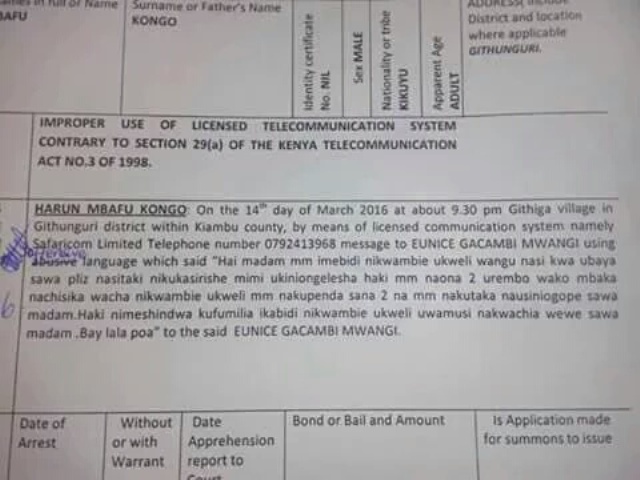
Harun Kongo charged with improper use of licensed telecommunication system for expressing love to Eunice Mwangi

Harun Mbafu Kongo was charged with improper use of licensed telecommunication system for expression his affections to Eunice Gacambi Mwangi.

Before being charged Harun worked as a herds-boy and and gardener for Eunice’s home in Githiga, Githunguri, Kiambu County. Eunice is widowed and has three children, the older being in University while the youngest is in class two.

Harun recounts that it was an effort to safeguard his job that led him to send the text.

We have known each other for six years and nine months because I worked at her home. Before she reported me, I had reported her at the labor office for sacking me without a valid reason and refusing to pay me. It is after she realized I had reported her that she decided to file the case.

Mr. Kongo agrees to have sent the text on 14th March 2016. He says before the husband to Eunice died, she used to express feeling for him. But they grew bolder when he died in January this year. He therefore decided to send her the text in a bid to show her that he also had some affections for her. His aim was to secure his job.

Eunice sacked him stating that she intends on selling the cows so that she can get school fees for her children. He says that while indeed he sent the text, he has no feelings for her.

Harun charge sheet


Harun Kongo was charged in a Githunguri court on 7th April 2016. The charge sheet stated that the improper use of licensed telecommunication system was because he used a Safaricom Limited telephone line to send a message to Eunice Mwangi. The message he sent to her is what the plaintiff (Eunice) felt was offensive.

In the message, he tells Eunice that he has feelings for her as she is beautiful. He confesses to have harbored the feelings for a while and urges her not to be afraid.

When he went before court, he pleaded guilty. While Eunice was in court she did not speak anything. The court however forgave him and he was set free.

Eunice was unreachable on phone. We will update the story once she offers her right of reply.