Monday, December 22, 2025
Home Blog Page 36

Mombasa aspirant will not have manifesto or make campaign promises

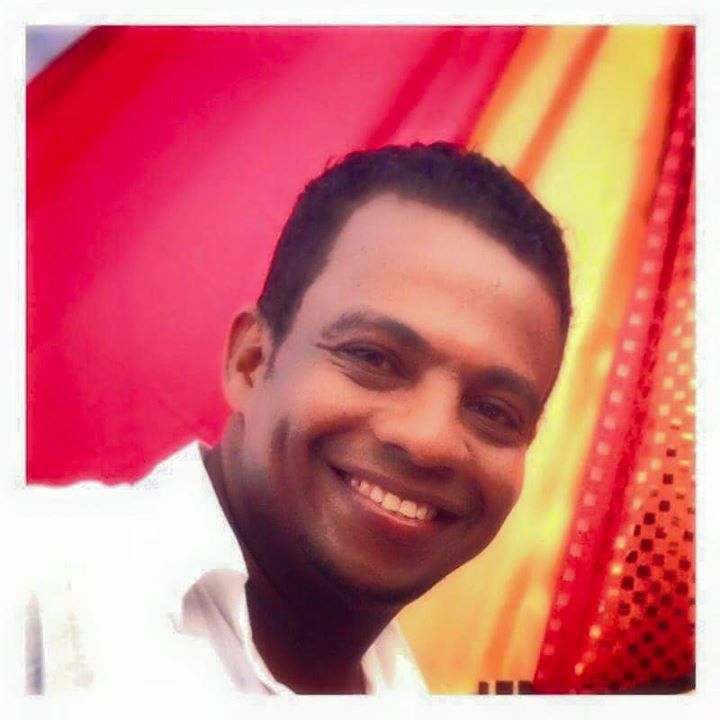
Hemed Said Hemed aspiring MCA Mombasa Old Town Ward

We are 2 years away from the elections but that has not slowed down the clamor by politicians for political seats. Already Nyali MP Hezron Awiti has indicated that he is going to lock horns with governor Ali Hassan Joho for the governors position. Other aspirants have already announced their plans for parliamentary and county assembly positions.

None of has attracted as many aspirants as Old Town Ward. This ward is right in the city and is the location of two important sites in Mombasa, Fort Jesus and the Old Town. It is an influential ward in the history, culture and politics of Mombasa. The nominations come 2017 will be spirited and hotly contested.

However, one candidate has completely changed the game with a promise not to make promises or have a manifesto. Instead Hemed Said Hemed has promised to donate his  salary to the ward in order to solve the citizens problems. He also promises to be a man of the people who will shun titles like Mheshimiwa which he says alienates the people from wananchi.

“I will be the first MCA in Kenya to refuse the Title “Mheshimiwa”. I want to be regarded as the “people’s servant. I will be elected to serve the people therefore Waheshimiwa are you the people. I am an employee not Mheshimiwa.”

In what seems to be a contradiction to his humble stance, Hemed introduces himself as his “His Highness” which is a form of address for a Prince. He states

“I his Royal Highness Hemed Said Hemed the son of Legendary retired politician and ambassador.”

Hemed elaborates on his plan for old Town in which he vows to be the first politician to demand “zero salary”. Instead, Hemed’s salary will be; “distributed to orphans, sick, poor and scholarships” He will also not make any promises or create a manifesto.

Naela Buran congratulated Hemed saying

“By doing this, it motivates, empowers and inspires the community to your vision…. you have always been a people’s person from a senior to a junior and if anyone can do it, YOU CAN. You were born to do this. Bring on the change!”

On his Facebook page “Hemed for old town ward” his supporters are enthusiastically looking forward. Messages of support and encouragement are plenty.

Patricia on the other hand challenges Hemed to do more for the residents.

“Giving money to the destitute, is like putting the carrot in front of the cart. Restore the glory. Priority is Security, schools, hospital.”

Hemed’s message is clear for would be voters.

“Sina Ahadi bali nina Vitendo”
I have no promises, only actions.
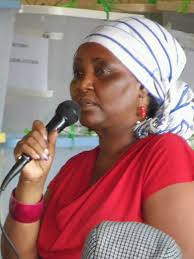
Kilome MP warns Senator Mutula against inciting residents on Makueni-Kajiado border row

Kilome MP Regina Ndambuki Photo:Google
Kilome MP Regina Ndambuki
Photo:Google

The border dispute between Makueni and Kajiado County has taken a different twist after Kilome MP Regina Ndambuki hit out at Senator Mutula Kilonzo Junior for allegedly fanning the border dispute.

Ndambuki cautioned the Senator to refrain from making remarks that could create tension between the Kamba and Maasai communities and instead called for an amicable solution in resolving the border dispute.

Speaking at Kalembwani when she toured the area to assess development projects, the MP maintained that the boundary between the two counties was the railway and not in Emali town as stated by Mutula Junior.

“I call on residents especially those in Emali to remain calm and desist from being involved in the border dispute that could jeopardize the peace that has existed between the two communities,” she said.

The MP underscored the need to involve leaders and communities from both counties to address the problem and asked the residents not to pay attention to the senator’s sentiments.

However, in a quick rejoinder Senator Mutula Junior challenged the Kilome legislator to take on the Independent Electoral and Boundaries Commission (IEBC) who have adopted the Emali town as the boundary for the two counties.

In Facebook post in his official page, the senator asked the MP to challenge the map on the boundary issues not, him.

“Hon Regina should have challenged the IEBC letter and Map,”read the post in part.

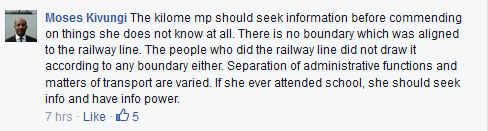
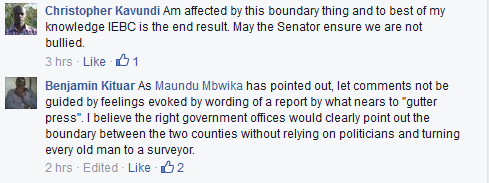
The border dispute has also continued to stir a debate on Facebook with majority residents asking the MP to seek  facts on the border dispute before dismissing the senator.

Below are the comments.

T1

T2

T5

Others cautioned leaders over their remarks and called on the relevant authorities to help resolve the matter.

T3

T4

The dispute was triggered by Senator Mutula Junior recent remarks that a piece of land measuring 800 metres from the railway line in Emali town falls under Makueni County sparking protests from Kajiado leaders who have insisted that the boundary lies at the colonial railway line.

A meeting held by Kajiado leaders on last Thursday led by Kajiado Governor David Nkedianye did not yield much as their Makueni counterparts snubbed the meeting.

2007 PEV led to quest for reforms, audit report on constitution says

Constitution Snip
Former President Mwai Kibaki holds a copy of the new constitution during its promulgation in August 2010. The audit report says the search for the constitution was partly due to the 2007/08 post election violence that left more than 1,000 people dead (Photo/Google).

The 2007/08 post election violence that left more than 1,000 Kenyans dead is one of the key reasons that led to the push for constitutional reforms in Kenya.

An audit report on the constitution has stated that the violence which also left more than 650,000 people displaed was adopted as

“part of the long-term measures to address the root causes” of the violence.

The report which traces the constitutional reform to the colonial times also says the reforms were pushed by the need to deal with dictatorial Presidents.

“Kenyans‘ desire for a new constitutional dispensation can be traced back to the effects of concentrating power in the presidency without attendant checks and balances.”

It will be noted that the violence has been associated with the contested Presidential election results of the time. And despite there being no clear winner of the election as the then Electoral Commission Chairman Samuel Kivuitu would later say, Mwai Kibaki was declared the President.

According to the report, prior to the new constitution which was inaugurated in August 2010, elections in the country were not platforms that advanced democratic rule in the country. This bad practice the report says started as early as 1969 with the ban of the Kenya People’s Union (KPU) – one of Kenya’s earliest opposition political parties – the introduction of the infamous Section 2A that saw KANU made the only party in Kenya and the attempted coup of the August 1982.

“Elections became rituals as opposed to a channel through which the democratic voice of the people could be heard,” the report partly reads.

The report further notes the unfortunate situation that would later be experienced in the country after the (re)introduction of multiparty politics in 1991 – that of constant ethnic clashes every time Presidential elections were held in the country.

“Presidential elections triggered deadly ethnic clashes in the Rift Valley and Coast Regions which were perceived as KANU strongholds. The political objective behind the clashes was said to be intimidation of communities perceived as opposition supporters. As it turned out, the displacements during the voting period disenfranchised voters.”

“It became clear that multiparty politics, without broader political reform, was no guarantee for democratic space. The state had invented ways to subvert democratic will even within the context of multi-party politics.”

The report names the Provincial Administration and Local Authorities as some of the ways the state was using to remain in power “illegally.”

“Kenyans wanted institutions through which repressive laws and practices were meted out such as the Provincial Administration either abolished or reformed and the Police Force turned into a Service for the people.”

Following the violence the then President and Leader of Party of National Unity Mwai Kibaki entered into negotiations with Raila Odinga, the then leader of the Orange Democratic Movement (ODM) who would later become a Prime Minister under a shared power deal. The negotiations were led by former United Nations Secretary General Kofi Annan and came up with a raft of recommendations that later became known as the Agenda 4 items.

And in a big way the Agenda 4 items or the ‘long term issues and solutions’ were later to be given serious considerations in the new constitution. They include institutional and land reforms among others.

The new constitution is also clear on how the President is to be elected and the threshold (50% plus 1 vote) which is required before a Presidential candidate can be declared a winner.

Further the constitution is clear on how the Presidential elections can be contested and even how the President should be sworn in.

“The swearing in of the President-elect shall be in public before the Chief Justice, or, in the absence of the Chief Justice, the Deputy Chief Justice,”

states Article 141(1) of the constitution.

Changing schools isn’t solution for Garissa terror survivors

Candle 2

Having encountered the traumatic events that led to the brutal death of their colleagues, some survivors of the April 2nd terrorist attack survivors at the Garissa University College are still not in a stable state to make the next move in their academics.

Psychologists say that it is too early to make decisions to relocate the students who are yet to come to terms with the horrific events at their university. Solomon Mwangi, a counselor at Christ is The Answer Ministries (CITAM) Valley Road says that the survivors of the April terror attack should be allowed to mourn and cry instead of hurrying to make immediate major decisions.

“They need counseling. They should also be trained to forgive those who did this evil despite how difficult this may be. They should be allowed to talk as much as possible regarding their experiences from the incident,” said Mwangi.

According to him, it normally takes at least nine months to mourn the death of a close friend or relative. Sometimes it takes a few years depending on how close you were to the departed one. He, thus, says that changing the learning environment is not necessary the solution to the trauma.

“Would you, for instance move from your permanent home after a robbery attack?” he poses.

Mwangi was responding to the government directive to transfer the survivors to the Moi University’s main campus in Eldoret after the Garissa University College was closed in April following the attack. The students reported at Moi University Main Campus on May 20th, less than two months since the attack.

Edwin Orang’o, a Second Year Business Management student at the Garissa University College told The Monitor that he just got his new national Identity Card after as he came to Nairobi with nothing.

“We left everything there and were given Sh1,000 each by the school administration before being put in the bus that brought us to the Nyayo National Stadium. When we asked about our books, certificates and other personal belongings, we were told they will be brought back. But we have not received any feedback yet,” Orang’o explained.

But he says although some of the items have been delivered to him, he still lost some clothes and his mobile phone.

“Some of my colleagues even lost their laptops,” said Orang’o.

Despite the uncertainties surrounding their back to school plans, Orang’o says he is psychologically prepared to continue his education after receiving regular counseling from Kenyatta National Hospital where he was attending once every week.

“I would often meet most of my friends during these sessions and we shared a lot on any updates about our going back to school. But we were still uncertain about our admission requirements in Moi University, accommodation plans, how to recover our items and whether we will be paying school fees or not,”

said the 19-year-old former Upper Hill School student.

While moving to a new campus will be healing and therapeutic to some students, Mwangi says that to others it will be characterized by flashbacks of the April 2 happenings.

“This will take probably not less than one semester to adjust to a new environment, make new friends even as they try to forget or live with the Garissa effect psychologically. Stabilising fully will take some at least a year and others less,” he says.

But despite the impact of the terror attack that led to the death of over 140 students, Mwangi says that life must move on. He adds that it is not time to breed religious differences, especially among students at this time.

Mombasa Creatives to work together

0
Creatives in Mombasa

In a quest to foster creativity and innovation among the youth in Mombasa, a group of creatives have started monthly meetings to discuss and nurture growth amongst themselves. The monthly meetings known as ‘Over Coffee’ seek to create awareness of the challenges they face and develop a peer support system for those in creative industry in the city. They also intend to raise the visibility of the creatives in Mombasa amongst local businesses and seek new markets for their skills.

The group includes photographers, designers, bloggers, writers among others based in Mombasa.

As more and more youth find an outlet in creative businesses, the lack of formal support structures is evident and it is the basis for Over Coffee meetups in Mombasa.

The meetups will empower the youth and develop their skills, network, learn from peers and discuss any burning issues with like minded people. They will also invite guest speakers/lecturers to the event.

Toby Wesa, the events founder said

“There is so much that can come out of an informal discussion, and I’m ready to share whatever little knowledge I’ve acquired in my journey as a photographer to anyone starting out and I know there are countless professionals out there who are willing to mentor too. I’ve benefited immensely from conversations I’ve had with others more experienced than me in my career and want to open up this learning opportunity for other.”

Creative industry in Kenya has immense potential for job creation in Kenya. According to Kennedy Kachwanya the Bloggers Association of Kenya Chairman, creatives have the biggest potential to create jobs.

“There are a number of creatives who are very talented and for a long time I have always thought they can do more to create brands. Now jobs are created when people put their foot down on the ground  and build SMES,’ he added.

Davis Mbele a copywriter was delighted  with the opportunity to interact and learn from peers.

“There are so many creative minds in Mombasa but have no clue on how to start or even go about their way. This platform is supposed to be a platform that will lift the creatives and also network them to other opportunities.”

“It has been tough at the beginning trying to venture out as a creative. I noticed there aren’t many places in Mombasa to assist in building a talent. However, through this initiative, I am excited to meet fellow creatives, to learn, and to empower each other”, said Jamila a Mombasa based blogger.

Mbooni MP wants officers involved in graft in Makueni sacked


Mbooni MP Michael Kisoi  photo courtesy of K24
Mbooni MP Michael Kisoi
photo courtesy of K24


By Daniel Kituku

Makueni Governor Kivutha Kibwana should relieve off duties officers arraigned in a Machakos court over graft allegations.

Speaking on Saturday in Nduluku, Mbooni Sub County during the launch of Hon. Kisoi Munyao talent search MP for Mbooni Michael Kisoi Munyao and three Members of the Makueni County Assembly (MCAs) gave Kibwana a 21 -day ultimatum to send the officers packing until the court cases are determined.

Kisoi and Ward Representative for Kisau /Kiteta Jackson Ngovi, and his counterparts from Kako/Waia and Kalawa wards Mutinda Mwangangi and Patrick Kithale respectively said Makueni county had lagged behind due to corruption noting that this was the opportune time to fight the vice.

The leaders said if Kibwana fails send the officers home they will lead Makueni residents to the county headquarters and forcibly remove them from office.

“We shall not relent in this fight against corruption,” said the MP.

Last Thursday Ethics and Anti-corruption officers arrested eight officers working in Makueni county government and arraigned them on Friday in a Machakos law court for graft.

Ag.County Secretary Rael Muthoka, Director of Tourism Diana Muli, Agriculture Chief Executive Officer Mary Muteti, Roads and Infrastructure Chief Officer Martin Kitavi, Director Finance Justus Suka, Director Procurement Alex Kyalo, former Chief Executive for Water Daniel Mututa and his former Education counterpart Augustine Kitheka were charged in Machakos law court for willful failure to comply with the law relating to procurement contrary to section 45(2)(b) as read together with section 48 of the Anti-corruption and Economic crimes Act, 2003.

According to the prosecution, the eight who are members of the tender committee, on the 21st day of June 2014 within Makueni county , being employees of Makueni County Government jointly and willfully failed to comply with the law relating to procurement with regulation 10(2)(a) of the Public Procurement and Disposal Regulations of 2006 by failing to ascertain all procurement processes had been undertaken when awarding the contract for supply, installation and commissioning of a skid mini dairy plant at Kikima farmers coop- society in Mbooni Sub – County to ASL Ltd.

The Ag.County Secretary Ms. Muthoka, also faced two alternative charges of abuse of office contrary to section 46 as read with section 48 of the Anti- Corruption and Economic Crimes Act no 3 of 2003 and failure to comply with the law relating to the procurement contrary to section 45(2)(b) as read together with section 48 of the Anti-Corruption and Economic Crimes Act , 2003.

Ms.Muthoka was released on a cash bond of Sh300, 000 while the other seven were released each on a cash bail of Sh100, 000.

The Governor has however denied the allegations that his officers have been involved in graft and accused the MCAs of reporting the tender committee to the Ethics and Anti-Corruption Commission (EACC).

Community health volunteers on big assignment in Machakos

Charles Muia-Vice Chairman-Kivaa Community Unit- (Photo by Lilian Kaivilu)

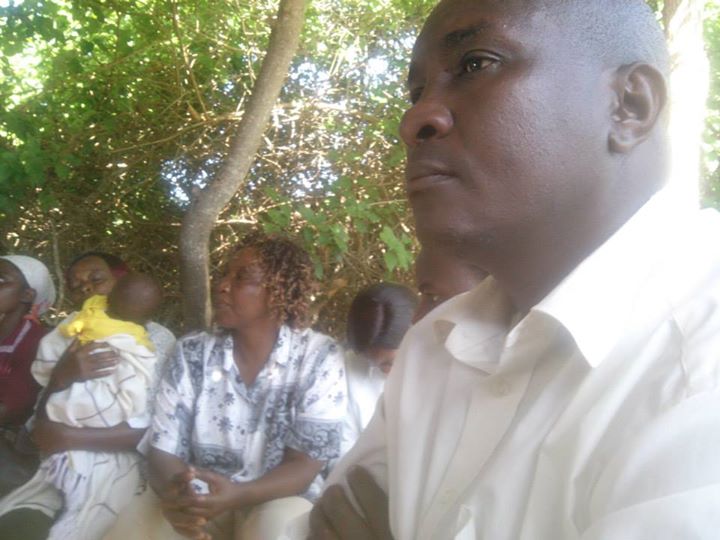
In the serene and relatively calm Kivaa Sub location of Masinga Sub County in Machakos County, off the Thika Garissa Highway, life is seemingly usual but not to over 60 men and women busy strategizing on how to improve the health of the children and mothers in the area.

A health facility along the road is filled with three groups of men and women holding regular meetings within the compound. Just outside the gate of Kivaa Sub-location Community Health Unit is a government ambulance, popularly referred to the locals as ‘Governor Mutua’ ambulance.

But the ambulance is just but a means for the 62 volunteers who have come together to address the health needs of residents in the area. The group comprising 40 women and 22 men comprises of community health workers, community health extension workers employed by the Ministry of Health and a community health committee.

Established in 2011 under the government’s community health programme, the Kivaa Community Unit (CU) consists of more than 50 trained health workers who are assigned 20 households each.

“Each community health worker is expected to keep track of the members of the 20 households under him by ensuring that they have adequate access to health services such as immunization, child protection, reproductive health, nutrition and disease control,”

explained the Kivaa CU Vice Chairman Charles Muia.

Currently, the CUs cover up to 1,000 households in the region and each CU is linked to a health centre for medical referrals.

“The Kivaa CU is linked with Kivaa Health Centre with the nurse in charge following up the community health workers and assisting them on matters of treatment and nursing care for the patients they refer,” said Muia.

According to the, Muia, the group’s main agenda is to ensure that all community members obtain immunization and health education towards reducing preventable diseases. He added that the CU members meet once every month to give report about the health status of the 20 households. He added:

“We bring forth such reports as the number of pregnant mothers, attendance of the antenatal clinics, follow-ups on immunization and growth monitoring of the children, follow-ups on ARV uptake by people living with HIV/Aids, TB defaulters and latrine construction.”

Jacinta Mutuku, a community health worker in the area says that the team also works to ensure child protection in Kivaa and its outskirts.

“With the help of Plan International in this area, we have so far arrested several people and initiated five cases in court and we hope justice will be given,” she said.

To improve their livelihoods as volunteers, the community health workers have registered a social group under which the members can access loans. So far, the group has saved more than 234, 000 which is used to advance loans to members. By April last year, the group had bought 139 goats which have been given to each member for rearing on behalf of the group. The group also has planted 1,500 seedlings which they sell to the community at subsidized prices.

Claire Nasike, a 2015 BAKE Awards nominee, wins the Wangari Maathai Award

From left-Janet Mawiyoo CEO KCDF, Mwihaki Muraguri-Kimura Senior Associate Director of Rockefeller Foundation Africa Regional Office, Dr. Isaac Kalua Founder and Chairperson of Green Africa Foundation and Wanjira Mathai of Green Belt Movement. PHOTO CREDIT: conservationatheart.wordpress.com

Claire Nasike won this year’s Wangari Maathai Scholarship Fund Award, becoming the third winner of the annual environmental innovations award.

Nasike, who was also a Best Environmental/Agricultural Blog nominee at the recently concluded Kenyan Blog Awards in May is a blogger on www.conservationatheart.wordpress.com.

The award established three years ago is as a result of a partnership between the Rockefeller Foundation, the Green Belt Movement and Kenya Community Development Foundation (KCDF).

The fund which was established in memory of the late Prof Wangari Maathai and her work in environmental conservation seeks to develop and nurture development and action oriented young women with strong values and commitment to the conservation of the physical and social environment in Kenya.

Twenty-Four year-old Nasike is a Bachelor of Technology in Environmental Resource Management student at Technical University of Kenya. According to her, her passion for environmental conservation dates back to the time she was growing up, at the age of eight, when she learnt from her grandmother about caring for natural resources. Nasike grew up in flood prone village of Port Victoria in Budalangi.

Besides, Nasike leads the “Return to Sisterhood’ project that seeks to empower school children to regain control of their environment. To date, she has reached and impacted over 400 girls in various schools within her community.

According to the Kenya Community Development Foundation, the annual award of Sh500,000 is given to a competitively selected female recipients aged between 18 and 25 years, who have demonstrated outstanding leadership in environmental conservation.

Claire hopes to scale her conservation projects with the scholarship fund to empower young girls and women in her area to conserve the environment for future generations as well as to benefit from it through different livelihood projects that come from environmental conservation.

The event held on Tuesday in Nairobi was graced by, among others, the Green Belt Movement Chairperson Ms. Wanjira Maathai, KCDF CEO Ms. Janet Mawiyoo, Rockefeller Foundation, Africa Office Associate Director Mwihaki Muraguri, Director Wangari Maathai Institute Professor Gitahi Kiama, and Green Africa Foundation Chairperson Dr. Isaac Kalua.

Photo credit: conservationatheart.wordpress.com

The gap in MDGs that SDGs will fill

Exit Millenium Development Goals usher Sustainable Development Goals Photo by UNPD

It is only a few months to the deadline of the attainment of the Millenium Development Goals (MDGs). MDGs were an 8-pointer development framework that was launched in 2000.

As the countdown begins some people have questioned the structure of the MDGs and highlighted a few loopholes that could have led to the challenges that faced their implementation. The MDGs after 2015: Some reflections on the possibilities, a document published in 2012 by Deepak Nayyar, states that the MDGs failed in that they did not address the processes and means of attaining the goals but rather concentrated on the end goals themselves.

Mwangi Waituru, the Post 2015 policy and advocacy adviser for Africa and also the Beyond 2015 Kenya National coordinator says that the greatest weakness of the MDGs was that the rich countries set the goals which they expected poor countries to plan within, a condition that would grant the poor nations aid from them.

The MDGs have also been faulted as not being holistic as they never addressed poverty fully. Even though poverty was a key pillar in the MDGs, it was like sustaining poor countries but not really delivering them from poverty. Last month, the World Bank Group President Jim Yong Kim revealed that there are still about 1 billion people living on less than $1.25 (Sh116.7) a day.

He explained,

“Poverty is 2.5 billion people not having access to financial services like bank accounts. Poverty is 1.4 billion people without access to electricity. Poverty is having to put your children to bed without food. And poverty is not going to school because, in order to survive, everyone in the family needs to earn a few cents each day.”

Currently governments are being engaged to give their opinion on what they are comfortable with in each agenda in the Sustainable Development Goals (SDGs).

“The MDGs, however, was like a contract between the rich countries and the poor countries. The poor countries like Kenya did their part but the rich countries did not. The rich were to give the poor countries 0.7 per cent of their Gross National Income if they complied with the MDG framework,” explained Waituru.

To discuss how the financing of the SDGs will be financed, the third International Conference on Financing for Development will be held in Addis Ababa, Ethiopia in July this year.

The meeting will address, among other things, how the Sustainable Development Goals are going to be financed and implemented. In the conference, countries will be represented by ministers of Finance, World Bank and the International Monetary Fund and all those who control the resources.

According to the United Nation’s Department for Economic and Social Affairs, the conference that will take place between 13th and 16th July will bring together gather high-level political representatives, including Heads of State and Government, ministers of Finance, Foreign Affairs and Development Cooperations, Non-governmental organizations and business sector entities.

Although they are yet to be officially launched, the SDGs, unlike the MDGs, are designed in a way that they are participatory and they address what matters most.

In the SDGs, the member states are represented in the formulation of the goals. For instance, Kenya and Hungary were co-sharing the process that listed the 17 proposed SDGs. Now, Kenya and Ireland are co-facilitating the same.

Arrest of eight Makueni executive officials creates frenzy on social media

EACC headquarter in Nairobi.Eight Makueni officials have been arrested by the antigraft body for corruption allegations Photo:Google
EACC headquarter in Nairobi.Eight Makueni County officials have been arrested by the anti-graft body for corruption allegations.
Photo:Google

Last evening, officials of the Ethics and Anti-Corruption Commission (EACC) arrested eight Makueni County executive officials over allegations of graft.

County Secretary Rael Muthoka, Director of Tourism Diana Muli, Agriculture Chief Executive Officer Mary Muteti, Roads and Infrastructure Chief Officer Martin Kitavi, Finance Director Justus Suka, Director Procurement Alex Kyalo, former Chief Executive for Water Daniel Mututa and his former Education counterpart Augustine Kitheka were arrested at around 6 pm for flouting procurement procedures and overspending over the approved budget.

The eight who are said to be members of the tender committee were later released on a cash bail of Sh50,000 and are expected to appear today before a Machakos court to answer to the charges.

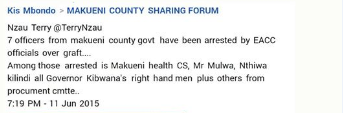
Initial and unconfirmed reports posted on social media had indicated the Health Executive Dr. Andrew Mulwa and Assistant Director for Research Nthiwa Kilindi who are close allies of Governor Kivutha Kibwana were among those nabbed creating frenzy on social media.

The post  from Twitter and shared in a  Facebook group called Makueni County  Sharing Forum drew more than 200 comments within the  first hour  including the Governor and the other two officials who were erroneously mentioned.

The two officers have since demanded an apology from Terry Nzau who initially Tweeted the arrests. The post has since been pulled down.

g1

In the Governor’s post which has been re-posted in his official Facebook page, Kivutha admitted that the officers had been summoned by the EACC  and would appear in a court today in Machakos. He absolved the officers from any wrong doing and instead turned the heat of the Members of the County Assembly who he accused of witch-hunt.

The post reads in part,

“The County Assembly of Makueni made allegations to EACC that we, the Executive, had authorized expenditure ovér and above the budget for Kikima Mini-Diary. The EACC has today notified 7 members of our tender committee and the Ag. CS that they should present themselves at Machakos Law Courts for official charging tomorrow.”

It continues to read,

“Regarding Kikima mini-diary, the committee did a first open tender where the tenders were in the region of sh12M. They did not award any company. During the second bid, which was also an open tender, the tenders came to about sh6m. The committee awarded the lowest bidder.”

According to Kivutha the fact the the tender committee did not award the Sh12M tender saved the county money.

He said,

“As a governor I am persuaded that the tender committee ensured we got value for money by refusing to award in the first instance and awarding to the lowest bidder in the second instance. The Assembly delayed the budget up to November 2013. This made real procurement for about 600 projects start in April 2014 after the survey, design and preparation of Bill of quantities or specifications. The tender committee had to work even past midnight in many occasions to help us meet our obligations.

The Governor ends his post by saying,

“God is the source of truth and justice.”

The arresting of the officers comes barely two days after the Director of Prosecution Keriako Tobiko recommended for the prosecution of the Governor and the tender committee members for spending over and above the approved budget in the 2013/2014 budget.

The arrest puts the Governor who is seen as  anti-corruption crusader in a tight spot. The MCAs have been on the record accusing the Governor for abetting corruption and time will tell whether the MCAs were right or perhaps it is a case of witch-hunt as Kivutha has intimated.

The timing of the arrest could also raise eyebrows coming hot on the heels after the commission of inquiry unearthed the rot of nepotism and graft in both arms of the government. The governor while testifying before the Mohammed Nyaoga – led commission waded through the murky waters of corruption allegations with tact and admitted to institutional and personnel challenges that could have led to the pilferage of millions of shillings.

Consequently, the fact that the news first broke in social media through a Tweet from a journalist confirms the role of social media in relaying information instantaneously to a large number of people long before the mainstream media. However on the flip side the fact that some of the officers were falsely mentioned is also another confirmation that social media is awash with rumors and allegations that could have far reaching consequences on the persons involved.

Therefore, as journalists adopt social media as a source of news, its prudent that caution be exercised to avoid misrepresentation of the facts.

Mombasa Senator launches human dignity Bill

Senator Hassan Omar
Senator Hassan Omar launching the Human Dignity Bill

It is no secret that Kenya is one of the most unequal societies in the world. It is also one of the most corrupt nation ranking poorly in corruption for the last two decades. Indeed, it is one the worst places in the world to be poor or underprivileged as the government does little in terms of bridging the gap between the rich and the poor.

If you are absolutely poor, then there’s nothing the government can do for you. Hunger or disease will most likely kill you and your poor kin have to do a fundraiser just to bury you. Our leaders have resisted the need to bridge the gap, they have cheap votes come the election time. By raising the standards of living, buying voters becomes hard or expensive.

However, having a population that is impoverished guarantees politicians easy votes. Sometimes, for a few hundred shillings and a few packets of maize meal is all it takes to secure a seat.

Once elected, the leaders go on to widen the gap. “eating” wherever they can, with little regard for the poor. Despite our progressive Constitution, this country is lacking in  meaningful interventions for the poor, old, marginalized citizens. The antics at the August House with a disgraced Public Accounts Committee show where our leaders priorities lie.

Perhaps, our leaders have missed Chapter 4 of the Constitution under Economic and Social rights, it says;

(1) Every person has the right–
(a) to the highest attainable standard of health, which includes the right to health care services, including reproductive health care;
(b) to accessible and adequate housing, and to reasonable standards of sanitation;
(c) to be free from hunger, and to have adequate food of acceptable quality;
(d) to clean and safe water in adequate quantities;
(e) to social security; and (f) to education.
(2) A person shall not be denied emergency medical treatment.
(3) The State shall provide appropriate social security to persons who are unable to support themselves and their dependents.

Senator Hassan Omar’s move to introduce the Human Dignity Bill is a laudable move to ensure that leaders deliver as per policy and not play politics with service delivery especially to the poor people. The bill enshrines support for the poor in government policy both at the national and county level.

The bill seeks to;

(a) Ensure that economic and social rights are realized by all as set out in the constitution.

(b) Establish a framework to guarantee economic and social rights

(c) Ensure that National and County Governments adhere to standards set towards realization of economic and social rights;

(d) Monitor and promote the realization of the economic and social rights by the County Governments;

The bill also addresses the need for central government to provide grants to ensure human dignity at county level and proper allocation of the equalization funds especially for urban counties that are struggling with big populations of underprivileged people.

“This Bill will see that every person has access to the highest standards of health, accessible and adequate housing, is free from hunger, have access to clean, have social security and education,” said Omar.

Should this bill sail through, it will alter the political landscape forever. It puts the responsibility of ensuring human dignity squarely on the government at all levels with clear policy. Politicians will no longer use projects like opening public toilets, improving hospitals, feeding the poor as campaign tools.

It is their job in the first place and delivery will be guaranteed to citizens by Constitution. This Bill may finally de-link politics from informing policy especially where human dignity rights are concerned.

It is perhaps time, as Senator Omar argues for leaders at the national and county government should tell us how how better-off the people are and not on how many highways they constructed.

Makueni court acquits Priest charged with attempting to murder fellow Priest

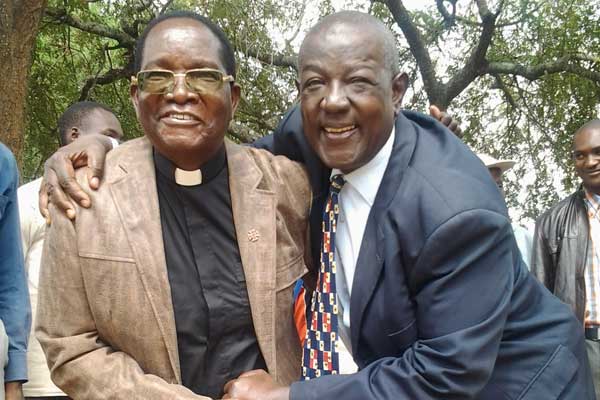
Fr.John Makewa and his Lawyer Fred Nemisi Photo:Nation
Fr.John Makewa and his Lawyer Fred Nemisi
Photo:Nation

A Makueni court has set free a Catholic priest accused of attempting to kill his colleague in March 2010.

Senior Resident Magistrate Richard Koech acquitted Fr. John Makewa for attempting to kill Fr. Fidelis Nzuki at the Makueni parish house.

The magistrate in his judgment cited lack of sufficient evidence and proceeded to declare the accused innocent.

“I do not find the accused guilty as charged and therefore declare him innocent,” he said.

Koech accused the police of bungling with the investigations and noted that the fact that the accused took Fr.Nzuki to the hospital and visited him severally when he was admitted was enough to prove the accused innocence.

Immediately, the priest was declared innocent, his supporters who had accompanied him to the court broke out in song and dance.

Fr. Makewa was initially charged in Makueni court in 2010 for shooting and attempting to kill Fr. Nzuki for unknown reasons, a charge that the accused denied.

In his defense, the accused said that robbers who had invaded the parish house at dawn on the material day shot and injured Fr. Nzuki.

This is the second time the case is being heard after the accused successfully appealed in Machakos High Court after a Tawa court sentenced him to seven years in jail for the crime.

The accused lawyer Fred Nemisi lauded the judgment saying that his client has been vindicated.

“It has been a long journey for my client and we are happy that this court has finally delivered justice,” he said.

One the accused supporters Albanus Mutisya extolled the court for acquitting the accused.

“The father has suffered enough for those years and we are happy that God has finally answered our prayers,” he said.

The complainant Fr. Nzuki declined to talk journalist, instead got into his car, and sped off after the judgment perhaps irked by the outcome.

The much awaited judgment has brought to an end a case that has put priesthoods on test. One would wonder why a priest would want to kill a colleague.

Of great interest would be whether the Catholic Church will reinstate the once powerful and influential priest.

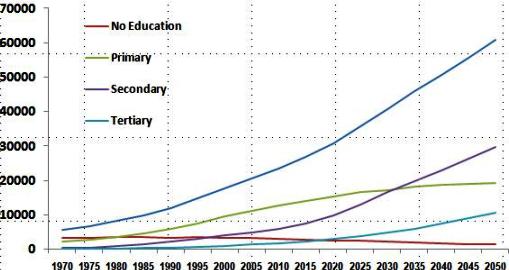
Is increasing education funding cure to unemployment!

Education funding has been increasing in Kenya (Photo Courtesy of the Kenya National Bureau of Statistics)

Over the years, the education sector in Kenya has been allocated an increasing amount of money during the annual national budget. But whether the increasing allocation to the sector will result in automatic economic development and job creation in the country is still a puzzle.

In the recently released Kenya Economic Survey 2015 by the Kenya National Bureau of Statistics, 800,000 new jobs were created in 2014. Over 600,000 jobs, which represents, 82.7 per cent of the jobs came from the informal sector. There were 22,000 new jobs created in casual employment for females in 2014, representing a 6.2 percent increase in the informal employment in 2014. This is higher than the 5.9 per cent increase in 2013.

The education sector continues to get the lion’s share of the country’s national budget each year. According to the Highlights of the 2015/2016 Budget-The Mwananchi Guide, the sector was allocated Sh27.1 billion more; from Sh308.6 billion in the 2014/2015 financial year to Sh335.7 billion in the 2015/2016 financial year. Out of this, Sh32.7 billion has been set aside for free secondary education, Sh14.1 billion for free primary education, Sh52.9 billion for university education, Sh181.1 billion for the Teachers Service Commission and Sh17.58 billion for the laptop program.

In its 2013-2017 manifesto, the Jubilee Government outlined its commitment to do away with the financial and non financial hurdles that hinder access to education. The government, in addition, promised to increase the amount allocated to the education sector.

The Coalition government’s manifesto had also indicated the plan to increase education funding by 1 per cent each year so that by 2018 it reaches 32 percentage of Government spending. This seems to be the trend of increasing allocation without necessary also determining the output from the increase.

The Society for International Development Report 2013 cites that attainment of higher education across all segments of the population is expected to translate to increased economic growth and ensure more equitable distribution of incomes in the long term.

To enhance higher education in the country, the government has consistently increased the funding to university education. In addition, there has been an increasing number of students enrolling in primary, secondary and institutions of higher learning. The total enrollment in primary school rose from 9.9 million in 2013 to 10 million pupils in 2014 while secondary school enrollment rose from 2.3 million to 2.1 million pupils.

But Geoffrey Injeni, a lecturer at Strathmore Business School says that funding education ought to be objective if we are to realize meaningful results.

“If we are just increasing the funding to recurrent expenditure such as paying salaries, then we will not achieve a lot. You may have a little employment arising in the formal sector. This is because, by having more people access education, there will be increased acquisition of technical skills hence more Kenyans will most likely resort to self employment,”

said Injeni, adding that such a scenario is most definitely likely to result in a lower labor force in the formal sector.

He added that funding infrastructure within the education sector can only create side jobs such as construction personnel.

In the 2015/2016 budget to be read on Thursday by the Finance Cabinet secretary Henry Rotich, the money allocated to sanitary towels in schools remained at Sh0.4 billion while the allocations for the resettlement of Internally Displaced Persons doubled from Sh0.6 billion in 2014.

Sheng’ is evolving time and again

0
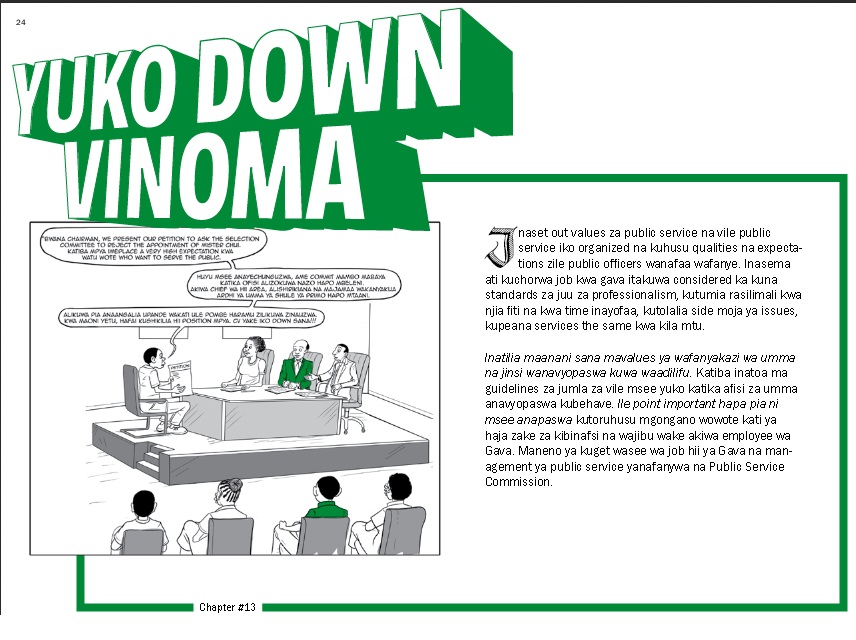
Katiba Mtaani booklet cover


So if you grew up in Kenya from the 80’s onwards you obviously speak sheng or understand sheng in one way or another. Even if you don’t agree with sheng, Safaricom and other corporates ensure you do as they try to outdo each other with new catchy sheng slogans. Ama huna bonga points?

Sheng has been studied by scholars from all over the world and there’s yet no agreement if sheng can be classified as a language or not. According to renowned Kenyan scholar Ali Mazrui, Sheng plays an important socio-psychological function of promoting a sense of group solidarity within the speakers, mainly youth. Sheng speakers feel a unity of motives, feelings, beliefs which is expressed in various localisations of sheng throughout Kenya.

Some months ago, we were part of a project Jukumu Letu with the aim of educating the youth on the different issues in the Constitution including health, youth representation and participation, youth employment, gender and human rights issues. One of the important tools for this task is a simplified version of the constitution (Katiba Mtaani) which incorporates sheng.

A look at the Katiba Mtaani booklet

Jukumu letu intends to enhance the participation of the people in the exercise of the powers of the state and in making decisions affecting them. The citizens are educated on their responsibility of ensuring transparency and accountability in governance.

Sheng speakers were separated from the rest the other day when speakers engaged each other in the sheng debate using the hashtag #MorioDebate. All I can say is it looks like we need to update our sheng knowledge.

The number of people that felt lost in the new sheng is astounding. We will need refresher courses.

The #MorioDebate was generally light hearted with a lot of new words thrown in.

Some corporates got involved and made it even livelier.

The only constant thing with sheng is the change it seems and we have to keep adapting lest they lock us out.

Utange land tussle exposes deep lying land issues

Utange Land Protest
Utange Land Protest (facebook/teammca Mombasa)

A 70 acre piece of land has been the cause of unrest and chaos in Utange area after residents moved in and started fencing and cultivating a 30 acre section of the land that they are claiming. The squatters drawn from Utange 1 settlement have made many claims on the land before and have been tussling with the owners for ownership in a battle that goes back many years.

The land legally belongs to Swaleh Nguru, one of the biggest landowners in coast province who is now deceased. His estate is now administered by his sons.

The matter is an example of the challenges that bedevil land ownership in Coast that have resulted in negative ethnicity, created squatters out of indigenous people and the often mentioned historical land injustices. These matters have resulted in stagnation of development in some areas as the citizens do not own land. The land matter goes a long way back in history and is as old as Mombasa.

The British and Germans allocated the Sultan of Zanzibar a 10-mile strip of land along the entire coastline. The land is from the Ocean to the hinterland for a distance of 1 mile.

The strip has 1,128 parcels of land measuring 80,000 hectares, was the first point where local people got disenfranchised as those within the strip were rendered landless.

Arab landowners and later Europeans were able to legally acquire ownership of huge tracts of land due to locals ignorance of law and illiteracy. As a result, the land ownership question in Mombasa and other coastal areas is one of the most intricate in Kenya. Absentee landlords own about 77,000 acres of land in the coast, as much land as a county.

Some of these lands have never reverted to the communities and are now controlled by absentee landlords through a complex system where residents pay land rents to build and develop on these lands. This is the case in Mvita, Kisauni and other places where the residents continue to pay rent for the land they live on without knowing who exactly owns the land.

In March, the Mombasa County executive for Lands Francis Thoya stated that the county will search for absentee landlords and where they will not be found then the county will take an inventory of everyone situated on the land and divide it to the people.

More than 128,000 families in the coast are squatters in their ancestral land with Mombasa having the most at about 52,000 going by 2009 figures.

Land grabbing, political land allotments and other unfair land ownership practices post independence have worsened the situation. Already, the Waitiki land in Likoni is one of the land crisis that has reached a boiling point and needs quick government intervention.

The squatters at Utange allege that the 99 year leasehold on the land has lapsed and thus are making a claim for it. However, the owner has gone to court and is enforcing an order forbidding them from building, cutting trees or cultivating on the land.

The residents took to the streets and barricaded the road demanding for a right to own the land. During the demonstration, a teenager Ronald Baya was shot and injured in the leg by police who were trying to break the demonstration.

The matter remains a complex one and needs a quick resolution as was the case with the Langata Primary land. The squatters have been calling on Dr. Mohamed Swazuri and the National Lands Commission to get involved in order to solve the long standing issues of land in Utange.