Tuesday, December 16, 2025
Home Blog Page 39

Mombasa County garbage removal trucks an eyesore

Mombasa Garbage Trucks Eyesore

When the current Mombasa County government came into power, one of the promises it rode to power on was to ensure proper garbage collection and disposal. A few months into its term and the government introduced huge trucks parked in strategic places around town where people could place their refuse and the county would dispose of it as it deemed fit. This was greeted with a lot of joy from Mombasa residents who applauded the county government for ensuring sanitation in the city and other places within the county.

Over time however,  amid strikes by county government workers, and flagrant sleeping on the job, the trucks are often left for too long before they are emptied, some are also broken down more times than not. Walking around the Mombasa CBD, one gets disappointed seeing how many of the trucks have been left to overflow with garbage,  with some littering the streets on the ground near the trucks.

Along with the piling mounds of garbage are Street families who scavenge the heaps for food or other valuables. The smell emitted by the garbage heaps on the trucks and surrounding them is as pungent as it gets.

Kevin Odhiambo, who works on Jomo Kenyatta Avenue says the situation has become too much to bear.

“Imagine coming to work in the morning and being greeted with a smelly pile of rubbish. It kills the morale. The trucks were a good idea, but right now I’d rather something was done about them.”

The consensus seems to be that there is little difference between now and before the trucks were introduced.

“In the past, we used to complain about drainage pipes blocking with dirt and smelly mounds of garbage in street corners now we have smelly trucks overflowing with the same garbage they are supposed to take away. What has changed?” asks Mwenda Katumani, a trader who runs a shop in Siwatu, Kisauni.

The eyesore that was the dump site at Bombolulu is now back. The old trucks are in disrepair and most times they are overflowing with trash and once again the area is foul. The dump site is now back.

Masoud, a resident of Mombasa says the County got it all wrong.

“It would have been easier to buy dumpsters and bins and have them everywhere in the County. Then have a few well serviced trucks that move around all day emptying the trash. No where in the world do people use parked trucks as dumpsters.”

There was a glimmer of hope that the situation would improve when the county government in 2014 signed a memorandum with Bamburi cement that would see the cement plant help the city deal with solid waste in a 4.8 billion plan. Not much has been said of that plan since.

Speaking at the signing ceremony, Bamburi Cement Managing Director, Hussein Mansi was quoted;

“The main goal of this project is to address the challenges of solid waste in Mombasa County by developing an integrated solid waste management system.”

Bamburi Cement offered land and final disposal site besides providing scientific waste management expertise and know-how to help the county government manage solid waste.

A county government officer who chose not to be identified assured that the garbage removal trucks are being utilized properly and are emptied as soon as they are full. The county is also allocating its bulldozers to cleanup open air dumping sites regularly and prevent garbage from building up.

Shootings in Old Town worries residents

Tuk Tuk in Old Town Mombasa
Old Town Mombasa (www.willtravellife.com)

At around 7.30 P.M on Sunday evening Khalid Ibrahim Khatri was relaxing with friends along Ndia Kuu near Masjid Shikelly like he does on many evenings. Unknown to him, a gunman was planning to end his life at that spot. An unknown gunman opened fire. Khalid’s quick instincts may have saved his life as he was able to fire back immediately discharging his firearm twice according to eyewitness. This caught the gunman by surprise and he fled into the narrow alleys of Mombasa Old Town. He suffered gunshot wounds to his chest and legs.

He was rushed to Mombasa hospital which is less than 400M away, where he was stabilized. He has now been flown to South Africa for specialized treatment.

This shooting comes barely 3 weeks after another one where a woman and a man were injured by unknown people. A senior CID officer was also shot and killed in the same area less than 2 months ago.

Residents are now a worried lot as it seems as if the police force is powerless to stop the shooters with little being done to apprehend the gangsters. Speculation is life that Khalid, a businessman in the County was a target due to business rivalry. Awadh, an old town resident said,

“May Allah help our society, there are too many guns in the wrong hands in Mombasa and it seems as if these gunmen cannot be apprehended.”

According to a small Arms Survey, Kenya has up to 600,000 illegal firearms in the hands of civilians. That is one illegal firearm for every 70 people. Mombasa is a major entry point for these illegal arms which have found a way through the port due to many loopholes and corruption. The report also states that the coast line has been used to land weapons using light boats to remote sites and smugglers houses.

Speaking last year after an attack on a church, Mombasa County Commissioner Nelson Marwa issued a one week ultimatum to those holding illegal arms to surrender.

“All criminals in this county who are harboring illegal weapons should surrender them within one week. If you are found to be having illegal guns while terrorizing Kenyans, you will be dealt with accordingly.”

Almost a year down the line, residents are already a worried following this shooting.

The National Action Plan (NAP), which attempts to address the issue of small arms in Kenya recommended among other measures, building the capacity of law enforcement agencies, developing socio-economic alternatives to illegal firearm use and promoting public awareness of the dangers of firearms and the need for peaceful conflict resolution.

School boys vow to support menstrual hygiene

Photo courtesy of www.menstrualhygieneday.org

Over 150 boys from different secondary schools in Kibera joined girls from their schools as they celebrated the World Menstrual Hygiene Day last week.

In what was seen as many as a hue shift and a show above the cultural stigma around menstrual hygiene, the boys accompanied the more than 300 girls their various schools to mark the day.

The event that was held at the Kenya Assemblies of God Church in Kibera on May 28, 2015 saw all the girls present benefit from sanitary towels. This years Menstrual Hygiene Day was themed: Let us end hesitation around Menstruation

During the event organized by Garden of Hope Foundation, a non-governmental organization that deals with mentorship and menstrual hygiene for high school students, the students were told the importance of menstrual hygiene and the role of boys in the issue.

As we incorporate the men, we have seen them engage more with the girls in tremendous way. Ironically the boys ask more questions related to menstruation than girls do. Some of those questions include: It is a wrong to buy sanitary towels for my sister? and How does a girl behave when she is menstruating? We have tried to break the silence in some of the words used to refer to periods by constant education to both boys and girls,

said Victor Odhiambo, the Garden of Hope Foundation Director.

Barclays Bank of Kenya who had sponsored the purchase of the sanitary towels lauded the inclusion of the boy child in the discussions around girls health.

We strongly recommend that the boy child becomes part of the menstrual hygiene talk. No girl should ever stay at home because she is in her monthly periods. And that is why as Barclays Bank of Kenya are committed to ensure that all these girls here today and many others access sanitary towels to enable them to be in school, even when they are menstruating,

said Christine Mwai Marandu from Barclays Bank of Kenya.

Some of the schools that benefitted from the sanitary towels include: New Langata Secondary School, New Horizon Secondary School, Strait Secondary school, Calvary Secondary School and Silver Springs Secondary School, all in Kibera, Nairobi.

Mombasa residents against intention to buy County inspectorate vehicles

Brand new county inspectorate cars
Brand new Mombasa county inspectorate cars

The recent announcement that the county government of Mombasa would introduce a fleet of 25 new patrol vehicles which will assist in its security strategy seems to have rubbed many the wrong way. There are already a number of police vehicles patrolling the county, which were introduced by the government last year. The new fleet, which will be fitted with 360-degree cameras will be operated exclusively by officers from the country’s traffic inspectorate.

The new fleet, to be launched in a ceremony which both the Inspector General of Police and the Interior Secretary are expected to grace, has elicited sharp reactions from sections of the Mombasa residents. Some see this as a waste of resources. Many have questioned the wisdom in buying more cars without first ensuring roads in the county are in good condition.

Roy Dzilla, a resident in the Count thinks the government needs to get its priorities right, and sort out issues with roads such as the Kisauni-Kiembeni road and drainage systems in the county; as well as investing in health care which is in more dire need of resources.

“Instead of flashy cars, we need to prioritize development in terms of infrastructure; proper drainage, good roads and sound  health policies. Bamburi roads is a mess. Let the county government invest first in infrastructure and thereafter buy their toys,” he said.

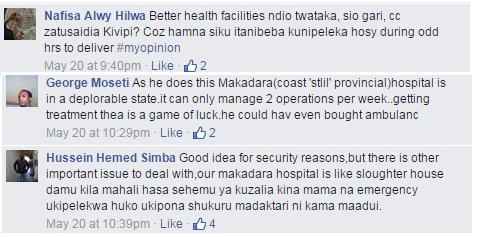
Most citizens were quick to suggest things that were of more priority to them instead of the cars. These suggestions included better roads, bursaries, security among others. However, health care was the most commonly suggested use with most decrying the sorry state of the county hospitals and the lack of ambulances as can be seen on social media posts below.

county cars comments 1 county cars comments

Still, some think it’s a step in the right direction.

“Let us improve security first and development will automatically follow,” says Diruph PH, a Mombasa resident.

Some like Japheth Karanja from Likoni think it’s a bad idea not to involve the Kenya Police in the new initiative, saying this will only go far their stretching the already poor relations between the county government and the national government represented by the County Commissioner Nelson Marwa.

“Security is not a devolved function.”

Mzee Hassan, however,  cautions that efforts such as this may amount to nothing if the cameras and vehicles are not maintained by trustworthy people as the video evidence may very well be tempered with by unscrupulous individuals. There’s also fear that the county inspectorate may turn into some kind of ‘police force’ or become an extortion machine without control as they are not trained legal enforcement officers.

A liaison office will be sent to monitor video recordings, communication and linkages, it was announced.

Law compelling Mombasa businesses to display Governor’s portrait causes stir

Business owners in Mombasa, have one additional requirement if a new law passed by the county assembly is signed. All businesses will be required to display a portrait of Governor Joho in their business premises. The motion was brought forth by MCA of Mjambere ward ostensibly to help create unity and patriotism in the county among residents.

According to the MCA, the law will create respect for the office of the governor among the residents of Mombasa county.  This additional requirement burdens the county residents and there are questions as to how such a law would be enforced and what would be the penalties of going against the law. This news was met with shock and angst among Mombasa residents who are grappling with a myriad of problems among them a poorly equipped hospital, broken drainage system and worsening road infrastructure among other challenges.

Most social media users chose to ridicule the bizarre laws, which will become the first of its kind in Kenya once enacted. It’s constitutionality will be up for debate no doubt, but Mombasa residents are looking at this matter keenly.

Catherine a business owner says the rule shows that the county government has given up on making meaningful change for the residents and is now engaging in sideshows that have little meaning to the wananchi.

“So does that mean I will be arrested by the County Askaris because I don’t have the governors portrait? Why does that matter more than improving life for us?”

she asks animatedly pointing to stagnant greenish sludge outside here shop in Bamburi.

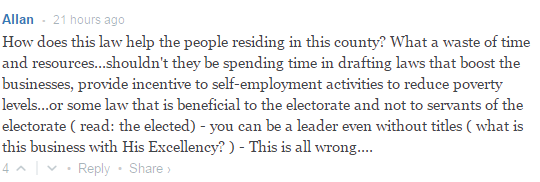
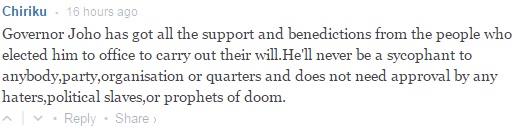
joho comment 1

However, the governors supporters came out strongly to defend the move saying that after all, even the presidents portrait is displayed in business premises. Most argued that Mombasa county had authority to make laws it deemed suitable without the central government meddling in. joho comment joho comment4

However, in a swift rejoinder the governor has issued a statement denouncing the law. In the statement, he urged members of the county assembly to focus on legislation that benefits the residents of Mombasa. This again brings into focus the role of MCA’s in the county government if such a motion was proposed, discussed and passed. Mombasa County Government Statement

Work hard to secure your future, Ambassador Godec tells Nakuru students

Gidec snip

The United States of America Ambassador to Kenya Robert Godec has encouraged students in Nakuru to work hard in their studies in order to secure a bright future. Speaking during the regional Storymoja Festival held in the Nakuru National Library Godec challenged the students that nothing is easy to come by in life.

“In order to become a doctor, pilot, teacher, lawyer or a journalist you need to put more efforts in your studies,” he advised.

He also urged them to adopt a reading culture saying it was a requisite to obtaining knowledge and that it is the best way to change Kenya was through quality education.

“Kenya is wonderful country and it is in need of talented manpower to explore its underutilized resources so as achieve the vision 2030,” he said.

“By reading you also acquire the soft skills necessary for career success in order to be adequately prepared to become job creators, ” he added.

Among those who hosted the Ambassador during the tour of the festival is Dr. Auma Obama who is the patron of Storymoja.

“When I was young I loved reading and also enjoyed touring different nations which motivated me to work hard in school leading to my appointment as a diplomat,”

said the Ambassador after participating in a story telling session among pupils.

This is the first time that the festival which has been held outside Nairobi in the past is taking place in the county following what organizers have termed as an interest they spotted among Nakuru residents in previous events.

“Every Kenyan has the opportunity to read a book today,”

said Dr. Obama echoing the words of the American Ambassador.

Dr. Obama who is the half sister of America’s President Barrack Obama said it is important to nurture creativity among young people.

“I like people who are creative. Getting straight A’s in school is not enough,” she added.

The creative arts is an industry that can employ a lot of young people if given the necessary attention that is needed by all stakeholders in the country. To this effect one of the election promises for the Jubilee administration was the development of infrastructure on art based disciplines.

While the above facilities are yet to be developed in most counties, Nakuru included, there is still the challenge that parents are reluctant on accepting their children to take up art based and creative disciplines for fear that there will be no jobs.

But a writer with Storymoja who is part of the team behind the festival in Nakuru has said there is hope.

“Art is beginning to stand on its own,”

said Muthoni Garland in response to whether art pays in the country.

By Lonah Abuga.

Beatification stirs debate on Facebook

1
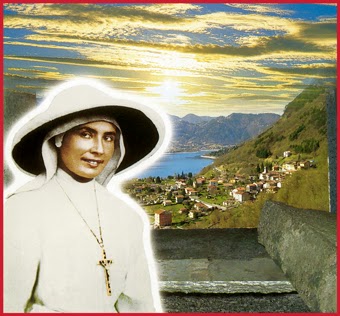
Sister Irene Stefani  Photo:Google
Sister Irene Stefani
Photo:Google

Last Saturday, President Uhuru Kenyatta led thousands of Catholics at Nyeri town for the beatification of Sister Irene Stefani. Sister Stefani an Italian nun born in 1891 came to Kenya in 1915 and later settled near Nyeri where she was christened “Nyaatha”, meaning “Mother of Mercy” in Kikuyu for her compassionate deeds.

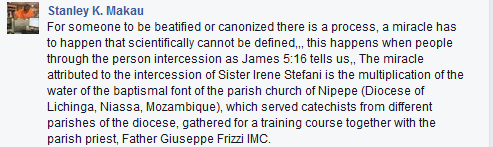
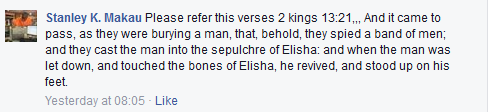
While the momentous event has elicited excitement especially among the catholic faithfuls, a cross section of Kenyans have continued to question its biblical foundation stirring multiple conversations on social media.

Makueni residents have taken to Facebook to express their views with a majority delving into the scriptures to support their arguments. Those who supported the process said beatification was justified and based on biblical teachings.

u2

U3

u4

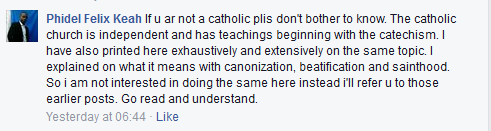
Those who are not Catholics were advised to keep off the debate and the Catholicism.

u5

u6

u8

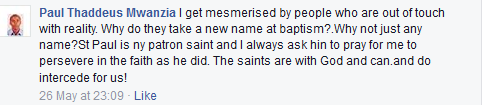
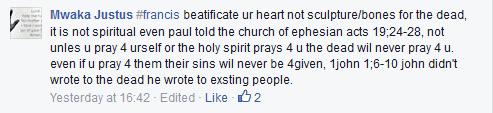
While those who opposed it did not mince their words and they also backed their opposition with scriptures.


u9

u11

u10

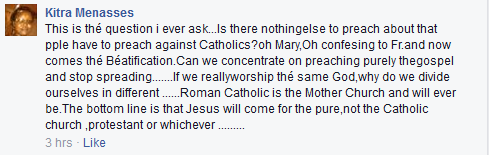
However, others struck a conciliatory note, saying that denomination will take people nowhere

u13

u14

According to Wikipedia Beatification is derived from two Latin words beatus which means , “blessed” and facere, meaning “to make”). It is a recognition accorded by the Catholic church of a dead person’s entrance into heaven and capacity to intercede on behalf of individuals who pray in his or her name.

Stefani was cleared for beatification in 2014 after a miracle found to have been attributed to her intercession was ratified, and she was beatified on 23, May 2015 in Nyeri, by Cardinal Polycarp Pengo on behalf of Pope Francis.

The process has continued to elicit mixed reactions from Kenyans and judging from the above comments, the debate on whether beatification is biblical or not is certainly far from over. According to Makueni Parish Father –in- Charge Fr. Paul Munguti those who do not subscribe to the Catholic denomination cannot fully understand the process.


Former political detainees financially haunt current regime

Political detainees
Photo courtesy of The Star newspaper

Yesterday’s decision in which the High Court ordered government to compensate former political detainees shines a spot light into governments’ past mistakes, its current obligations and future decisions. Many Kenyans were wrongfully detained, with and without trial, for many months, some dying while those alive are fighting for the ‘restoration of their human dignity’.

In the court ruling, Justice Isaac Lenaola awarded nine former Kenya Air Force officers Sh19M for unlawful arrest, detention and torture during the 1982 attempted coup. He ruled that the brutal arrest and inhuman treatment the nine were subjected to was a violation of their rights.

In the case, Peter Mwangi will get Sh2.2M, Humphrey Shume Sh3.4M, James Gitau Sh2.2M, David Mwangi Sh2.3M, Francis Kuwona Sh1.3M, Obadiah Maza Sh1.2M, Placide Edward Sh1.15 M, John Thairu Sh1.1M and Lawrence Kiarie Sh850, 000.

The nine had argued that in August 1982 Kenya Army soldiers stormed the Nanyuki Air Base and ordered all Kenya Air Force officers to surrender. They were disarmed, arrested, stripped naked and beaten using fists, kicks and gun butts. They added that they were locked in a makeshift cell in the supplies block without enough ventilation and were fed one meal a day. The nine were detained between periods of 40 to 120 days.

However, some of them are considering appealing the ruling saying the compensation is too little. They are relying on the previous case in which Judge Mumbi Ngugi had awarded Koigi wa Wamwere sh2.5M only for him to appeal and was awarded sh12M.

It is not the first time that the courts have come to the rescue of former political detainees. Former journalist Otieno Mak’Onyango was awarded sh20M for wrongful detention.

Lawyer and activist Mbugua Mureithi who represented the nine explains that there are no standard guidelines on what determines how much one is compensated.

“Courts consider the period and intensity of torture and any precedence set on the matter. That is where a judge becomes very important,” he asserted.

There are other cases ongoing in courts. For instance, a former air force officer detained for four years, without trial, no court martial has sued the government for compensation. His case is likely to lead to higher compensation since he has evidence of all correspondence that show the magnitude of the unlawfulness the government held him. For instance, he kept all letters sent by his wife in which they were first opened by police officers, read, then enclosed and marked censured before he is given to read.

But even as these cases increase, another concern lies with enforcing the judgments. Koigi has yet to be paid though he told Kenya Monitor that he is yet to seek the compensation from the Attorney General’s office. Otieno Mak’Onyango stayed for years without being compensated. The former MP was detained following the abortive 1982 coup during the Moi government. In her ruling on June 13th 2012, Justice Kalpana Rawal affirmed that Mak’Onyango’s fundamental and constitutional rights were violated. He had demanded sh2B for wrongful detention of over 4 years.

Sadly, Mak’Onyango was only partly paid last year, after years of going back and forth in the Attorney General’s office. News story had shown him living in squalor conditions, perhaps the airing of it led to some humane considerations from government.

Another example is that of former photojournalist Wallace Gichere, now deceased. Wallace died on 26th of April 2008, aged 53. In 1991, Gichere was thrown by police out a three-story window in his house in Buru Buru, Nairobi, during a crackdown on the Kanu regime, an event which left Gichere paralyzed for life.

He needed to use a wheelchair and had no way of earning an income. He fought for compensation from the Kenyan government for almost a decade, including staging a hunger strike at the Attorney-General’s chambers for several days and nights. He was compensated after these hunger strikes in which various activists joined him at the AG’s chambers but did not live long to enjoy them as he died soon after.

Mbugua explained that in awarding these compensations, the courts are doing their jobs to enforce fundamental rights and freedoms that they had been suppressed. This is to ensure that government is held accountable for mistakes of the past and to secure the future.

This laxity to recover compensation can be attributed to archaic laws. No law exists that stipulates once you have been compensated, the process of recovering it. In addition, the Government Proceedings Act does not allow for attaching government property if it fails to pay any debts. The Public Finance Management Act only has provisions for payments of external debts. It is estimated that the government owes between sh5B to sh30B to Kenyans in compensation claims.

Their origins come from ancient common law, that the King does no wrong hence one could not sue government. The Crown Proceedings Act came into force in 1948 which allowed it but said you cannot compel enforcement against the King because courts are his. Ideally this should have ended in 1964 when Kenya because a republic but they are still in our statutes. Mbugua said

“such a law is a mockery of independence the judiciary enjoys because it means that a court can make a ruling that is not binding or that the government is not bound to commit because of another restricting law.”

This is a position in many commonwealth countries. However, South Africa did away with it in 1999. Theirs was referred to as State Liability Act but which the courts ruled them unconstitutional. After the ruling South Africa passed amendments to the law that also stipulates the procedure and timelines including if not given, what you can do, which is by going back to the courts which can then give an order to attach property of that government department.

This South African ruling is a blessing to Kenyans. On the 10th of June 2015, Judge Lenaola will be hearing a petition challenging the constitutionality of these laws. Mbugua who is the lawyer representing the petitioners challenging their constitutionality says they will be relying on the South African ruling.

The idea behind the petition is to ensure there is accountability for human rights violations. Mbugua says

“human rights violations must hurt the treasury.”

Meaning that treasury should find itself budgeting for these compensations amounts similar to funding ministries and departments a situation which should compel the Cabinet Secretary for Treasury to inform government, especially the President on the need to abide by fundamental rights and freedoms so that these allocations are used for developments and not compensations.

Personal rivalry between Governor and Speaker to blame for Makueni squabbles

0
Commission of Inquiry on Dissolution of Makueni County Chair Mohammed Nyaoga (right) and Commissioner Taib Ali Taib during the hearing at KICC Read more at: http://www.standardmedia.co.ke
Commission of Inquiry on Dissolution of Makueni County Chair Mohammed Nyaoga (right) and Commissioner Taib Ali Taib during the hearing at KICC 

Personal differences between Makueni Governor Kivutha Kibwana and Speaker Stephen Ngelu are to blame for the county woes, a witness told the Makueni probe team.

Cosmas Nzilili, the MCA for Ivingoni/Nzambani ward told the inquiry looking into the possible dissolution of Makueni County that the two leaders were in opposing camps during the 2013 general elections in which the governor defeated the Wiper Party candidate Professor Philip Kaloki, a close ally of the speaker.

The MCA said that the governor did not appreciate the election of Ngelu as the speaker and the rivalry has led to the current leadership crisis in the county.

“The two have never accepted each other and the problem we have is personal and not between the two arms as always perceived,” said Nzilili adding that the governor has always seen the speaker as a representative of Kaloki.

The MCA also trivialized the shooting at the county assembly where six people including the governor’s bodyguard William Kinoti and the Chief of Staff Douglas Mbilu were shot and injured saying that there were no plans to kill the governor.

“There were no plans or attempts whatsoever to kill the governor who enjoys a majority support from the people,” said MCA.

Nzilili termed the petition filed by more than 50,000 as ignorant saying that allegations that the county assembly delayed to legislate on the budget are false.

He said that the two arms of the county government held high-level consultations with various stakeholders including the Controller of Budget to come up with a reasonable budget but even after passing the 2014/2015 budget the governor wrote to the government printer not to gazette it.

Asked by the governor’s lead counsel Wilfred Nyamu why they had to consult with the Controller of Budget, the MCA said that the county assembly had no previous budget model to compare with hence the need for the consultations.

However, the MCA’s description of the petition as ignorant did not go well with the commissioners prompting the MCA to drop the statement.

The witness, who the petitioner’s lawyer Kyalo Mboova described as elusive, slippery and fairly educated had his earlier evidence given in camera trashed by the commission Chair Mohammed Nyaoga terming it as sentimental and dramatic.

“The evidence that the witness gave in camera is about a book in the bookshops that anybody can read,”said Nyaoga.

Storymoja Festival starts in Nakuru

Storymoja snip
A poster on the event that will be attended by Ken Walibora among other reknown writers. (Photo: Storymoja).

The first Nakuru regional Storymoja Festival kicked off in Nakuru on Wednesday with over 14,000 participants expected to take part in the event.

Speaking to Kenya Monitor Storymoja Assistant Media Liaison Officer Juliet Maruru said that the event will provide a platform to celebrate the best of African literature by displaying exemplary performances and the finest artists and talent in Africa and beyond.

This is the first time that the event that has currently been held in Nairobi is taking place in Nakuru.

“It was started in 2008 by a collective of writers who are committed to publishing contemporary East African writing of world-class standard, ”she said.

She said they were expecting the participants to turn out in large numbers since they had worked closely with the Nakuru county government which “had taken enough time to mobilize the residents about this event.”

“We will have more than 140 sessions for children where they will be involved in creative art, painting, dancing, reading and also interaction with professionals who are meant to mentor them.”

“We shall also have sessions with adults, couples and family so as to educate them on how to cultivate a reading culture on their children and also show them how to find solutions to life’s problems through the attainment of knowledge”, she added.

Maruru said the main target audience were students and pupils as they aimed at encouraging them to read for life skills as opposed to reading for examination purposes.

Commenting the Storymoja team for holding the event in Nakuru, Michael Kamunya a resident said it was a great move.

“It’s a welcome idea, we are getting a chance to interact with books and get exposed to writers and the writing process,” he said.

Kamunya who is a household name in creative arts in the county also commented the team for holding the event at the national library.

“It’s a chance to know where the library is and the services it offers for the people on Nakuru.”

During the festivals that will culminate with poetry and dance performances in a special event dubbed Koroga poetry and Music a special encyclopedia on careers will be launched.

“Most students do not even know how to start the reading process thus stumble into career and subject decisions that impact them for life. They are poorly prepared for the job market as they do not have the skills necessary for career success,”

she said adding that they hope through such an encyclopedia the students will end up learning how to become job creators.

Among the writers that will be gracing the event is Ken Walibora the author of Siku Njema a Kiswahili novel that was taught as a set book in Kenya a while back. American Ambassador to Kenya Robert Godec is also expected to attend.

This is a good opportunity for Nakuru residents to learn how to read and write for self life skills. One can only hope that they will attend the festivals in great numbers.

By Lorna Abuga.

Key events leading to Kenya’s 2010 Constitution

Kenya-constitution-006

Many Kenyans lost lives, others went to exile while some suffered irreparable damage both financial, socially and politically. Kenyans therefore wanted a document that has fundamental changes to its state and governance structures. At the heart of the constitutional change was the desire to restore sovereignty to the people by identifying them as the basis of all state and public power.

The spirit of these changes is reflected in the national values and aspirations that are identified in the Constitution as including: the rule of law, democracy and participation of the people, human dignity, equity, social justice, sharing and devolution of power, good governance, integrity, transparency, and sustainable development.

The following are key events or milestones that accrued ‘anger’ in Kenyans wanting a new supreme law. They were contained in the interim report of the working group on socio-economic audit of the Constitution of Kenya 2010

1982: Repeal of Section 2A of the Constitution. This repeal officially made Kenya a one party state and ushered in a one party state. It also ushered limitation of political options to one party; KANU.

1985-1988: End of cold war. Global geo-political changes resulted in the end of the cold war. There was also the fall of Berlin wall and the collapse of the Soviet Union resulted in a wind of change that swept across Africa. Locally, it triggered increased constitutional reform agitation, with disaffection on the one party dictatorship reaching fever pitch in which the key players included the church, civil society and political pressure groups.

1988: Flawed Mlolongo elections of 1988. The flawed mlolongo elections saw the rise in voices seeking constitutional reform. A sizable part of the citizenry became totally disaffected with the country‘s political and constitutional landscape. The flawed electoral system provided a clear evidence for the one party dictatorship excesses. It can also be described as the watershed period that triggered clamor for constitutional change.

1988: Constitutional amendment removing security of tenure of judges and other officials. It was interpreted as the Government‘s affront to judicial independence and the independence of constitutional offices. It therefore increased the urgency for constitutional reform.

1990: Saba Saba Riots. Political pressure groups led by Matiba, Rubia and Raila declared for the holding of Saba Saba meeting on July 7 1990. The Saba Saba rally is attributed to the political murders of Robert Ouko and Bishop Alexander Muge. The death of Bishop Muge can be directly attributed to his incessant demand for constitutional reforms and multi-partyism. The resultant arrests of the leaders, riots and deaths played a key role in the clamour for multi-partyism and constitutional reforms.

1990-91: The Saitoti Review Committee. The committee was tasked with investigating KANU‘s internal electoral and disciplinary conduct. It recommended cessation of party members‘ expulsion but instead sought short suspension. It also opened the doors for political reforms, more critically, setting the stage for the return of multi-partyism.

1991: Tribal clashes and heightened pressure and Increased number of players. The politically motivated tribal clashes drew condemnation and heightened demand for constitutional reform. Violence was seen as government‘s attempt to forestall clamour for multi-partyism and constitutional change. The twentieth sixth Amendment, Act No. 10 of 1991 increased the number of constituencies to a minimum of 188 and a maximum of 210, without any input
whatsoever of the ECK. Resulted in the joining of forces by NGOs, religious and secular organisations and political pressure groups to fight the KANU onslaught on constitutionalism. Key players included, NCCK, Episcopal Conference of Catholic priests, LSK, ICJ (K), KHRC and FORD. Foreign ambassadors further weighed in, most notably the then American ambassador Smith Hempstone, adding their voice to the reform clamour.

1991: Restoration of multi-partyism. The 27th Amendment, Act No. 12 of 1991 restored Kenya as a multi-party state and restricted presidential term to two five-year terms. Democratic space was therefore opened up and thus emboldening the pro-reform brigade.

1992: Demand for comprehensive reforms before elections & first multi-party elections. Opposition leaders demanded comprehensive reforms as a pre-condition for participating in 1992 elections. The church prevailed upon them to relent and allow elections. President Moi won albeit with a 33% vote.

1997: The IPPG Initiative. It established through the Constitution of Kenya (Amendment) Act No. 9 of 1997. The number of ECK commissioners rose from 12 to 22, where the opposition parties would nominate 10. The nomination of MPs was pegged on the parties‘ strength. In addition, the Constitution was amended to officially state that Kenya was a multi-party State.

1998 – 2000: Constitution of Kenya Review Commission Act. It was enacted to oversee the review process. The review process was spearheaded by the PSC chaired by Raila Odinga. The clergy withdrew from the process and formed their own review process dubbed Ufungamano Review Initiative. Ufungamano published the – People‘s Draft‘.

2001 – 20012: Constitution of Kenya Review Commission. It was formed to spearhead the review process and headed by Prof Yash Pal Ghai. There was the merger of the CKRC and Ufungamano Initiative. It birthed the collection of views by CKRC and preparation of a new Constitution draft. There was also convening of a delegates‘ conference to debate and ratify the draft but the conference aborts due to parliament‘s dissolution.

2003 – 2004: BOMAs Delegates Conference. The NARC victory quickly ushered in convening of the BOMAs talks.  The CKRC draft of 2002 formed the basis of the talks. Political fallout in NARC spilled over to the BOMAs process. It led to a defeat of the government side where the draft was approved by delegates.

2005: Kilifi Draft. Kenya held a referendum in 2005. The then Attorney General Amos Wako prepares the Kilifi draft using the BOMAs draft as a basis. The Kilifi/Wako draft subjected to the referendum and it is defeated through a popular vote in August 2005.

2006: Kiplagat-led Committee of Eminent Persons. It was a Multi Sectoral Review Forum tasked with collecting public views on how to move the process forward. The Constitution of Kenya Review Bill drafted to jump start review process. It bore no results before the 2007 General Elections.

2008: National Accord and Reconciliation Agreement. This birthed Agenda Four. Several legislations were made including the Constitution of Kenya (Amendment) Act, 2008 and the Constitution of Kenya Review Act, 2008. This was due to the Post-election violence resulting from disputed presidential elections. It led to the signing of a National Accord Agreement providing under Agenda Four the need to institute Constitutional Review as a long term peace solution. There was also the enactment of the Constitution Review Act establishing the Committee of Experts to spearhead the review process. PSC, National Assembly & Referendum were the three other critical organs in the process as outlined by the Act. COE prepared a Harmonized draft Constitution and a Report from the previous drafts: CKRC draft, BOMAs draft & Wako draft. The harmonized draft made public for debate.

2009: Revised Harmonized Draft. COE collected public views on the harmonized draft as well views from all public interest groups. COE incorporated amendments in line with the collected views and produces the RHDC accompanied with a report.

2010: Revised Harmonized Draft after PSC Naivasha meeting. The PSC retreated to Naivasha to consider the RHDC and made significant recommendations. COE considered the recommendations albeit not incorporating all the proposals. A new revised draft presented to parliament for debate and consideration. The draft was approved without amendment.

2010: Proposed Constitution led to a Referendum. The approved draft published as the Proposed Constitution. The proposed draft approved by the citizens in a referendum. Kenya unanimously, 63% approved the document which is not the Constitution of Kenya.


Sexual abuse rampant in Mukuru

Photo courtesy of dreamzz2020.blogspot.com

Sexual abuse and exploitation especially defilement and rape continues to be one of the most life-threatening acts committed in Mukuru kwa Njenga slum. Young girls and boys as well as women continue to face the challenge of being raped or sodomized in their daily life as they seek food, water or even in search of a place to relief themselves.

According to information from the chief’s camp of Mukuru kwa Njenga, nearly a month does not go by without receiving two cases of defilement and one attempted defilement case of girls aged between 10-15 years. Shockingly, this defilement are done by a family relative either step-father, uncle or someone close to the family. Many of whom have been accused of this are male family relatives aged between 35 and 50 years.

Young boys too have been sodomized by their colleagues, neighbors and their uncles. Out of the five cases of sodomy reported since December last year to May this year, four were done by colleagues to the victim while one was committed by the victim’s uncle.

Furthermore, hardly four months passes on without rape/marital rape case of woman aged between 20-35 years being reported. On many occasions, the act is committed by former husband to the woman or during evictions which occur during the night.

Even though the Kenyan Laws provides for the child rights and protection according to Penal Code (Cap.63 Laws of Kenya) against any form of sexual abuse; the rights enshrined in the Law is only a word which has not yet achieved its meaning. Many rape victims and especially for the slums continue to suffer after being denied justice due to flawed investigations from the administration or from the family members who decide to hide the matter from the authorities.

Poverty, congested houses, cultural practices, and lack of cooperation from the arm of the government to pursue the matter continue to provide environment for the crime to thrive. According to Peter Sila, chief of Mukuru kwa Njenga slum, rape cases are rampant in his area of jurisdiction among women and girls though lately boys have become victims also.

Chief Sila notes that, out of all the cases many fail to see the light of the day due lack of cooperation from the victim’s family. Only one case proceeds to court and which on many incidents is thrown out after the complainant fails to appear in court.

“You will find woman abused by her husband-Marital rape, but when you propose to take the matter to court she refuses. Being economically disfranchised and the husband being the only bread winner, they tolerate since the family will suffer if she takes him to court”.

“Sadly, families of young girls who have been defiled by family relatives or other people decide to settle the case outside court. By the time we get to know of the offence, already the family has been paid to keep quiet and even taken the victim to other areas. To others it is a taboo to take family relative to court even on sexual abuse case. Rituals are performed to cleanse the offense. With such challenges even with good will to seek justice for the victim, you can’t present the case in court as it will be thrown out on basis of lack of evidence”, he argues.

Despite the many challenges, gender defenders from various Non-governmental organizations continue to fight for the weak in the society. By organizing educational seminars, they create awareness among the residents on what to do in the event of rape/defilement case.

“We encourage the residents to report to any health facility within 72 hours after rape/defilement and not to take bath before reporting. We also encourage forming of small youth clubs in schools around here so that they can educate others on what to do if such thing happens. Defilement cases have good money; we urge government and the family of the victim not to allow money as justice for the victim. Not jailing the offender of defilement will encourage the vice,” notes Marry Nyambura, gender defender-Mukuru kwa Njenga.
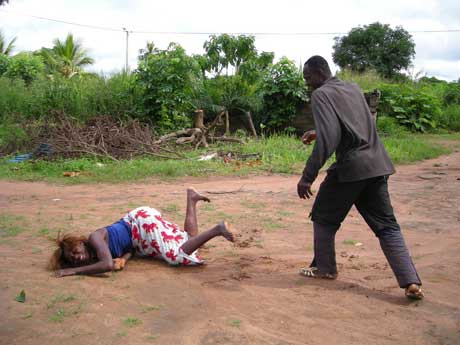
It estimated that one in every three women has been subjected to sexual abuse with many cases arising from the slums, according Family Health Option Kenya 2010 report. Many victims have not received justice while others have been left with permanent trauma and stigma from the public. Poor policies to guard slum people as they are regarded as burden, exclusion from the master plan and lack of good infrastructure continue to undermine the fight against sexual abuse.
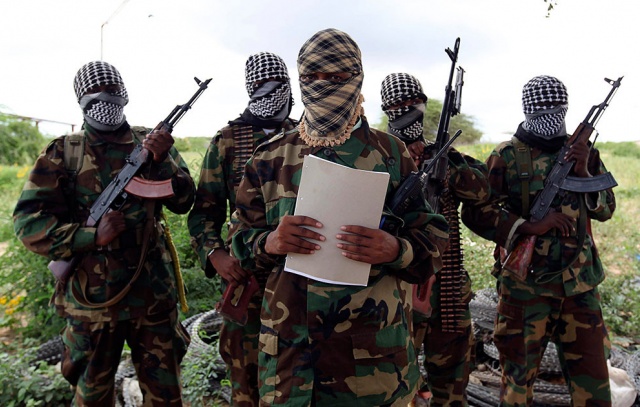
Mukuru kwa Njenga slum represents many other places which are facing the same problem of sexual abuse. For this vice to end concerted effort is needed.


No youth took up government amnesty offer due to fear of being killed

0
Alshabab
Al Shabab Millitia Men (http://www.garoweonline.com/)

The Kenyan government offered an amnesty to AlShabab members after the Garissa massacre, in an effort to make radicalized youths to mend their ways and be integrated back into the society. The Interior Secretary Joseph Nkaiserry gave the youth an ultimatum to report at government offices or else face criminal action. As the amnesty period came to an end last week, it became apparent that it would be a long shot.

In Mombasa, posters bearing the ‘most wanted’ terror suspects have drawn little or no attention from the residents. However, friends and supporters of the suspects are suspected to have damaged some of the posters alleging that the government was shaming their people. That in itself shows how deeply radicalisation has taken root in Mombasa and will need lots of work to remove.

The Supreme Council of Kenyan Muslims (SUPKEM) had pointed out last week that the ten days was a short time and should be extended to a month. The SUPKEM chair Adan Wachu had also asked the government to involve the religious leaders and local leaders in the amnesty process.

According to Mombasa County Deputy Police Commander James Kithuka, only one individual surrendered to police in kisauni. He rightly pointed out that fear of reprisals from radical Islamists was making militants not to take advantage of the clemency.

“Once someone joins a criminal or terrorist group such as the AlShabaab, leaving it is basically a suicide mission.” explains Hamisi Bala, a Sheikh at a Mombasa mosque.

“The rest of the members feel betrayed and will even kill in order to prevent deserters from revealing their secrets. I think that is what these youth are afraid of.”

The Kenyan government has in the past demonstrated its lack of mercy when dealing with dissidents. Most people feel the young men surrendering will only be victimised by government officials once they show up to hand themselves in. As such then, Muslim leaders across the country have suggested they be involved in the process as the youth are more likely to trust them than the government. Mzee Jumba Mwate of Kwale believes this is the sure way to go.

“The sheikhs in the mosques relate with these youth most other lives. They know them well. They are in a better position to rehabilitate these yours and talk them out of the radical groups.”

Another Mombasa sheikh who declined to be named for fear of victimization thinks the amnesty call is a futile effort. What these young people have been brainwashed to believe, is that there is more to gain being jihadists. For them, it is more desirable to stand right with their religious convictions and thus have little consideration for earthly graces.

However, according to Hassan Ole Naado the deputy secretary general of SUPKEM the amnesty was a good thing and the results were good. He did not give figures but alluded to the good progress as radicals sought amnesty through religious leaders rather than the police.

It remains to be seen what step the government takes next in order to stem the radicalisation of Kenyan youth and stop hem from joining terror groups such as AlShabaab.

Child labor a sore in Mukuru kwa Njenga


Young children hawking tissue papers in the estates.

Child labor in Mukuru kwa Njenga/Reuben has become a plague that cannot be ignored! As the evening sets in, children as young as 6-14 years both girls and boys start flocking the roads in Mukuru kwa Njenga slum to hawk all kind s of items. On the roadside they stand next to “their” stalls. With roasted peanuts on their hands, tissue papers stacked on their backs, onions among other products, they fill the streets hoping to capitalize on the many industrial workers who are on their way home from work.

They will follow one customer after another sometimes blocking their way and perhaps forcing them to stop, then with eyes portraying innocence they will plead with the workers to buy in a sheng language. To some irritated workers who are already tired they shove them aside not worrying neither their age nor their next stand.

At the junction of AA of Kenya and Muhindi Mweusi supermarket around 6pm, I meet Dennis Mutua, aged 12 years selling omena. He has proceeded to standard eight. His mother who also runs a vegetable stall some few meters away assigned him the duty since it’s on weekend.

Mutua has been helping her mother during the holidays to make extra coins to support their family. Though he would love to have time with his friends and perhaps play some games, he can’t because he opens “his” business from 4pm. Even after closing at 8pm he has to wait for her mother tills she closes then go home together.

Her mother Eunice Mutua asserts there is nothing wrong with her child helping her to earn few cents to better their lives.

“Hii si child labour kama vile unasema. Kuna gani shida mtoto akisaidia Mamake? (This is not child labour as you term it. What’s wrong with a child helping her mother),” and at that point she ends the conversation.

The story is the same for Joseph Musyoka and Ben Ndolo who move around selling tissue papers in the estates. With stacked packets they move from house to house and even to passers-by. Their stop-over is at movie sellers where they catch a breath while viewing the latest movie or watching the trailers. The two have been hawking for three months now. Joseph lives with his aunt while Ben stays with his mother at Transformer area in Mukuru kwa Reuben.

“Tunaenda shule lakini si kila mara, (we attend school but not regularly),” the two notes

Their aspiration of one day to become IT expert and roads engineer respectively continues to be shuttered each day they skip school and move around looking for money.

Same scene is witnessed at the upcoming dump-site in Mukuru kwa Reuben, it is filled with young children all searching for scrap metals/plastics without any protective gears in order to earn a few coins which they will take home to cater for other family members.

These activities according to Joshua Ajigu, a paralegal from Kituo Cha Sheria constitute violation of children rights hence child labor.

“These acts of children hawking can be termed as modern day slavery and degradation of children’s rights. It hinders the fight against poverty eradication in the slum and even shutters the dream of having a society which does not indulge in child labour. The same children will be parents of tomorrow without any proper mode of living; their children may be forced to become hawkers too. Here in Mukuru kwa Njenga its prevalent.” said Joshua.

Joshua notes that there is a thin line between child labor and children helping their parents at home. He argues that, children under the age of 18 years can assist in clearing the dishes after meals, tidying the house or any activity which does not put the child in danger or interferes with physical or social status of his upbringing.

“Any activity an underage child takes to earn money for whichever reason willingly or unwillingly, to support particular cause that is classified as child labor, as the activity prevents the child from enjoying the privileges of being child as he/she assumes the role of an adult” he explains.

Young children are being denied the joy of being children and hence burdened with the responsibility of becoming breadwinners at tender age. The responsibility the parents place on these children has created a vicious cycle. Having no basic education, they grow up with nothing to hold on to future, marry the same people who they have been hawking with and bring children who also get in to the same practice at young age.

Many parents continue to use their children as baits since they will attract more customers than them. But while resting in the house waiting for the day’s returns, the children out there encounter all sorts of harassment.

Damaris Wairimu, sukumawiki vendor near Embakasi Girls’ high school, can attest the brutality these innocent children go through.

She has witnessed some children being beaten on allegations of having stolen from a customer. Others forced to give extra balance even after they have returned the money and worst of all being robbed by other street children.

“We try to assist them but many residents question why their parents allowed them to come to streets. Other times they are mistreated before our eyes with nothing to do due to fear of being victimized also.”

Young girls too are prone to defilement! But what has hindered the fight against child labor in this area? Chief Peter Sila of Mukuru kwa Njenga slum notes that it hard to trace the children’s parents as they too cannot take you to their home.

“It is a challenge considering the nature of life here, congested house without number to identify where the children come from. However, we are working closely with other organizations to sensitize the importance of taking care of the young ones and dangers of reversing the parental role,” notes Chief Sila.

Though there is enacted law in Kenya, Children Act 2001, to protect children even against child labor, its fruits are yet to be seen or felt. As many slums continue to mushroom so does the child labor continues to expand. Having many young children roaming the streets without proper education is like brooding ground for criminal activities to prosper. They too deserve better lives and all effort should be done to protect them against this vice.

I will not run for Nakuru Governor seat in 2017 declares Gikaria

0
Gikaria
Gikaria’s poster during the 2013 general elections. He has said he will not run for the Nakuru gubernatorial seat in the next elections. (Photo/facebook).

Nakuru Town East MP David Gikaria has declared he is not interested in running for the gubernatorial seat in Nakuru come the next general elections.

He said this over the weekend as he handed over cheques to beneficiaries of the Uwezo fund in his constituency. A total of Ksh. 9 million was distributed to benefit youth, women and person with disabilities.

“I am not interested in running for governor for now. My people need me more at the constituency level and that is where am going to serve them,” said Gikaria.

From the start of this year Gikaria has been involved in a wrangle with Nakuru Governor Kinuthia Mbugua with word going round that he is preparing himself for the gubernatorial race in the coming elections.

Their disagreement has largely been around the relocation of hawkers which the MP has been opposing. In April the Governor called for his arrest after he allegedly got involved in a scuffle to oppose the demolition of informal structures in the town that left some county officials critically injured.

His announcement might therefore be seen as a smart move to either mend to start mending ways with Governor Mbugua. During the event at the Nyayo gardens he even went ahead to praise the governor for “waiving the cost” to him.

“The cost normally is sh50,000 but Mr. Kinuthia has directed that we use it for free,” said Gikaria.

He added that he had decided to “humble himself” and cooperate with the governor for the sake of moving the development agenda of the county.

“When the Governor and I are at fighting politically, the common man fails to get services,” said Gikaria.

He also went ahead to explain that he had also mended ways with the Nakuru police boss Bernard Kioko.

“Somebody had fed falsehoods to the OCPD about me. The truth has finally come out and am at a very good working relation with Kioko. He has provided us with enough security today and I commend him for the good work he continues to do,” he said of the police boss.

There has been discussion on probable candidates for the seat of the Governor in the county for a quite a while now. About two weeks ago NACADA chairman John Mututho announced he would run for it in the coming elections. His announcement was not taken well by the incumbent who challenged him to concentrate on his roles in the drug use fighting agency.

Other people said to be interested in the seat include the current Senator, James Mungai however performed poorly in a recent survey by Infotrak on how voters rate Senators in the country.

By Martin Gicangi.