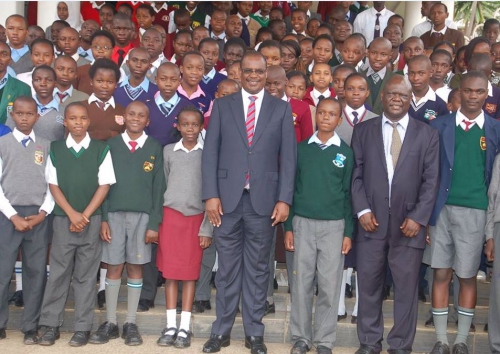
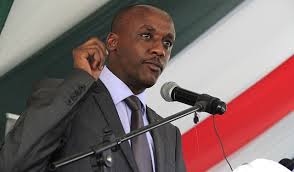
Nairobi Governor Evans Kidero disbursed Sh24 million worth of scholarship to a total of 300 needy students. Photo courtesy of The Standard.
By Sylvester Makato
Nairobi County Governor Dr. Evans Kidero has disbursed sponsorship amounting to sh24 million to three hundred pupils who are academically endowed and who come from needy families within the county. The deserving pupils from the 85 wards in the Nairobi County will now have a chance to stay in school and ensure their dream to become educated people in the society is achieved. In addition, the sponsorship will cater for tuition fee until the beneficiaries complete their secondary education level.
This sponsorship which started in the year 2014, is a complimentary to the bursary initiative undertaken by Members of County Assembly at Ward levels. Speaking during the disbursement at City Hall, Governor Kidero noted that the move was a radical change from the existing bursary allocation plans where a child received only sh5000 which could not sustain them.
“When you educate a child you empower a whole nation,” said Governor Evans Kidero.
Emily Onyango, a mother of three children who was one of the beneficiary applauded the project saying many needy parents who had no power to ensure they children complete education now had peace of mind.
“Nimefurahi sana, mimi nina watoto wawili secondary na kulipa karo kwao ni ngumu, hii mchango umenisaidia sasa nitakuwa natufuta karo ya mmoja,” (I am very happy since I have two children in secondary school and paying fees for both is difficult. This contribution has gone a long way and now I just need to look for school fees for one of them), said Emily.
In addition, she called upon other counties to ensure deserving children get full sponsorship to complete their education.
For now it remains to be seen if other counties will emulate Nairobi County example and ensure bright students stay in school. Some have been getting it through CDF while some counties have also come up with scholarship for students. However, what all counties need to ensure is that there is transparency in the process of selecting the needy students so that only deserving students are assisted to attain education.
The egg alleged to have been laid with a name on it in Nzaui,Makueni county Photo:The Star
Residents of Nzaui, in Makueni county on Wednesday evening flocked the home of a pastor whose hen is alleged to have laid an egg, with his name inscribed on it.
The curious residents, brought operations of the busy Emali town to a halt for almost two hours as they struggled to get a glimpse of the egg that bore the names Juma Kioko.
Area local assistant chief Michael Kivondo while confirming the bizarre incident said Kioko was a pastor in a church at the Emali town. The administrator said police had taken the egg to the Emali police station and warned locals against speculating on the cause of the incident.
Efforts to reach the pastor for comments were futile.
The incident has created a buzz in the social media with a majority of Makueni residents terming it as a wonder.
There are those who dismissed it saying that its only a stamp and a desperate attempt to gain publicity.
There were also hilarious comments from the residents.
Whether the incident is true or not, it i rather weird and as the residents put it,
Barely a week after Mbooni MP Kisoi Munyao, moved to the High Court seeking the suspension of the commission of inquiry in to the dissolution of Makueni County, the county government is now accusing the MP of attempting to disrupt the inquiry process.
The county government said it reads mischief in the legislator’s move to stop the public hearings of the inquiry team appointed by President Uhuru Kenyatta to look into a dissolution petition filed by more than 50,000 residents following incessant wrangles between Governor Kivutha Kibwana and Members of the County Assembly (MCAs).
Through lawyer John Nyamu, the county government said the MP’s petition was meant to stop the inquiry process and deny the people of Makueni their constitutional right.
While representing the county government at the high court before Justice Mumbi Ngugi early last week, Lawyer Nyamu said the MP had not in his plea, proved that the petition of the residents had been faulty.
“Kisoi Munyao’s petition is misguided, untimely, mischievous and disgraceful,” he said.
The lawyer also dismissed accusations that the governor initiated the dissolution of the county.
The Mbooni MP moved to court on April 22, to have the inquiry stopped, saying the process was a breach of the law. In his application through lawyer Tom Ojienda, the Kisoi argued that there was no public participation and the reasons of the petition had not been publicized.
The legislator had also argued that since there was no civic education on the petition many residents did not understand the petition and could therefore make informed decisions of whether to dissolve the county or not.
The Mohammed Nyaoga- led commission and the Attorney General Githu Muigai who has sought to be enjoined in the case as an amicus curiae opposed the MP’s petition through Lawyer P Beta, who said that there was no condition for direct public participation and that the petition had already been filed by more than 50,000 residents.
The ruling of the case has been slated for May 8, 2015.
The commission started its sittings despite the MP’s petition on April 23 at the Kenya International Convention Center (KICC) and has scheduled a public hearing in Makueni on May 5.
Nakuru Governor Kinuthia Mbugua (with mic) and other county leaders during the release of the funds. Each ward received Ksh. 1 m to be distributed as bursary.
The County government of Nakuru has disbursed a total of sh55 million meant for bursary. The amount will be distributed equally to each of its 55 wards and will benefit close to 17,000 students.
While disbursing the funds at the county headquarters on Friday April 30 Governor Kinuthia Mbugua said that this number represents 10 percent of all students in the county.
Apart from benefiting needy students in Primary and Secondary Schools the money will also be distributed to students in driving schools and in special schools.
Over 49,000 students in Nakuru have benefited from the Nakuru county bursary program in the last two years.
The Governor said that the bursary programme which has benefited close to 50,000 students since it was launched two years ago has impacted positively on the welfare of citizens in the county.
“This program has also a high impact socially, economically and politically in the society and it has also played a key role in retaining students in schools which impacts on the education standards in the county,” he said.
“Enhancing and sustaining quality education is difficult but we are determined and through a program like this we will achieve,” the governor said.
But while saying that the issuing of the funds is welcome, John Ojimbi of the Nakuru Catholic Justice and Peace Commission (CJPC) has observed it might raise questions on its timing just before the close of the government fiscal year on 30th June.
“County governments are now dishing out the money they have in their accounts so that they don’t return it to the their treasury,” he said calling for more scrutiny on the use of county funds.
Responding to this Dundori Member of County Assembly (MCA) Steve Kihara blamed the central government “delaying funds” thus leading to the delay of the bursary issuing process.
“This money was meant for the first term but we started filling the forms in January. The money from the treasury should be sent to the counties in time,” he said.
The county had allocated sh2 million for bursary in the 2014/15 financial year and it will be expected to issue the remaining sh1 million before June 30.
Standard Journalist Nyambega Gisesa with an ward he won in the 2013 AJEA awards.
Kenya’s finest journalists will be unveiled and feted today, Monday May 4 in an event to be held at the Kenyatta International Convention Center (KICC). This will be a culmination of this year’s World Press Freedom Day celebration aimed at highlighting the successes and challenges of the Media industry in the country and the world at large.
This is the fourth time that the Annual Journalism Excellence Awards (AJEA) event which is usually organized by the Media Council of Kenya (MCK) is taking place in the country. To mark the day MCK has organized a convention to reflect on this year’s theme ‘Let journalism thrive! Towards Better Reporting, Gender Equality, and Safety in the Digital Age’.
MCK will also launch a media monitoring report on the coverage of the extractive industry in Kenya.
This year’s celebrations are being held at a time when the security of journalists is under threat. Two days ago an Eldoret based journalist, John Kituyi, was attacked on his way home and later died in hospital. The incident is being linked to his work as a journalist.
And in mid April, journalists were severely attacked by the police while on duty in the Tana River county.
These two incidences and several other incidences in which journalists have either been threatened with their lives due to their coverage of certain sensitive issues in the country are likely to be part of the discussion as the scribes mark the day.
Other issues that are likely to be discussed this year include the controversial security laws that were passed by Parliament towards the end of last year proposing hefty fines to journalists and media houses who allegedly flout the code of conduct for the practice of journalism in the country.
The increasing threats to activists on social media and bloggers as witnessed in the last one year may also be discussed.
But the moment that the journalists will be waiting for is the naming and awarding of the top cream performers in the last year. Apart from naming winners in different categories an overall winner will be named for the media competition which is the most prestigious in the country.
World press freedom day is here with us, just like every year. It is a time to reflect on how far, as Kenya media has come and interrogate where the future lies.
Wikipedia defines public broadcasting as;
Public broadcasting includes radio, television and other electronic media outlets whose primary mission is public service.
The best example of how public broadcasting and its impact to the public is the BBC. BBC is largely funded by the taxpayers and also through charity. It therefore does not rely on advertising for its growth and sustainability, hence able to truly avail public interest information to the public. It is currently undergoing restructuring, informed by this financial model, but still remains robust.
A great example of its impact is its investigations program Panorama. In March 2002, it unearthed many untruths about Britain’s involvement in Iraq, citing then Prime Minister Tony Blair as having lied to the public. It also unearthed Blair’s inaccurate financial dealings in which he falsified documents so that he gets money to pay for his son’s fees at Yale.
The impact of these investigations saw Blair resigning from office. It was then stated that his departure was due to differences with the then Chancellor of the Exchequer, and his successor Gordon Brown.
That a media house can investigate the head of government and unearth serious anomalies is not only fundamental media independence but also lies at the core of the existence of media itself.
In Kenya, political leadership in the country largely controls media directly and indirectly. This coupled with advertisement, the life blood of the industry means that quality and quantity public interest stories will be too much to ask for. You certainly cannot bite the hand that feeds you.
This then seeks the question whether a public broadcaster is the answer!
There are so many ills in the country which TV stations try to highlight from time to time, however they have many limitations. For instance, no media house will touch the big corporates like Britam, Safaricom, Barclays, Equity, EABL, and Cocacola, just to mention but a few. This does not include government itself which provides about 60 percent of all advertisement to media houses.
In the event we had a public broadcaster, this would never have been the case. Dr. Bitange Ndemo proposed this around 2011 but was muzzled by the media owners who knew this effort will eat them dry; their viewership. You see, these media houses depend on viewership to cost advertising. Anyone who would threaten their viewership is an enemy to the bottom line.
A public broadcaster in Kenya would be financed solely from the consolidated fund. They would do a budget and submit to Treasury, just like independent constitutional commissions and institutions like the Judiciary do. Then Parliament would appropriate accordingly.
Of course this does not mean that their independence would be absolute. They will still suffer threats, from financing from Parliament and Treasury so as to render it ineffective. This then provides for two avenues;
One, the institution be allowed to source for funds from charitable institutions. This means that institutions like Safaricom, even though they have foundations and if they want to support it, will have a stringent guidelines that ensure they will not tamper with the editorial independence of the organization.
Secondly, a minimum threshold should set. This entails something close to how Counties and CDF are currently being funded. This minimum could be any figure or percentage arrived at from either ordinary revenues or from allocations to the Ministry of Information. This is critical since the minimum would guarantee ability to do some investigations in a year. Investigative journalism is very expensive and time consuming. It would also mean it is able to attract and retain great talent.
The Dr. Ndemo suggestion would have seen KBC split into two; a public broadcaster and a private one, free to get adverts. This was seen as critical to helping revive the company, which is currently strangled with debts which negatively impact on its growth. There are proposed reforms to the institutions currently, which will not yield much so long as the fundamentals remain the same.
Ceteris Paribus, a public broadcaster is the answer to Kenya’s search for informative media. It will help streamline egoistic mainstream media and ensure the fourth estate truly lives to its billing.
A victim of the 2007 PEV at the Pipeline IDP camp, Nakuru, celebrates when ICC Prosecutor withdrew the charges against Kenyatta in December last year. The case was terminated in March this year, a move that Opiyo supports (Photo/Kioko).
A leader of the persons who were internally displaced (IDP’s) following the post election violence (PEV) of 2007/2008 and who are currently residing in Rongai, has welcomed the termination of President Uhuru Kenyatta’s case at the International Criminal Court (ICC).
Robert Opiyo who is the Secretary General of the victims who got settled at the Gicheha Farm says he is happy with the decision and now looks forward towards the termination of the case involving Uhuru’s Deputy William Ruto and journalist Joshua Sang.
“I welcome the decision. Most of our members are also for the decision,” Opiyo told Kenya Monitor.
ICC’s Trial Chamber V(B) terminated the case against Kenyatta as well as the proceedings in his case on March 13 this year. The chamber also terminated sermons against him to appear before The Hague based court to answer to charges. But the chamber cautioned against the interference of witnesses and or victims although it did not say if the victims in the case would receive reparation.
It will be noted that in 2007 the victims at the Gicheha Farm which is associated with the Kenyatta family were perceived to be supporters of Raila Odinga led Orange Democratic Movement (ODM). Therefore they were likely a representative block of the victims in the Kenyatta case, at least from a general perspective and may have been part of those to receive reparation had the case proceeded to full trial and a verdict given.
Opiyo says they are comfortable with the decision to terminate the case even though they may never receive reparation from the ICC.
“We are aware that we have no reparation now. But we can get it from well wishers without basing it on the decision of the case.”
According to him the decision is enough reparation to them. He says it brings them much desired peace.
“There is no need for me to receive reparation when there is no peace,”
he said making the inference that an otherwise decision on the case would have stirred the state of tranquility currently being witnessed in Nakuru, Naivasha, and Rongai regions which is known to be stirred by political waves in the country.
“We are now living in harmony. We have reconciled. Without peace reparation would have made no sense,” he added.
Opiyo is now urging the government to also look into affairs of all the victims who did not go to camps but sought refuge among family members and friends during the chaos that rocked the country 7 years ago.
“We are asking that all integrated families that were never considered for resettlement to be resettled now. Its only those IDP’s who formed self-help groups who were resettled,” he says.
He is also advocating for a speedy conclusion of all court cases involving farms on which IDP’s have since been resettled. Some of these farms include the Mohu Farm in Nyandarua where IDP’s are still living in tents as they cannot build permanent structures until the case is concluded.
Kenyatta has since apologized to Kenyans for the 2007 crimes that claimed more than 1,000 lives and left more than 650,000 persons displaced.
We all easily gravitate towards news outlets that reinforce our world view. (Photo/http://farm3.staticflickr.com)
My favorite story as a kid was the tale of the Blind men and the elephant. If you have never heard it, let me give you the skinny. A king beloved by his subjects for his wisdom asked six blind men to determine what an elephant looks like by feeling different parts of the animal’s body.
The blind man who felt the leg of the beast said an elephant is like the trunk of a tree; the one who felt the tail said an elephant is like a snake; the one who felt the trunk said an elephant is like a tree branch; the one who felt the ear said an elephant is like a hand fan; the one who felt the belly said an elephant is like a wall; and the one who felt the tusk said an elephant is like a solid pipe.
The wise King explained to the blind men that they were all right and wrong at the same time because their opinions were informed by touching different parts of the elephant. The story, of course, is a neat way of conveying the fact that our subjective opinions and prejudices colour the way we see the world.
Working as a professional journalist the last five years – and being a news consumer for as long as I could read – I have learnt that people gravitate towards the news stories/content that reinforces their worldview. This used to be harder to do back in the day when there were three or so newspapers around in Kenya but with the multiplicity of news outlets it’s become a lot easier .
This is the future you see and Twitter, Facebook and citizen journalism are in vogue. The vagaries of these new platforms and outlets mean that you follow/befriend/read/subscribe to (delete as appropriate) who/what you want. Choice is the name of the game. The result, though, is there is a hardening of opinions because people only get to see the world the way they want to see it.
Don’t get me wrong. I am not saying that we’re all deluding ourselves on purpose. Not at all. What I mean is our new world of “choice” with its specialized news websites and blogs has made it possible for us to consume the news without ever being confronted with opinions we don’t agree with. It’s made it possible for us to exist in news echo chambers in which we only get exposed to the points of view that mirror our own.
To avoid falling into the custom-made news trap, we have to constantly ensure that we challenge ourselves to look beyond our digital comfort zones. If we don’t we’ll be no different from the blind men of the story. Comforted by our subjective view of the world but unaware of other truths and realities that are different from our own but just as worthy.
Former Makueni Senator Mutula Kilonzo Photo:Jamiiforums.com
April 27, 2015 marked exactly two years since the death of former Makueni Senator Mutula Kilonzo. The senator died at his ranch in Maanzoni, Machakos County and the body was found on his bed on the fateful day at around 7am. The death of Mutula who had earlier claimed that his life was in danger shocked many people and Kenyans of all walks of life mourned his death.
The cause of Mutula’s death has never been established as postmortem results of the senator, who was said to be in good health before the demise, have never been released to the public despite the family hiring a London based pathologist, Ian Calder.
Makueni senator Mutula Kilonzo Jnr.He claims that his father was poisoned Photo:Facebook
On January 13 this year, his son, Makueni Senator Mutula Kilonzo Junior, sensationally claimed that his father was poisoned, and that samples sent for analysis in the UK had been tampered with raising concerns of foul play.
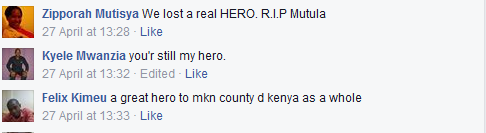
Although there was no remembrance ceremony held to mark the second anniversary as witnessed last year, residents of Makueni County took to social media to celebrate the senior counsel’s life.The residents on Facebook poured out their tributes to the former senator whom they described as a hero.
His contribution to the country,they said will never be forgotten.
The senators absence,the residents stated was also missed by the lions in the ranch with his son accusing the former senator ‘s Window Nduku Kilonzo of starving the cats.
Some residents also argued that the current infighting between Governor Kivutha Kibwana and MCAs would not have happened if Mutula were alive.
Renewed calls to have his murderers if any, brought to justice were also made.
The promise to release the long awaited results of the postmortem conducted by both local pathologists and his family Pathologist Calder was still fresh in the residents minds.
Now that his son had taken over the leadership mantle, the residents hoped that Mutula junior would follow his father’s footstep
Mutula was born in Mbooni in July 2, 1948 to Wilson Kilonzo Musembi and Mama Rhoda Koki Kilonzo. Despite his humble backgrounds the former legislator rose up the ranks to become one of the most powerful and respected lawyers in the country earning him the title senior counsel. He was the former president’s Daniel Moi long serving lawyer.
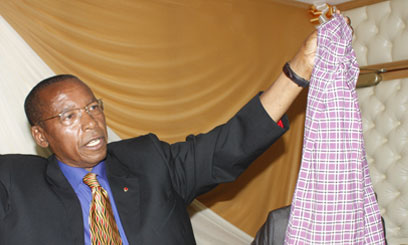
Mutula shows a skirt to the press after his controversial remarks Photo:CapitaL Fm
Mutula joined politics in 2003, when he was nominated to Parliament and won the Mbooni MP seat in 2007 and appointed the Minister for Metropolitan and Justice and Constitutional affairs. He was later transferred to the Ministry of Education where he is remember for banning holiday tuition and controversially pushing for school girls not to be forced to wear what he described as nun skirts due to their long lengths.
His short stint at the education docket made him a darling of many people in both Makueni and the entire country. This perhaps explains the reason why he easily defeated former Kilome MP Harun Mwau in the 2013 senatorial race despite the latter putting up a spirited and well financed campaign.
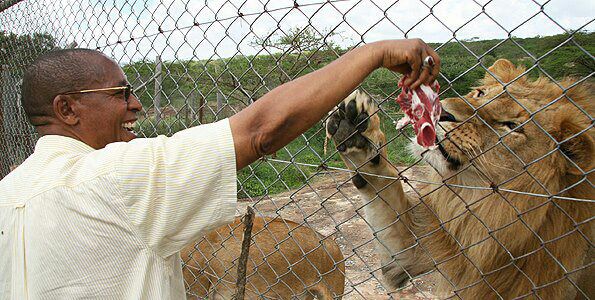
After his death, his son Mutula junior won the Makueni senatorial seat. His contribution is not only perhaps missed by the country but also his family especially now that his son and his step- Mother Nduku have recently been involved in a public spat over the management of the Machakos ranch. The Makueni senator has accused Nduku of starving his father’s lion.
Mutula feeds his lion at the Machakos Ranch Photo:Kenya Today
Probably of more interest and concern to many Kenyans is whether the cause of the senior counsel’s demise will remain shrouded in mystery just like the deaths of other prominent figures in the country.
Social media has changed media landscapes in Kenya and the entire world
Kenya on May 3, 2015 joined the rest of the world to mark the World Press Freedom day set aside to celebrate the fundamental values of press freedom and the need for governments across the world to uphold media freedom.
The press commonly referred as to the ‘fourth estate’ plays a very important role in the society as it keeps the masses informed on what is happening. It also acts as the the society’s watchdog by exposing corruption and any injustices meted out to citizens.
Due to the integral role that the media plays in the society, quality journalism is of essence and journalists at all costs should adhere to the professional codes of ethics. Journalists are required to practice accurate, objective and fair reporting. They should remain independent and impartial in their work.
However, the need for quality journalism and media freedom in the country is becoming a constant concern due to technological, governance and commercial developments.
Although the current constitution passed in 2010 was extolled for expanding freedoms of expression of the press, there is a general feeling that the Jubilee government is out to curtail that freedom through prohibitive laws, with the security laws being the most recent.
Increased reports of brutality aimed at journalists and arbitrary arrests of bloggers and other social media users has been a major concern to many media players. In the most recent case, two journalists were beaten and seriously injured by General Service Unit (GSU) police officers at a ranch in Tana River County.
NTV’s Nehemiah Okwemba and Reuben Ogonda of Citizen TV, based in Malindi, were attacked by the officers when they went to cover a story on alleged corruption in the Agriculture Development Finance Cooperation ranch in Galana.
As the world marked the day, there is need for the Kenyan media fraternity to take stock of such cases of brutality and explore ways in which further attacks on journalists can avoided in the future. This is especially so as Eldoret based journalist John Kituyi was murdered by unknown assailants this last week.
Questions of who is a journalist have also been raised with many media houses in Kenya accused of employing media workers as opposed to trained journalists. The emergence of bloggers as reporters has also complicated the practical definition of a journalist.
Media Council of Kenya Program Officer Victor Bwire has been on the record calling for media houses to employ professionally trained journalists.
“What we have in many media houses in Kenya are media workers who have never entered a journalism class, journalism is a profession like any other,” he said in Machakos during a media-training workshop.
In Bwire’s argument, the that fact that a person has a talent in comedy or blogging does not make him/ her a journalist. He argues that a journalist is a person trained and equipped with the skills of the profession.
But it is perhaps the emergence of social media that has changed the media landscapes in Kenya in the recent past. The growing use of social media platforms to report news has led to citizen journalism with ordinary Kenyans instantaneously reporting news and sharing it to the rest of the world using the new media.
The emergence of the new phenomenon has changed the way journalists operate because, more often than not, breaking news are now being reported in social media platforms first before they make it to the mainstream media.
For instance the terrorists attack at the Wetsgate in Nairobi where more than 67 people were killed and scores injured was first tweeted. Thanks to citizen journalism incidents in far flung areas in Makueni like human wildlife conflicts and several road accidents along the Mombasa-Nairobi highway hit mainstream media headlines faster than before as residents on social media in those areas capture the events and share the new platforms.
The availability of these social media tools has therefore helped journalists in covering events that take place in areas that would otherwise take long to access. Journalists are also using the social media as a source for developing their content and many now write articles based on opinions and updates of social media users.
However, social media platforms are awash with inaccurate information and journalists need to verify the stories before they can report air them on mainstream media. Although most of the stories are verifiable others are just but mere rumors.
It is no doubt that social media has aided journalism but on the flipside, the preserve for reporting breaking news by traditional media as witnessed before is long gone and journalists have to compete with the social networks to break news. The fact that they should verity facts from relevant authorities makes it even harder for journalists to achieve the fete.
There has been a raging debate that citizen journalism is slowly edging out the practice of professional journalism but it should be noted that journalism is a profession guided by ethics and laws unlike citizen reporting which has no clear guidelines.
Opponents of professional media argue that the new media cannot replace professional journalism as it is just another source of content for journalists. However the fact that the social media networks help citizens and even journalists get access to information or news that would otherwise been impossible should not be underrated.
Social media is a tool whose power can be harnessed to influence masses across the globe, just like the traditional media and it should be utilized well for the sake of the masses.The line for citizen and professional journalism many may argue is blurring but the future for the two fields should remain distinct and play a complimentary rather than a competing role.
As the world celebrates the press freedom day whose theme is the media’s importance in development; the safety of journalists and the rule of law; the sustainability and integrity of journalism, journalists should embrace social media platforms in their reporting to help them remain relevant in this digital era.
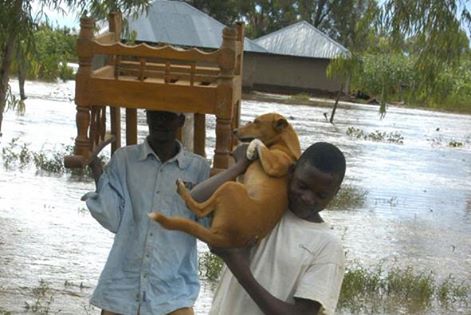
Residents salvage their belongings during floods Photo:Facebook
More than 250 residents of Mbitini, Makueni County have been left homeless after floods washed away their homes following a heavy downpour on Wednesday last week.
Property worthy thousands of shillings was also lost after the raging floods accompanied by strong winds destroyed homes and other premises.
Reports by Nzaui Deputy County Commissioner Mr. Franklin Ongori said no casualties were reported and that the affected families had sought refuge in the nearby schools. Ongori singled out Masumba, Nguu, Kavuthu,Valunei, Katani and Mii as the villages worst hit by the floods.
The Deputy Commissioner said that the national government in conjunction with the county government had donated foodstuffs and mattresses to the affected families and appealed for more donations to help the displaced residents.
“The national government has given each family has been 20kg rice and 10kg of beans, while the county government gave out the mattresses and blankets,” he said.
Governor Kivutha Kibwana in his official Facebook page said that his government had already send officers to the affected regions to assess the damage and promised to extend help to the affected families.
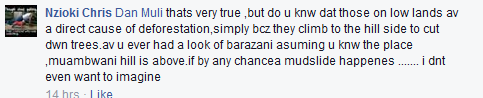
The floods got the attention of residents on social media who attributed them to deforestation and called for an immediate stop of the vice.
The displacement of the residents of Mbitini comes against a wake of increasing reports of floods across the country. More than 9 people are feared dead in Narok after flash floods caused by massive downpour Tuesday, April 28 carried away homes and buildings leaving a trail of death and destruction. With the weather man’s warning that most parts of the country may continue to receive slightly above normal rainfall in the next few days, things could only get worse for a country that is ill equipped with disaster management.
Police are yet to establish the circumstances that led to the killing of a primary school headteacher in West Ngosini, Makueni County. Utithini Primary School Headteacher Simon Nzuuna, was hacked to death by unknown assailants at his house on Tuesday at around 1 am.
Makueni OCPD Philip Opiyo said three men armed with crude weapons brutally murdered the head teacher after tying his wife with rope before escaping with Sh20, 000.
Opiyo said that police are still investigating the motive of the killing as the assailants declined to spare the teacher’s life even after he offered them the money.
The brutal murder has attracted the wrath of local leaders who have called for speedy investigations into the matter.
Area Member of County Assembly, Martin Mutuku condemned the killing and asked the police to conduct thorough investigations and bring to justice the perpetrators of the act.
Makueni Father –in-Charge Fr.Paul Munguti also echoed the MCA’s words and called for increased security.
The body of the head teacher was taken to the County Referral Hospital awaiting postmortem.
KUSO chair Babu Owino wants President Uhuru Kenyatta to reconsider his parastatal appointments. (Photo/http://www.kenyadigest.com)
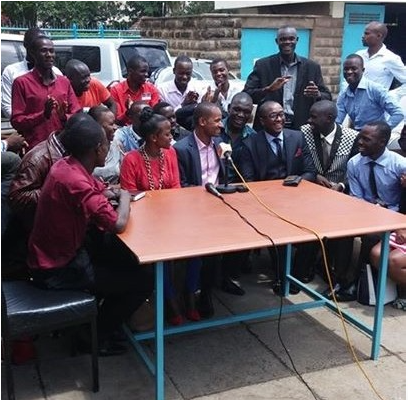
Student leaders drawn from several of Kenya’s universities have given President Uhuru Kenyatta 3 days to reconsider his decision to appoint seasoned politicians to parastatal positions announced on Monday. Speaking under the umbrella of the Kenya University Students Organisation (KUSO), the student leaders argued that Kenya’s youth deserve at least 20 positions from the 302 announced earlier this week.
Led by KUSO chair Babu Owino, the group said that they would organize demonstrations to remove the appointed individuals from office if President Kenyatta doesn’t comply with their demands. One KUSO member Charles Juma also appealed to the appointed individuals to show mercy on the youth and refuse the appointments.
“To the appointees, be merciful and reject these appointment by saying: ‘We have served for many years; give this to the youth,’” he told the Daily Nation.
LOL Babu owino KUSO chairman has given His excellency president Uhuru Kenyatta 72 hours to reconsider his appointments for parastatals heads
This development comes amid a growing debate about whether it’s actually wise to entrust the youth with the responsibility of running government bodies like parastatals.
Ichung’wa: Parastatal job appointments are not the jobs of the youths. The youths want a place where they can utilize their energies.
#RecycledPoliticians I pity the youth who think that being young is a qualification. These gentlemen ooze experience a key requirement 4 bd — Karoki Ndirangu (@Karoki3) April 28, 2015
the jobs require wealth of experience not some random youth who grew up watching telitubbies.the #RecycledPoliticians ar best fit 4 the jobs
Others like former KISS FM radio presenter Caroline Mutoko feel the youth in Kenya only have themselves to blame for missing out on the parastatal appointments by not putting themselves out there enough.
Mutoko is partly right. The youth should blame themselves but not for the reason she is suggesting. The youth should blame themselves for allowing petty differences like tribe to divide them every election instead of keeping an open mind and voting for the candidate who would fight for their interests. Uhuru talked a good game when campaigning for the presidency in 2013. His actions however show that he is interested in maintaining the same old “kazi kwa vijana, pesa kwa wazee” status quo that has left the youth despondent.
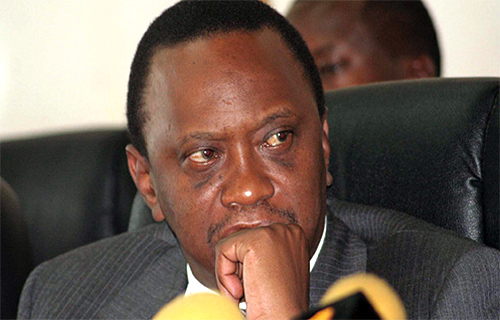
President Uhuru Kenyatta can’t catch a break (Photo: malawi24.com)
Kenyans on twitter aren’t giving President Uhuru Kenyatta a break. The president made several controversial parastatal appointments on Monday and three news cycles later, some Kenyans are giving him grief about it on twitter. Those opposed to the appointments have used the hashtag #SendUhuruHome to convey their displeasure with the usual mixture of humour and acerbic wit.
Uhuru returning former corrupt politicians in govt reveals his real stand on the fight against corruption #SendUhuruHome — Aswani. M (@itsAlumasi) April 29, 2015
Some of the recycled waste politicians will have to be bedridden to work.I dont think they can remeber hw to use modern equip #SendUhuruHome
You have shown no respect for the youths who you voted you in office. Dont take us for granted!!!! @UKenyatta#SendUhuruHome — KahiuWAGithutha.Hon (@KahiuWAGithutha) April 29, 2015
There’s also the curious question of why the president’s notoriously excitable digital press team still hasn’t come up with a foil for the hashtag.
#SendUhuruHome is trending, the hashtag crew at statehouse are crunching their heads looking for a counter…..tick tock, tick tock — Muthui Mkenya (@MuthuiMkenya) April 29, 2015
Even my good friend @OleItumbi cannot shamelessly defend the nauseating Uhuru appointments. #SendUhuruHome. Kenyans are very smart
Meanwhile there’s an appeal for caution about trying to hound the president out of his office from an unlikely corner. Activist Boniface Mwangi feels the demand for the president to exit from office is premature.
#SendUhuruHome I don’t think so. Hashtags won’t run Kenya. He was elected and has a mandate from the electorate. Wait for 2017 & vote wisely
Perhaps it’s a good thing that the president’s PR machine is giving this one a wide berth. You have to pick your battles especially in a country where each week brings a new scandal. Nonetheless, it is worth paying attention to the subtext of the #SendUhuruHome hashtag.
To be sure, some are using it as yet another political attack point but there is also a substantial majority out there that feels genuinely let down by the President. Its how well the president addresses the grievances of this group that will determine how he will fare in 2017.
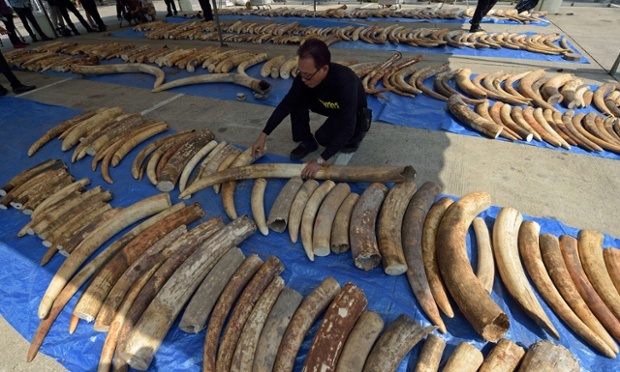
A Thai customs official lays out the ivory seized in a container sent from Kenya bound for Laos. (photo/www.theguardian.com)
In a stunning development, it has emerged that part of the 3 tonne ivory haul seized in Thailand earlier this week included pieces of ivory that were previously in the custody of the Kenyan police as evidence. Pattaymail.com, a Thai news outlet, quoted Gen Dapong Rattanasuwan, the Minister of Natural Resources and Environment, saying authorities had previously seized some of the ivory and sent it back to Kenya as evidence.
Gen Dapong Rattanasuwan, Thai Minister of Natural Resources, is the one who stated many of the tusks were seized before, and sent back.
“Most of them were the tusks earlier seized and sent back to their origins in Africa whereas some were those having been kept as evidence in some countries,”
reported Pattaymail.com about the ivory that was seized in a container sent from Kenya headed to Laos. The news has shocked many Kenyans because it suggests that corrupt networks in the Kenya police service are involved in the ivory trade.
From one thai media outlet, many of the tusks seized had already been seized once, sent back to Kenya as evidence, only to be shipped again.
Some Kenyans are suggesting that it’s perhaps due to the embarrassing nature of the revelations that Kenyan authorities and the mainstream media are mum on the matter.
@GrantBrooke The official Silence around Kenya’s own investigation into who pulled the trigger on this smoking gun is ominous. — mzungundege (@mzungundege) April 29, 2015
Noted Kenyan conservationist Dr. Paula Kahumbu says the silence wont do. She is pressing for authorities to investigate and put an end to the corrupt networks that make Kenya a haven for black market ivory traffickers and dealers.
It could have been a container full of bombs, grenade,s guns, drugs, children..if a container of #ivory can pass Msa https://t.co/iNuZLbgicl
President Uhuru Kenyatta in early March set fire to 15 tonnes of ivory to send the message that the country is serious about ending poaching. However the developments in Thailand show that, as with so much else in Kenya, poaching is rooted in the corrupt fabric of the Kenyan system and can only be eliminated if the president fights the war on graft with the sincerity of purpose and single-mindedness it deserves.