Wednesday, December 17, 2025
Home Blog Page 54

What are the Rights of arrested persons in Kenya

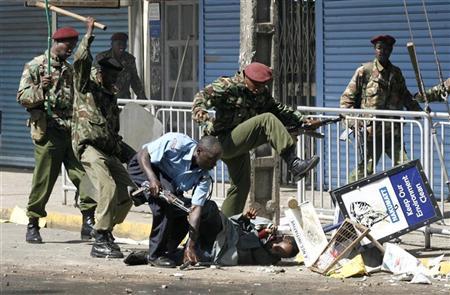
Police Arrests in Kenya
Police Arrests in Kenya (image courtesy of  Hiiraan.com)

The two year sentence conviction for Alan Wadi Okong’o aka Lieutenant Wadi for ‘undermining the authority of President Uhuru’, by Magistrate Ann Waguru brought into focus the rights of an arrested person since he lacked legal representation. According to the charge sheet, Wadi was prosecuted based on Section 13 (a), (b) and 2 of the National Cohesion Act, which if he was well informed of the gravity of the case, the fourth year student of Political Science would probably be free today.

Section 13 of the National Cohesion Act (2008) relates to Hate speech. The specific clause he was charged states;

(1) A person who— (a) uses threatening, abusive or insulting words or behaviour, or displays any written material;                  

                      (b) publishes or distributes written material;

which is threatening, abusive or insulting or involves the use of threatening, abusive or insulting words or behavior commits an offence if such person intends thereby to stir up ethnic hatred, or having regard to all the circumstances, ethnic hatred is likely to be stirred up.

(2) Any person who commits an offence under this section shall be liable to a fine not exceeding one million shillings or to imprisonment for a term not exceeding three years or to both.


The case which sparked controversy on how fair the trail was and the general safety of internet content creators in Kenya in exercising their rights to expression including when challenging the government ignited the Constitutional rights that an arrested person is entitled to. Perhaps, Wadi’s failing was to admit culpability, but he probably was not well aware of his rights, albeit some have argued that he could have been coerced by the state to confess.

Be as it may, the Constitution, guarantees an arrested person certain rights as well as procedures on what should be done:


Rights of arrested persons.

  1. (1) An arrested person has the right—

(a) to be informed promptly, in language that the person understands, of—

(i) the reason for the arrest;

(ii) the right to remain silent; and

(iii) the consequences of not remaining silent;

(b) to remain silent;

(c) to communicate with an advocate, and other persons whose assistance is necessary;

(d) not to be compelled to make any confession or admission that could be used in evidence against the person;

(e) to be held separately from persons who are serving a sentence;

(f) to be brought before a court as soon as reasonably possible, but not later than—

(i) twenty-four hours after being arrested; or

(ii) if the twenty-four hours ends outside ordinary court hours, or on a day that is not an ordinary court day, the end of the next court day;

(g) at the first court appearance, to be charged or informed of the reason for the detention continuing, or to be released; and

(h) to be released on bond or bail, on reasonable conditions, pending a charge or trial, unless there are compelling reasons not to be released.


(2) A person shall not be remanded in custody for an offence if the offence is punishable by a fine only or by imprisonment for not more than six months.
Internet and law in Kenya

The rise in the use of the internet in Kenya has increased the need to learn about the do’s and dont’s when engaging through the various social media platforms like Facebook, Twitter, Blogs, Linkedin and Instagram among others to ensure one is within the law. This informed a workshop themed “The law and Internet in Kenya” held at the Nailab on 6th March 2015 led by Mugambi Laibuta, an Advocate of the High Court of Kenya.


The conversations started with the need to define Hate Speech. This could have been informed by the proliferation of cases against bloggers. The government has either held bloggers for interrogation or charged them in court or convicted them on various charges related to hate speech.


It soon became clear that how to behave when police arrest you is crucial to determining your fate.


Rights of an arrested persons 

Online content creators need to ensure that they establish publishing standards to inform their professionalism. This includes issues on ethics and other rights that inform what can be published in their blogs.    


The other critical issue is the need to ensure that you do not infringe on others copyright.


    Where allegations or unconfirmed reports or issues arise, your choice of words counts.     

 Social media usage has implications beyond writing a post or comment. Practices like liking a comment and retweeting them have grave repercussions.   


In addition, checking whether your creativity is original goes a long way in ensuring you do not infringe on others intellectual property.


 Even when doing campaigns where you generate content for clients, intellectual property issues can also arise.  


And when having fun over an image, be careful as it may land you in trouble


Kenyans to Al Shabaab: Please blow up our Parliament

By Kenya Monitor Contributor

It’s no secret that most Kenyans don’t like their Members of Parliament. Their constant bickering, unwarranted salary hikes, corruption and chronic absenteeism means that there is precious little affection to go around for MPs. It appears some Kenyans have taken this loathing to a whole new and deadly depth.

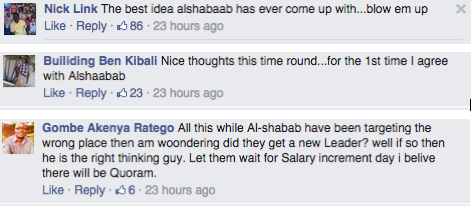
A Facebook post by Nation FM revealing a plot by 12 Al Shabaab agents to blow up the Kenyan parliament has attracted a cheerful chorus of comments begging the Somali terror group to go right ahead with its plans.

AL 1


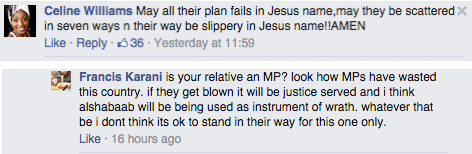
Even when calmer heads tried to prevail they were shouted down

 AL 5

Kenyans on social media are of course known for their “out-there” sense of humour. Indeed some of these comments might just be innocent attempts to get a cheap laugh from a stranger. But the tone of most of the comments is such that it’s worth considering if indeed some Kenyans feel MPs are ripe to be slaughtered en masse by one of the most bloodthirsty terror groups on the planet.

Most worryingly, though, these comments give comfort and encouragement to Al Shabaab. If parliament wasn’t on its lists of targets after those posts it surely must be because, like Westgate, it’s a high profile target certain to attract the attention of the international media and, like Lamu and Mandera, it has the potential to divide Kenyans along tribal and religious lines.

Hopefully these comments have caught the attention of MPs too. They deserve a share of the blame for this sorry situation. That Kenyans have resorted to daydreaming of their deaths at the hands of Al Shabaab is sign if ever there was one that they need to mend their ways. Like Al Shabaab the MPs have subjected Kenyans to their own brand of terror courtesy of their incompetence (hat tip David Ndii), shortsightedness and greed. The effects of their terror might be less catastrophic but it’s just as harmful.


Using art to engage on the Constitution

Institute of Performing arts (IPAL) entertaining the guests at the launch.

Art is becoming a pervasive and acceptable form of expression in Kenya, a reality that if well utilized, offers a great opportunity to learn and unlearn some otherwise hard concepts like the Constitution. Lack of understanding and readership of the Constitution has been blamed on its language, something those in the know are working to unpack through forms that also promote better retention capacity.

Jukumu Letu is one such initiative meant to promote the understanding of the Constitution through art. The initiative supported by various donors like Hivos, uses social media, music, performing arts and puppets to drive Constitutional messages to citizens.

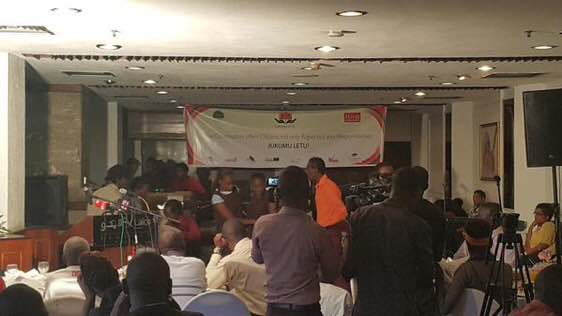
This was the message passed across during its media breakfast and stakeholder mapping on Friday, 28th February 2015.


At the breakfast, it was clear that the use of art is not only apparent but also useful as it helps to reach out to more people through avenues people easily relate to. This is especially the case considering that the struggle to get a new Constitution was fraught with many hurdles which would only be worth if the document is implemented.

“The struggle for a new constitutional dispensation was hard but the implementation process is even harder,”

noted Project Consultant of Interactive Media program Outfit Program (iMOP) Kawive Wambua.  


Ensuring that the Constitution is understood by all regardless of class and education is therefore a core focus of the Jukumu Letu initiative. This was underscored by Regina Opondo, the Executive Director of CRECO. She said that the  project is meant to ensure Kenyan citizens benefit from devolution, exercise self-governance through robust citizens participation, providing a platform where citizens meet county assembly or county government leaders to discuss issues that affect them, priorities and chart the way forward for the county, to give citizens support to audit what is happening in their own county, make decisions and decide the destiny for their county. She said

“CRECO brings together civil society, Media and various partners. We have Education in Democracy (IED), Institute of Performing Arts Limited (IPAL), Interactive Media Program Outfit Program (iMOP), Sarabi Africa, DJs with a cause, Bloggers Association of Kenya, Ghetto Radio, Hivos and Visual Artistes to sensitize people about the constitution.”


             It is equally a Constitutional obligation to respect and uphold the Constitution.


This responsibility involves all, both young and old.


Jukumu Letu initiative intends to take this program across the country.


This initiative is not happening without a core context. Hivos notes that the Jukumu Letu programme comes at a time when various attempts have been made by the state to undermine institutions of governance. This calls for action to adopt a political strategy towards promoting democracy, transparency and accountability.

“Hivos is committed to this process and wants to play a leading and coordinating role among the programme’s partners and provide the resources necessary for Jukumu Letu to be implemented,”

says Nyambura Gathumbi, Hivos’ Programme Officer for Rights and Citizenship.

The vision is not only clear but also robust from the initiators of the program.

“If you look at the initiative, it involves many players, for instance, musicians, thespians, bloggers. When we sat down to consider our involvement, the fact that we will be getting the opportunity to work with ten musicians from every county in Kenya was a chance we could not pass up. Imagine, talking about and composing songs on social justice with all these musicians. That is 470 musicians around Kenya singing about issues in their locality, in their own sound and in their own language, I don’t think there is anything bigger than that! For us as a band we wanted to be part of that process and that is the gift we can give to our country,” says George Ndeche, Sarabi’s founder.  


High Court ruling shows Kenya has to resist the impulse to nullify its Constitutional gains

From left, Cord lawyers Anthony Oluoch, James Orengo, Paul Mwangi and Haron Ndubi during a court hearing on the security laws. Photo courtesy of Nation

The idea that the process of making laws is messy has never been phrased in a catchier way than Otto von Bismarck’s oft quoted refrain

“Laws are like sausages, it is better not to see them being made.”

Kenyan’s got to see why Bismarck’s quote still rings true on December 18th last year when, on live TV, fistfights and scuffles broke out in parliament as MPs discussed the Security Laws (Amendment) Bill.


The Speaker of Parliament Justin Muturi, a real cog-in-the-wheel type, managed to pass the bill with the support of MPs from the ruling Jubilee coalition but not before he was pelted with documents and bulky parliamentary tomes by opposition MPs. It was a low ebb only possible in Kenya’s increasingly fractious and unyielding political climate. President Uhuru Kenyatta, reiterating for the umpteenth time why the Bill was important in the fight against in Al Shabaab, signed it into law the next day.


The feverish days before the bill was passed were consumed with partisan debate over its merits and demerits. Those in favour of the bill played up the president’s line about arming our security agents with the legal tools they need to nail terror suspects. Put simply: Terror suspects – constitution rights = less terror attacks. Those against the bill (yours truly included) argued that the Bill was a backhanded way of depriving Kenyans of their constitutional rights and that passing it would be a prelude to a return to the “dark days.” Or put another way: Constitution – Security Laws = dark days.


Predictably, the Coalition for Reforms and Democracy (CORD”) and the Kenya National Commission on Human Rights (KNHRC) filed a petition challenging the legality of the Security Laws in the High Court. This past Monday, February 23, 2015 saw the five-judge bench empanelled to hear the petition deliver its judgment. The judges struck out eight sections of the Act relating to the media, freedom of expression, bail, the right to a fair hearing and those relating to refugees and the appointment of a National Police Disciplinary Board for being unconstitutional. Media coverage since the judgment was delivered has focused on the broad strokes of the 231-page ruling and CORD’s victory lap coming as it does off their less successful appearance before the Supreme Court in 2013.


In doing so the media has failed to infer the real import of the ruling: the judges’ unanimous rejection of the impulse to nullify Kenya’s constitutional gains. The most potent argument for the Act was its necessity in the fight against terrorism like the Al Shabaab. That’s why the judges made sure to acknowledge that balancing constitutional liberties and security is fraught territory under any circumstances but especially so in the face of a bloodthirsty death cult like Al Shabaab.


The necessity of taking extraordinary measures against an extraordinary foe notwithstanding, the judges were adamant that Kenya need not gut its Constitution in the name of fighting terror.

“Insecurity in Kenya is not due to absence of laws but inefficiency of public bodies mandated to secure Kenyans,” read the judgment in part.

Also complicating matters for the government in the eyes of the court is Attorney General Githu Muigai’s own admission during the hearing that Kenya’s war on terror is hobbled by

“corruption and lack of coordination among security agencies.”

Given the comet-size holes that the judges were able to poke into the Act some are wondering how a Bill riddled with such patently unconstitutional provisions ever made it through to parliament for discussion in the first place. The simple answer to that is the Bill was a product of its time. By this I don’t just mean the climate of tension caused by sporadic but deadly terror attacks but the fact that the government had ample reason to think that the Constitution was a document of no consequence.

Let’s consider the evidence. The “Integrity” provisions of the Constitution were torn to shreds last year by the candidacy and election of several individuals with dubious track records. Several Cabinet Sectaries still hold on to private sector jobs even though the Constitution explicitly outlaws it. The government has instructed County Commissioners to stay in site even though the High Court has declared their positions to be unconstitutional. If its run-ins with the judges and magistrates vetting board is anything to go by, the judiciary itself is also not immune to ignoring the Constitution when it suits it.

By all accounts Kenya has one of the most progressive Constitutions in Africa if not on the planet. Staying true to the lofty values ascribed in the Constitution will not be an easy feat but it’s something Kenya must aspire to. The ruling on Monday reminded us that the Constitution is not just a dormant document that we should respect when we can but a guide on how we can be our better selves as a country.

Brian Obara is a lawyer and writer and the Nairobi County Editor for Kenya Monitor

The Bloggers Forum Video: Blogging In Kenya, Should It Be Regulated?


The Communications Authority of Kenya
The iHub yesterday (18th Feb) hosted a forum to discuss blogging, its merits, demerits and whether this space should be regulated or not. The forum sought to know and shed some light on the differences (if any) between journalism and blogging, and therefore if there is a need for  the Government and regulatory bodies to regulate bloggers.

In case you missed this enlightening forum, you can watch it from this video courtesy of the iHub.

Blogging needs no Regulation

Photo courtesy of @kiruik

Bloggers and journalists came together yesterday (18th February 2015) at the iHub to discuss whether bloggers should be regulated. The forum also discussed some differences (if any) between journalism and blogging, and therefore how the Government and regulatory bodies should handle them (the same way, or differently?)

From the start, panelists agreed that defining blogging is of great importance to better steer discussion.


Is there a difference between journalism and blogging?  

The role of bloggers in the increasing technological space in access to information is becoming evident. It is also providing information that media would otherwise not publish.

However, the standards for bloggers needs to high. If they are to attain professionalism, much is expected of them.  


The question of regulating blogging was therefore unanimously agreed as a no.


There is however need to ensure that as blogging grows, there is more responsibility from bloggers. This should not be limited to the blogger alone. They need to also instill the same responsibility to other bloggers to ensure it is respected as a profession.


Moving forward, bloggers were challenged to extend their tentacles and take part in international conversations that affect the internet. This is because blogging is global and decision made anywhere in the world will affect local bloggers.

Some unknown aspects also came to the fore. For instance, the Communication Authority of Kenya (CAK) has links with institutions like Facebook which Kenyans should exploit when need arises.  


Finally


You can watch the session here.

A Seminar on The Law and Internet in Kenya on 7th March

IF560x956Logo

The Constitution of Kenya, 2010 provides for the protection of the freedom of expression, freedom of the media, freedom of information, freedom of belief and opinion, the right to a fair hearing, access to justice and fair administrative action. While these rights are not absolute, they may only be limited within reasonable parameters as would apply in a free and democratic society. In the recent past there have been limitations of constitutional rights by the State in relation to the use of the internet by bloggers and social media users. Further, there are laws that have been selectively applied to social media users.

Over the last year, Kenya has witnessed State harassment, arrests and conviction of Kenyan social media users. Valid and invalid allegations have been made against social media users including defamation, hate speech, undermining a public official, abuse of a licensed telecommunication device, postings on social media that cause anxiety among others. Interaction between the law, social media and the state has been unclear and ambiguous.

It is for this reason that BAKE in collaboration with Mugambi Liabuta – an Advocate of the High Court of Kenya will carry out seminars on social media and the law. The seminars target bloggers and social media content generators to sensitize them on how their interaction online are regulated by the law and steps to undertake when challenged on the content they have generated. This hopefully, will equip online content generators with enough legal knowledge to objectively navigate the blogosphere. The topics for discussion in the seminars will include but not be limited to:-

  • Legal system
  • Defamation
  • Criminal Law Process
  • Communication Laws
  • Privacy
  • Confidentiality
  • Intellectual Property
  • Consumer Law and
  • Social Media Policies


The seminars will be precluded by a one week online discussion of the proposed topics. The Advocate will initiate debate with a 500 word brief on what each topic is about and how it affects online content creators. The seminars will also be held in Kisumu, Mombasa, Nakuru and Nyeri.

The Nairobi training will be held on 7th March, 2015 from 8.30am to 2.00pm. The venue is The Nailab, 4th Floor Bishop Magua Centre, Ngong Road opposite Uchumi Hyper.

The training is free for BAKE members but non members will be charged Kshs.500/-

Click Here to Sign up

About the Trainer
Mugambi Laibuta is the team leader at Mugambi Laibuta & Associates. He is Advocate of the High Court of Kenya with experience in legal research and project management. He has academic and practical expertise in constitutional review, design and implementation plus legislative drafting. Currently he is a lecturer at the Kenya School of Law and a former Research Fellow at the African Centre for Business and Human Rights at Strathmore University. He is also a Trained Mediator and a Monitoring,  Evaluation Professional and advisor on business innovation and sustainability.

The Changing Role of Kenyan Bloggers in Exposing Corruption

 Kenyan Blogger Robert Alai
Kenyan Blogger Robert Alai uploaded the video clip of Nandi MP Alfred Keter threatening Police officers (image source BBC)

When a Police officer secretly filmed a video clip of  outspoken Nandi Hills MP Alfred Keter threatening and insulting police officers and workers at the Gilgil weighbridge on the Nairobi-Nakuru road, he did not send the video clip to any of the Kenyan Media houses including some of the biggest in the region. Instead, the officer chose to send the clip to Blogger Robert Alai who went on to upload it on  YouTube and tweet about it, in the process exposing the Nandi Hills MP abuse of office.

Mr Keter was accompanied by his URP colleague, nominated MP Sunjeev ‘Sonia’ Kaur Birdi, whose truck, which was fitted with a drilling rig, had been detained because it lacked an exemption permit as required by law. The 5 Minute video clip captures Keter clearly invoking President Uhuru Kenyatta’s name even when on the wrong side of the law and using expletive rants using words such as motherf****r.

The clip elicited an immediate statement from The Director of Public Prosecution, Mr Keriako Tobiko, who put out a statement within hours directing the police and the Ethics and Anti-Corruption Commission (EACC) to investigate the Gilgil incident. Acting Inspector General of Police Samuel Arachi also asked Mr Keter to report to the police for investigations. The clip also started the debate on why the police officer who filmed the incident from his cell phone chose to share it with a Blogger and not an Mainstream Media or Journalist.

There has been continuing criticism from media analysts, critiques and ordinary Kenyans online regarding what most term as ‘Media Houses receiving their instructions from State House on what to make known public’. Many Kenyans no longer think that media houses are giving them unbiased coverage of news and stories especially on governance, corruption and anything that might paint the current government in bad light.

The role of Kenyan blogs is now increasing and filling the void  of a platform that Kenyans can publish information on corruption as well as easily access and share such information. Kenyan Blogger Abraham Mutai was recently detained in police custody for questioning and later released for exposing corruption in the Isiolo County through his Blog and tweeting about it.

Robert Alai has been quite outspoken through his blog Kahawa Tungu as well as through his twitter page that has over 145,000 followers. Alai was in December last year charged with undermining the authority of Kenya’s President Uhuru Kenyatta.

Blogger Abraham Mutai Arrested and Released for reporting on Corruption in Isiolo County

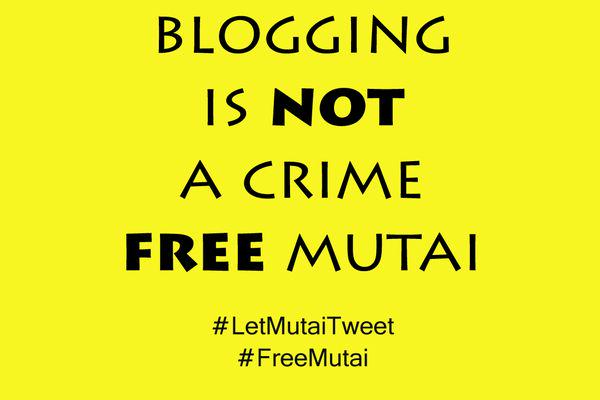
Blogging is not a crime, Free Mutai

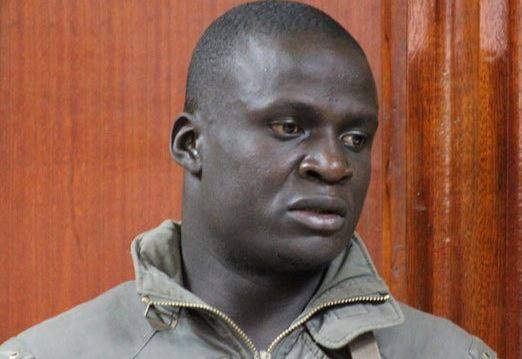
On Saturday afternoon, a blogger by the name Abraham Mutai was arrested in Mombasa and quickly airlifted to Nairobi. There were rumors that the arrest was connected to recent tweets he posted about rampant corruption activities going on in Isiolo County.

Police accused Abraham Mutai of misusing a licensed communication platform to cause anxiety. Mutai who uses the Twitter account @ItsMutai, was arrested at about 1pm in Mombasa before he was driven by CID officers to Nairobi. They arrived at about 11pm and was booked at Muthaiga police station. Sunday, he was taken to CID headquarters where he was questioned for more than an hour before he was released.

He was freed on personal bond. Sources said Mutai had published on his blog “issues that offended many people and caused anxiety without evidence”. Police accused him of misuse and abuse of communication-licensed platform, an offence they said they are investigating.
The online account associated with Mutai on the popular micro-blogging site has in recent months been used to post allegations of poaching, corruption and misuse of funds in Isiolo, Mandera and Mombasa counties.

The blogger has also posted claims of impropriety at the Geothermal Development Company and linked several names to the alleged corruption. CID director Ndegwa Muhoro said there had been a complaint regarding issues that Mutai had handled in the recent past and that was why he was arrested and questioned.

“I do not have details but there was a complaint on that man,” said Muhoro without elaborating.


His account had been disabled by the officers who arrested him. His colleagues were however able to lobby Twitter to re-activate his account. His arrest sparked an outrage online with a hashtag #FreeMutai being created to push for his release. The hash tag was trending number one in Kenya from Saturday till the whole day on Sunday even as the news on his release trickled in.

Mutai has vowed to continue running his blog and to hold the county governments accountable by reporting on corruption.

Listen to a full narration from Abraham Mutai on the whole ordeal from the time he was called by the his Boss under the instructions of the CID officers under the pre-text of owing some money to lady, to the time he was taken in for questioning to his release and the questions that the CID offers asked him.

[soundcloud url=”https://api.soundcloud.com/tracks/186628548″ params=”auto_play=false&hide_related=false&show_comments=true&show_user=true&show_reposts=false&visual=true” width=”100%” height=”450″ iframe=”true” /]

24 Year old Nancy Mbindalah Held in Custody then Pardoned for Undermining the Embu Governor

 24 year old Nancy Mbindalah who was arrested for insulting the Embu Country Governor on her Facebook Page
24 year old Nancy Mbindalah who was arrested for insulting the Embu Country Governor on her Facebook Page

A 24-year old University Student, Nancy Mbindalah was in January this year arrested by Police in Embu County and held for allegedly abusing, spreading hate and inciting statements against the Embu Governor Martin Wambora on social media.

Ms Nancy Mbindalah,  an intern with the department of Finance at the County Government is said to have made numerous postings on Facebook some dating as far as 2013.

Embu acting County Secretary Raymond Kinyua said he received a complaint from Mr Wambora and forwarded the information to the police who arrested the former Mt Kenya University student.

On Saturday, Mr Kinyua said he and Finance Chief Officer Damiano Muthee had recorded statements on the same.

He however didn’t elaborate on the actual wording of the posting only saying they were “insulting”.

“What was put on the OB is that there is somebody who is using insulting language and peddling some statements which are misleading and inciting. The complaint came from the office of the governor and is now in the hands of the investigators. I did it in my capacity as the acting County Secretary. The lady has been on internship at the cash office and was in office as late as Friday,” said Mr Kinyua on phone.

The arrest attracted criticism from a section of Embu residents with some calling on Mr Wambora to pardon Ms Mbindalah.

“The Investigating Officer  confirmed that Nancy Mbindalah was locked up for demeaning and being insulting to the County Governor through numerous Facebook posts. The police were hesitant to grant a police bond

The prosecution said Mbindala committed the offence on February 14 last year. In the second count, she was charged that on February 7, she said one cannot get a tender or a job in Embu county without compromising Wambora. The prosecution said Mbindala alleged the governor deals with youth, whom he treats like wives.

 In the third count she was charged with writing on December 5 last year that she was “proud to be a Kenyan from Embu, the land of Impeachments, where even an Illicit brew called Gathufuria impeaches people to death”.
In the fourth count she was accused that on March 11 asked why a certain tender was not advertised and instead it was single sourced. She further wondered why Wambora was giving all county tenders to one woman.The fifth charge states she wrote on December 22 that Ishiara Level Four Hospital had been closed due to lack of water. She said the hospital’s water supply was disconnected due to unpaid bills and questioned what the county government was doing over the issue. She asked whether the government was signing and sealing death certificates for Ishiara patients adding that the Kiritiri health centre would also be closed.The accused who was released on Sh30,000 cash bail on January 12th appeared before the magistrate on Tuesday to demand the release of her documents and cell phones.

(Additional Source The Star)

Hate Speech Cases against Allan Wadi and MP Moses Kuria Raise Questions on Double Standards

Gatundu South MP Moses Kuria
Gatundu South Member of Parliament Moses Kuria

The hate speech case against Gatundu South MP Moses Kuria and the shift to have it resolved out of court as opposed to going to full trial continues to elicit public debate.

This is more so owing to a previous conviction of a 22-year-old Kenyatta University Student Allan Wadi, who without legal representation took a plea of guilty and was sentenced to two years in prison.

The public has questioned why the laws seemingly applies differently for the two accused under the same crime.

The crime of hate speech falls under the category of a misdemeanour, a minor crime that does not need to be settled in court and for which jail terms are generally less than a year.

This is in comparison to capital offences such as murder which are triable in a court of law and which have penalties more than a year upon conviction.

While Wadi was charged with hate speech and undermining authority on account of calling for the ejection and displacement of a certain community, as well as insulting President Uhuru Kenyatta, the former charge would have benefited from alternative means of resolving it.

The alternative disputes resolution which exists as a mandate of the National Cohesion and Integration Commission, a constitutional organ that came into being in 2008 following the post-election violence of December 2007 that ran till February 2008.

Former UN Secretary General Kofi Annan who was the chairman of the mediation panel resolved with the negotiating teams from ODM and PNU that a body would be formed to bring about reconciliation and check against future incidents of incitement to violence.

Section 13 of the NCIC with is Act 12 of 2008 hence states the following as a deterrent to hate speech;

(1) A person who–

(a) uses threatening, abusive or insulting words or behaviour, or

displays any written material;

(b) publishes or distributes written material;

(c) presents or directs the performance the public performance of a

play;

(d) distributes, shows or plays, a recording of visual images; or

(e) provides, produces or directs a programme,

which is threatening, abusive or insulting or involves the use of threatening,

abusive or insulting words or behavior commits an offence if such person intends

thereby to stir up ethnic hatred, or having regard to all the circumstances, ethnic

hatred is likely to be stirred up.

(2) Any person who commits an offence under this section shall be liable to a

fine not exceeding one million shillings or to imprisonment for a term not

exceeding three years or to both.

(3) In this section, “ethnic hatred” means hatred against a group of persons

defined by reference to colour, race, nationality (including citizenship) or ethnic or

national origins.

However because hate speech is a misdemeanour likely to cause disunity among different ethnic groups the NCIC is mandated to resolve such a crime through means other than a full trial in a court of law.

Section 25 of the NCIC Act states;

(2) Without prejudice to the generality of subsection (1), the Commission

shall–

(g) promote arbitration, conciliation, mediation and similar forms of

dispute resolution mechanisms in order to secure and enhance

ethnic and racial harmony and peace;

This particular section is what Kuria through his lawyer Francis Munyororo invoked and applied for an out-of-court settlement with LSK and NCIC as the complainants in his case.

Conversations on the two cases on social media have now raised the question on whether the alternative dispute resolution mechanisms should be included in the Bill of Rights under Chapter 4 of the Kenyan Constitution as opposed to being in the NCIC Act

Section 51 of the Constitution under the Bill of Rights which deals with Fair trials for accused would best serve to have the ADR mechanism included in it and which would be communicated to the accused in a misdemeanor suit prior to trial.

This would offer equal opportunity to an accused for a misdemeanor crime along with provision of legal representation by the state. This then serves to further the cause for national cohesion.

(Source The Star)

University Student Allan Wadi gets 2 years Jail Term for Hate Speech on Facebook


Allan Wadi Okengo, A 25 year old University Student Jailed for 2 year for Hate Speech on Social Media
Allan Wadi Okengo, A 25 year old University Student Jailed for 2 years for Hate Speech on Social Media (image Source: Daily Nation)

A fourth-year university student will spend two years in jail for posting on social media  insults against President Uhuru Kenyatta.

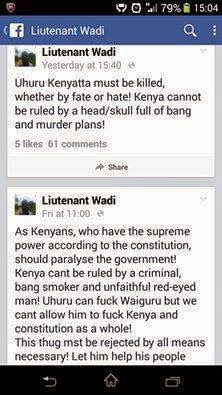
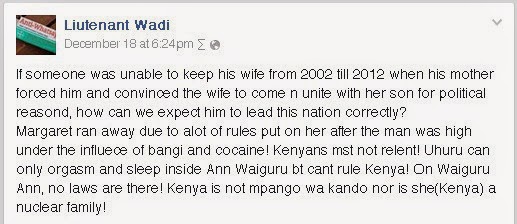
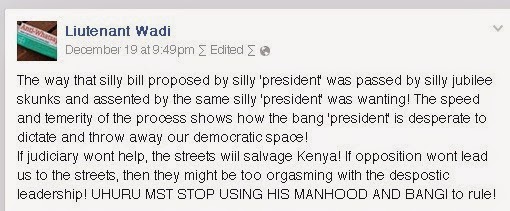
Alan Wadi Okengo, alias Lieutenant Wadi, was accused of posting the messages on his Facebook account on December 18 and 19 at an unknown place within Kenya.

Allan Wadi's Facebook posts that got him a jail term of 2 years
Allan Wadi’s Facebook posts that got him a jail term of 2 years
Allan Wadi's Facebook posts that got him a jail term of 2 years
Allan Wadi’s Facebook posts that got him a jail term of 2 years
Allan Wadi's Facebook posts that got him a jail term of 2 years
Allan Wadi’s Facebook posts that got him a jail term of 2 years

Wadi, 25, a political science student at Moi University, was arrested as he attempted to sneak out of the country through the Busia border on December 31.

He was brought back to Nairobi CID headquarters where he was interrogated by cybercrime police sleuths.

Wadi, who looked composed, told Milimani Law Courts resident magistrate Ms Ann Kaguru that he was ready to “apologise to President Kenyatta personally if he was not handed down a custodial sentence.”

The charge against the university student stated that “the message he sent was calculated to to bring into contempt the lawful authority of the President of the Republic of Kenya.”

PLEA NOT FACTORED

His plea was not factored when he was he was being sentenced after pleading guilty to two charges of hate speech and demeaning authority of a public officer, contrary to Section 132 of the Penal Code.

In her ruling, Ms Kaguru said,

“the offence is serious and a deterrent penalty is called for to serve as a warning to others abusing the social media forums.”

She proceeded to pronounce the sentence after saying that

“he was convicted on his own plea of guilty.”

A state counsel, Mathew Karori, told the magistrate that the accused was arrested while he was about to cross the border through “panya routes” (unofficial exit) to a neighbouring country.”

Mr Karori urged the court to treat the remorseful student as a first offender although he said the abuse of the social media forum should be discouraged.

Wadi was accused of posting the two offensive messages when National Assembly passed the Security Laws (Amendment) Act No 19 of 2014 on December 18 and the following day when President Kenyatta signed the Bill to become law last year.

The first indictment was that he posted a hate speech message intended to stir up ethnic hatred between various Kenyan communities on the other by alleging a particular tribe should be deported to their home county.

Reaction from Kenyans On Social Media

The jailing of Allan Wadi drew sharp reactions from Kenyans Online with most of twitter sharing their sentiments using the hashtag #AllanWadiJailed. Many were however supporting the action taken against Wadi for what they believed was pure hate speech which most believed, went beyond the boundaries of freedom of expression.

Still there were those who believed that, despite Allan abusing his right of free speech online, he did not warrant such a punishment and that the sentencing reflected badly on the current Jubilee government as well as on the president himself.

(Additional Source Daily Nation)

We need Better Laws in Kenya to better protect Internet Freedoms

The Collaboration on International ICT Policy in East and Southern Africa (CIPESA)
The Collaboration on International ICT Policy in East and Southern Africa (CIPESA), A body that monitors and promotes internet freedoms, primarily in East and Southern African states.


As at the end of the year 2014, Kenya status on Interned Freedoms was ‘Free’. According to Freedom House, an independent watchdog organization dedicated to the expansion of freedom around the world, Kenya was ranked at position 28 globally on Freedom of Net total and at position 12 on violation of user rights.

That was 2014 and it seems like Kenya’s ranking on internet Freedoms will have undergone a significant change by the end of 2015.

Kenya has seen a steady rise in the number of bloggers and Social Media opinion makers who are free to speak their mind on not just Politics but also on social issues affecting Kenyans. The void created by Media houses failing to provide unbiased coverage and lately, lack of in-depth coverage of news and stories happening, has presented an opportunity for bloggers to become Citizen Journalists.

The Kenyan Government is seemingly becoming quite intolerant of voices of dissent and dissident Kenyans who have continued to become more vocal on Social Media and Blogs.

The recent arrest of Robert Alai, Allan Wadi, Mercy Mbindalah(she has since been pardoned), and Abraham Mutai yesterday is a clear indication of a growing trend to silence Kenyan Bloggers and ordinary citizens on Social Media.


Why the internet is becoming an important tool for Free Speech

The internet is a crucial medium through which people can express themselves and share ideas and has become an increasingly important tool through which democracy and human rights activists mobilize and advocate for political, social, and economic reform.

Fearing the power of the new technologies, authoritarian states have devised subtle and not-so-subtle ways to filter, monitor, and otherwise obstruct or manipulate the openness of the internet. Even a number of democratic states have considered or implemented various restrictions in response to the potential legal, economic, and security challenges raised by new media.

This power of the internet and specifically social media became very evident on Sunday 18th January after Kenyans Online rallied each other and demanded the release of Abraham Mutai (@itsmutai), a blogger and whistle blower who was arrested on 17th in Mombasa for his expose of corruption in Isiolo County among other exposes.


Internet Censorship

Internet censorship is the control or suppression of what can be accessed, published, or viewed on the Internet. It may be carried out by governments or by private organizations at the behest of government, regulators, or on their own initiative. Individuals and organizations may engage in self-censorship for moral, religious, or business reasons, to conform to societal norms, due to intimidation, or out of fear of legal or other consequences.


18th January Internet Freedom Day

The arrest of Abraham Mutai coincided with the celebrations to mark Internet Freedom Day which began in 2013 to mark a one year anniversary of the technology community’s Internet blackout over the Stop Online Piracy Act (SOPA) and its sister bill, the PROTECT IP Act (PIPA). SOPA was intended to curb online content piracy.

The Bloggers Association of Kenya (BAKE) had on Thursday 15th January called on all Kenyans online to mark Internet Freedom Day using the Hashtag #iFreeKe. Kenyans were requested to write about something they love on the Internet that they never want to see censored in the form of blog posts, tweets, Facebook updates and/or YouTube videos.

Kenyan bloggers, Social Media users together with activists joined in the call for Free Speech and internet Freedoms online through the hash tags #FreeMutai and #iFreeKe throughout today ( 18th Jan). This prompted the release of Mutai from Police Custody and prompted Kenyans Online to share their thoughts and concerns on the current and declining state of Internet Freedoms in Kenya.


Recommendations for Better Internet laws in Kenya

In a report on the ‘State of Internet Freedoms in Kenya in 2014 ‘, an investigation into the policies and practices defining Internet Freedom in Kenya, Open Net Africa Initiative and The Collaboration on International ICT Policy in East and Southern Africa (CIPESA) made the following recommendations to improve internet Laws in Kenya.

  1. Kenya should expedite the enactment of the Access to Information law and the Data Protection law. Civil society should be given opportunity to provide meaningful inputs into these laws.
  1. The circumstances and laws under which individuals are charged over their online activities need to be clarified. The National Cohesion and Integration Act has improperly been applied to take action against individuals accused of propagating hate speech.
  1. There should be clear definitions of what constitutes hate speech and ‘causing annoyance’ as grounds for taking legal action against individuals.
  1. Conversations on what constitutes free speech and the distinction between blind control and respect for freedom of expression online should be fostered and should draw in civil society, the media, religious organisations and government departments.
  1. Create awareness among the media and human rights defenders on internet freedoms and encourage development of a network of advocates and educators on online freedoms.
  1. The NCIC, police and other security organs should make public all results of their surveillance of citizens’ communications, as well as investigations and prosecutions of hate speech and other offences and crimes committed via digital technologies. The law should clearly specify the responsibilities of intermediaries and other parties in relation to filtering, removing and blocking content, the steps that need to be followed in these processes as well as appeal processes where there is an attempt to filter, remove or block a site or content


Arrested Kenyan Blogger Abraham Mutai @ItsMutai released on bond

From left, Boniface Mwangi, ItsMutai,His layer 2Olez and BAKE CHariman Kennedy Kacwanya this morning after Mutai's release
From left, Boniface Mwangi, Abraham Mutai (@ItsMutai), His lawyer @Olez and the Bloggers Association of Kenya (BAKE) Chairman Kennedy Kachwanya this morning after Mutai’s release

Following the arrest of Kenyan Blogger Abraham Mutai  who uses the twitter handle @ItsMutai  in Mombasa yesterday, at long last, he has been released where he was held. Mr. Abraham Mutai was released on personal bond and will be required to report to the  CID Head Quarters on Monday morning to answer to charges of ‘Misuse of telecommunications equipment and  tweets that may cause anxiety.

It started when @ItsMutai was called from his office in Mombasa by the police, telling him that a certain lady had complained about Ksh.3000 which he owed her. Looking back Mr.Mutai says that was the CID’s way to find out where he was yesterday. From there CID found their way to his office. Before arresting him, they said that Isiolo Government was complainant. They were not clear exactly who from Isiolo Government complained. They took him to the CID HQ Mombasa and then to Nairobi Muthaiga Police station.

On his way to Nairobi Before being released the head of the station mentioned in passing his tweets and blogs about the Ivory and the Mandera expose. According to Mutai, he sensed that throughout the detectives were in contact with the Head of CID Mr. Ndegwa Muhoro. They frankly admitted that there was massive support on twitter under the hashtags #Freemutai and #iFreeKe

This comes at a time when the world marks Internet Freedom Day on 18th January. Kenyans online took to their platforms to not only express their solidarity with Mutai but also mark this day reflecting on the internet freedoms that are now becoming less and less not only for Kenyan bloggers but also for any Kenyan with dissent views on the current government.