The International Centre for Transitional Justice (ICTJ) considers the youth an integral part of peace achievement, and a key player in shaping and strengthening Kenya’s democracy.
After working on the renowned TJRC report The Truth, Justice and Reconciliation Commission (TJRC) sought an adoption of the report to make it relevant to Kenyans and most specifically, the youth. That is how TJRC and the ICTJ got to work together in 2011.
ICTJ is now on its final stages of adopting the report that will be released through a booklet dubbed ‘Learning from the Past: An Exploration of Truth, Justice and Reconciliation in Kenya’. The report intends to teach the young generation and Educators about conflict prevention, democracy building, and social cohesion in Kenya.
As ICTJ finalizes the report, it seeks to be all inclusive and to gather as many ideas as possible. It is with this intention that they will be holding a consultative forum at PAWA 254. Through the forum, ICTJ will engage the youth and get ideas on how they can be more involved in peace, justice and reconciliation initiatives, in light of President Kenyatta’s recent apology and call for TJRC recommendations to be implemented.
The Kenya Institute of Curriculum Development (KICD) is also interested in reforming the curriculum to include ways in which the youth can play a part in justice, social cohesion and peace issues, even in the classroom. ICTJ intends to meet the Curriculum Reform Steering Committee and share all the thoughts and ideas gathered from the event with the committee.
This forum is a good opportunity for you to air your views, suggest new ideas, and propose any changes in matters to do with peace and justice in Kenya.
You are invited to join the forum by attending this event that will be held at PAWA 254’s Mageuzi Theatre on Wednesday, the 15th of July, 2015 from 4:00pm to 7:00pm.
Due to a limited seating capacity of only 50 people, you are requested to RSVP your attendance here
Kwani? Trust recently concluded a one week writers workshop in Mombasa. The workshop was part of Kwani?’s wider plan to collect essays, fiction, creative non-fiction, poetry and photography based on the Coast Region.
Most importantly, after the workshop, the writers will help explore what new narratives can emerge from the ‘Coast’ from a social and political standpoint.
The Coast based writers were privileged to work with experienced trainers and authors for an intense one week workshop. During this workshop, they learned aspects of a writer’s craft and developing style.
Participants at the Kwani? Fiction Workshop (facebook/kwanitrust)
Kadara Harith, A lecturer at Pwani University covered Politics and Religion on the Kenya Coast. Other tutors included Caine Prize for African Writing, 2003 winner: Yvonne Adhiambo Owuor and Kwani?’s managing editor Billy Kahora.
According to participants, the benefits of the workshop are immense. The brief history on Mombasa and coast is important especially when telling stories from the Coast.
For those who attended, the workshop may perhaps be the best thing to ever go down, involving writers in Mombasa.
For a while, it seemed as if creative writing in Mombasa had taken a backseat, especially considering that writers in Nairobi and other places like Nakuru have been getting the biggest share of the ‘writers cake’- think Storymoja Hay festivals and Kwani? litfest.
Abdulrahman Ndegwa, who writes as Akhy Mjanja is one of the writers who took many lessons from the Kwani? workshop.
“I have learned a lot on writing, especially of description and building a character. These two are very crucial in writing a story and it was something that was not in my writing journey. Having activities at the workshop that help in building a character was very helpful because it gave me a practical way to view the process.”
According to Jamila El Jabry, a Mombasa based blogger who writes on LifeinMombasa.com, she found immediate use for lessons from the workshop.
“I was in the process of writing a story and I was stuck at a point, but the workshop has given me insights on how to move forward with my story. The workshop will help in how we tell our stories; Coast writers will have a voice in creative writing. The stories will move from verbal to written.”
Yvonne Owuor engages the participants. (facebook/kwanitrust)
After an entire week of learning from the best- Billy Kahora and Yvonne, the writers walked out of the workshop with a keener, more alert perspective of what writing is all about. Lessons about about voice and characters, dialogue and description as building a character’s life remain etched in the writers minds.
In closing, Abdulrahman Ndegwa was thankful for the mentor-ship he received during the workshop.
“I was mentored by Billy Kahora and perhaps the biggest impression that stuck with me is his passion to tell a story that touches on people’s lives. Ever since that mentoring session, I write more keenly with my target audience in mind. I pay more intention to where I want the reader to go with my story!”
In the wake of the last day of June 2015, work the busiest port in East and Central Africa, Mombasa came to a standstill. All of its 6000 dock workers downed their tools in solidarity with other trade unions against the new National Hospital and Insurance Fund (NHIF) levies imposed on them without their approval. It was the same commotion at the Ferry Services in Likoni as its 200 workers also joined in the strike forcing the local managers to step in and handle the mammoth task of billing cars getting into the ferry.
About 500 containers are offloaded from ships on a daily basis hence it was a major inconvenience to the many exporters and importers that rely on the Kenya Ports Authority (KPA). With trucks that pick up an average of 1000 containers daily, drivers were left stranded along Mikindani-Changamwe road siting their complaints.
Mr William Kidima, the business representative for Uganda at the port, said it was not easy to quantify the losses.
“If this goes for two days we may have to ask (the) KPA to waive charges for us because it is not our fault that cargo remains at the port while it’s supposed to be cleared,” he said.
Later in the week, posters went all around the county of Mombasa asking people to apply for the impending KPA jobs since the management had threatened to have all those who didn’t comply sacked. These were shared by leaders in the county among them Mvita M.P Abdulswamad Nasir. Thousands of job seekers were on Saturday turned away by the Kenya Ports Authority where they were seeking employment opportunities.
It was reported that there was stampede as more than 3,000 people turned up from as early as 4 am and jammed the KPA college compound for the interviews. Some were injured and attended to by emergency medical personnel. Kenya Ports Authority managing director Gichiri Ndua said they intended to keep a database of qualified individuals who they would call upon if the need arises. He also revealed that businesses in East Africa had lost more than Sh1 billion as a result of the two-day strike at the Mombasa port.
“We will rely on the database to bring on board qualified employees when there is need,” said Mr Ndua.
KPA then went further and evicted the workers from their houses with no notice prompting the workers to go to court. On the July 7th, the Industrial Court ordered 20 workers to go back to their homes after they had been sacked.
The court ruled that the sacked workers will remain in the staff houses until their case is concluded after the workers went to court on Tuesday to challenge their dismissal and eviction from staff houses in Makupa, High Level, Mbaraki and other estates in Mombasa.
The judge directed the parties to appear before him for the next hearing on July 24th. The complainants are hoping the court will declare their termination unlawful and unconstitutional and want to be immediately reinstated.
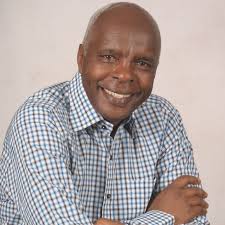
On Monday this week, Makueni Governor Kivutha Kibwana issued a stern warning to lazy and incompetent officers that they risk being sacked should they fail to deliver in their duties.
The usually calm and collected governor did not mince his words during the signing of the county’s performance contracting at the county headquarters in Wote town and at one time in the middle of his speech ordered the whole cabinet to stand before putting them on notice over ineptitude.
“If you don’t crack the whip on non-performing officers I will personally sack them,” said the governor.
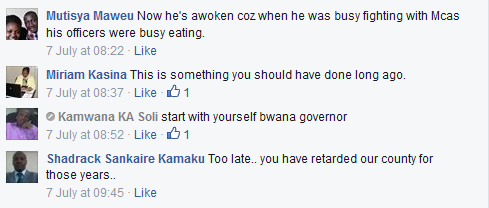
The seemingly bold move by the governor to crack the whip on non-performing officers in his government that has been bedeviled by constant wrangling between him and the Members of the County Assembly for the last two years has continued to elicit mixed reactions on social media.
Residents took to Facebook to express the varied opinions on the governor’s threat to weed out lazy and ineffective government officials.
While there are those who rallied behind the governor,
and praised the governor for his transparency besides challenging him to walk the talk,
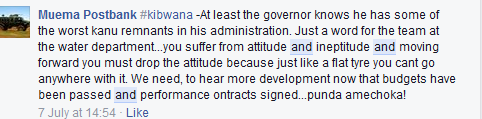
Others took a swipe at the governor saying that the warning was long overdue.
and some even accused the governor of nepotism and demanded for development.
Governor Kivutha seems keen on recovering the time lost in the wrangling over budget related issues between him and the MCAs, hence his strong stance on incompetence. However judging from the reactions of the residents the governor and his team will have to burn the midnight oil and deliver services to the people of Makueni for the remaining period before the next general elections in 2017. It is perhaps this realization that has prompted the Governor to issue the stern warning.
Shells of the two trucks burnt in Kasikeu Photo:Facebook
Irate residents of Kasikeu in Mukaa Sub County last night torched two trucks that were found harvesting sand illegally at Kaluku river.
Area Police Boss Muturi Mbogo said the trucks, in a convoy of four had sneaked to the river to scoop sand when area residents waylaid them and set ablaze two of the trucks. Mbogo said the drivers managed to escape while the other two trucks sped off before they could be caught up in the melee. No casualties were reported.
The police boss warned sand harvesters against scooping sand without permit and also cautioned residents against taking the law in their hands.
He said no arrests have been made so far but, disclosed that police have launched investigations into the incident and promised to bring to book those found culpable.
Incidents of lorries torched while harvesting sand in Kasikeu are not new. Last year several lorries were set ablaze after residents impounded them while ferrying sand.
Despite the Sand Harvesting Act that was passed by the Makueni County Assembly early this year cases of illegal sand harvesting are rampant as the new act is yet to be effected due to lack of proper structural frameworks.
Director Water and Environment Joseph Munyao told Kenya Monitor that according to the new act, a sand harvesting management authority that is mandated to regulate the activity has not been constituted.
Governor Kivutha Kibwana banned sand harvesting immediately he took office in 2013 and according to Munyao it is still not clear whether the ban or the law is in effect.
Despite the ban, the activity continued unabated particularly in Kasikeu and Kibwezi. Consequently the county government efforts to form an enforcement unit to curb the menace has not borne much fruits as the officers are outnumbered and threatened by the sand loaders and harvesters.
Illegal sand harvesting has had devastating effects. Several people have lost lives in the fight against the activity while many rivers, which act as main sources of water, have dried.
Kikuo Water Resources and Users Association (WRUA) Antony Mutua says with the environmental degradation residents are forced to walk for long distances in search of water for both domestic and livestock use.
While the sand harvesters rake in millions of money from the activity, (a lorry goes for between Sh40, 000 and Sh60, 000 in Nairobi or Mlolongo) residents and especially unemployed youth who act as loaders continue to languish in poverty. The youths are paid a paltry sh400 per lorry.
With this worrying trend, perhaps its time that the national and county government collaborate to fight the menace and implement the new enacted sand act to prevent further wanton destruction of environment and property.
Are you looking to improve your writing or blogging skills on any of the following topics: Parliamentary business, Devolution and County Assemblies work, data journalism and Constitutional Implementation? Mzalendo Trust and the Bloggers Association of Kenya (BAKE), would like to work with you to grow your skills in a one day intense training program that will run on Friday, 24th July 2015.
There are only 30 slots available, please apply only if you’re interested in:
Development blogging
Parliamentary affairs
Political analysis
Devolution
Social Justice
The prerequisite is that you must have a blog. The training is FREE to all participants.
Shortlisted participants will be informed via email on 22nd July 2015.
Jessica Musila is the Executive Director of Mzalendo Trust, the organization behind www.mzalendo.com, Kenya’s premier Parliamentary Monitoring Initiative
Jessica Musila is the Executive Director of Mzalendo Trust, the organization behind www.mzalendo.com, Kenya’s premier Parliamentary Monitoring Initiative. Over the last four years, she has spearheaded Mzalendo’s evolution from a blog into a largely self-sustaining site with an organization supporting it. She is passionate about social justice and prior to her involvement with Mzalendo has worked in the governance, development and humanitarian sectors.
The 2015 Internet Freedom Fellows program focuses on the theme “Empowering women and girls: the power of IT“. It brings five bloggers, activists on human rights from Kenya, Brunei, Zambia, Palestine and Belarus to Geneva and to the United States to meet with fellow defenders, U.S. and international government leaders and members of civil society engaged in information technology, human rights and women’s empowerment through the internet.
A key goal of the program is to share experiences and lessons learned on the importance of a free Internet and an engaged use of the social media to the promotion of women’s freedom of expression as a fundamental human right.
Before joining Mzalendo Trust, Jessica held various roles at mySociety UK, Hivos Foundation – Twaweza project, German Technical Cooperation (GTZ) and the International Committee Red Cross (ICRC). Jessica has a B.A. in Communication and Community Development from Daystar University, Kenya and a Master of Public Policy (MPP) from the Willy Brandt School of Public Policy, Germany.
About the Internet Freedom Fellowship
The Internet Freedom Fellows program brings human rights activists from across the globe to Geneva and Washington, D.C. to meet with fellow activists, U.S. and international government leaders, and members of civil society and the private sector engaged in technology and human rights. A key goal of the program is to share experiences and lessons learned on the importance of a free Internet to the promotion of freedom of expression and freedom of assembly as fundamental human rights.
Communication shapes the way societies are built and every person should have the right to express his/her ideas, feelings and emotions as well as hopes for the future. The protection of an individual’s right to freedom of expression and assembly is an integral part of a free and democratic society where these rights are essential human rights. In the beginning of 21st century a new challenge facing all societies is Internet Freedom. Ensuring that individuals have the same rights of freedom of expression and assembly on the Internet as they are entitled to elsewhere is one of the human rights challenges of the present moment.
The principal goal of the program is simple — to highlight the essential importance of a free internet to the promotion of human rights at the grass roots level. By identifying and involving grass roots human rights activists from around the world, the program will highlight in a tangible manner why and how a free internet is essential to their work.
Launched in 2011, the Internet Freedom Fellows program is an initiative of the U.S. Mission to the United Nations in Geneva. Core partners for the 2014 Program GMedia Center, a Geneva based NGO which works to empower media to further civil society goals; and Meridian International Center, a Washington D.C. based NGO promoting international understanding through exchange programs.
From his days as a Jubilee strategist, Moses Kuria’s rise to notoriety is a matter of public knowledge. He was in and out of court last year, charged with incitement to violence, hate speech and fanning ethnic hatred through comments on his social media accounts.
Things got to a head when the Director of Public Prosecutions (DPP) and National Cohesion Integration Commission wanted Kuria to be jailed as he was frustrating attempts to resolve the matter out of court. The DPP went as far as applying for Kuria’s bail to be cancelled as he had posted more hateful comments as his case was going on. His case will be brought up on the 9th and 10th of September this year.
However, it seems like he has learned nothing despite his public apologies for previous remarks, some of which were published in newspapers.
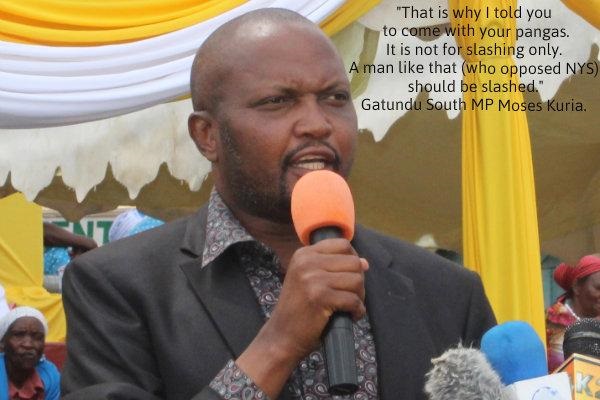
In a new video,
Moses Kuria telling Gatundu people that they should cut anyone criticising NYS with a panga
Kuria addressing his constituents in Gikuyu language, he tells people to use pangas to ‘chop’ those that are opposing NYS. He made the remarks in his constituency when addressing the youth in a NYS recruitment drive.
Speaking to the media later, Kuria was unapologetic saying he had done nothing wrong and claimed his remarks were aimed at those trying to destabilize the NYS project.
“The days when they would say whatever they want and no one would answer them are long gone”
he said in regard to the opposition leaders.
His remarks have drawn ire from social media users in Kenya. The hashtags #MosesKuria #ArrestMosesKuria and #KillMosesKuria have been trending in the last 24 hours.
His repeated remarks have rubbed many the wrong way and Kenyans are tired of his hateful speech. The lack of action on the NCIC part has also been brought to focus considering that Moses Kuria is a repeat offender.
If this idiot called Moses Kuria will not get arrested,no one & I mean no one should ever lecture us on matters unity.#ArrestMosesKuria
His remarks also do the NYS no favors with all the allegations of massive corruption and nepotism that have put the NYS in negative light since the beginning of last month. From payments to shadowy suppliers, massive procurement, hacking of the IFMIS accounts, supply of imported foodstuffs to internal power wrangle; NYS is an organisation that is under scrutiny.
Now my doubts are cleared and case is rested. NYS is nothing less of a transformed militia group #ArrestMosesKuria
President Kenyatta Inspects the Standard Gauge Railway progress
By Davis Mwandawiro
When it was announced that the long awaited Standard Gauge Railway (SGR) project would commence last year, there was a huge relief that it would open up the region and ease up the congestion that is usually along the busy Mombasa-Nairobi road. However, controversy is flaring up once more over the construction of the multi-billion shilling Standard Gauge Railway.
The project has hit a snag in Mombasa where residents have refused to be compensated for the lands in order to pave way for the contractors to continue building the railway. Communities along the 15KM stretch from Banda to Port-Reitz claim that the region is ancestral land and will not part away with it.
The Sh 324 billion contract to build the Mombasa-Nairobi railway went to two Chinese state-owned enterprises. China’s Third Railway and Design Institute Group Corporation (TSDI) will supervise the construction work by the China Roads and Bridges Corporation (CRBC). Some of the land evaluators complained that the high levels of illiteracy in this region made it even more hard to communicate effectively.
One particular local argued that he can never move out of his land because all of his family has been buried there. Efforts by government officials to try and talk sense have bore no fruit. In a twisted chain of events, it is alleged that local leaders in the region have had a hand to play in the resistance. It is speculated that they conspired with the public urging them not to accept any compensation.
It is alleged that most of the locals who are against the land relocation plan don’t even have title deeds. The land they currently live on is owned by an anonymous Indian tycoon who has tabled a case in court for the removal of the squatters.
Already, there has been a war of words between the National Government and the County Government over the compensation of landowners. Mombasa County Commissioner, Nelson Marwa has accused the Members of County Assemblies (MCAs) in the area of playing politics with the matter and warned those inciting locals will be arrested and charged. However, MCAs alleged that landowners in areas affected have been paid ‘peanuts’ for their land and want the National Land Commission to repeat the exercise.
The county executive for lands, Francis Thoya also recently clashed with Marwa, calling him a small man who should not overstep his mandate as he has no authority on land matters.
Its highly unlikely that this standoff will continue. The Standard Gauge Railway (SGR) is an inevitable government project that must be completed. For now, its just about a matter of time until all these issues will be resolved and its completion.
National Land Commission (NLC) Chairman Dr. Mohammed Swazuri has called on local politicians not to interfere with the SGR land compensation as the projects will benefit all Kenyans include Mombasa residents. The NLC hopes that a meeting between the contractors, Kenya National Highway Authority (Kenha) and other stakeholders to sort out the impasse.
Makueni Governor Kivutha Kibwana and Health Executive Dr.Andrew Mulwa during the signing of the performance contracting in Wote.
Makueni Governor Kivutha Kibwana has threatened to sack lazy and incompetent officers in his government.
In a strong –worded warning, the governor stated that he will neither condone ineptitude nor hesitate to send packing public servants who fail to deliver in their respective dockets.
Speaking in Wote during the signing of the county performance contracting, Kivutha said that the people of Makueni deserve an efficient workforce for service delivery and called on the workers to embrace accountability and integrity.
The governor regretted the standoff between him and the County Assembly that had almost brought the county operations to a near halt but promised that his government will compensate for the time lost and deliver the much-needed services to the residents of Makueni.
“We very well know that we have had budget wrangles for the last two years that has seriously affected development but this is the time to work and not to point fingers at each other,” said the governor.
Kivutha also stated that his government will not tolerate corruption but will operate in a transparent manner.
While invoking Article one of the Constitution, Kivutha also called on the residents to keep the government in check by fully participating in the county affairs.
“The sovereign power belongs to the people and they should exercise that power as outlined in the constitution,” he said.
During the signing of the performance contracting different departments committed to deliver on key flagship projects in the 2015/2016 financial year.
Agriculture Executive Jacobus Kiilu committed to establish the Kalamba Fruit processing plant at a cost of Sh210M for value addition, diary units at Sh13M and enhance extension services to farmers at the cost of Sh15M.
Roads and Infrastructure Executive Alidan Mbinda promised to initiate a street lighting project in major towns to the tune of Sh50M, establish parking areas and improve access roads in towns at a budget of Sh55M and upgrading of major roads across the county at a cost of Sh50M.
Health Executive Dr. Andrew Mulwa, stated that his department will strive to complete the maternity wing under construction at the County Referral Hospital, set up a High Dependency Unit besides establishing a trauma centre at the Makindu sub county hospital to cater for accident victims along the busy Mombasa-Nairobi highway while his Lands and Urban Planning counterpart Judy Kalinga promised to issue title deeds especially to learning institutions and plan all major towns.
Others included the newly appointed Water Executive and former Chief of Staff Douglas Mbilu who committed to construction of water dams at a cost of Sh60M and upgrading of water supply in Wote town, the county headquarters.
The chair of the County Public Service Board Benjamin Mutie promised to develop county laws and policies adding that the performance contracting was a turning page for Makueni in terms of development.
He reminded the workers that they were bound by the civil service code of regulations, which require them to execute their duties diligently and effectively.
Makueni Parish Father in Charge Fr. Paul Munguti extolled the governor’s bold move of issuing a stern warning to lazy and incompetent officers saying that despite the wrangling the county was now headed to the right direction.
“The governor’s sentiments rekindled hope and focus with an echo of aspirations and dreams of Makueni people,” said Fr. Munguti.
He challenged the governor to walk the talk.
Kivutha’s stern warning comes barely week after the County Assembly unanimously passed the 2015/2016 budget, the first to be approved without any wrangling. With three budgets to implement in a span of one year, the Governor has perhaps no choice but to crack the whip on lazy and incompetent officers who might hinder his goal of delivering services to the residents of Makueni who have already lost two valuable years of service delivery courtesy of the wrangling.
With a complainant and a good lawyer the Nakuru radio station, Hero FM, that delivered news of HIV/AIDS infection to an unsuspecting man can be found guilty and fined. This is because the programme followed a plot similar to the one Ciku Muiruri of Classic 105 followed in 2010.
In the Classic 105 incident both Classic and Ciku were fined a total of sh800,000 for the offense after the Aids Law Project (ALP) lodged a complaint with the Media Council of Kenya (MCK), in which Classic 105 was the first respondent and Ciku Muiruri was the second respondent.
“In the said broadcast, the 2nd Respondent under the direct control, knowledge and authority of 1st respondent impersonated the wife of a cheating spouse who was allegedly the boss of the lady he was having an extra marital affair with and while role playing the part of the wife of a cheating spouse, disclosed allegedly that the cheating spouse was HIV positive,”
reads information available on the MCK website about the case.
“It is the complainant’s contention that the broadcast of the HIV/AIDS status of a person without their consent on national radio is breach of the person’s right to privacy as provided for under Article 31 (c) of the Constitution,” the information further reads.
The ALP argued that the respondents contravened this right when they made it easy for the person to be identified.
“Disclosing the HIV/AIDS status of a person even though not disclosing their full identity but nevertheless information that friends and close associates of a person would easily speculate or even correctly identify the identity of that person like putting their voice on radio without distorting it and their names,” reads the MCK website.
In defense, Ciku Muiruri stated that
“it was the woman’s spouse who called her and asked her to bust the cheating couple,”
adding that
“the show is meant to expose cheating spouses in order to curb the vice.”
But she also admitted that at times she would fabricate a story for the ‘Busted’ segment “and does not rely on a real story to ‘bust’ a spouse.”
“She also admitted that she used HIV / AIDS as a prank in this particular busted and has never used it before.”
And although
“she understood that the tenets of journalism were to entertain, educate and inform, she stated that she was not familiar with the Code of Conduct for the practice of journalism.”
The Code of Conduct stipulates that unless in exceptional cases where the public’s right to know is at stake the consent of the interviewee must be sought before recording interviews and telephone conversations.
“Before recording a telephone conversation for broadcast, or broadcasting a telephone conversation live, a station shall inform any party to the call of its intention to broadcast the conversation,” the code reads in part.
“Intrusion and inquiries into an individual’s private life without the person’s consent are not generally acceptable unless public interest is involved,”
the code says. Private life in this case includes
“a person’s home, family, religion, tribe, health, sexuality personal life and private affairs.”
In contrast to Ciku Muiruri though, the presenter at the Nakuru radio has benefited several times from trainings by the Media Council of Kenya in which the Ciku Muiruri programme is always cited as a case study to irresponsible journalism.
However, it is to be noted that for the Nakuru radio and its presenter to have a case to answer there has to be a complainant who has to approach the MCK first like the Aids Law Project did in the Ciku Muiruri/Classic 105 case. Listen it here
Budding mathematicians gathered at the Allidina Visram High School, Mombasa this weekend for the Brookside Mathlete contest to fight it out for coveted prizes amongst tens of other students from the Coast Counties. The Mathlete a word coined from Math and Athlete, seeks to identify and award the top performers in Mathematics in different education levels.
The Brookside Mathlete brought together students from schools such as Jomo Kenyatta, Agha Khan and Memon High School. The Mathlete has also been held in other parts of the country in schools such as Kenya High and Kabarak High School. The Mathlete aims to promote excellence in Maths by demystifying the subject.
At the end of the Mathlete, the top students will compete for a national award where the winner will get a scholarship to pursue a degree at Strathmore University.
Winners received plaques and other prizes in the event which is sponsored to the tune of Sh6 million by Brookside Dairy. One of the winners in the form 4 category was Fatuma Mohammed Noor a student at Abuhureira academy. Khairat Abdirahman also of Abuhureira, emerged the best girl in the form three category.
In attendance at Aldina Visram school were Peter Wasonga Brookside marketing manager, Mvita MP Abdulswamad Nassir and Tendai Lewa the County Executive for education.
It has been noted by researchers that the performance of Mathematics as a subject in 8-4-4 system has been poor since inception. According to one researcher M’Kiambi Kinanu, the poor performance is generally attributed to negative attitude towards Mathematics by the students among other factors.
Coast Province counties of Mombasa, Kilifi, Kwale and Lamu have performed consistently poorly in National Examinations over the last decade usually ranking among the last 10 counties in Education. In the last Kenya Certificate of Secondary Education (KCSE) rankings, only 2 schools from Mombasa were ranked in the top 100 schools nationally. It is hoped that the Mathlete will improve students perception and love for mathematics and with it the overall performance in KCSE and Kenya Certificate of Primary Education (KCPE).
In a bid to improve the performance, the Mombasa County Governor has put in place prize money awards for the top students currently at sh1 million. In addition, the county assembly last year established the Mombasa Education Development Bill with the principle purpose coordinating technical, financial and human resources towards quality access to education.
The county government of Kitui has assured students of job opportunities in the county government and other sectors of the economy within the county.
Speaking last weekend during a career day at Thitani Girls Secondary School in Kitui County, James Nduna, Board Secretary at the Kitui County Public Service Board outlined the various job opportunities in the county, urging the students to endevour to give back to their county once they complete their education.
“We have 10 ministries in the Kitui County government and jobs are available in all these sectors,”
said Nduna, adding that Information Communication Technology is one of the most promising careers due to the fact that Kenya is now in a digital age.
The county official emphasized on the need for fresh graduates to tap into the growing mining sector within the county.
“This is one of the richest counties in minerals in Kenya. Kitui county has the largest coal deposits in the country. There is therefore need for more students to consider mining and engineering related courses. This way, you will not only give back to your county but also to the country at large.”
He admitted that those kinds of skills are lacking currently, a reason for the current students to consider these courses as opposed to pursuing careers in already “saturated fields”.
Nduna urged the students to widen their scope in career choice.
“Mining is now a big opportunity for our county and I will encourage you to consider courses in this area,” he said.
He explained to the over 500 students the diverse career opportunities that they can pursue.
“A pharmacist can work in research institutions such as Kenya Medical Supplies Agency (Kemsa), Kenya Medical Research Institute (Kemri) or even work in private practice,” he added.
The school principal Christina Mwanzia said that the career day was an eye opener to the students, expressing confidence that it would encourage them to do better in their examinations and consequently excel in their careers.
“This is the pioneer career day in the history of Thitani Girls Secondary School. It is an eye opener for you students in your career choices as it will prepare you as professionals, not only of this county but for the entire nation of Kenya.”
High Court Justice William Musyoka refuted claims that the job market is already flooded, instead asking the students to position themselves to take up the various jobs that are coming up in the various government departments.
“The market is not saturated as many people may want to portray. There are enough employment opportunities out there. For example, people still want justice, and this is an indication that there is still space in the legal profession. The law profession is so diverse and one can train as a criminal lawyer, family lawyer, advocate on children’s rights, gender advocate or even an environment lawyer among other branches of law,” said Justice Musyoka.
McDonald Kange, a former chief accountant at the UAP Insurance Company urged the school to consider having mock interviews with the students before they complete their secondary education.
“This will help prepare the students for the real world of work. It will also impart confidence and professionalism among the students as they move up the career ladder,” said Kange.
The Nakuru radio ‘busted’ a man live on air for allegedly having an extra marital affair with his house girl (Photo: Google).
A Nakuru based radio station, Hero FM, has replayed the 2010 stigmatization against people living with HIV/AIDS in which Classic 105’s Ciku Muiruri ‘busted’ a woman who was alleged to be having an affair with her boss. Just like Ciku did in the programme, the Nakuru radio host went ahead to deliver “HIV/AIDS news” to an unsuspecting person live on air.
In the programme by the Nakuru radio station Hero FM, which is normally aired between 4pm and 9pm every evening, the show host calls a man who is said to be trapped in a love triangle involving his house girl, his son and his gardener. The show host casts the impression that the house girl has contacted the radio and shared this information. But even so, the bombshell that the host is to deliver to the man is the fact that she is HIV/AIDS positive. What the man should therefore conclude is the fact that he has been infected – by the house girl.
It is not clear the exact date and time when this specific show was aired. However, information from the station indicates that the show is used for discussing family issues, topical issues on relationships, health and society.
Although listening to the conversation one feels like it is a prank, the ‘act’ plays so well that it gets the man off guard and he breaks down.
“What is happening between you and your house girl”
asks the host after introduction.
“Why should you know what is going on between me and my house girl?”
the astounded man asks from his end.
“Because what I want to tell you will shock you so you don’t need to be rude with me,”
the hosts goes on.
“I am not being rude with you because you cannot just enter my personal life without informing me,”
the man responds.
It is at this point that the host goes ahead to deliver the ‘bad news’ before the man goes berserk and starts screaming on air.
“Oooh my God…eeeeh,”
the screams pleading that the host makes it clear.
“Yes you started by being rude…”
the host responds upon which the man says he wasn’t only that,
you cannot start interfering with my life and you start telling me such things.”
By the time the conversation ends the man is left confused, partly because he feels like his life has come to an end, a fact that he even reveals on air. At one point the host mocks him, asking him why he cheated on his wife. However when the man completely breaks down asking for assistance the host calms him down, promising that there is life after contracting HIV/AIDS and that one can live with it even “for 20 years.” The conversation ends as the man is requesting that they go off air so they can talk and as the host promises him to refer him to a counselor.
Programmes touching on HIV/AIDS are usually very sensitive and journalists, radio show hosts included are usually advised to have caution before they air content that may lead to stigmatization or stereotyping. Just like in the Ciku Muiruri programme, this particular programme can likely attract a penalty once presented before the Media Council Complaints tribunal.
People Living with Disabilities (PWDs) in Makueni county have a reason to celebrate after the County Government set aside Sh40M in the 2015/2016 budget for their support.
Out of the total allocation Sh25M will be used for the construction of a rehabilitation center while Sh10M and an additional Sh5M will be used for general support and empowerment of the PWDS respectively.
Representative of PWDs at the County Assembly Gideon Mwango (nominated) lauded the initiative to put up the rehabilitation center saying that it will be a multipurpose institution that will offer both vocational training and psycho-social support to PWDs.
The MCA called on the disabled to utilize the center once it is constructed and gain skills that can make them self-reliant.
“PWDs need to engage in income generating activities for economic independence and stop begging,” he said.
Mwango who is visually impaired, said with the devolved systems of governance, county governments had no option but to uphold the rights of PWDs as envisaged in the constitution.
“The disabled had been marginalized for long but the current constitution guarantees us equal rights that should be actualized,” said Mwango
Catherine Mueni extolled the efforts done by the Makueni County Government in a bid to empower PWDs. Mueni who is physically handicapped and operates a salon at Kathonzweni market exuded confidence that the disabled will benefit from the rehabilitation center to uplift their social economic status.
She called on parents with disabled children not to hide them but instead expose them to the world and educate them to secure their future.
“I thank my parents for accepting and educating me. I would never be here today were it not for their commitment in educating me. I wish parents with children like me could emulate them,” she said.