Tuesday, December 16, 2025
Home Blog Page 41

Supermarket chain Nakumatt under fire for pricing discrepancies

1
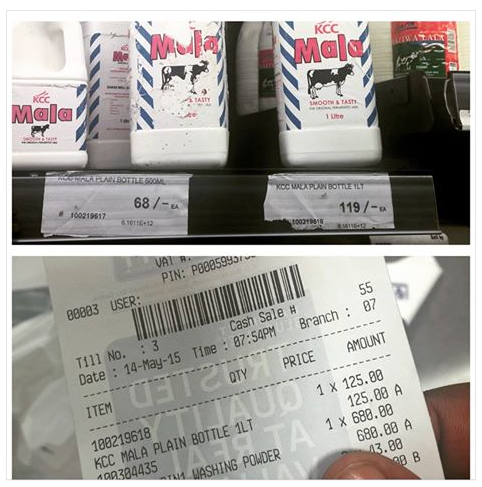
Disgruntled customers have put pricing discrepancies at Nakumatt branches under the spot light. (Photo/ www.arushatimes.co.tz)

Kenyan supermarket chain Nakumatt Holdings is under fire from Kenyans on social media over concerns that it is cheating customers out of their hard earned money by under-pricing goods on the shopping aisle shelves and quoting a different, higher price at the point of payment.

The pile-on against Nakumatt started when several irate customers shared their experiences of being overcharged at Nakumatt branches. One customer, former radio presenter Marcus Olang posted photos of the goods he had bought on Facebook along with the price quoted on the shelf and the one at the point of pay, showing the discrepancy.

Photo via Marcus Olang

Olang also detailed his experience on Facebook saying he had lost faith that the discrepancies were made “accidentally.”

“This has happened a number of times in the past, and now I don’t buy that Nakumatt stores do this “accidentally”. I highly suspect deliberate deception at play here,” he said.

“I’m now questioning the integrity of Nakumatt’s operations. The fact that this has happened more than once bothers me. I wonder whether they take advantage of the fact that many people don’t check their receipts, and thus get away with such deception,” added Olang.

Nakumatt’s competitors like Tuskys and Naivas might be taking some pleasure in its troubles but – based on some postings – they too should tread carefully.

The pricing irregularities are bad enough but it appears Nakumatt’s problems extend further.

Nakumatt has emerged from under the torrent of complaints and criticism to say the company is addressing the matter.

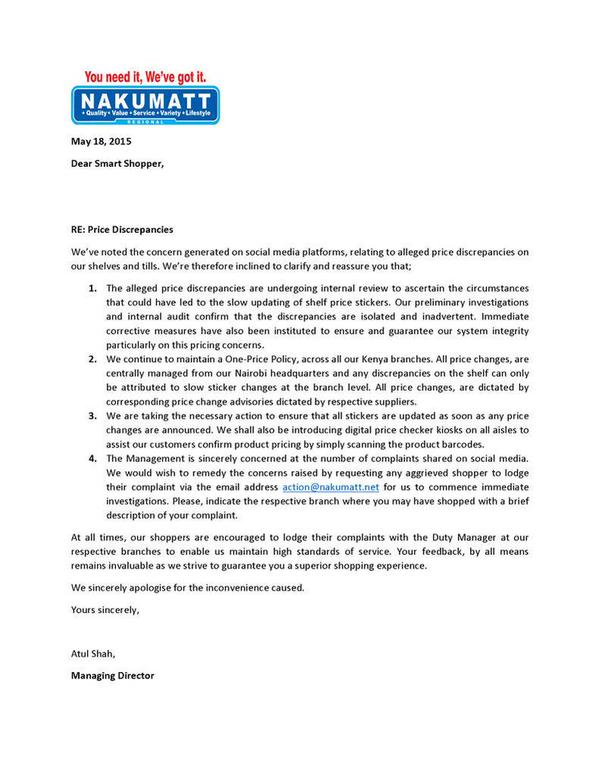
The company also released a statement on Monday evening blaming the discrepancies on “slow updating of shelf price stickers.” Nakumatt also said the problem was “isolated and inadvertent” and added it would be introducing “price checker kiosks on all aisles to assist customers confirm product pricing by simply scanning the product bar-codes.”

Here’s the full statement from Nakumatt Holdings in response to the furor over pricing discrepancies.CFTQonSWIAAYgPI

Fears missing Nairobi girls have joined ISIS

ISIS, the islamic terror group that is trying to set up a caliphate in the middle east, is actively recruiting in East Africa (Photo/http://en.wikipedia.org)

Two missing Somali girls from Nairobi’s South C area may have joined the Islamic State of Iraq and Syria (ISIS) also known simply as the Islamic State (IS), the Islamic terror group that is spreading terror across vast swathes of Syria and Iraq. The girls Salo Abdalla and Tawfiq Abdahir have been missing from home since Wednesday last week when they are said to have gone to Nairobi Muslim Academy in South C.

The management of Nairobi Muslim Academy however denies that they could have gone to the institution since it was closed owing to the floods that hit the area last week. The mothers of the missing girls Khadija Abdalla and Rahma Abdhan told Citizen TV reporter Evelyne Wambui that they have been trying in vain to get in touch with them. Tawfiq, known as Tawfy to her friends, had a phone on her when she went missing and the gadget was last traced to Nairobi’s Pangani area.

Fears that the girls have joined ISIS were sparked by a screenshot of a SMS message reportedly sent by Tawfiq to her cousin in which she appears to say she is now in Syria.

Friends and acquaintances of the two families have been expressing their concerns as the news of the girls’ current location and apparent radicalization has spread.

Coming in the wake of the attack on Garissa University College which was carried out by at least one university-educated Kenyan national, the news that the girls have joined ISIS, if confirmed, will reawaken fears that the specter of radicalization is a clear and present danger in Kenya.

The news also raises concerns about how effective terrorists have become at targeting potential recruits through the internet right under the noses of their parents.

Kenya is not alone in confronting this challenge. The BBC documentary “Britain’s Jihadi Brides” reveals how young girls – some as young as 15-have been groomed on the internet by ISIS recruiters. The girls are lured from the UK through promises of a paradise-like existence in ISIS controlled areas where they don’t have to worry about taxes or bills for the rest of their natural lives.

But there is dark side to this “paradise”. The girls are promised husbands but its often the case they wont have a say on who they marry. ISIS fighters have been known to show no mercy to the people of the areas they conquer, raping girls as young as 12. Its not a stretch to assume they would treat their “brides” with the same barbarity. Reports have also emerged about how the girls are forced to remarry after their husbands are killed in battle.

ISIS appears to be actively trying to get recruits from Kenya and the wider East African region. Two Kenyan ladies and Tanzanian companion were arrested last month while trying to sneak into Somalia with the aim going of going to Turkey and eventually Syria. The Kenyan girls Khadija Abubakar Abdulkadir and Maryam Said Aboud – both 19 – were arrested together with Ummul Khayr Sadir from Zanzibar who is reportedly a medicine student at International University of Africa in Khartoum. The girls are currently on trial in Kenya and have reportedly told investigators that they were recruited on the internet by a female ISIS agent.

Social media, blogging use define Kenya’s internet freedom concerns

Gado on social media

Concerns over internet freedoms in Kenya can be broadly traced to larger rights and freedoms enjoyed by Kenyans in the 2010 Constitution. The Constitution has a progressive Bill of Rights which among others guarantees rights to privacy, freedom of media, freedom of information and freedom of expression among others. Prior to this Constitution, internet concerns in Kenya were largely about access.

Kenya’s internet growth has been synonymous with the worldwide growth of Information Communication and Technology (ICT) tools. Embracing ICT was seen as progressive in creating employment, reducing production costs, improving costs of service delivery and decentralization of services.

The history of the Internet in Kenya can be traced to 1994 when the African Regional Center for Computing (ARCC) was set up to offer full internet connectivity in the country through the support of the U.S. National Science Foundation. According to a paper by Nixon Muganda, submitted to the Department of Information Systems University of Cape Town dubbed ‘Internet Diffusion in Kenya and Its Determinants: A Longitudinal Analysis’, the liberalization of the sector also resulted in the creation of a National Task Force on electronic commerce in May 1999 with a view to providing an enabling environment for electronic trade in the country.

As a result, awareness of the potential of internet increased with many stakeholders indicating interests in applying Internet in their business. By 2000 it was estimated that the number of Internet users was around 30,000-50,000 with a total of 34 Internet Service Providers(ISPs).

According to the the latest Communications Authority of Kenya (CAK), statistics in  the quarter under review October to December 2014 (Q2 FY 2014/15), the estimated number of internet users during the quarter increased to 26.1 million up from 23.2 million subscriptions reported last quarter. This marked an increase of 4.8 million subscriptions when compared to the same quarter of the previous year.

Consequently, the population with access to internet grew significantly to stand at 64.3 per 100 inhabitants up from last quarter’s figure of 57.1 per 100 inhabitants. The growth in internet access and usage could be attributed to the numerous data promotions carried out by the various service providers during the quarter. For instance, one of the service providers offered free social media access by post-paid and prepaid subscribers on their network.

This increase is supported largely by increase smartphone use. Majority of users primarily access social media sites on their phones, followed by 3G modems. Others use them through Terrestrial wireless data, Satellite Data, Fixed DSL Data, Fibre Optic and Fixed Cable Modems. This increase can be attributed to the abolishment of the 16 percent Value Added Tax (VAT) levied on mobile phones by the Government in 2009, which led to reduction of the cost of mobile phones. A reintroduction of the VAT in 2013 has not necessarily seen prices increase due to more cheaper phones availed by phone manufacturers while dealers have also devised ways of bringing in phones without paying taxes hence transferring the ‘benefit’ to consumers.

The internet is seen as providing information which enables the realization of growth and development in various sectors. This is through availing information that can be accessed and by anyone globally. For Kenya, worldwide narratives inform its challenges and opportunities that various individuals and organization surmount in their daily lives.

Telling these narratives is Kenya’s contemporary way of utilizing the internet as a tool of communication. Previously concerns by Kenyans were about access to the internet. This was reduced by the launch of fibre optic cable in 2009. Its distribution across the country continues to enable more Kenyans access it while areas with good internet, largely towns shift to fast and reliable internet. Today, most of the towns in Kenya have access to the internet either through Local Access Network portals of 3G modems in additions to data provided by telecommunications companies.

The degree of internet freedom can be correlated with the degree that a country enjoys civil liberties and political freedoms, argues a report dubbed ‘The Internet Legislative and Policy Environment in Kenya’ by the Kenya Human Rights Commission (KHRC) published in January 2014. Internet freedoms in Kenya have largely been about efforts by government to clump down through arrests, intimidation and prosecution of Kenyans using various social media and blogging sites. No time has this been evident than in the past four years, especially the two under the current government.

Blogger Robert Alai stands out as one person who has had several legal problems over his use or alleged misuse of internet. In August 2012, was arrested, detained and charged in court for an altercation with the then Government Spokesman Alfred Mutua. Alai had stated through his social media accounts that Mutua ordered the murders of Oscar Kin’gara and Paul Oulu, two activists who were brutally assassinated on Waiyaki way, Nairobi on March 5, 2005. He was charged under section 29 of the Kenya Information and Communication Act, 2009, for sending abusive and annoying messages.

In March 2013, the blogger was summoned and questioned by detectives after a series of tweets regarding Francis Kimemia, the then head of Civil Service and current Secretary to the Cabinet and later charged in court for causing annoyance to Mr. Kimemia.

In May 2013, the same blogger was charged under the National Cohesion and Integration Act with hate speech
intended to stir ethnic tensions between members of the Kalenjin and Luo based on one of his posts on the popular social networking site Facebook.

In May 2013, Alai was charged under Section 29 of the Kenya Information and Communication Act for posting annoying tweets about William Oduol, a local politician. The blogger is currently out on bail, pending the determination of these matters by the Courts.

In July 2013, Betty Waitherero, a blogger, upon posting an article on her blog about the Jubilee Government, the then Government Spokesman Mr. Muthui Kariuki who was also mentioned in the article is alleged to have called the blogger’s father (a former workmate) and threatened to have the blogger arrested if she did not pull down the article and refrain from writing such pieces in the future. While the threats cannot be ascertained, the blog post was
subsequently taken down by the author.

In August 2013, another blogger, Wanjikũ Revolution Kenya’s Facebook profile was blocked for seven days and a post mentioning the Jubilee Government on her Facebook timeline was taken down by Facebook. She blamed Kenya Government operatives for the act stating that they were responsible for reporting her profile as violating Facebook community standards.

More recently in 2015, blogger Abraham Mutai and web developer Geoffrey Andare have had their freedoms threatened in one way or the other through use of the law. Mutai’s blog was pulled down while his twitter account also suspended for some hours. Other cases included Nancy Mbindalah and Allan Wadi.

Nakuru opens a mimispot.com page

Mimi spot snip
The face of the mimispot.com page meant for discussions on issues in the county. Other information technology based platforms that are currently being used to keep the county government on track include Facebook and Whatsup…

A local interactive online platform has been introduced in Nakuru. The platform known as mimispot.com allows users to discuss local relevant issues online and also share photos.

“The unique factor with mimispot.com is that it shows you the distance from where the other person is posting in kilometers,” explained Mr. Paul Mvuria who is spearheading the project in Kenya.

Mvuria who also owns a company that makes documentaries in Netherlands was speaking at a hotel in Nakuru when he met Chief Francis Kariuki and Martin Macharia who will lead the introduction of the platform in the County.

Apart from Nakuru mimispot.com has also been launched in Nairobi, Mombasa, Thika, Kibera, Kariobangi, Dandora, Kwale and Kasarani.

“Nakuru people are very receptive and vibrant on social media. We expect they will take up the platform and revolutionize its use like Chief Kariuki did with twitter,”

commented Mvuria while explaining why chose to launch the platform in Nakuru.

Mimispot was introduced in Kenya in January this year after South Africa and Zambia. The use of mimispot is not widely spread currently partly due to ignorance of its existence and partly due to normal product growth dynamics.

“If more people can come on board, we can use the platform to discuss locally relevant issues. It has no character limit like twitter and since it uses a low bandwidth even a person with a low end internet enabled phone can use it,” explained Mvuria.

Chief Kariuki has promised to explore the platform for ways in which it can serve the community and make a positive impact.

“For me, serving the community comes first and am open to new ideas that improve my productivity,” said Chief Kariuki.

The byline for mimispot.com is “Talk and Trade” and apart from discussions it allows a registered user to sell products and services online for free.

Posts on mimispot.com can also be shared on Twitter, Facebook or by email. From the interface, a user can invite friends to join either through SMS or e-mail.

Apart from this new platform other platforms that are being used by residents to discuss the issues affecting residents in the county include facebook and whatsup. A month ago the Constitution and Reforms Education Consortium (CRECO) also launched an initiative dubbed ‘Jukumu Letu’ aimed at sensitizing the community towards taking a leading role in the implementation of the constitution.

By Martin Gicinga

Kamba community urged to unite

Machakos Governor Alfred Mutua bids Makueni governo Kivutha Kibwana after the fomer paid a coutsety visit to Kibwana as Deputy governr Adelina mwau looks on photo:Governor Press
Machakos Governor Alfred Mutua bids Makueni Governor Kivutha Kibwana after the former paid a courtesy visit to Kibwana. Deputy Governor Adelina Mwau looks on
photo:Governor Press

Two governors from the lower eastern region have called on the Kamba community to unite and address the problems that have faced the region for a long period.

Machakos Governor Dr.Alfred Mutua and his Makueni counterpart Kivutha Kibwana said the eradication of high levels of poverty in Ukambani require concerted efforts and urged the leader’s to shun divisive politics.

Speaking in Wote on Thursday when the Machakos Governor paid a courtesy visit to Kibwana, the governors said devolution had given leaders a chance to correct mistakes done by past regimes and regretted the current leadership standoff in Makueni county.

“Devolution has the capacity to change lives of our people who have suffered for long even after 50 years of independence, if we don’t deliver the much needed services then we will have no one else to blame apart from ourselves,” said Kibwana.

Mutua expressed his concern on the current leadership crisis in Makueni saying that the residents deserve to have a working government.

“The people of Makueni need a government that will deliver services, if it does not they should be given chance to elect another one,” he said.

He said that his government would rally behind the people of Makueni to have a system that works for them.

“As neighbors were are very disturbed by what is happening in Makueni including the violence that rocked the county last year and the people Machakos will gladly offer their contribution if any,” he said.

The two leaders exuded confidence that the tribunal appointed to look into the possible dissolution of Makueni county will make a decision that reflects the will of the people.

“ My hope is that the inquiry is a process that will be led by the people of Makueni and arrive at a verdict that will be of benefit to the residents,” said Mutua.

Kibwana also echoed the Machakos Governor’s words and urged the commission to expedite the process.

“We look forward to a speedy conclusion of the matter,” he said.

Makueni Deputy Governor Adelina Mwau said the three Ukambani counties should put in place strategies to unite for the sake of development.

Arts in Mombasa need nurturing

0
Comedian Entertains in Mombasa Last Word Standing Event

Comparisons are often drawn between the capital city Nairobi and Mombasa as far as literary engagements go. When it comes to arts and culture, however, there is need to realise just how Mombasa is becoming increasingly able to hold its own.

For a while there were little or no activities in the coastal art scene. If there were any events, there were largely unheard of, elitist or lingually inhibitive due to their exclusivity. Early 2012 and there seemed to be a sudden paradigm shift. The capital was a boiling point of the arts then, literary events were being held every other day. Such could not be said of Mombasa.

Ufalme Africa, a coastal art group would hold its poetry eventing Mombasa Old Town, but tussles and disagreements killed the buzz. For quite a while there was a lull as far as performance art goes. Then new groups started emerging. Last Word Standing held its first poetry, Spoken Word and Hip Hop Event at Jahazi Coffee House in October 2012. What started as a protest against the dormancy of art in the region became a monthly event for artists and lovers of art to meet and fraternize.

There are two main art spaces in Mombasa. Alliance Française hosts concerts, musicals, plays as well as screening of various local and international films. They also run art exhibitions once in a while. Little Theatre Club in Mbaraki is the other space. It is mostly theatre, but it has also become an incubator of Sports, providing equipment and space for artistes to practice and showcase their various skills. Dancers actors, poets and musicians have their home here.

The youth of Mombasa are hungry for success. The talented among them want to make their talents work for them so bad they are putting in place measures to get them there. The Talent Unplugged is a group formed by youth to provide a platform for engaging the youth through art and literary performances.

The county government seems to have noticed the efforts of the county’s youths and has also started organizing events for them. Amoury, a popular Mombasa singer is all praise for the county government.

“The government really is supporting the youth, and can now even help foot part of the production costs for our projects,”

said the artist whose latest video Sebene features the county’s Youth and Gender Services Secretary Mohammed Abbas and county government patrol cars.

“Mombasa county 001 through the Department of Youth, Gender and Sports under Waziri Abbas has made it possible for our youths who are talented to taste the sweet fruit of our County. Thanks to our H.E Governor Hassan Ali Joho,” says Alfred Mwakio, also an artist.

With the kind of determination seen among the youth and the increasing frequency of art and cultural events in the city, it is only a matter of time before Mombasa takes over as the boiling pot for arts in the country. With the support of the county government, the youth can now earn a living from their artistic talents.

Mombasa urgently needs a second Nyali bridge to ease traffic

0
Nyali Bridge
Nyali Bridge (skyscraper city.com)

There is a perennial traffic congestion problem at the Nyali Bridge every single day during rush hours. This has only seemed to worsen as days go by. The surge in population growth in the North coast doesn’t look like it is about to ease off any time soon. Both County and National governments are aware of this. In fact, everyone agrees that we need another bridge connecting the Northern mainland to the Mombasa Island. The county assembly only recently approved plans to construct the bridge, slated to kick off next year. The only problem is where to build it.

A 2012 report indicated that the bridge is supposed to link Abdel Nasser Road on the island and Links Road in Mkomani, Nyali. According to the same report, the bridge is expected to be built in the same location as the old steel suspension bridge which was decommissioned after the current Nyali Bridge was opened.

Construction of the new Nyali Bridge has faced hurdle after hurdle since it was mooted years ago. The current Mombasa County governor, in his days as Kisauni constituency member of parliament agitated for the repossession of the piece of land where the old suspension Nyali Bridge once stood, 25 years ago. The old Bridge ran from Aldina school on island up to the narrow limb on the northern mainland where the Tamarind Village Apartments now stand. The government’s wish to demolish the buildings has pitted the owners against the Kenya urban roads Authority in a legal tussle that has seen the project halted by the courts.

Lawyers representing the Tamarind hotel chain claim the government has no legal grounds to cancel their title deeds and repossess the land on which his apartments stand. A high Court judge agreed and ruled that while the government was acting in public interest, it was imperative to follow the rule of law and due diligence and compensation. It remains to be seen how soon the alleged encroachments can move to pave way for construction of the bridge which will go a long way in streamlining traffic flow in Mombasa.

Mr. Shah, a Nyali resident thinks the bridge is long overdue.

“The distance from my home to the Central Business District (CBD) isn’t much, but the jam in the morning forces one to wake up early so as to get to work in time. In the evening it’s worse. The new bridge would help some of us commute from home to work and back more easily.”

Earlier this year, Deloitte Consulting Limited was selected to be the lead transaction advisor for the construction of the second bridge. Partnering with Deloitte Touche Tohmatsu India Private Limited, the firm is conducting a feasibility study, due diligence and transaction planning. They are also expected to provide project assistance until the financial close, including marketing it to private investors , as well as bidding and evaluation of contractors.

No evidence linking Daadab refugees to terrorism

UNHCR Country Representative Raouf Mazou

The Deputy President’s directive that the Daadab refugee camp should be closed came in after the Garissa university attack, providing the thinking by government about the camp. It would perhaps be useful to know whether any intelligence report has linked a refugee in the camp to terrorism. In addition, if any refugee is to leave the camp, the process has to be facilitated by the Kenya government.

Raouf Mazou, the United Nations High Commissioner for Refugee Country Representative shed light into this issue, among others in an interview.

From the over 350, 000 refugees in Daadab, some 335, 000 are from Somalia. Others are from Burundi, Ethiopia, South Sudan and Rwanda.

What are the thoughts of refugees about going back home especially Somalis?

The government’s position hasn’t changed and has been for a while and it is very understandable. Some have been therefore been there for over 24 years. But Kenya is also currently active trying to stabilize Somalia through KDF. Finding the Solution is a stable Somalia.

Refugees want to go home but they wonder whether they will find education healthcare and livelihoods coupled with good security. These basic services are critical. There are conversations on how to help return people to specifically where they came from and what kind of assistance can be provided.

What arrangements exists between Kenya and UNHCR in terms of security?

UNHRC has been providing support to government through a program called Security Partnership Program (SPP), initiated in 2012. SPP is about $3.6M a year.The support includes providing vehicles, training of police officers, accommodation, fuel and building police stations. We have been discussing with government on how we can enhance this. This will and has to be done regardless of whether they go back or not.

Any evidence suggesting linking refuges to terrorism attacks

I have not been aware of any evidence linking this. I believe if there was any, there would be measures taken appropriately like arrests.

Some people are uncomfortable with the location since the camp is near the border and the town of Garissa. This has largely been the main issue since the border is near a country currently under violent conflict.

What plans do you have regarding $45M granted by the US government through Secretary John Kerry?

The real solution to Somalia problem is real stability in Somalia. That is where most efforts will be utilized. However some others will be used to improve security management and host management. Host management bare the brunt of these refugees and more will need to be done to provide support to host communities.

How much budget is allocated to run Daadab in a year?

It is about $75M a year, that is according to this years budget. That is UNHCR with its partners.

There was a team formed to manage the situation, please shed more light into it!

There was a tripartite agreement signed in November 2013, it was agreed that a tripartite commission be formed. It would have representatives including from the ministerial level. It will have representatives from governments of Kenya, Somalia and UNHRC.

The commission was formed then but took time to set up but worked informally. So the commission was launched last year on 21st of April at the presence of ministers of foreign affairs from Somalia, Kenya and myself. The commission’s work is to manage the return process in total, review type of assistance and any legal issues that may arise among others.

What considerations will go into going back to Somalia?

Beyond security, the main issue is how fast basic services can be put back. That is an issue of circumstances and not resources as such. A sense of urgency is however critical to informing the process. More importantly, this has to be voluntary, something the tripartite agreement felt is critical.

What kind of support does government provide at the camp?

The investments  made are security personnel like the salary and training they had, the water, land and firewood used by the population and general asylum. No money can compensate for this protection.

How easy is it for a registered refugee to move outside the camp?

Movement outside the camp is restrictive. It requires a movement pass issued on a case by case basis by the Department of Refugees Affairs which is under the Ministry of Interior. They coordinate this with police and local administration like the County Commissioner and sub-county commissioners.

Kinuthia Mbugua hits at Mututho

0
Mbugua New Look
Nakuru Governor Kinuthia Mbugua at a past event. He hit at Mututho for announcing he would campaign for the gubernatorial seat in the next general election (Photo/Kioko).

The National Campaigns Against Drug Abuse (NACADA) chairman John Mututho seems to have opened a can of worms for himself after he announced over the weekend that he would vie for the Nakuru Gubernatorial seat in the general elections.

Speaking to a group dubbed ‘Nakuru King Makers’ whose members communicate through a Whatsapp group with the same name the former Naivasha legislator said he stepped aside from the race in the last general election after being told President Uhuru Kenyatta who was then the Jubilee candidate would give him another job.

The group had congregated at the Lake Nakuru Lodge and during the meeting Mututho is said to have ‘bragged’ of having been one of top contributors in the last Parliament. He blamed the current leadership in Nakuru County which is led by governor Kinuthia Mbugua for not “delivering” to the people.

And today, Mbugua who is sometimes a reserved politician hit back at him while scorning him for losing the Naivasha seat in the last election.

“When wananchi tell you we cannot give you a seat that is enough,”

Mbugua told an audience that had gathered at his offices for the commissioning of a sh2 billion project for the upgrading of informal settlements in the county.

“We all know how his people rewarded him for making those contributions,”

Mbugua said in reaction to the contributions Mututho had said he made in parliamentary debates during his term as Naivasha M.P.

“Those contributions were to disrupt,”

Mbugua hit out while also hitting at the group that had given him the forum at the lodge.

“The king makers are here. They come out in the open and talk to people,”

Mbugua said while challenging Mututho to concentrate on his work at NACADA.

Ironically before Mbugua made the remarks in response to Mututho, he had started by telling the gathering he does not like politicking.

The event was also attended by the National Assembly Speaker Justin Muturi. He asked Kenyans to tolerate each other in the ongoing debate about the gender representation in Parliament.

“We must allow debate and freedom of expression and the right to hold opinion,” he said.

The Nakuru gubernatorial seat promises to be a very hotly contested seat in the next general election. Apart from Mututho, former Secretary to the Cabinet Francis Kimemia is rumored to be eyeing the seat while Lee Kinyanjui who was eliminated at the party nomination stage might also be going for it.

And even so, Mbugua might have a hard time convincing Nakuru voters to give him a second chance given that the region has a history of not re-electing leaders.

Online error: Nakuru County Assembly has two Deputy Speakers and two Majority Leaders

Assembly snip
Nakuru County Assembly logo. Information on the assembly’s website shows that the positions of the Deputy Speaker and the Majority Leader are being held by two people at the same time (Photo/Nakuru County Assembly website)

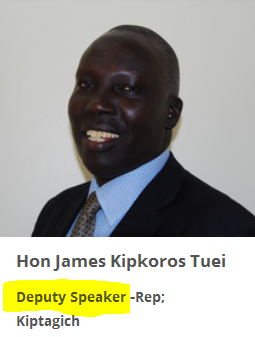
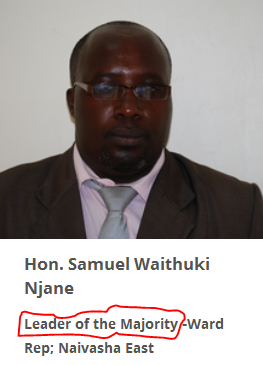
The Nakuru County Assembly has two Deputy Speakers and two Leaders of the Majority. This is according to the information posted on the Assembly’s official website showing that the two positions are being held by two people at the same time.

As at Wednesday May 13 the website had the information that Samuel Tonui who is the Member of County Assembly (MCA) for Nesuit Ward was still a Deputy Speaker two months after he was impeached.

Deputy Speaker Snip 2
He holds the position with James Tuei of Kiptagich Ward who in this case is the rightful occupant of the position since the March 13 changes.

Dep Speaker Snip 1
And in another error, the position of Leader of Majority is also held by two people. Mosop Ward MCA George Mwaura still holds the office from which he was kicked out in June last year.

Mwaura Snip

He shares it with Samuel Waithuki of Naivasha East Ward, who in this case is the rightful holder.

Njane Snip
The two positions – that of Deputy Speaker and that of Leader of Majority – are powerful positions in both the County and National Assemblies as well as the Senate. For this they are usually heavily contested and as witnessed in Nakuru, changing their bearers can at times get murky.

And while this is a mere online error, it needs to be corrected as it is misleading and confusing to all those who are not familiar with the latest developments at the Assembly.

Bodaboda operator brutally murdered in Makueni County

0

makueniPolice are investigating an incident in which a 38-year-old boda boda operator was brutally murdered by unknown assailants and his body dumped in Makongo forest, Makueni County.

Makueni Police Boss Philip Opiyo said Darius Munyaliti’s severely mutilated body was discovered yesterday morning by members of the public who informed the area chief Mr. Jonathan Mwania.

Opiyo said the boda boda operator who had gone missing for three days allegedly left his Engavo home in Ukia location last Friday at night to meet his estranged wife at Mukuyuni market.

He said police are trying to establish the motive of the killing adding that the wife is expected to record a statement to aid police in the investigations.

Munyaliti’s brother John Kilonzo said that the deceased received a call from an unidentified man on Friday at around 9pm asking him to meet the wife who resides in Nairobi at the local market.

Kilonzo said that his brother hired a fellow boda boda rider to take him to meet his spouse and had been missing since then.

The body has been taken to the County Referral Hospital Mortuary awaiting post mortem.

Mombasa residents weigh in on Likoni cable car project

0
Cable cars in Hong Kong  (https://www.flickr.com/photos/randomwire/
Cable cars in Hong Kong
(https://www.flickr.com/photos/randomwire/

Residents of Mombasa and its environs had great reason to cheer when the Kenya Ferry Service announced that it will, in the very near future begin the construction of an express cable car service at the Likoni ferry crossing to link Mombasa Island and the southern mainland. It is expected that besides helping in reducing jams, the project will also boost tourism in the South Coast as it will reduce delays at the crossing, from 10 minutes to only 3 minutes.

The cable cars will have a reported capacity of 11,000 commuters per hour in both directions. Currently, the ferries have a capacity of approximately 300,000 commuters and 600 vehicles daily. The faster movement of goods, people and services across the channel will spur economic growth in Mombasa and surrounding counties.

“With the way the ferries have been stalling every now and then in the recent past, the cars will be a great relief for those of us like me who live in Ukunda, and need to get to work in the Mombasa CBD early,” said Tony Wakhungu, a frequent user of the ferry.

Ms Mwenda, a trader at the matatu stage near the ferry thinks the project will offer many employment opportunities.

“They are going to need planners and builders as well as people to run the cars and maintain them. This is a big opportunity for youths from around here to get employed and earn a living. The county government needs to ensure that happens.”

Estimated to cost around $41m (Ksh3.6B) the Trapos Limited-sponsored project will receive project funding from the CFC Stanbic Bank. It will employ technology by Doppelmayr, a Swiss-Austrian specialist company. Doppelmayr is a big name in the manufacture of chairlifts, cable cars, gondolas as well as amusement parks and urban transport systems.

The project, the pilot and key contributor to the Mombasa Integrated Mass Transit Plan, is expected to start by September 2015, to be completed and commissioned by December 2016. This is according to the Managing Director of the Kenya Ferry Services, Musa Hassan, who pointed out that tourists will no longer face delays at the ferry crossing.

“Yes. The cars will reduce the time taken for tourists to move from Mombasa to hotels here in the South Coast.” concurs Timothy Mriya, a manager at a hotel in Diani.

That is not the only way the tourism industry will stand to benefit from the project.

“With the cable cars will running 100 metres above and concurrently with ferries, the infrastructure will be an attraction in itself,” Mr Musa said, “offering panoramic views of the entire Mombasa”.

However, not everyone is impressed with the idea. Mwamidi, a taxi driver who crosses the ferry many times in a week does not trust Kenya Ferry Services (KFS) with the idea.

“They have trouble maintaining a few ferries. Even the new ferries that are less than 5 years old are now constantly broken down. How will they maintain something more complex?”

Journalism under threat

The standard Deputy News Editor and Nakuru Bureau chief Alex Kiprotich (left) and his lawyer Juma Kiplenge. Photo courtesy of The Standard

Independence of journalism has once again come under scrutiny after a standard newspaper journalist was summoned to the Criminal Investigations Department (CID) to reveal sources of information.

The standard Deputy News Editor and Nakuru Bureau chief Alex Kiprotich was summoned to the Nakuru CID office to inform them about sources of stories done on the ongoing Nadome Killings, Baringo County.

Under the jubilee administration, journalism has come under various threats. Last month, two journalists were beaten by JSU officers in the coast. Reuben Ogada (Citizen TV) and Nehemiah Okwemba (NTV) were beaten by General Service Unit officers at Agricultural Development Cooperation Kulalu-Galana Ranch. A few weeks ago, veteran Eldoret Journalist John Kituyi was murdered in the town. His latest story was about the ICC.

In addition, Nation Media Group Editors and K24 journalists were summoned by CID last month. They were Macharia Gaitho, Bernard Namunane, Purity Mwambia and Frankline Wambugu. The Directorate of Criminal Investigations (DCI) summoned them over a story that linked the deportation of a senior spy officer by the Dutch government to The Hague cases.

The letter did not disclose whether the editors are wanted as suspects or witnesses, nor does it specify the nature of crime. It also did not disclose the identity of the aggrieved party. Their lawyers therefore advised them that;

“the purported summons fail to comply with the Constitution in several respects, and cannot, therefore, constitute lawful authority for appearance.”

At first, the jubilee administration signaled a cordial relationship with media when, within a few weeks of being sworn to office, President Uhuru and DP Ruto hosted editors at State House. Concerns at that time were the import of this gesture to objectivity in reporting. It was felt that the visit was to ensure journalists do not investigate and unearth rot in the administration.

This may not be the sole concern today, two years into the jubilee administration. There have been three previous attempts to muzzle the media through laws. The first were a raft of amendments into the Kenya Information and Communication Act (KICA) and the Media Council Act that provide for hefty fines if in breach of certain codes of conduct related to defamation et al. The concern here is not that journalists are free to defame, but laws in Kenya can easily be used to muzzle people due to lack of independence. The case is still in court.

The second attempt was by Eldas MP Adan Keynan through the Parliamentary Powers and Privileges Bill 2014 had inserted a clause that sought to impose a Sh500,000 fine and jail term on journalists who publish reports that in the lawmakers’ judgment defame Parliament. Some MPs have been aired as sleeping in the House and this irked the members. Pressure from media and civil society made him to shelve the Bill.

The other attempt was to pass a law, which was later declared unconstitutional under the Security Laws Amendment Bill 2014 that would see journalists seek permission from police and affected family members before publishing terrorism related news. Section 12 of the Act had amended the Penal Code, making it criminal to publish or broadcast through print, digital or electronic means, or images of dead or injured persons likely to cause fear and alarm in the general public, or disturb the peace. Anyone convicted of this was liable for a fine of up to Sh5 million, or three years in jail.

Kipkoech’s story adds salt to an already alkaline state of affairs. In this times when bloggers are also threatened and intimidated for publishing information either charged under the Penal Code or KICA Act or both, there is reason to worry

Next time, bloggers who in recent months have been the reliable source of news, especially sensitive news like on corruption and abuse of office, they are likely to be threatened and summoned to reveal sources of information. For instance the tape recording showing MPs Sonia Birdi and Alfred Keter threatening police officers was reveled by blogger Robert Alai. Other corruption allegations at Geothermal Development Cooperation (GDC), Isiolo County and Tana and Athi River Development Authority (TARDA) are examples of revelations made by bloggers.

Bloggers may not enjoy the same protection as journalists in Kenya albeit internationally, jurisprudence exists on treating bloggers the same as journalists when requested to reveal sources of information.

The Standard reports threats by Valley Regional Police Commandant Gideon Amala to Kipkoech of unspecified actions if he does not reveal sources of his information.

“I swear by the name of God that someone must pay for this. Either you or your boss, someone must pay. We will not continue allowing you to report like this,”

Amala is heard on the recorded conversation in their possession.

Amala ha called him demanding to know the source of a story that appeared in The Standard about senior police officers who escaped death narrowly when they were allegedly ambushed by bandits at Kalpat village in Nadome, Baringo County.

Luckily, Alex had a lawyer in whom confidence can be expected to protect his client and also the profession. Security agencies should do their job to weed out insecurity across the country and specifically in Nadome and not intimidate journalists whose sole role is to inform society.

Mixed reactions greet slum upgrading program in Mukuru kwa Njenga

Women and youth doing slum cleaning in Mukuru a programme under the national youth service

The face of Mukuru kwa Njenga informal settlement is gradually changing to a better place from insecurity related issues, poor sanitation to youth and women employment. This new developments can be greatly attributed to absorption of many youths/women into the National Youth Service (NYS) programme of cleaning the slum. According to area chief of Mukuru kwa Njenga, this new project has been a blessing to the community as it has helped a lot in terms of improving their living standards and also creating safe environment to live in.

Among other achievements, the project has helped to reduce criminal activities in the slum after many youths were absorbed into the upgrading programme hence getting them engaged.

“When we have youths living in this slum environment, they are prone to many temptations of indulging in mugging and other related criminal activities. I am happy that since the beginning of the programme criminal cases have dropped with less than 10 of cases break-into and assault being reported every week. I wish the programme will be long term plan,” says the chief.

Last year in a report which revealed hotspot areas to crime, Muindi Mweusi supermarket area in Mukuru was among the list, although of late the residents acknowledge there is little improvement. Most of those who were affected by lack of security included bodabodas and traders who usually close their businesses at late hours. Nzioki 29, a bodaboda rider and a father of two agrees that nowadays they operate till late hours and a week may pass without any incident of attacks to their colleagues.Casuals demolishing a building to pave way for road construction  in Mukuru

For now mugging has reduced which they think is because many youths are busy in the programme hence no time to idle, though they are afraid the situation may change if long term solution is not sought to address youth unemployment in the area which is becoming a concern.

In addition to security improvements, the programme has given married/single young mothers an opportunity to provide for their families and also help their husbands during this hard economic times. As opposed to when they used to look for casual jobs like washing clothes or at industrial companies which was unpredictable, now they are assured of work to do. Furthermore, those with small kids have time to take them to school or day care as cleaning job starts at 8.am in the morning and ends at 4pm leaving enough time to do other house chores.

Jane Muendi a single mother of one girl working with the NYS has opened a vegetable stall from the little savings they are paid every week and in return she has “employed” her cousin who operates it while at work.

“Kwa siku naweza pata mia tano, hiyo savings yangu imenisaidia (I get about sh500 per day which proves that the savings have been useful), noted Jane.

This sentiments are shared by many women who are now able to provide for themselves.

With over 1000 youths enrolled into the programme, it has acted as an eye opener to business related minds and already some have set out plans on where to spend their savings once they get from the Sacco. I meet a group of five youths who disclose to me they intend to start  operating a poshomill once they get their saving from the Sacco. With each day being deducted sh140 which goes to their Saving Sacco, they are  assured of enough money which may require little top up to start their business. Even though they agree saving into the Sacco is a noble idea, they lament one can’t be allowed to have his savings as an individual and therefore, finding likeminded people who wish to start a similar business is hard. In addition, one may wish to use the savings to expand already established business which is impossible.

However, as many celebrate the good things the programme has brought, some are counting losses as they are forced to demolish their houses and premises for roads to pass through. With no compensation as they have no valid land ownership documents, they feel the programme has worked against them. Now they are forced to relocate to unknown which means more expenses in constructing their premises again.

The residents too who are of low income are starting to have sleepless nights as they fear demolition of their households from the land cartel in the area.

“Wakati huu Mukuru itakuwa nzuri, maskini hizi nyumba za vibanda zitambolewa na wakubwa ndio wajenga za mawe, mtu kaa mi nitafford nyumba ya pesa mingi? lamented one of the residents.

Slum upgrading programme through the National Youth Service could be one the best things which happened to the slum as roads will be constructed and other business opportunities will sprout. But for it to have long term impact, ways of sustaining what has been started in terms of job creation to the youths and women and cleanliness to the surrounding will have to be put into place. Otherwise it will be exercise in futility as it will slide back to the old state of dirtiness and crime.

Makueni Deputy Governor criticizes Speaker Muturi’s proposal to scrap Women Reps, nominated seats

Makueni deputy governor Adelina Mwau Photo:Standard
Makueni deputy governor Adelina Mwau
Photo:Standard


Makueni Deputy Governor Adelina Mwau has criticized the proposal by National Assembly Speaker Justin Muturi to swap the women representatives seats and nominated MPs with 100 affirmative seats in Parliament.

The deputy governor said the speaker’s proposition is a tactic to derail the implementation of the two third-gender rule as stipulated in the constitution.

Adelina said that the gender rule should not be misconstrued to mean that women were being offered leadership positions on silver platter.

“It should not assumed that women are just being given these positions as flowers,” she said.

The deputy governor noted that despite women being the majority electorate it was still difficult for women to marshal their votes to elevate fellow women to leadership positions due to the patriarchal nature of the Kenyan society and underscored the need for implementation of the gender rule.

“We are socialized to believe that men make better leaders than women,” she said

While addressing journalists in her Wote office, the deputy governor admitted that the 47 women reps had not made impact as expected due to lack of funds but added she will rally behind other women legislators to seek an alternative formulation to have women well represented in Parliament.

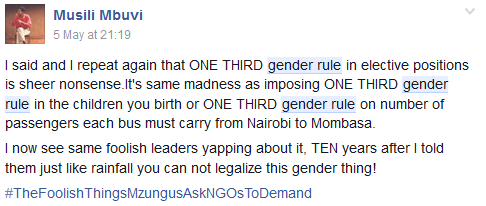
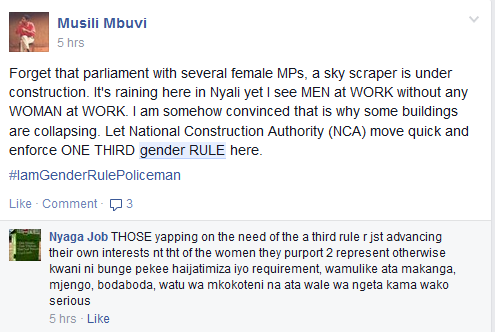
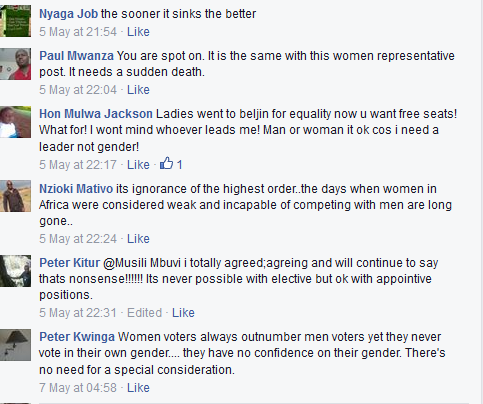
However the two gender rule has faced stiff opposition from residents of Makueni county on Facebook. Some dismissed it as sheer nonsense.

G3

G2

The opposition was overwhelming.

G1


However despite the residents opposition, Mwau’s sentiments  have been echoed by other leaders who have come out to oppose the speaker’s proposal for scrapping the seats. CORD leader Raila Odinga has accused the Jubilee government of failing to implement the constitution.

Raila has threatened mass action if the National Assembly and Senate do not implement the gender rule whose deadline is 27th August 2015.

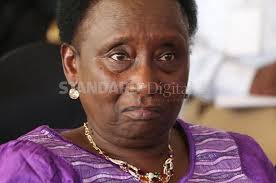
Martha Karua has also said that the attempt to postpone the gender rule is selfish. The proposal by speaker Muturi has created a heated debate and it will be interesting to see out the issue folds out in the next few months before the August deadline.