
Friday, December 19, 2025
Home Blog Page 16

Internet Freedoms Citizen Education Campaign launch on 15th December

Iinternet Freedoms Citizen Awareness Campaign a program by Monitor & The Bloggers Association of Kenya

When you log onto the internet, do you fully understand your rights as an internet user? Are you aware of your right to hold opinions without interference, your right to freedom of expression and information, your right to freedom of assembly and association, your right to freedom of thought, conscience and religion? Are you aware of your right to be free from discrimination in all forms, your right to enjoy your culture, to profess and practice your religion, and even to use your language? Do you know of your economic, social and cultural rights?

Maybe you don’t. But then again, maybe you are aware that the African Declaration of Internet Rights and Freedoms affords every internet user the above mentioned rights.

We will be hosting an event on the African Declaration on Internet rights and freedoms on the 15th of December from 5pm – 8pm at the Nailab.

During this event, we will host a moderated conversation on the state of Internet Freedom in Kenya and the principles of the African Declaration on Internet Rights and Freedoms. A video will also be screened to help develop a deeper understanding of how existing human rights apply to the Internet user in Kenya.

Many internet users stumble upon the internet and join social media platforms, unaware of their rights. Not many understand therefore that content blocking, filtering, removal and other technical limits on access to content constitute serious restrictions on freedom of expression. Fewer still understand that content filtering systems imposed by a government or commercial service provider and which are not end-user controlled are a form of prior censorship and are not justifiable as a restriction on freedom of expression

This forum will address the principles carried in the African Declaration on Internet rights and Freedoms, and will focus mainly on: Freedom of Expression, Right to Information, Freedom of Assembly and Association on the Internet, Cultural and Linguistic Diversity, Privacy, Security on the Internet and Right to Due Process.

Through this event, we hope:

  • To first and foremost, create awareness on the existence of the African Declaration on Internet rights and Freedoms
  • To educate internet users in Kenya their rights on the internet as Citizens
  • To educate Kenyans online on the specific rights entitled to them
  • To demystify each right by first finding out existing understanding of it.
  • To enable Kenyans to be assertive in their quest for the right to information and the right to cultural and linguistic diversity
  • To increase online dialogue from enlightened citizen on their internet rights and freedoms

This will be a chance for internet users to share their thoughts on the contents of the African Declaration on Internet Rights and Freedoms. We hope that at the end of this event, many will leave with a better understanding of their rights online.

See you then.

Details:

Event: Internet Freedoms Citizen Education Campaign
Date: Tuesday, 15th Dec
Time: 5pm – 8pm
Venue: Bishop Magua Centre, 4th Floor, Nailab.

Youths in Isiolo shifting from pastoralism to modern agriculture

By Malachi Motano

The harsh economic times and the attempts to fight food insecurity are making nomadic communities in Isiolo County shift from herding to crop production.

This is thanks to Isiolo River that has provided water for irrigation.

Some young men in Samburu, Turkana, Rendile, Borana, Somali who have traditionally engaged each other in cattle-rustling wars are changing their lifestyle by trying their luck in farming by growing beans, Kales (Sukuma wiki) among other subsistence crops not only for consumption in their homes, but also sell the extra in Isiolo town on large scale.

Augustine Moto is the voice of young farmers in Kitile village who have been farming for the four years (since February 2010) in Samburu.

“My dad had 80 cows, 40 goats and five donkeys. Long drought epidemics in this area claimed more than three- quarters of his herds. Today we have only 25 animals left in total, out of the 125 we had in 2009. It is from these experiences that together with some few friends mobilized young men and women to take an immediate action that would reverse the trend,” Moto says.

Although the decision sounded brilliant implementing it remained so challenging. Kitile village is 5km from Isiolo River. The young farmers needed to practice irrigation but because of lack of proper equipment, they had to do it manually. Young women would go to fetch water from the river in large buckets for irrigation as their men prepare the land for crops.

“We decided to start growing food crops though it was not easy. The river is far away from where we live. We don’t have long pipes that would bring water from the river. There is inadequate rainfall in this area and life has to continue. What else could we do? The only option we had (at the beginning) was to be literally fetching water from the river to our farms. We were a small group- only, about 20 ladies and gentlemen.”

For the first time in June 2010 Samburu residents ate their own agricultural produce and sent some for sale in the open air markets in Isiolo. The small group harvested large tones of kales, tomatoes and spinach from ten farms approximately two acres each.

“We managed to get a plenty of harvest. I imagine for the first time my mum never bought sukuma wiki. The produce was too much for home consumption and one of us came with a suggestion that we immediately adopted and today is like our main target. The suggestion was if we can try selling our produce. After making a good sale, we decided that we will not only be consuming the vegetables at home, but we will also take them to Isiolo Market and in fact today we are farming for business.”

Zubaida Ahmana is a vegetable vendor in Isiolo town.

“Nowadays I only use sh300 to make a purchase from our local farmers as opposed to before that I had to use at least sh2,000 because I had to go myself or send somebody because the once that are brought here are even more expensive.”

Mama Zubaida, as she is famously known sells vegetables at the open air market in Isiolo Town. [Photo: Malachi Motano]
It is until this time when the group of twenty (without a formal name) made big harvest for both home consumption and sell in the markets that more people from different villages came in for Agriculture.

Today, about 40 percent of vegetables consumed in Isiolo town according Adan Ali Wako the chairman of open air markets in the County, are locally produced and is wishing that farmers learnt the importance of the rive much early. The massive anger could be on roads to history books.

“I am very happy as the chairman, because my people can today produce their own food. When you visit people selling vegetables in the streets of Isiolo town, most of them will tell you that they have not made their purchase from Meru farmers.”

“Isiolo River has been here for very long, but people had not exploited it well. Today, farms are all over the river. We even allowed them to move closer to the river (riverbanks) and do their crop production,” he adds.

Mauren Saumo fetches water from Isiolo River. The river is transforming agriculture in the area. [Photo: Malachi Motano]

How lack of water denies Kenyans the ‘right to life’ in West Pokot

Pusu poltoy cho relach’ meaning, like clouds in the sky, new people will replace old ones but people will continue to exist.

This Pokot saying shows they believe in a future.

As the climate change debate continues and with COP 21 coming to an end in France this weekend, this future is at stake.

In a place where basic necessities are hard to come by, water is by far the hardest to find in West Pokot. One cannot really tell the importance of water until you get to spend a few days in this community.

Water is life is a statement that has essentially become a cliché and the importance of this commodity is grossly misunderstood by those who have it abundantly.

As Kenya grapples with the issue of lack of adequate rain and food, the most vulnerable are at risk as the government vacillates on providing basic necessities. West, Central and North Pokot districts are extremely dry. This problem is made even worse by the issues brought about by climate change.

Most people in this area spend hours on end in search of water denying them an opportunity to attend to other issues like farming, education and other development-oriented issues.

The availability of water can transform lives and entire communities. With water, time once wasted in its search is spent on other economic empowering activities like attending school and farming.

The writer (R) at one of the boreholes servicing the Pokot in the vast West Pokot District .[Photo: Solomon Mburu]
According to the Yang’at Girl Child Potential Sensitisation, people have died due to scarce water. This scarcity has often caused human-human and human-wildlife conflicts.

People have been stung to death by bees at watering points due to the ferocity of the dry climate in West Pokot. Yang’at Field Coordinator in the region Elizabeth Pkukat concurs adding that children had swollen genitalia most of the time because bees were attracted to the urine and they ended up being stung.

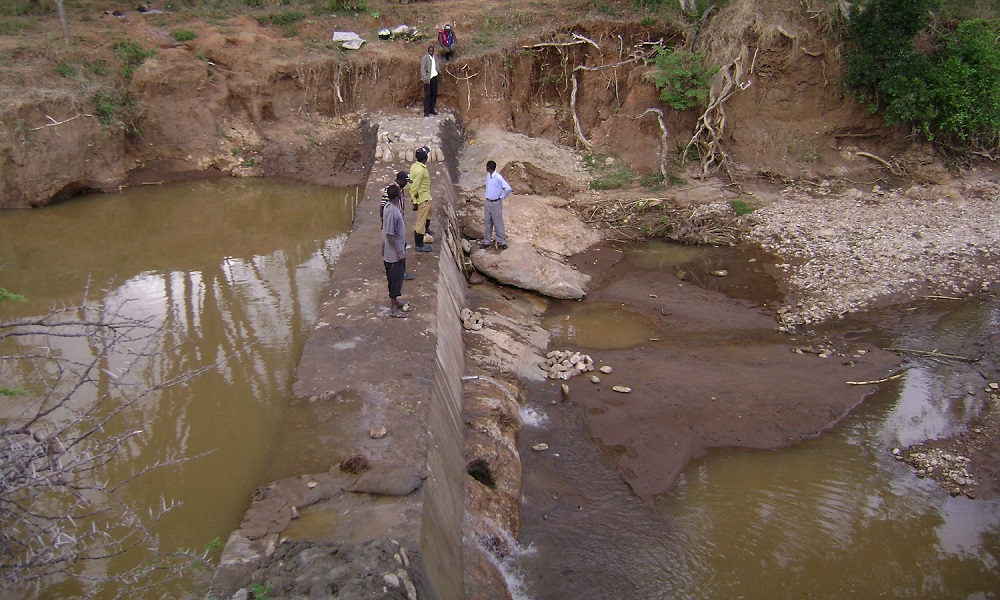
Some of these problems have however subsided with the provision of water in some parts of the vast and arid West Pokot region. Through the use of locally available materials, the locals are building sand dams on seasonal rivers where they get to store water safely for longer periods after the rainy seasons.

These innovative but cheap methods of water provision are attracting large numbers of the locals who are getting and living together increasing safety and closeness in the neighbourhoods. The advantage of these close communities is that delivery of services is also made easier and consultations can be conducted on a regular basis when the community is close together.

Due to the increasing cases of famine and increased conflicts over resources, there is an urgent need to get water for the inhabitants of this area. Charity can work – but only for a short time – and long-term solutions are needed to deal with the perennial water and hunger crises.

Mitigation steps need to be taken urgently to empower these people by making them independent through irrigation which can ensure a constant supply of food and reduction in conflicts over resources.

Already the steps towards a reliable source of livelihood are being taken. With the construction of sand dams, it is a first step towards dealing with the myriad problems facing people living in the arid and semi-arid areas.

With water provided, any other undertakings are feasible as evidenced by Kasepa residents. These people can become independent and self-sufficient in a short time if only they are given the basic support and the means on how to start living.

The dams can cost less than $10, 000 but the benefits far outweigh the costs and they outlive the erratic rainy seasons. This is an investment that with goodwill will save thousands of lives and enormously improve livelihoods.

The government can work together with the people for the benefit of the locals and the country in general. Kenya is a country endowed with resources, enough to satisfy the citizens and a surplus, which can be exported for the much needed foreign exchange.

Gone are the days and times when the ministries of agriculture and tourism should be the only foreign currency earner. We need to diversify in order to adequately address and meet the needs of the country- top on the agenda being job creation, economic empowerment and freedom from the stranglehold of poverty.

The Constitution empowers Kenyans and they can always demand better and improved livelihoods.

With the devolution of resources, these residents can become independent by relying less on aid agencies for food.

Democracy should also be seen to be trickling down to the most vulnerable in the society hence the need to see the Constitution implemented within the given timeframes.

And just like the Green Belt Movement which has been replicated around the world, we could may be – just may be- efficiently address the issue of climate change and re-green our planet.

Of Pope Francis, the ecological sin and why we need to confess

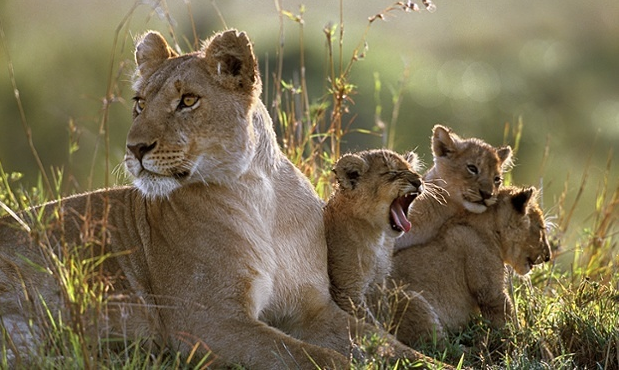
As we mark the international human rights day this year, Kenya and the rest of the world is mourning the death of the ‘Marsh Pride’ who were poisoned in the Mara.

The death calls to mind the many deaths of wild animals that have died out of human-wildlife conflict the world over. But they also bring to mind the many deaths of wild animals that have happened out of the sheer lack of care for the environment on the side of man.

Call it wanton destruction as you also think of how Cecil the Zimbabwean lion was killed by Walter Palmer in October this year – for fun one would say. But also think of the many elephants that have died as poachers hunt their tusks and the many other wild animals that face extinction because we, men, have decided to wipe them out of the face of the earth.

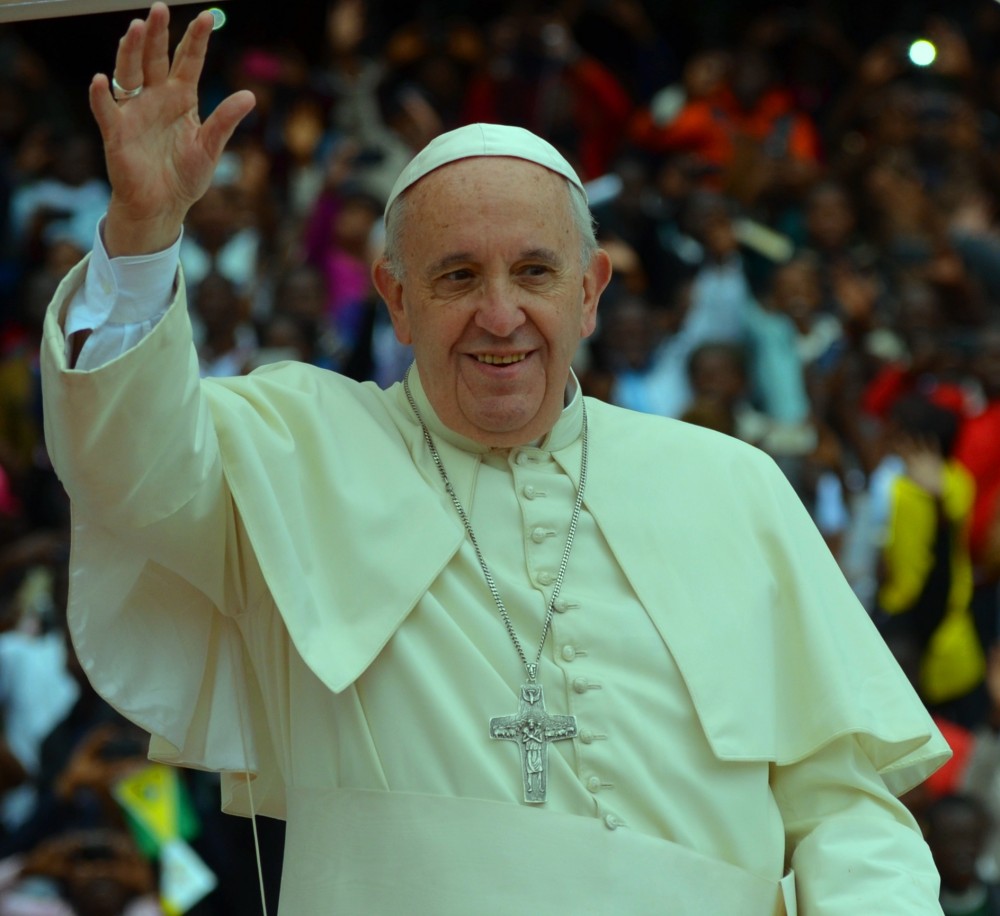
Think of all these animals as a beautiful part of God’s creation that is crying for our attention. To kill them is to destroy the environment and hence to commit an “ecological sin” as Pope Francis terms such acts of environmental destruction in his encyclical ‘Laudato Si’.

Marsh Pride
The Marsh Pride that were poisoned in the Mara this week. Recognition of human rights should also be about the recognition of environmental rights (Photo: BBC).

“To commit a crime against the natural world is a sin against ourselves and against God,”

he says quoting Bartholomew, an Ecumenical Patriarch.

“Every year sees the disappearance of thousands of plant and animal species which we will never know, which our children will never see, because they have been lost forever,”

the Pope says in the May encyclical.

“The great majority become extinct for reasons related to human activity,”

he adds, a message that is so on point in relation to the deaths of the Marsh Pride, Cecil and many others, but more so on the devotion for the international human rights day this year.

It is the

“launch of a year-long campaign for the 50th anniversary of the two International Covenants on Human Rights: the International Covenant on Economic, Social and Cultural Rights and the International Covenant on Civil and Political Rights.”

While announcing the above on its website the United Nations, through its Secretary General, Ban-Ki Moon says,

“on Human Rights Day, let us recommit to guaranteeing the fundamental freedoms and protecting the human rights of all.”

But looked at keenly, this call cannot succeed without care for the environment – the likes of the Marsh Pride and Cecil. Our rights as human beings, end, where their rights start, so the Pope would see it.

IMG_1082
A pile of filth at the Gioto dump site in Nakuru. The Pope says we need to collaborate in taking care of the environment (Photo: Kioko Kivandi).

“Because of us, thousands of species will no longer give glory to God by their very existence, nor convey their messages to us. We have no such right,”

he says in words whose heaviness should pierce all of our conscience.

These are ‘sins’ that we need to confess, as we mark such a day of the recognition of human rights. But they are not the only ones. We also need to confess sins we have committed against the earth through the poisoning of its waters, global warming, and many more.

“Detergents and chemical products, commonly used in many places of the world, continue to pour into our rivers, lakes and seas. Even the quality of available water is constantly diminishing,” he says.

“Things are made worse by loss of tropical forests which would otherwise help to mitigate climate change. If present trends continue, this century may as well witness extraordinary climate change and an unprecedented destruction of ecosystems, with serious consequences for all of us,” he cautions.

I think there is need for human beings, for man, to recognize that the enjoyment of his rights is directly related with the respect for the respect of environmental rights.

“The earth, our home, is beginning to look more and more like an immense pile of filth. In many parts of the planet, the elderly lament that the once beautiful landscapes are now covered with rubbish,” he observes.

And while the Pope says the political class has a higher responsibility he adds that all of us have a role to play. He wants us to collaborate in

“working towards a good environment. Humanity still has the ability to work together in building our common home.”

And in doing so we need to have the youth and the poor in mind.

“Young people demand change. They wonder how anyone can claim to be building a better future without thinking of the environmental crisis,” the Pope says.

Freedom of expression invaluable in development

Article 33 of the Constitution of Kenya states that every person has the right to freedom of expression, which includes freedom to seek, receive or impart information or ideas, freedom of artistic creativity, academic freedom and freedom of scientific research.

The right to freedom of expression is a fundamental human right. However, it has limitations and the same article further states that the right does not extend to propaganda for war, incitement to violence, hate speech, slander or defamation.

As the world marks the Human Rights International Day today, the need for access to freedom of expression cannot be overemphasized because of the integral part it plays in any development of a society or a country.

It is no wonder that countries that have recognized the importance of freedom of expression are more developed than countries that seek to limit the right. Citizens of such countries enjoy a better democratic space as they are given a chance to express and share their ideas, opinions or misgivings on the state of affairs in their respective countries.

Despite its central role in development, many governments across the world try to curtail it and Kenya is no exception. Although the situation has greatly changed thanks to the 2010 Constitution, previous regimes constantly sought to limit the right with the KANU regime having being notorious for suppressing dissent voices.

Assassinations, arrests, detention without trials and torture of human right activists, journalists, politicians and even members of the clergy who dared question and demand change of the status quo during the Moi regime were common.

Although the scenario changed when Mwai Kibaki ascended to power and the subsequent ushering of the 2010 constitution, the infamous raid of the Standard Group allegedly by state security officers shocked many particularly due to the fact that president Kibaki was elected on a platform of change.

Though infringements on the right to freedom of expression waned substantially during Kibaki regime with Kenyans enjoying a more free democratic space, the attack was and still remains to be a stark reminder of the lengths that government(s) can go to curtail the freedom of expression and the press.

Despite a constitution that guarantees basic rights and freedoms the current Jubilee government seems keen on curtailing the freedom of the expression and the media. The emergence of social media, which has opened new frontiers for freedom of expression, seems to be a nightmare for the Jubilee regime, ironically elected on a digital platform.

The controversial security bill and arbitrary arrests of journalists, bloggers and other social media users are perceived as some of the deliberate efforts by the government to curtail the freedoms that have taken long for the country to achieve.

Perhaps what is quite disheartening is the fact that President Uhuru Kenyatta seems to be leading the onslaught on the media. The president has been on record severally castigating the media for what he termed as misreporting without him citing specific examples.

Recent outbursts by the Interior Minister Joseph Nkaissery on the media and arrest of Nation Media journalist John Ngirachu under the orders of the minister are also worrying.

While Kenyans understand the challenges that the country is grappling with especially in the fight against terror and organized crime, the government should not use insecurity as an excuse to suppress the freedom of expression.

Freedom of expression is invaluable in building healthy and democratic societies and the government should be on the fore front in safeguarding it. However since freedom is not absolute, Kenyans should exercise the right responsibly and shun utterances that amount to hate speech or incitement to violence.

It is a shame that some politicians in Kenya continue to violate the right and utter remarks that have threatened to break the social fabric that holds Kenyans together. Legal action should be taken against the likes of Moses Kuria and George Aladwa among other senior politicians accused of hate speech.

It is also a shame that ordinary Kenyans propagate hate speech especially on social media, a vice that the government has not been able to tame partly due to lack of proper legislation. Kenyans who violate the right to freedom of expressions by writing, sharing or sending hate messages or inciting violence should also not be spared.

As we celebrate the Human rights Day, all Kenyans from all walks of life should recognize the importance and the limitations of the right to freedom of expression to ensure a stable and democratic society.

Nakuru woman with strange disease appeals for medical support

By Njeri Kimani

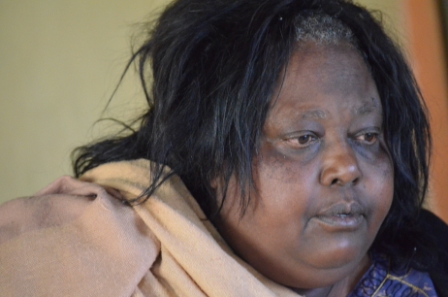
For two years, 55 year old Priscilla Kaniaru has been confined to her house in Kiamunyi area in Nakuru. What started as an off and on loss of vision ended up in a battle to survive.

In an interview, Kaniaru said that she fell ill after the delivery of her last son 19 years ago, but the effects of her mysterious disease started two years ago when she began experiencing various ailments which were recurrent and not directed to one condition.

“It started with partial blindness, elevated intracranial pressures, sudden weight gain, recurrent chest infections, and episodes of high and low blood pressure,” she narrated.

Now she says she is currently experiencing a feeling of “being sick”.

????????????????????????????????????
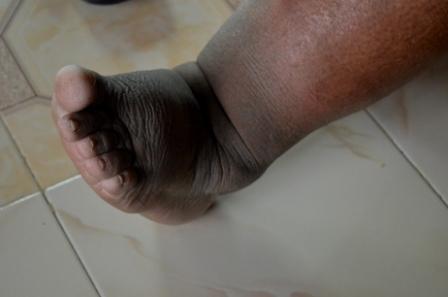
“My last born son always asks if I ever wore high heels. He finds it hard to imagine me in them especially now that I have swollen feet,” says Priscilla (Photo: Kioko Kivandi).

Her addiction to salt, which saw her craving for it to a point of finishing a whole packet daily, was one of the many symptoms of her strange disease.

“I have different diseases characterized by chest pains, hoarseness of the voice, a massive weight gain, painful muscle and joint pains, fever some times, (as well as) severe and chronic ulcers at the legs,” she added.

Even though she has been to the best hospitals in and out of the country, doctors are finding it hard to pin down her symptoms to one particular disease.

“Radiological tests including head CT scan, thyroid ultrasound, pelvic ultrasound, echo, doppler and blood tests was done showing varied results.”

“Some of the diagnoses suggested by various doctors include: empty sella syndrome, hashimotos thyroiditis, addison’s disease, autoimmune polyglandular disease, congestive cardiac failure, lupus disease and dercums disease,” she added.

Over time she has become almost a medical expert. She describes the different diseases she has been suspected as ailing from with a lot of ease. Her knowledge is deep.

“I was (once) told I also could be having graves’ disease – most likely developed as a result of stress during delivery of the last born. I also have bulging of the eyes, stasis dermatitis and stasis eczema that on the legs that end up discharging serous fluid, and take too long to heal making me immobile,” she added.

The hardest part of being sick was the fact that she had to keep visitors away from her house to avoid contamination.

“At first people thought it was rude for me to stop them from visiting me or even ask them to keep away. I also had to wear a dust mask when they were around. However, eventually they started accepting that it was not my fault and even understood why I had to leave the room when they came in,” she added.

Kaniaru cannot move outside the house as any speck of dust affects her breathing system. All the time she is forced to use an inhaler to clear her lungs.

A lover of art, Kaniaru, with the help of her sons, engages in design and painting.

“I love beauty and since I cannot spend a lot of time outside I prefer engaging in creative designs which often end up in my shelves,” she added.

Coincidentally, her last born is also developing interest in creative arts and has been designing coffee tables made of waste tires.

????????????????????????????????????
A coffee table made by Priscilla’s son. Priscilla is herself a lover or art (Photo: Kioko Kivandi).

She also laments that her current image has erased her sons memories of her.

“My last born son always asks if I ever wore high heels. He finds it hard to imagine me in them especially now that I have swollen feet. He has also never seen my skin smooth or dressed in a short designer dress.”

Although she has been in India once, doctors there still could not decide what was wrong with her.

“We went to different hospitals in India but unfortunately each doctor would come and diagnose a different disease and give me different drugs which ended up clashing in my body and making me more ill,” she added.

She however needs go back to India for a different treatment. But she needs sh5 million for the treatment.

“The doctors now think they can be able to pinpoint the disease to lupus which they say is treatable.”

Popular gospel musician Alice Kamande who is spearheading the campaign to help her raise the money needed to oversee the treatment called on Kenyans to help her walk back to health.

“We are appealing to everyone of goodwill to help us look into how we can be able to get her to the right doctors and help her be as productive as she was before,” she added.

Her pay bill number 198784 and goes with her name, Priscilla Kaniaru.

Concerted efforts required to end early marriages in Kenya

Today, December 10th, the world marks the Human Rights Day and Kenya will join the rest of the international community to commemorate the day set aside by the United Nations General Assembly to highlight specific issues on human rights and promote awareness on human rights all over the world.

Although Kenya being a young democracy has made major strides in upholding of human rights especially with the promulgation of the 2010 constitution that guarantees fundamental rights and freedoms, more needs to be done to ensure that ordinary Kenyans live in dignity.

With still many Kenyans not aware of the basic human rights and freedoms as enshrined in the supreme law, majority continue to have their rights violated by fellow citizens, institutions, political elite while others suffer in the hands of the same government that is supposed to uphold and protect human rights.

Incidents ranging from extra judicial killings in the guise of combating terror, arbitrary arrests of journalists, human right defenders and ordinary citizens to passing of repressive laws that curtail both freedom of expression and the media, are some of the serious human rights violations that continue to happen in the country, despite a progressive constitution extolled for providing for such freedoms.

Gender violence, child abuse including child labor, Female Genital Mutilation (FGM) and early marriages are other human rights violations that still remain prevalent despite prohibitive laws against such practices.

Although early marriages occur to both boys and girls under the age of 18, girls are more susceptible to the practice mostly propagated by poverty, retrogressive cultural practices and war or violence among other factors.

Marriage of girls before they attain 18 years is not only a basic human right violation but also a manifestation of gender inequality that is detrimental to the development of victims exposed to the practice.

It has devastating effects on the girls’ health, physical and social – economic growth. While many drop out of school to become wives and mothers at an early age, others develop pregnancy related complications and even die at childbirth.

Majority live under the mercy of the husbands and are usually subjected to domestic violence and with no or little education their chances of gaining any meaningful employment diminish and their families live in unending poverty.

Despite concerted efforts by different stakeholders to end the practice globally, early marriages are common especially in Africa where thousands of girls are plucked from their childhood and plunged into womanhood.

So rampant is the practice in Africa such that the theme for this year’s Day of the African Child was centered towards ending early marriages.

Statistics show that Kenya is one of the countries in the African continent where the practice is widespread with Northeastern and Coastal regions recording the highest rates.

According to the Kenya Population Situation Analysis Report 2013, in every 100 girls in Kenya 26 are married before they attain the age of 18.

Despite the Marriage Act 2014 and Children’s Act 2001 that outlaws marriage for underage in the country the government has not been able to completely rein in the practice.

Speaking during the Day of the African Child celebrations held in Kathonzweni in June, Makueni Children Officer Rasto Omollo admitted that girls were being married off at a very tender age with many cases going unreported.

While there, are no statistics to show the rate of early marriage in the county, Omollo said the practice was rampant and attributed it to poverty and retrogressive cultural traditions and underscored the need for stakeholders to create awareness on children rights.

“Many parents marry view the girls as a burden and marry them off especially during the dry season when food is hard to find. However we need a collaborative approach to end the vice because it’s a violation of the child rights,” he said.

This year’s theme for the Human Rights Day is “Our Rights. Our Freedoms. Always.” and seeks to create and promote awareness on the need to uphold social, political, economic rights of all human beings across the globe regardless of their gender, religion or political affiliation.

Girls and women at large form a very integral part of the society and there is a need to safeguard them against discrimination or practices that violate their basic human rights.

As a country, we should endeavor to have a society with empowered girls and women. The government in collaboration with other stakeholders should come up with laws and enforce the existing ones to protect women and girls from such harmful practices as early marriages and FGM.

Schooling under the gun common in Turkana

By Malachi Motano

As many different school motto’s read; Education is the Key to success, Knowledge is light, profession is power and the general belief that it is education that transforms young boys and girls into useful men and women in the society, learning in the pastoral communities in Kenya continue to face many hurdles.

This writer traveled to Turkana and learned that pupils in the area are escorted to school by police reservists, studying in makeshift classrooms among many other challenges. All in the name of getting an education.

Ignatius Omukaga is the headmaster at Nawoyaregae Primary School in Kaputir Location in Turkana County.

“The pupils cannot attend classes daily. Sometimes you may go to a classroom and find just a handful of them. This may go on for months. Again, school lasts just four hours so that children make it home early because of insecurity. The children are afraid. There are armed bandits hiding with stolen animals in the thickets behind the School.”

The continued cattle rustling between the neighboring Turkana and Pokot communities are the order of the day in this area. A long tradition of cattle raiding has been sharpened by competition over grazing land and water.

In the Turkana South District where Kaputir is found, primary school net enrollment is below average (about 26 percent) compared to a national ratio of 82.01 according to a World Bank Kenya’s Free Primary Education program is like had its work cut out for it here.

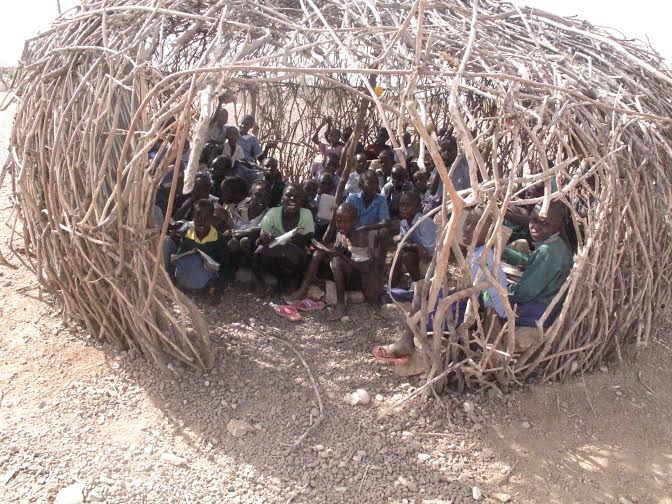
Nawoyaregae is a school getting by with what it can, its mud-walled makeshift classrooms already crumbling. Nursery lessons are conducted under a tree, with the young learners, 30 in number, crowded into the available shade, peering at instructions drawn on the battered blackboard.

“The school had more than 350 pupils, but this has fallen to 125. The figure fluctuates, but the trend is steadily downwards. In response, the community has employed the services of a armed police reservist, who accompanies children to and from school,” says Omukaga.

This writer with some of the pupils. Learning has many challenges in Turkana. [Photo: Malachi Motano]
Reservist Salim Iro, rifle at the ready, follows the children to play on the school’s field, to the River Turkwell to draw water.

“I escort them every day. I cannot take chances, because when the bandits come, they attack all our people including the children.”

Standing alert, gazing at the pupils from a distance as he caresses the weapon, Iro says,

“This place is volatile. But children must learn; and we must do all we can to ensure their safety when learning.”

Oxfam reports that as many as five pupils are killed in attacks by raiders every year.

In 2007, President Mwai Kibaki’s directive led to the recruitment of Kenya Police Reservists in bandit-hit areas, this has not addressed the security situation because of inadequate numbers.

Charles Lopuya is a local Chief,

“Only one police reservist is deployed to each of the three schools in the region, which are about 10 kilometres apart. This is insufficient to provide adequate protection. He wants about six reservists for Nawoyaregae.”

Development organizations in the area say the communities face a dilemma: insecurity keeps children away from school, but education is the key to solving such conflicts with traditional roots.

“To address this, we need to achieve some level of education and use it to build peace in communities. Providing opportunity for education to the young generation and helping them understand the role of peace in development is critical,”

says Nick Wasunna, World Vision Kenya’s senior adviser.

The writer with the head master. Human resources lack is also a challenge to education in this area. [Photo Malachi Motano]
The writer with the headmaster, Ignatius Omukaga . Human resources lack is also a challenge to education in this area. [Photo:  Malachi Motano]
Joyce Emanukor is, and Education officer at Oxfam in Turkana.

“I am concerned by how the prevailing insecurity has uprooted children from schools, particularly those on the Pokot border, forcing them to relocate to facilities in other areas, resulting in massive overcrowding. These facilities are overstretched. There are no additional books, classrooms and other learning material to care for the extra pupils; the quality of education is quite low.”

Insecurity is not the only factor compromising education in Turkana. A gross shortage of teachers is a concern. For example, Nawoyaregae Primary School, with an enrollment of 350 or more school-aged children, has only three teachers.

“This is a great challenge, especially when we have more pupils coming back to school after fighting has subsided. The teachers get overloaded, and this is not good for the pupils,”

Omukaga, the school’s head said. He said he would need about nine to be comfortable.

The situation is replicated in neighboring East Pokot, where the majority of schools have just two or three teachers serving over 200 students.

According to Mutuku Mwenga, the education chief in the area, teachers have been shying away from being deployed in areas such as Turkana and Pokot, largely due to the insecurity.

FGM is a tool to protect the spread of HIV, Maasais say

By Malachi Motano

“Cutting girls is something our people have done for hundreds of years,”

Nashilu Lenteiyo, the senior Female Genital Mutilation (FGM) ‘surgeon’ in the Maasai community of Ol Donyo Nyokie, tells a reporter.

She adds,

“No one can convince us that it is wrong.”

The women believe that an uncut woman has sexual feelings for every man she comes across, and is likely to stray from her marriage. In fact, they see FGM as a tool to curb the spread of HIV & AIDS in their community.

“When you cut a girl, you know she will remain pure until she gets married, and that after marriage, she will be faithful,” Nashilu explained.

“But when you leave a girl uncut, she sleeps with any man and brings the disease into the community.”

Asked about cleanliness during the procedure, the women say nowadays they use different disposable razor blades for each girl, instead of the traditional use of one knife to cut several girls. In addition, they now use gloves and have replaced the cowhide base sheet with a plastic one.

Toshi Mahmoud, cut just a month ago, is 11 years old and still has the bright-eyed curiosity and boundless energy of a young girl. She does well in school, is popular with her friends, and seems to have a happy, carefree existence.

Born into the very traditional community of Ol Donyo Nyokie in Kajiado, Toshi had no qualms about relating her own experience, but winced as she recalled the pain she endured when the practitioner sliced her clitoris off.

“She (the surgeon) slept in the same bed as me the night before. My mother woke me up at six o’clock in the morning and poured a bucket of ice-cold water over me, and then I was taken back into the hut and cut,”

she said in Kiswahili.

At just 11 years of age, Toshi is below the traditional age of cutting, but said that often, when the oldest girl came of age, her parents might have all her younger sisters cut to save the cost of having several ceremonies.

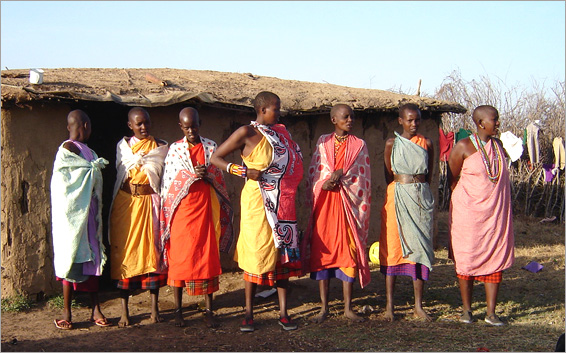
Maasai Morans. One of them says that FGM is a practice that should not be eliminated from their culture. [Photo: Malachi Motano]
She said that she dreaded the pain, but looked forward to ‘becoming a woman’ – she wanted to be cut because it would make her more acceptable in the eyes of her peers and her community.

“If you are not cut, no one wants to talk to you; the girls and boys in school laugh at you because you are still a child. No man will want to marry or have sex with you if you are not cut.”

But Toshi said that despite her own willingness to be cut, she did not support the practice of FGM, and insisted that she would not permit her own children to be circumcised.

“We are taught in our school health club that FGM is a harmful practice, and I wish the Maasai would stop forcing girls to do it,” she said.

Several circumcised teenage girls in Ol Donyo Nyokie say they would never put their own children through FGM, having been educated about the dangers of the practice. They were adamant that they would not bow to the community’s pressure to have their daughters cut, as many of their parents had.

Toshi and her friends, who were all circumcised in the same month, described how their wounds were coated with a paste made from cow dung and milk fat to stop the bleeding and accelerate healing; all maintained they had healed perfectly, and said they had never heard of any deaths

However, the head teacher of the Ol Donyo Nyokie Primary School, Rebecca Pateli, says, there have been several incidents of injury and even death from FGM.

“You hear of girls who die, but there is never an admission that it was FGM-related. The practice is so hidden that it is hard to know how many, but they do get sick, and some die,” she said.

The young men in the community, known as ‘moran’, or warriors, strongly believe that FGM is a useful practice that keeps women chaste.

“I am married to a woman who is cut, and will be cutting my daughter when the time comes. You cannot claim to be a Maasai man or woman if you are not circumcised,”

Kapande ole Saitoti, an Ol Donyo Nyokie moran, says.

In fact, the girls in the community reported that men were the biggest hindrance to the fight against FGM, because they continued to reject women who were uncut.

Nashilu Lenteiyo. She says that the tradition helps preserve their identity. [Photo: Malachi Motano]
Samson Ntore, a community-based health worker with the African Medical Research Foundation (AMREF), said most practitioners in Ol Donyo Nyokie had greatly reduced the severity of the cut, and merely made a symbolic incision rather than removing the entire clitoris.

However, the women could not make this public knowledge, for fear of the repercussions if they were found to be shirking their duties.

The Ol Donyo Nyokie community is a society fighting to cling to their ways in the face of pressure to change from all sides. Most of them support education, and education tells them to abandon FGM.

Today, the prevalence rate of FGM in this community is still 100 percent. But the young girls of the community insist that their daughters will never have to undergo the painful procedure.

Kenyans displeased with ‘tourist’ President Kenyatta, want austerity measures enforced

This December, the Presidency has been taken to ask to explain how it is spending billions of shillings despite promising austerity measures to cut ‘fluffy’ government expenditure.

In what is becoming a force to reckon with in terms of governance, social media in Kenya is playing an enormous role pushing for accountability from public office holders.

In the first week of December, Kenyans ‘netizens’ came up with hash tags seeking clarity on how the government could continue spending taxpayers’ money in travels despite a worsening economic situation which has seen inflation hit double digits.

This is due to the increase of taxation leading to increased prices of commodities like fuel. Ironically, the excise duty on fuel, specifically, came a few days after the announcement of price reductions following a drop in the global market.

Allegedly, President Uhuru Kenyatta had made 43 trips in his three years in power, 10 more than his predecessor, retired President Mwai Kibaki, made in his 10 years in power.

And these trips have not come cheap.

According to the Saturday Nation,

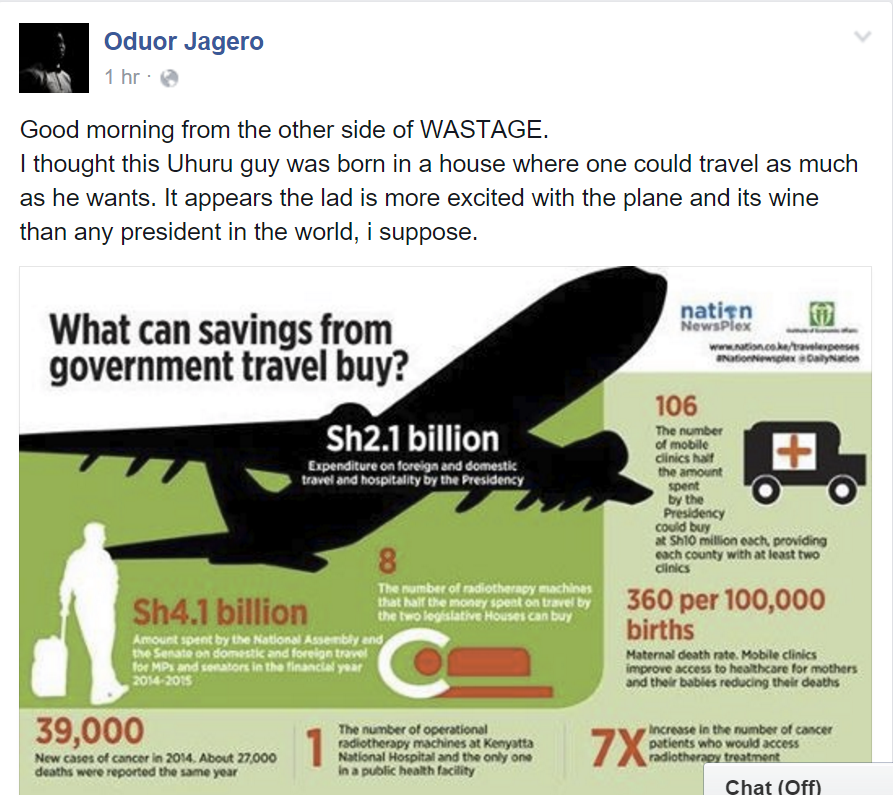
“If the presidency had spent half the amount it allocated to foreign and domestic travel, and hospitality, it would have saved enough to buy 106 mobile clinics at Sh10 million each. Each county would have been provided with at least two mobile clinics.”

To express displeasure with the trips, Kenyans have taken to twitter and other platforms to complain against these trips.

Jagero

//

Good morning from the other side of WASTAGE. I thought this Uhuru guy was born in a house where one could travel as…

Posted by Oduor Jagero on Sunday, 6 December 2015

Most of the comments on Twitter have however bordered on ridicule as the government has seemingly broken every promise it made to Kenyans in its manifesto.

So far, the country has been reeling under a burden of taxes and life is becoming more expensive. The outlook is gloom and the disdain from Kenyans is palpable. Despite this criticism, other Kenyans feel that the President is only doing his job.

And on Sunday, State House came to the defence of the president over the trips saying they were benefitting Kenyans.

Spokesman Manoah Esipisu said President Kenyatta is Kenya’s foremost diplomat who travels to seeking financial partnership for projects in the country.

“The President has to undertake what is necessary travel and he is doing that. You just have to look at other Heads of State. Secondly we cannot claim the leadership position we have in the region and yet shun our obligations to deal with the regional issues that we need to deal with. The President is called from time to time to deal with these regional issues and he does that. He has been called to deal with the Kenya issue and he has done that,”

Esipisu told a news conference at State House.

He noted that during the recent shuttle trips the President managed to seal financing agreements in energy and education.

However, most of these agreements are loans which Kenyans have to pay and which will mean more burdens for an already struggling populace.

KENIC’s shut down of a Kenyan Domain an infringement on internet Freedoms

Earlier today, a Kenyan registered website www.isUhuruInKenya.co.ke was brought down by Kenya’s Top Level domain custodian KENIC. The website which was created last week on Friday 4th December, was deleted today at 6am in the morning in what the  Kenya Monitor team has deduced to be pressure from the government following its popularity as Kenyans Online continue to build pressure on the current government to account for the president’s numerous travels abroad.

The simply designed website just gave a “YES” or “NO” response on whether the President was in the country.

The Hashtag #IsUhuruinKenya quickly garnered interest by Kenyans and soon by Kenya’s news outlets over the past weekend when it emerged that Kenya’s president Uhuru Kenyatta had flown direct to South Africa from the global Climate  talks that were happening in Paris earlier in the week. This has made many Kenyans question how beneficial all the trips the President has been making since the beginning of his term as President. The president has so far been on 43 official visits compared to his predecessor, Kenya’s former president Mwai Kibaki who in his 10 year term only made 33 trips in total.

Kenic’s shut down of a .co.ke domain comes barely months after they launched a month long  campaign in a bid to boost the uptake of the top Kenyan level domain. The campaign slogan was “Najivunia Kuwa .ke” and it showed Kenyans from all walks of life proclaiming their patriotism by registering .co.ke domains for their businesses. The move this morning by Kenic, has been viewed by Kenyan bloggers and internet users as an infringement of basic internet freedoms of free speech & free expression as the website posed no risk to National Security. As many Kenyans on twitter opined, it was simply a comical website that sought to entertain with the twitter handle sharing hillarious tweets speculating on the numerous trips by the president.  

The #IsUhuruInKenya hashtag continued to trend for the better part of Monday 7th morning even as the government’s online machinery was mobilised to counter the narrative from the hashtag by coming up with #UhuruTripsGoodies which attempted to justify the many trips by the president. A renown Telecomms analysis and policy advisor Tom Makau was among those who criticized Kenic for bowing to pressure to de-register the website.

Blogger’s Association of Kenya Chairman Kennedy Kachwanya also shared his sentiments and terming Kenic’s move as ill advised and would have dire consequences in regaining the confidence of Kenyan online content creators.

This is not the first time that Kenic is bowing to pressure to de-register a domain. In September 4th 2011, they de-registered safaricon.co.ke.

Makueni Governor outlines his key achievements in the last two years

Makueni County Governor Kivutha Kibwana has outlined health, infrastructural development and issuance of title deeds as some of the key accomplishments that the County Government has achieved in the last two years.

Kibwana said the county had performed exemplary well in all the health indicators compared to the national average and retaliated his government’s commitment in providing quality, accessible and affordable health care to the residents.

While giving the state of the county address in a special sitting at the County Assembly the governor said the infant mortality rate in the county has reduced to 42 per 1,000 live births against the national average of 52 per 1,000 live births while the under 5 mortality stands at 55 per 1,000 live births against the national average of 74 per 1,000 live births.

Consequently, maternal mortality rate in the county has reduced to 288 per 100,000 live births against the national average of 510 per 100,000 live births .

Kivutha attributed the improved health services to both infrastructural and personnel development saying that his government has so far renovated and upgraded 126 health facilities, operationalized 42 new dispensaries and recruited 250 health workers.

The governor also disclosed that ambulance services had been revamped through the purchase of 13 ambulance vehicles stationed strategically across the county.

“Other major infrastructural developments include construction of X-Rays blocks, maternity and operating theatres in Sultan Hamud, Mbooni, Tawa and Kilungu Sub-county hospitals and a trauma center at Makindu Sub county hospital to cater mainly for accidents victims along the busy Nairobi-Mombasa highway,” he said.

On title deeds, the governor said the government had spearheaded the issuance of more than 10,000 free title deeds to residents at a total cost of Sh10M while an additional 37,458 titles are ready for issuance.

In education, Kivutha noted that his government had employed 900 Early Childhood Development Education (ECDE) teachers and constructed of over 60 of ECDE while over 20,000 students had benefited from bursaries and scholarships, in the last three years .

Other notable achievements that Kivutha highlighted included construction of six mega dams, grading of 1,850KM road, construction of the Kalamba fruit processing plant, introduction of artificial insemination services and establishment of Kikima dairy-mini processing plant and milk cooling plants in Makiou, Kathonzweni, Kalawa, kalongo, Mukuyuni and Ilima.

Despite the achievements, the governor noted that his government had faced several challenges that derailed development including low revenue collection and the internal wrangles that rocked the county in the first two years.

He said the County Government had not met its target in terms of revenue due to delay of necessary laws while wrangles between the two arms of the government had brought the operations of the government to a near halt.

“ In the last two years we have had internal struggles that have strengthened our resolve to serve our citizens with more zeal. The conflicts we had, debilitating as they were, opened new horizons in the context of devolution. After losing time in the initial stages, we have subsequently gained greater momentum towards working together and deepening democracy not only in the county but also within the country,” he said.

The governor however underscored the need for the two arms of government to forget the past conflicts and forge a working relationship for service delivery.

“While we are cognizant of the fact that the law envisions separation of powers and oversight for effective service delivery, we must also remain alive to the fact that without cooperation and mutual goodwill we will fail our people. Our focus as elected leaders must at all times be guided by consultation and cooperation for prompt service delivery,” said Kivutha.

Reacting to the address, Makueni County Majority Leader Francis Mutuku lauded the governor’s speech but noted that more needed to be done to expedite implementation of projects.

“The governor has clearly articulated his achievements but he needs to sack lazy and incompetent officers who have failed in their duties,” said Mutuku.

The majority leader also echoed the governor’s words on unity saying that the County Assembly will work together with the executive arm of the government for better service delivery.

While notable achievements have been made by the Makueni County Government, it is no doubt that the infighting between the Governor and Members of the County Assembly (MCAs) that almost brought the county to the verge of dissolution greatly affected development.

With barely two years to the next general elections the residents of Makueni County can only hope that the government will execute its mandate and reclaim the time lost during the infighting.

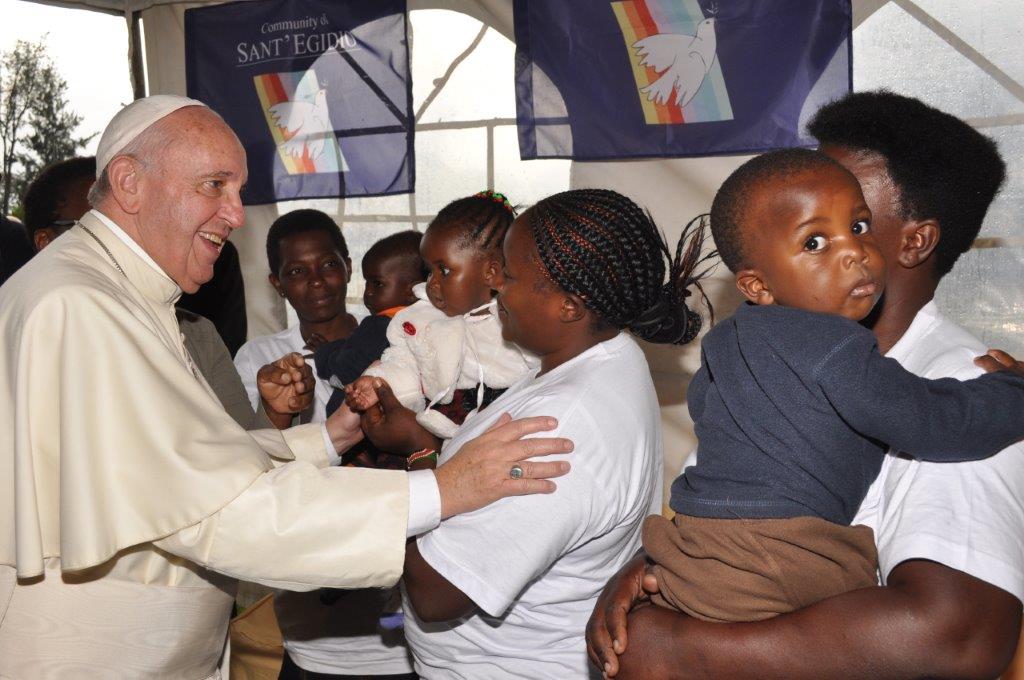
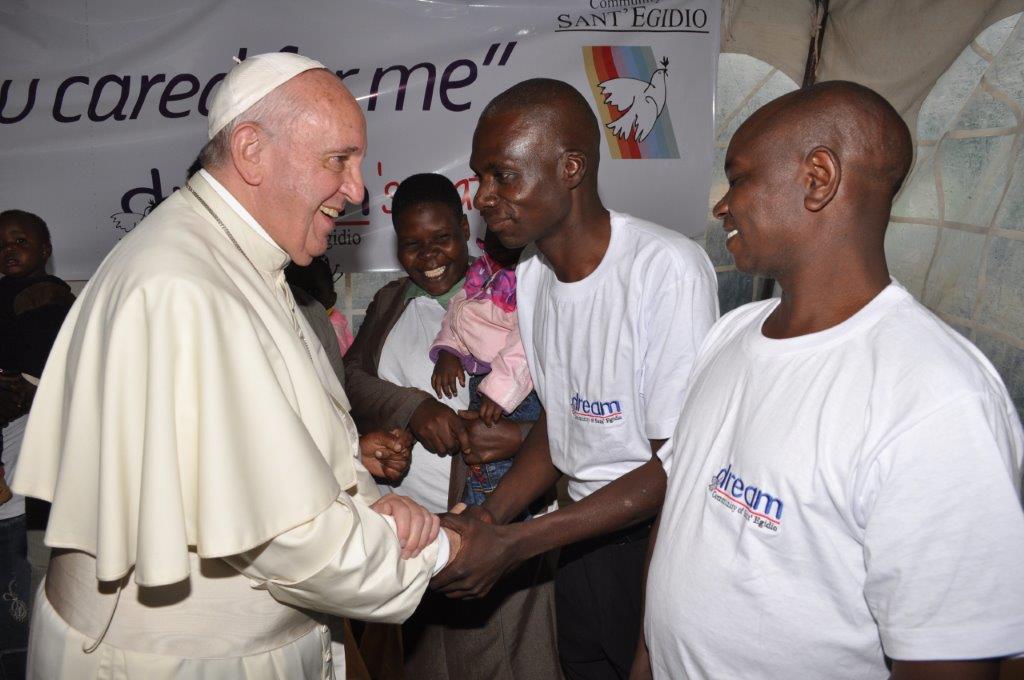
Sant’Egidio Kenya thanks Pope for meeting them

When the announcement of the coming of the Pope was officially made to Kenyans in July, a little known community of Catholic faithful in the country set on an agenda to meet him.

Known as the Community of Sant’Egidio, the community wanted to share with Pope Francis their joy and pains of their deep relationship with the poor.

“Every other Christian wanted to meet the Pope. We wanted recognition of the work that the community does in Kenya,”

says Francis Waithaka the Community’s Country Coordinator.

But above all,

“we wanted to express our solidarity with the Pope for his love of the poor.”

Started in 1968 in Rome the Community is a movement of lay people spread in more than 73 countries throughout the world. Like the Pope who has shown likeness and identity with the poor it runs projects dedicated to the most ‘insignificant’ of the earth – among them the elderly, women and children.

In Kenya for instance, every Christmas, Waithaka and his team usually gathers families from slum areas in Nakuru to serve them a hot meal. He also coordinates to see that they too get some niceties from Santa Claus like all of us – clothes and shoes and all. Such is a service Waithaka and his local team felt would interest the Pontiff.

Pope 2
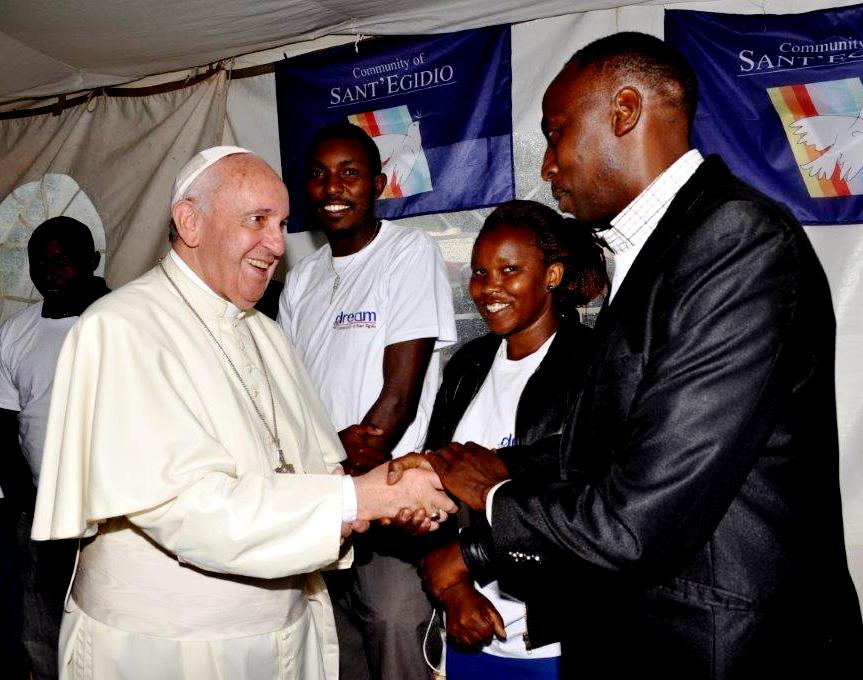
Santa’Egidio Kenya wanted to share with the Pope the work they do in the country (Photo: Courtesy/Waithaka).

“He (The Pope) had met the Community in Rome and has had contact with it in Argentina,”

Waithaka told Kenya Monitor on how they began planning on meeting him upon which they made a request to Vatican through the Pope’s security team.

Unfortunately the request was declined.

“So we wanted to be among those who would wait for him on his way to Kangemi,” he said.

But three days to the visit, lady luck smiled in their favor. Or let us just say the angels in heaven conspired to deliver their dream. After all part of their projects with the poor is one dubbed DREAM, and that coming at an era when we all believe, with utmost faithfulness, that all dreams are valid.

“Two days to the visit when the Pope’s inner security team arrived in the country we were shown a space on which we would pitch our tent at St. Mary’s grounds.”

With that they were set to meet, perhaps, the most influential figure in the whole world at the moment. Their meeting was slated just after the meeting of the Pope with the clergy.

In the tent they gathered a group of women living positively with their children who had been delivered free of the AIDS causing virus thanks to the DREAM programme of prevention of mother to child transmission run by the community in the country.

“DREAM means “dream”, but in recent years has become a reality for thousands of people, because it shows that even if you are HIV-positive, you can live healthy and take care of your family, having overcome stigma, a common barrier in Africa, since the disease (is) still considered by many incurable,”

a press statement released by the community after the visit partly read.

“The “miracle” in the eyes of many is the birth, of 1, 056 children born healthy to HIV-positive mothers here in Kenya, thanks to treatment. It is one of the challenges overcome by the DREAM program (Disease Relief through Excellent and Advanced Means) that in Africa is present in 10 countries, with 270,000 people on treatment and 55 000 children born healthy,”

the release further read.

According to Waithaka the Pope spent at least 7 minutes in their tent, interacting with the mothers and their children.

“He greeted everyone and kissed all the children,”

he says with nostalgia of the time they had with him.

Pope 3
“Talking to Pope Francis is like talking to heaven,” Waithaka (Photo: Courtesy/Waithaka.

He said in English,

“Thank you for the work of the community in Kenya”

and I said “Thank you”” remembers Waithaka of his communication with the Pope when he got at the tent.

“It was really great. We thank him for the time he spent with us. For us it’s a total call to go and serve the poor even the more. We also thank the Community in Rome for making the visit possible.”

Besides Sant’Egidio the Pope also held a private meeting with leaders from various religions during his three days visit in the country which was more close and personal than his other public forums.

“Talking to (Pope) Francis is like talking to heaven,”

concludes Waithaka who happens to have met Pope John Paul (II) in 2001 in Rome.

“Touching John Paul was like touching a relic, something that was holly,”

he says of the Pope who was declared a Saint in April last year as he compares him with Pope Francis.

During his visit to Kenya Pope Francis reminded all citizens to be committed in ending vices such as corruption and tribalism that have for long troubled the nation while repeating his call to the care of the environment, a topic he extensively wrote about in his May encyclical titled ‘Laudato Si’.

“I think the Pope talked to our hearts, our conscience,”

he says Waithaka while adding that his visit should inspire change in the country.

“His visit should change Kenya, if it doesn’t (then) I don’t know what will.”

We need proper laws to ensure accountability of County officials

By George Githinji

Recent happenings in the county governments point to a leadership that is not properly endowed with the requisite skills essential to steer these entities. For example, Nyamira county government puts up a gate for sh9 million, Governor Lusaka of Bungoma buys 10 wheelbarrows at an inflated cost of sh109,000 each, and Embu Governor Martin Wambora pays sh2 million to a communications firm to open a Facebook page for him.

Other bizarre matters include the ever repetitive issue of county officials minting millions out of foreign trips and local conferences or ‘bonding’ sessions and county assembly members claiming sitting allowances for committee sessions that that they never attend.

Governor Simon Kachapin of West Pokot was recently quoted in the media as having threatened to chase away journalists for reporting about corruption and bad leadership in his county. The same happened in Homabay when the county assembly decided to bar journalists from accessing the assembly, allegedly after the media reported about the sh51 million unsupported expenditure in the county.

Uasin Gishu County Assembly has also been accused of barring the public from accessing their ward representatives. Not to forget the sh7 million curtains purchased by the Meru County government that has raised serious eyebrows from the county residents.

These dubious and inflated costs of items in the counties represent a flawed and shady procurement system. The tendering and procurement system in Kenya is one of the avenues synonymous with massive loss of funds and corruption. Costs are inflated so that certain individuals can benefit from kickbacks when the tenders are issued without regard for open and transparent tendering processes. The case of the county government of Bungoma present such a scenario where the cost of a wheelbarrow, which at the prevailing market rate is sh10,000, is inflated by an astonishing 1,090 percent.

The information regarding the procurement and tendering in the counties is not made public, or if made available, the figures are never broken down. That is one reason why the counties are getting such a huge backlash because the public believes that the money has been stolen. Transparency in financial management in the counties is still wanting and the public should organize to demand accountability from their county officials.

The constitution is also categorical about the importance of public participation and public access to their elected representatives. Public participation includes public and media access to county assembly business during the plenary and the committee sessions, unless the speaker rules otherwise and in exceptional circumstances.

The West Pokot governor, Uasin Gishu County and the County Assembly of Homabay are breaking the law by threatening and barring journalists and the public from reporting on malpractices or accessing the elected representatives in the counties and that is a serious affront to the Constitutional provision on public participation. The county governments are supposed to perform their business in an open and transparent manner inclusive of public participation and with scrutiny of the media, which informs and shapes public opinion on the manner in which the counties serve the public.

The case of the County Assembly of Homabay barring journalists from the chambers also put into question the capacity of the assembly to play crucial oversight on public expenditure in the county. The assembly appears to lack integrity and the moral capacity to ensure that the county government accounts for all the money budgeted for in any financials year.

Its implication in financial malfeasance regarding the expenditure of sh51 million portrays it as a weak assembly that disregards public interest for its own selfish interests. It is now up to the residents of Homabay to organize and to demand accountability from their elected officials.

The Writer is a Political Scientist and comments on socio-political issues in Kenya – blogs at Politics Kenya

New HIV infections increasingly occurring among teenagers compounding elimination challenge

On World Aids Day (WAD), Kenyans commemorated it in different parts of the country in different ways.

With gains made towards eliminating the virus that causes Aids, HIV, statistics give a gloomy picture especially among the youths.

AMREF says that most new HIV infections are occurring among teenagers, painting a dark picture of the future if the young generation does not change their sexual habits.

Unicef also paints a picture that would render the future bleak if steps to tame the virus from spreading are not adopted by the youths.

Challenges to combating the virus still remain with stigma being a major one.

Kilonzo says that talking about HIV is one of winning against it.

In Nairobi, WAD was commemorated at City Stadium where First Lady Margaret Kenyatta was the chief guest.

The commemoration attracted a variety of personalities who expressed their commitment to ending the burden of the virus.

Sports have been identified as a way of the avenues that can be used to help in communicating the HIV and Aids message. Football is one of the games and there were competing teams at City Stadium who were keen to deliver the message through the game.

The first lady who has been very vocal when it comes to maternal and infant health was also made an ambassador during the event.

US Ambassador Robert Godec who was at the event said eliminating the HIV threat is possible. He said the stakeholders need to re-commit and end AIDS.

And some good news from Godec,

Despite the statistics showing that the demographics getting new infections are changing, there is still hope that the country will manage to eliminate the virus in the near future. This hope is however pegged on behavioral change among the most at risk populations.