The Ugandan playwright John Ruganda talks of situations in life when “you bleed the leech to fatten a heifer.” A leach is a parasite such as a tick, and thinking of how its blood can be used to fatten a heifer is classic irony.
Yet this is what happens in many situations in Kenya when funds meant for development end up in the pockets of the people in power through corruption. In so doing we bleed citizens who like the leach have no blood to fatten the leaders who like the heifers already have enough.
This is what cartoonists at the Jukumu Letu launch in Nakuru today will be showing to citizens the whole day in the event that will take place at the Nyayo gardens.
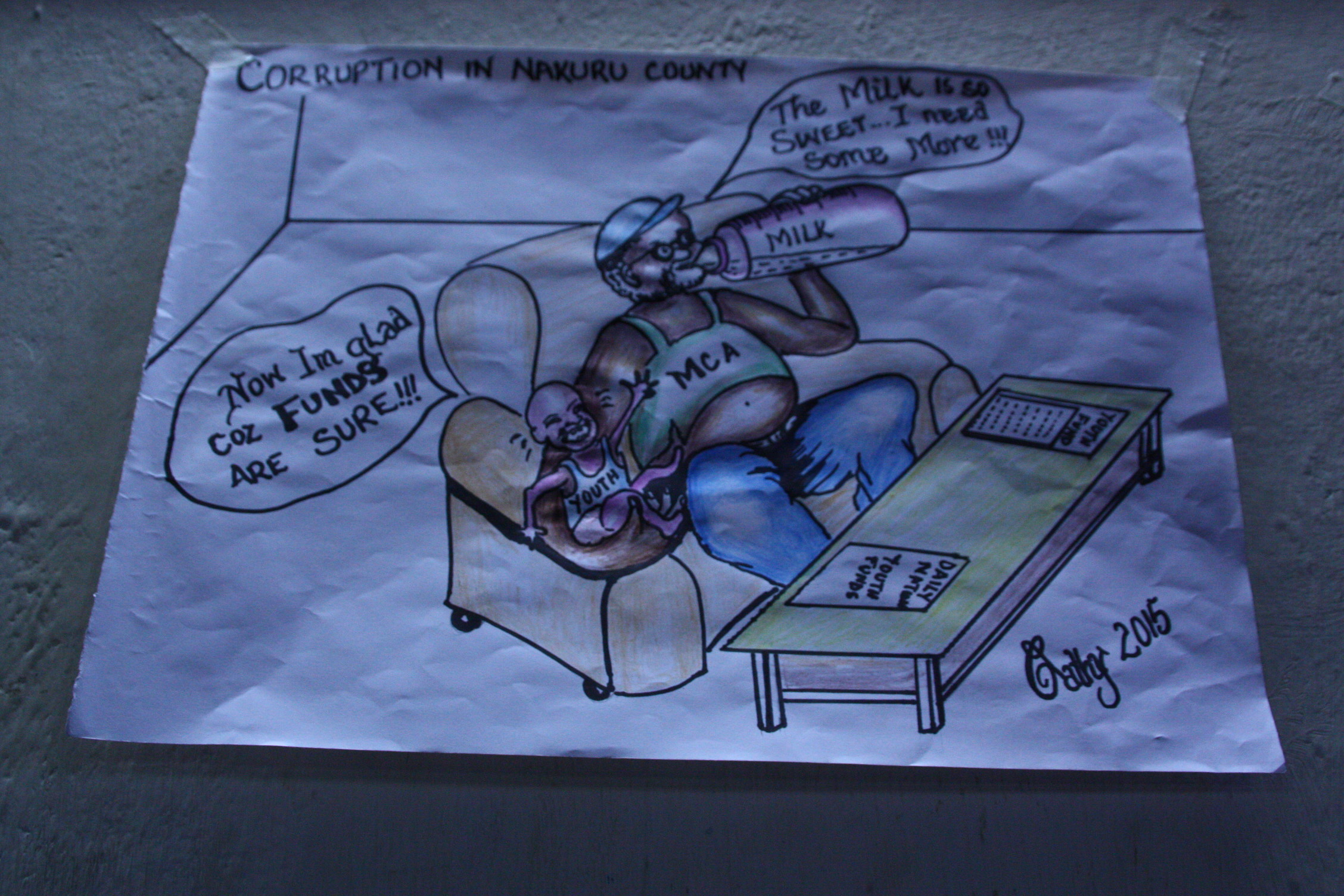
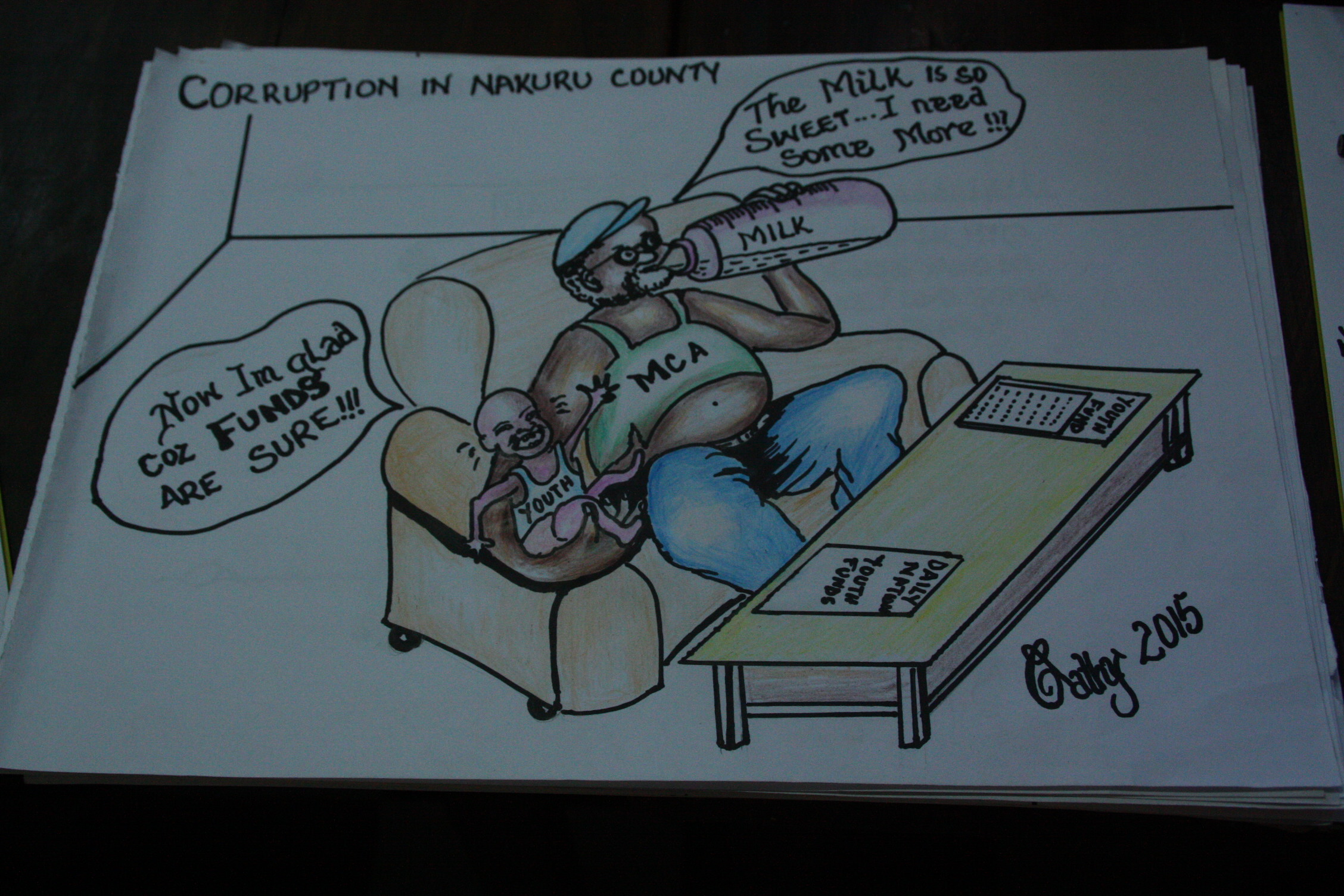
One of such cartoons shows an Member of County Assembly (MCA) who has taken funds belonging to the youth to benefit himself. Either the cartoon also shows the youth have to bribe the MCA if they are to get their rightful share of government funds.
The cartoons also depict the cat and mouse games that citizens go through as they seek funds from the government.
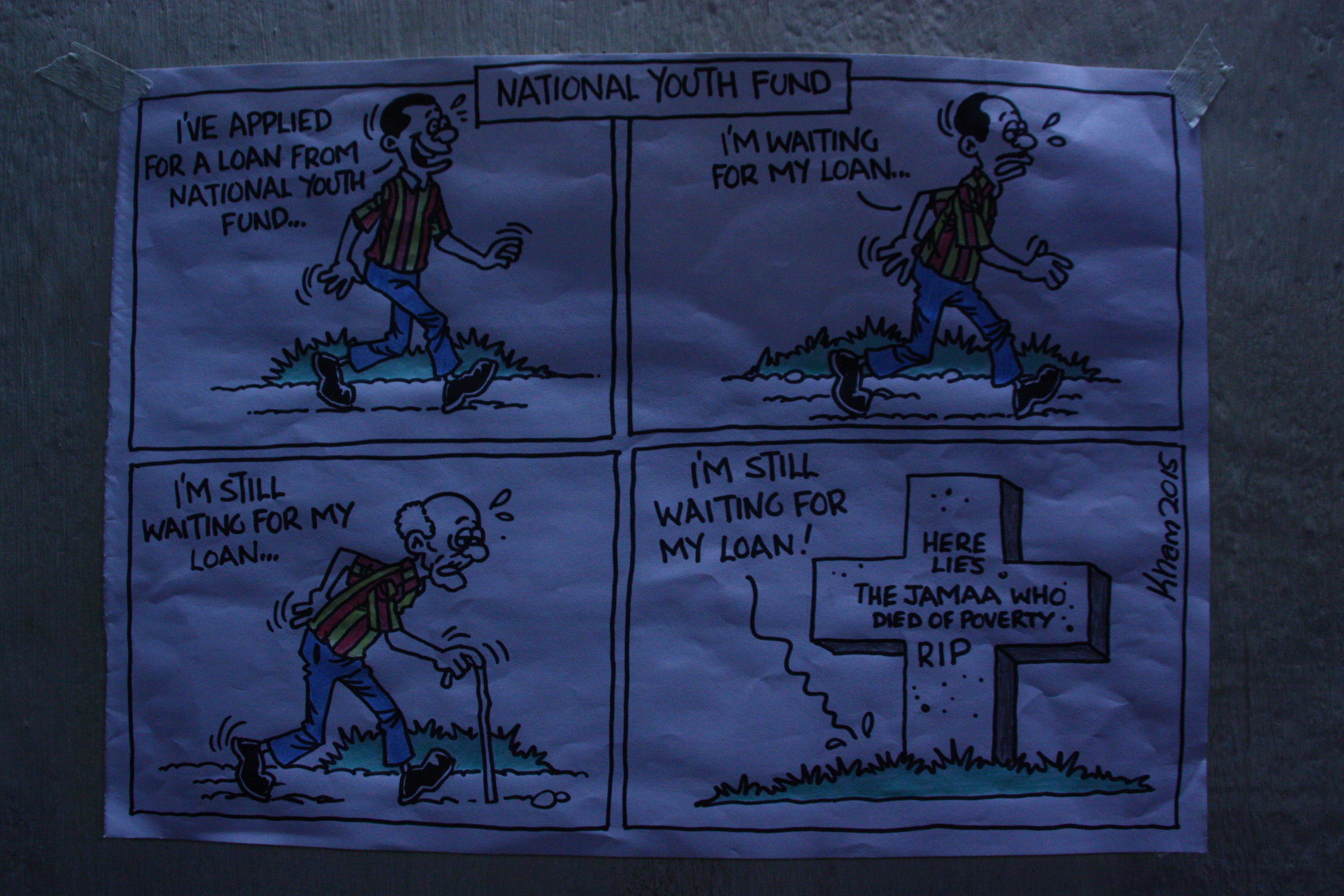
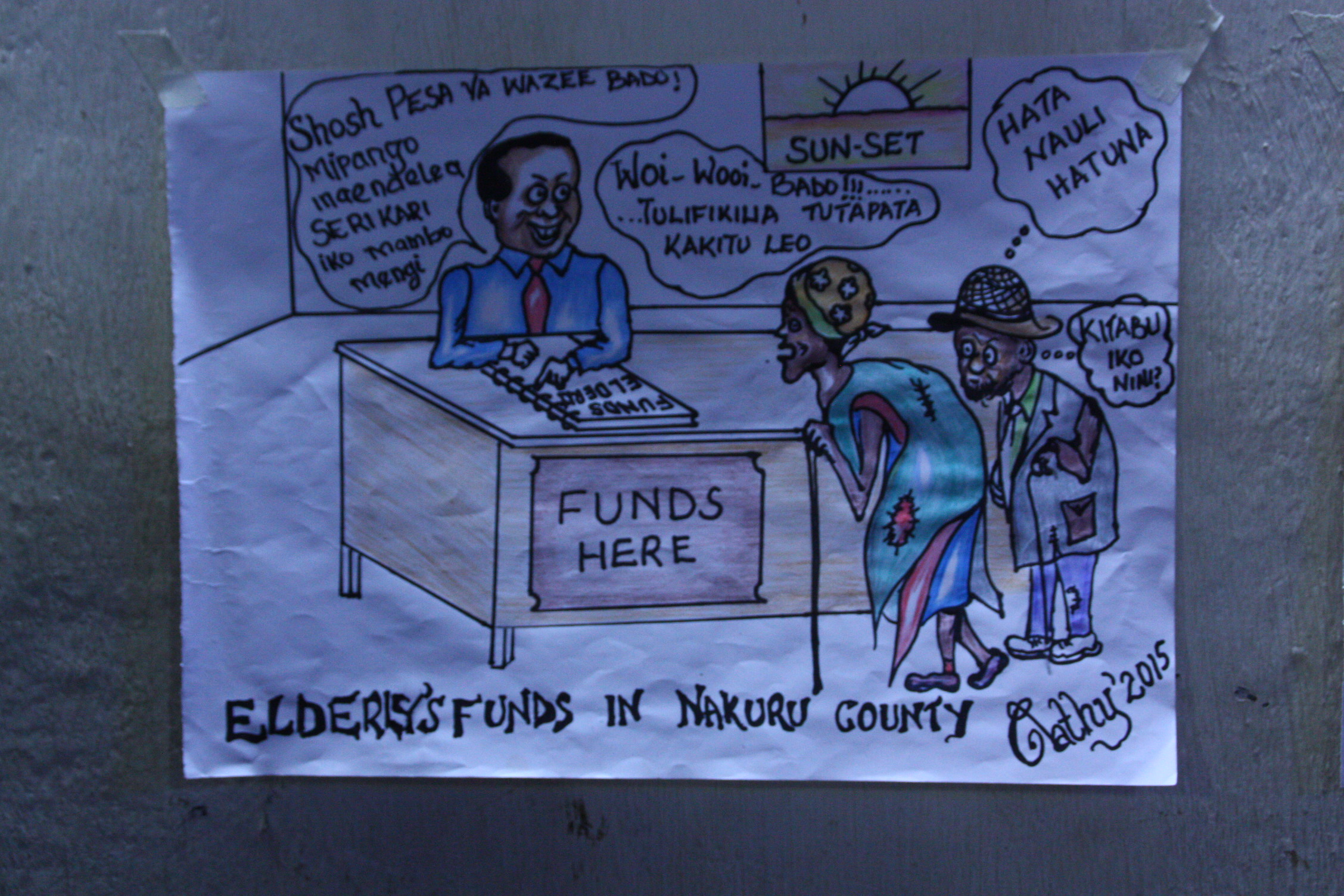
This cartoon decrying the time it takes before one can receive funds after applying for them (Photo/Kioko).A cartoons on the affairs of the funds for the elderly. Sometimes citizens also aid leaders in mismanaging funds (Photo/Kioko).
Apart from the youth fund, funds for the elderly and constituency development fund (CDF), the government introduced Uwezo fund targeting women and youth last year.
However all these funds capture what Ruganda observes of bleeding the leech to fatten a heifer.
While in some instances citizens have not been following up on the funds, some have been aiding their leaders to mismanage the funds.
When in 2013 an American diplomat cautioned Kenyans against electing the Jubilee duo because of the crimes they were facing at the International Criminal Court (ICC), he did not know his statement would go viral.
The three words sentence ‘choices have consequences’ not only became a common statement during the March 2013 campaign period but stuck among Kenyans. Today it is common to hear folks using it to caution each other or to laugh at the other’s mistakes and folly.
And as the Jukumu Letu campaign is launched in Nakuru, citizens will also be reminded about the statement as they are made to reflect on the quality of leaders they elected in the last elections.
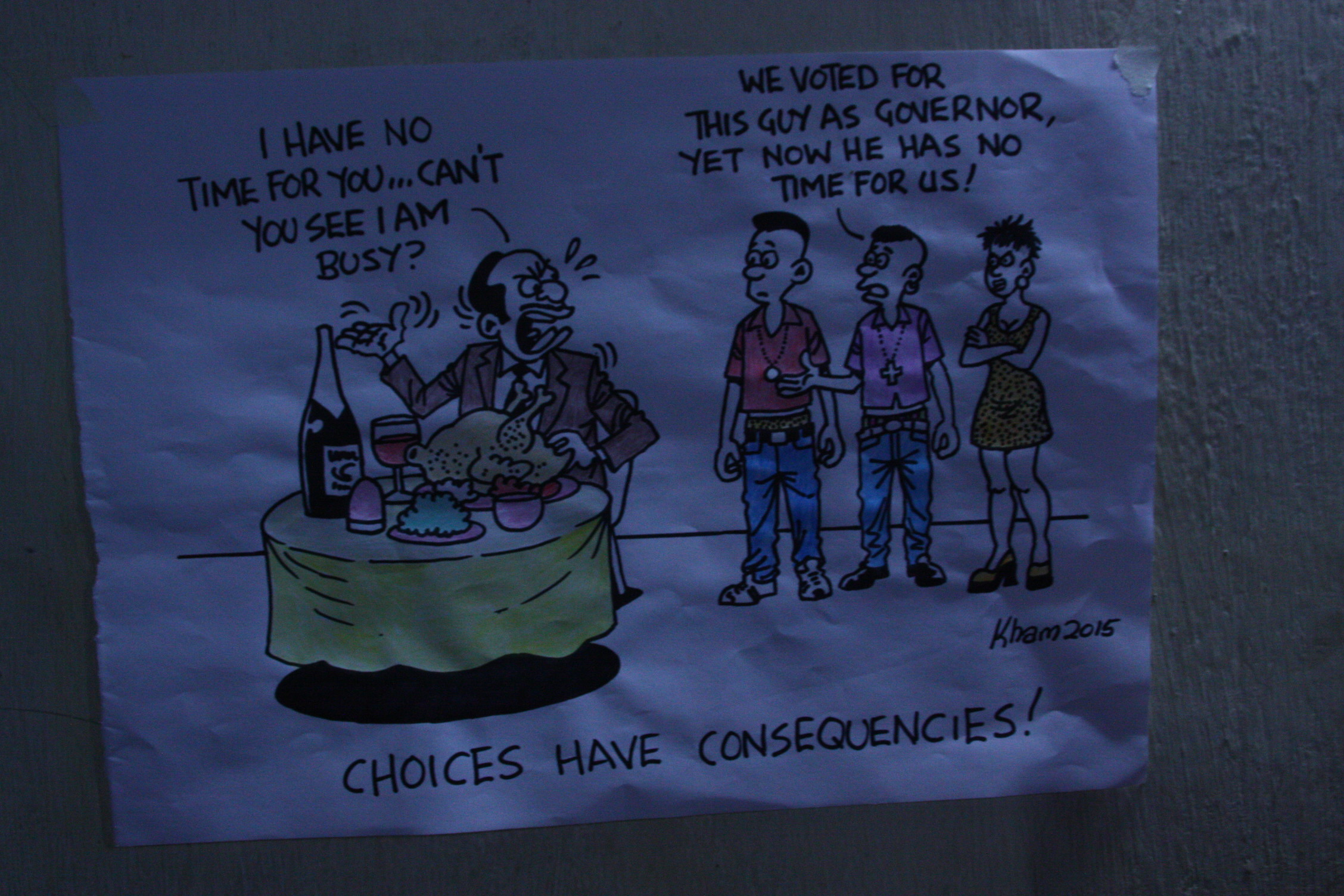
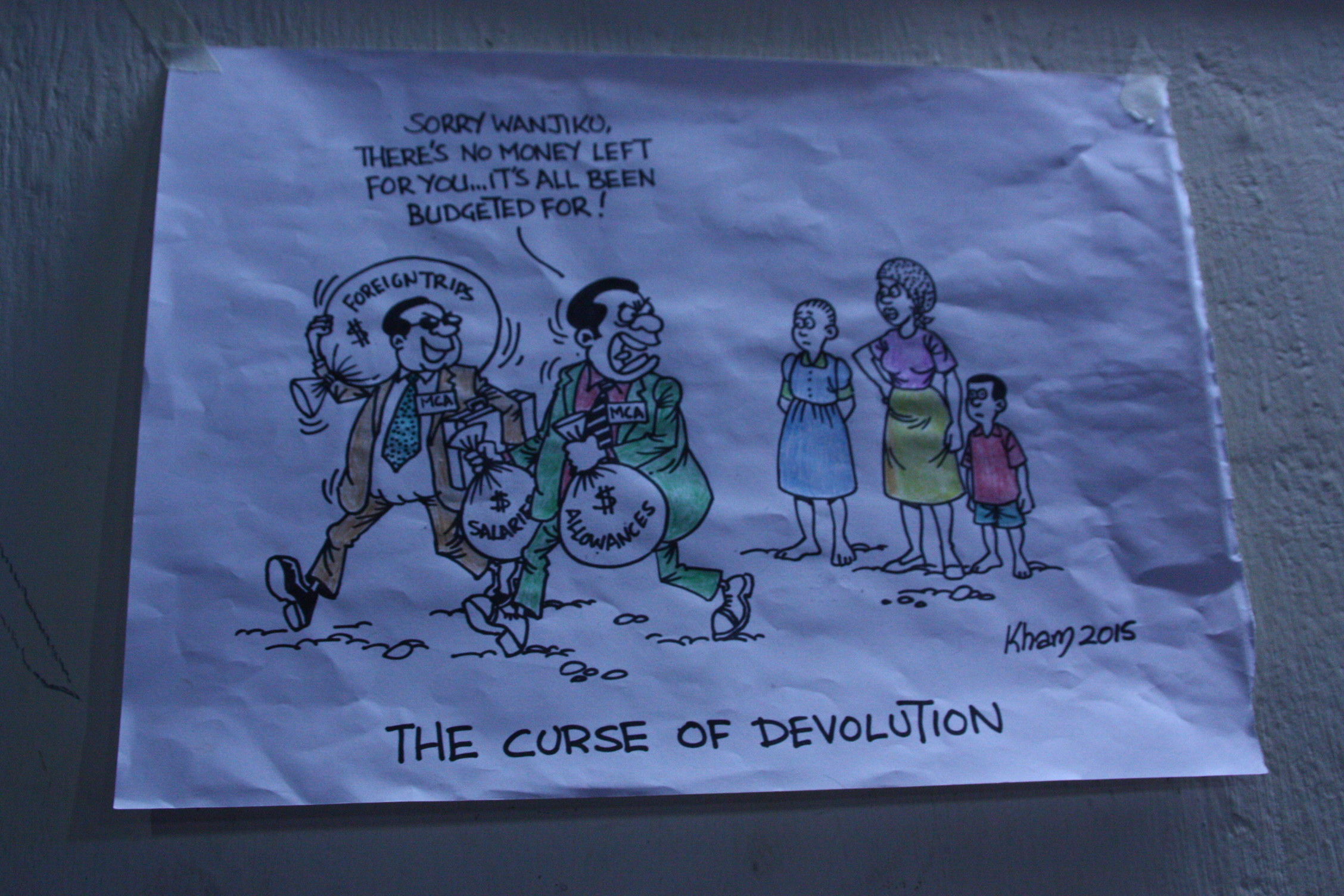
A number of the cartoons that will be exhibited during the launch aim at showing that devolution cannot succeed under poor leadership. So then, if the citizens made such mistakes in electing them, they are to face the consequences.
The cartoonists want citizens to understand that if they elect bad leaders they will end up with bad leadership (Photo/Kioko).
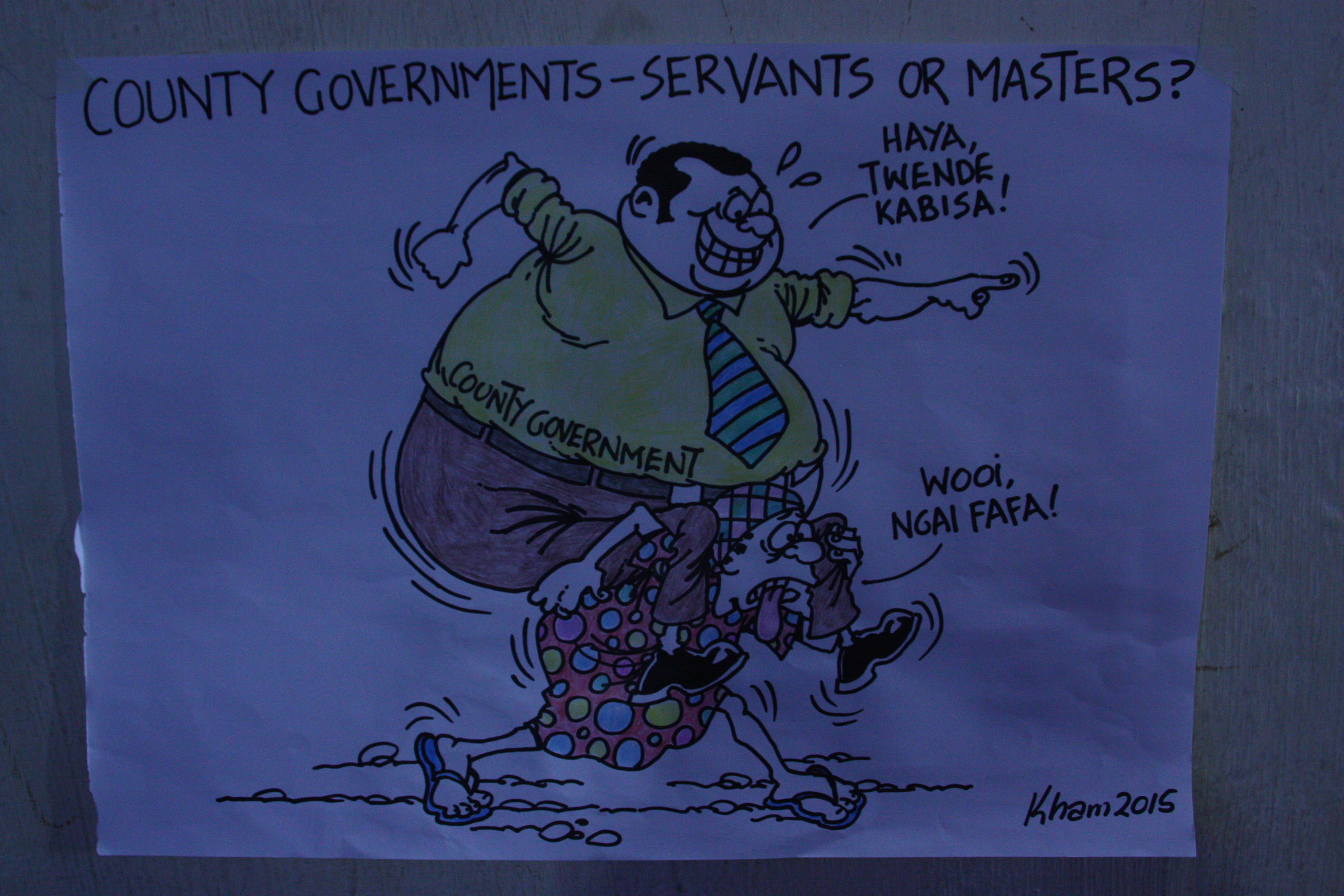
The cartoons also depict the ‘curse of devolution’ as the ‘bossy attitude’ among county officials as well as corruption among Members of County Assemblies.
A cartoon on corruption among MCA’s. County governments have been accused of embezzling funds and thus killing devolution (Photo/Kioko).Bossy attitude among county government officers also seen as a ‘curse of devolution’ (Photo/Kioko).
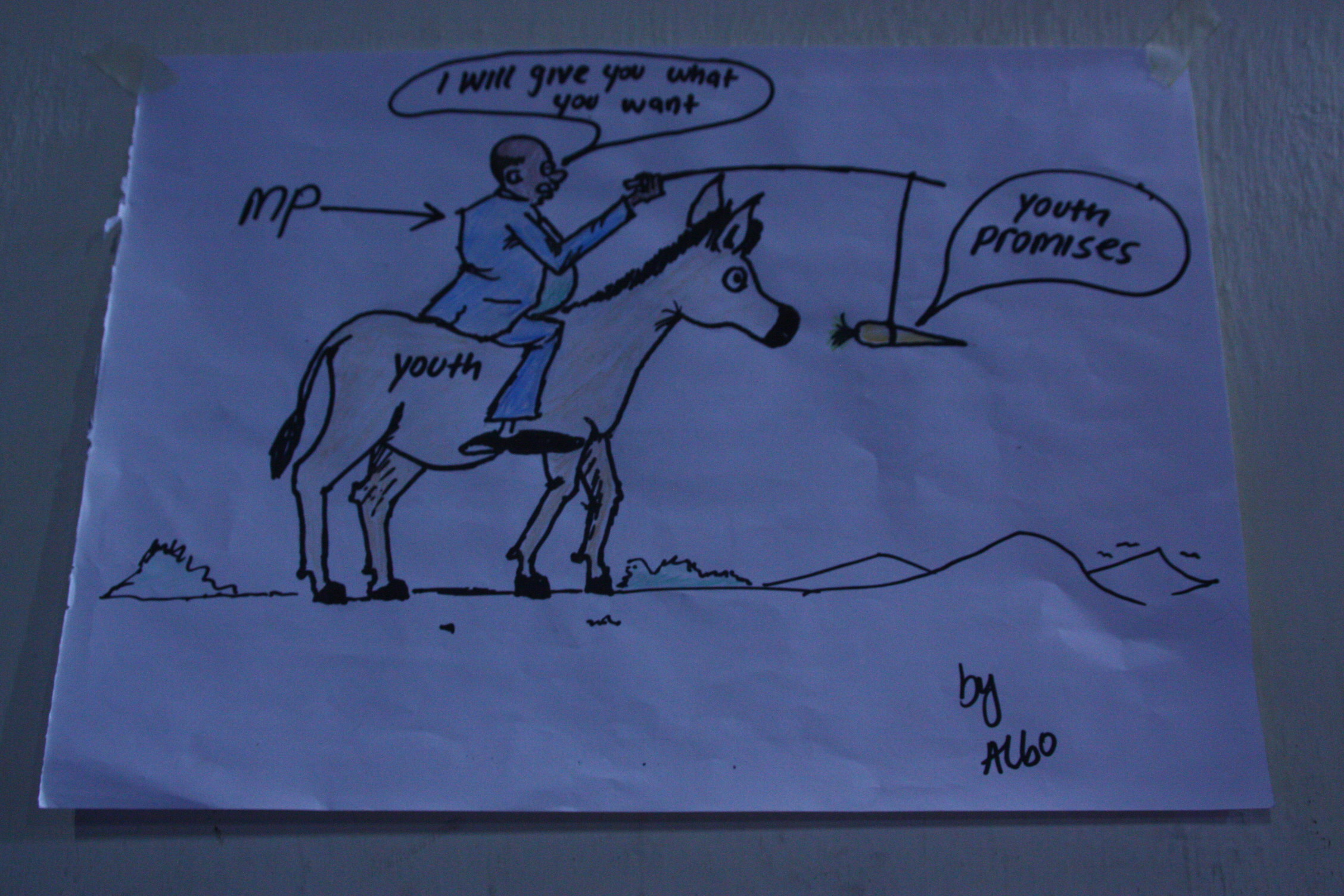
They also depict poor leadership as having a leader who keeps on shifting the goal posts and never delivering on his promises.
Fake promises among leaders has also been identified as ‘curse of devolution’ (Photo/Kioko).
Indeed choices have consequences but it takes an individual to see effects of bad leadership as consequences of poor decisions in the ballot stand. One can only hope that Nakuru citizens will reflect well and be ready to do wiser decisions on governance of their county.
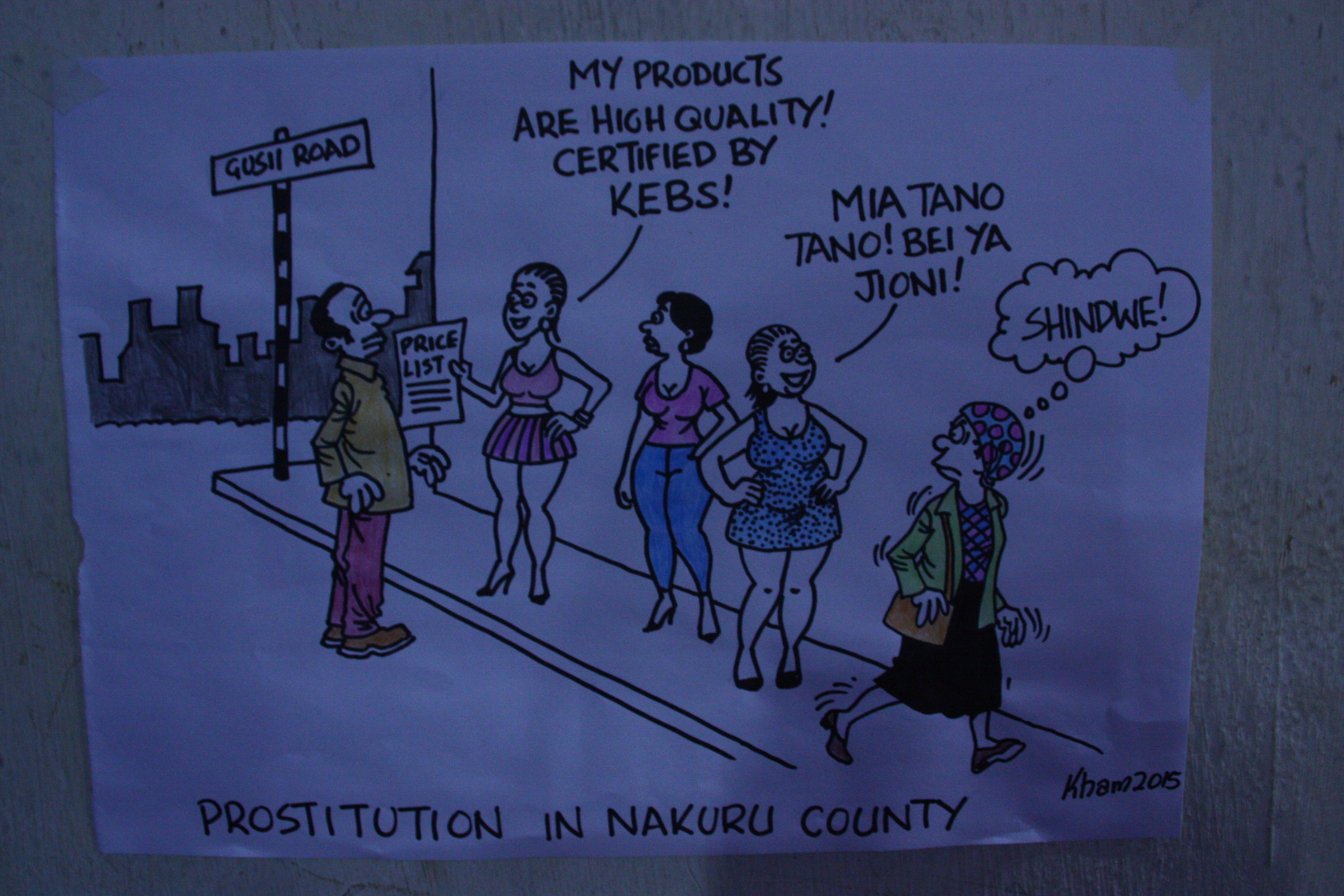
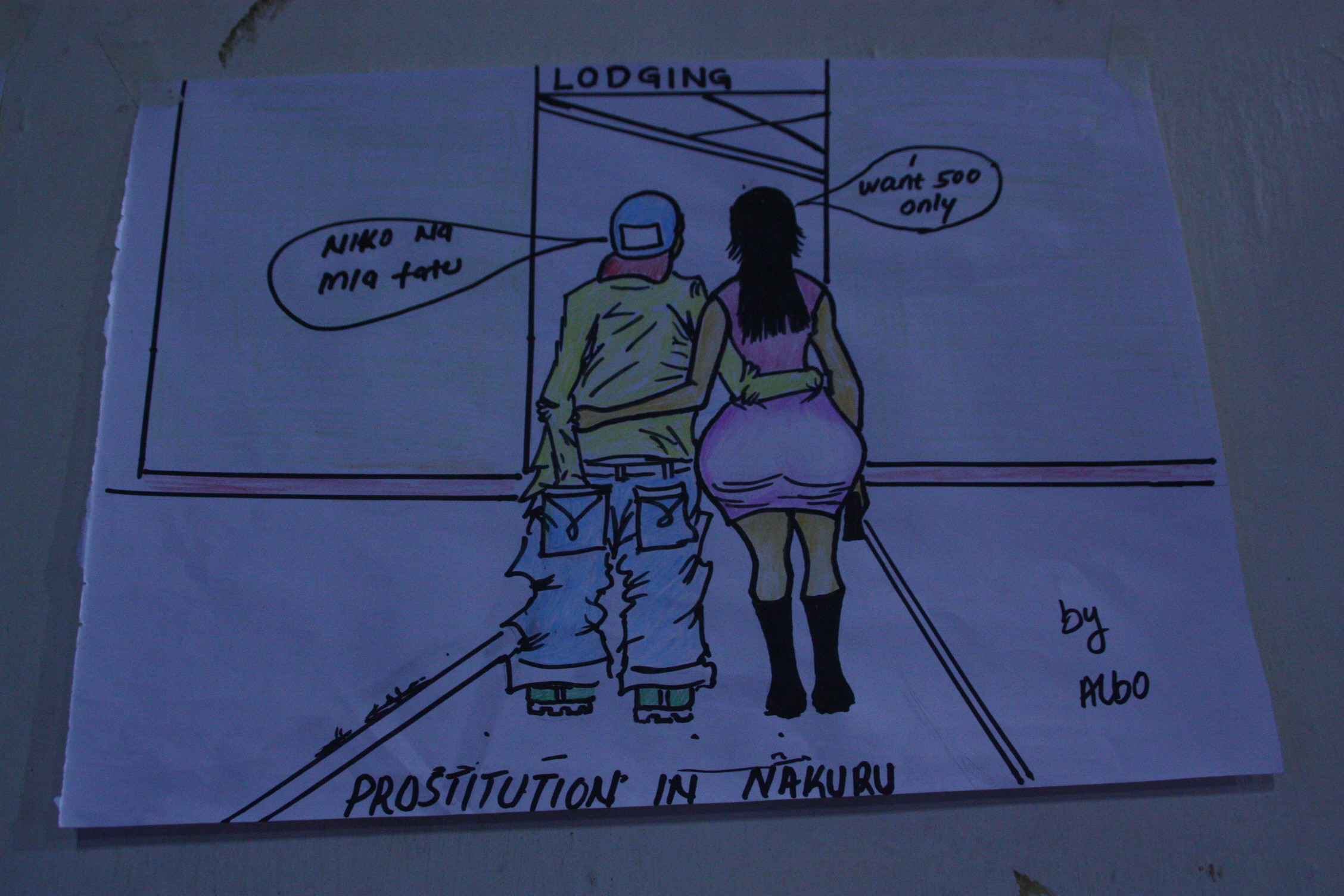
One of the cartoons on prostitution to be exhibited at the Saturday launch (Photo/Kioko)
Nakuru County has its own share of the fame that comes with prostitution. Like Nairobi it also has a ‘K Street’ – which is some sort of an informal designated region for prostitution. It is called Kanu Street and it is down town along a road that branches as you head to the Lake Nakuru National Park.
But there are also other ‘designated’ regions within the CBD (central business district) where those in the trade sell their ‘wares’ on a 24/7 basis. This is a known fact and it does not need the eye of a spy to spot the traders.
It therefore did not come as surprise when cartoonists trained by KATUNI, a Jukumu Letu campaign partner picked prostitution as one of the ills they wanted citizens to see and perhaps laugh about as they reflect on how to deal with it.
The cartoons will exhibited today during the launch of the initiative that seeks to encourage citizens to be more vigilant on the process of devolution show prostitution as a vice that is so entrenched in the society that it has a ‘formal price list for its products’.
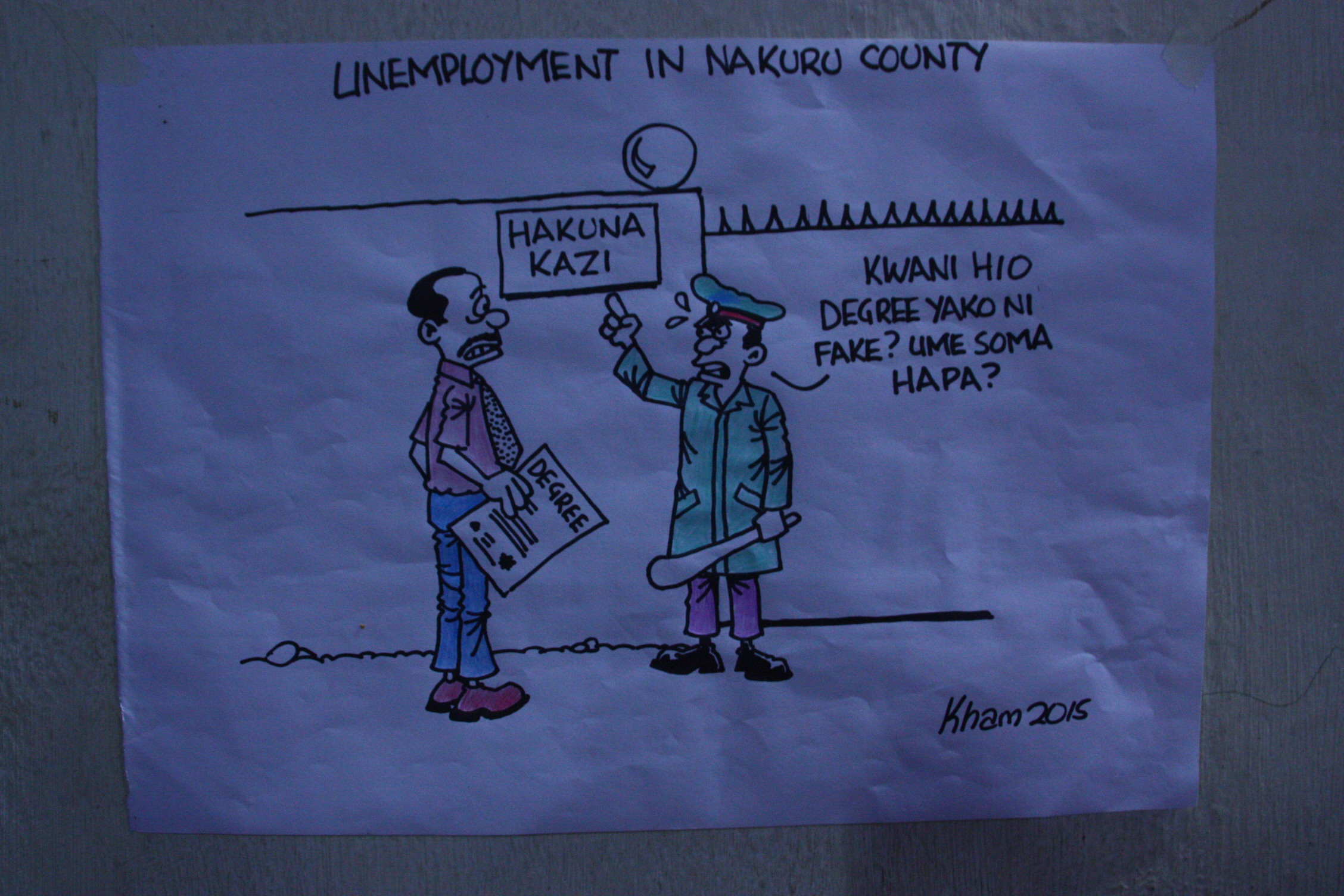
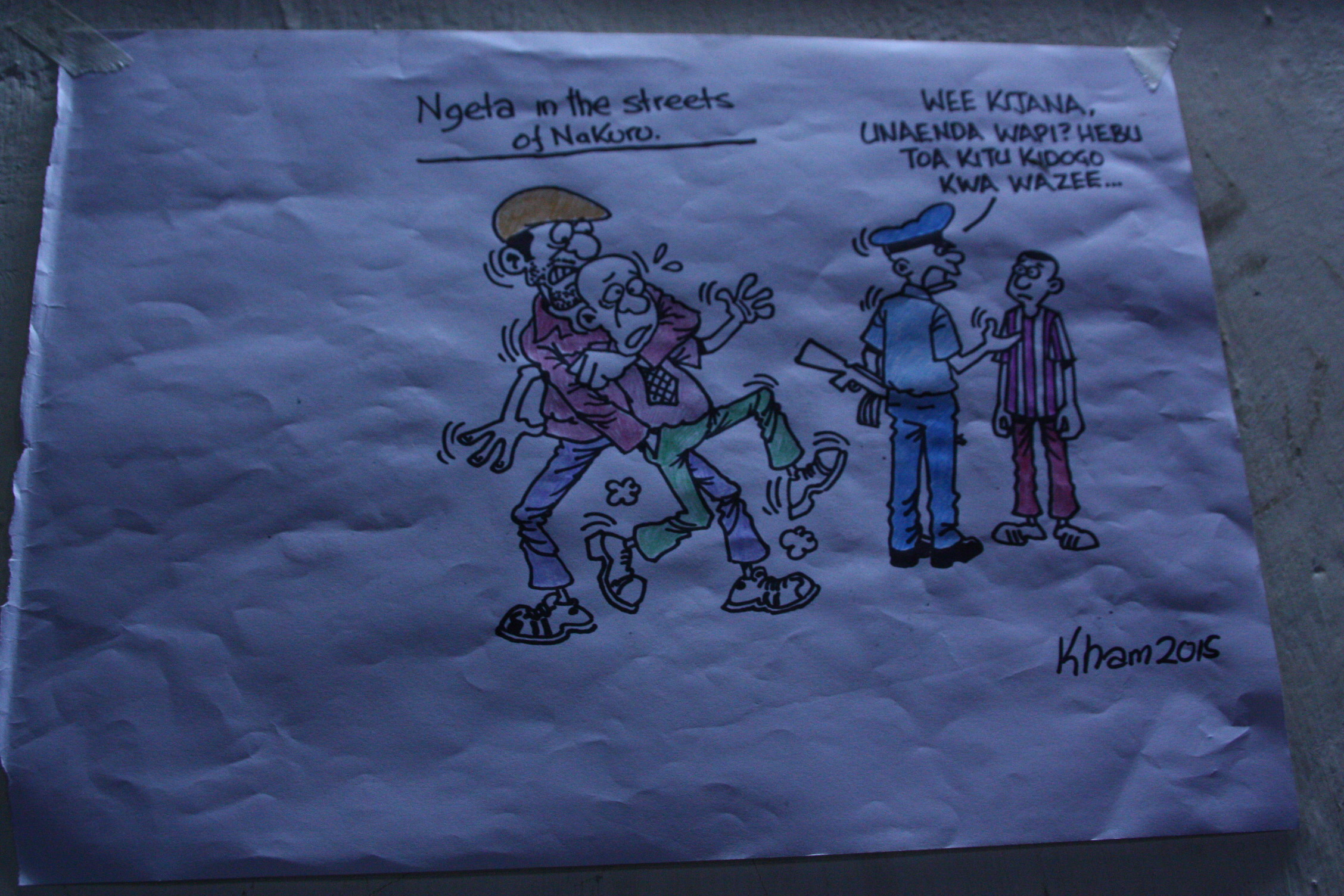
The cartoons seek to stir debate on social ills bedeviling the county (Photo/Kioko).
The cartoons also expose unemployment and the ripple effects it has on society such as rising incidences of crime sometimes even at the full glare of security officers.
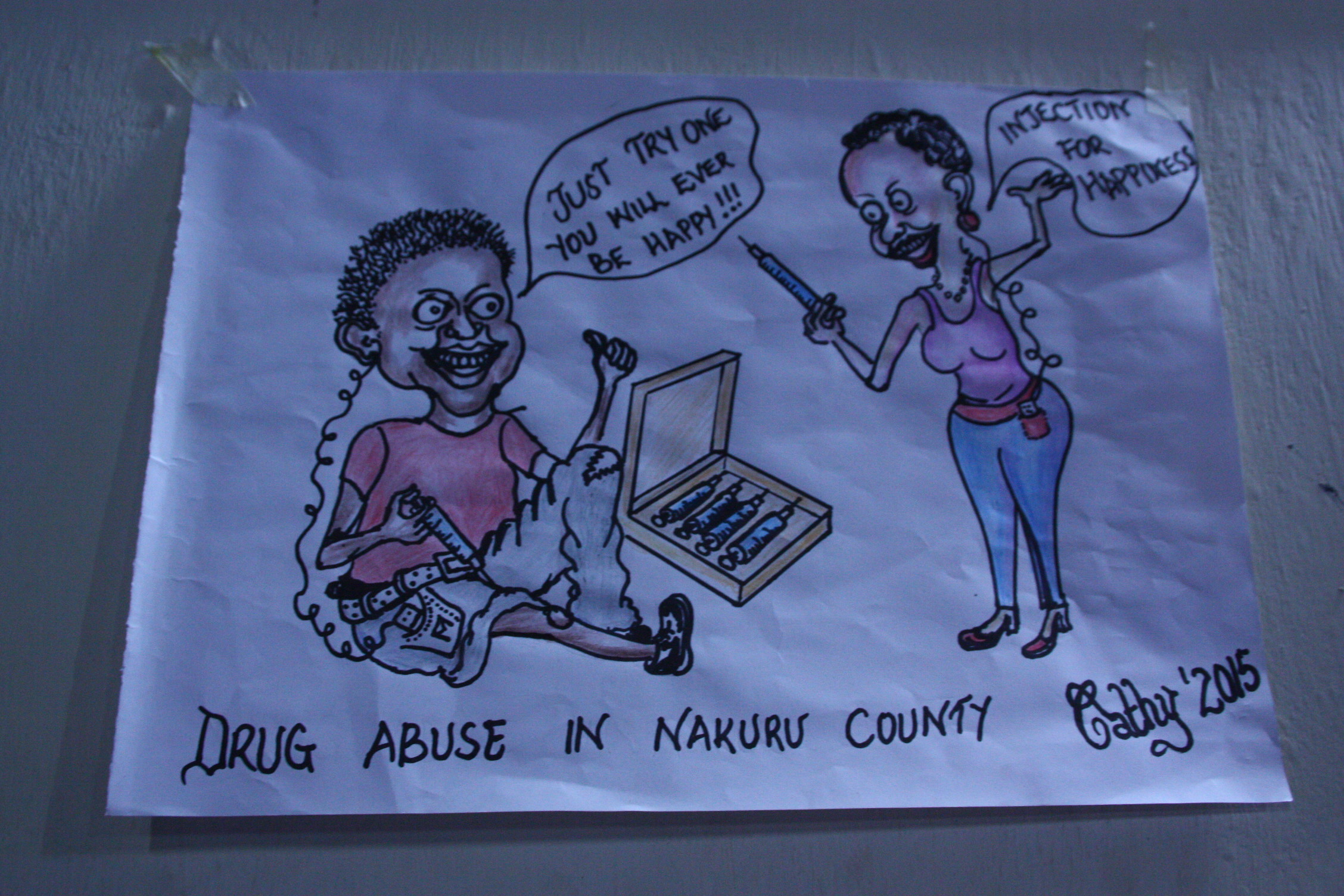
The cartoons also show the vice of drug abuse, especially among the youth.
A cartoon on drug injection. Drug abuse has been identified as one of the challenges affecting the youth in the county (Photo/Kioko).Alcoholism has also been identified as common among the youth (Photo/Kioko).
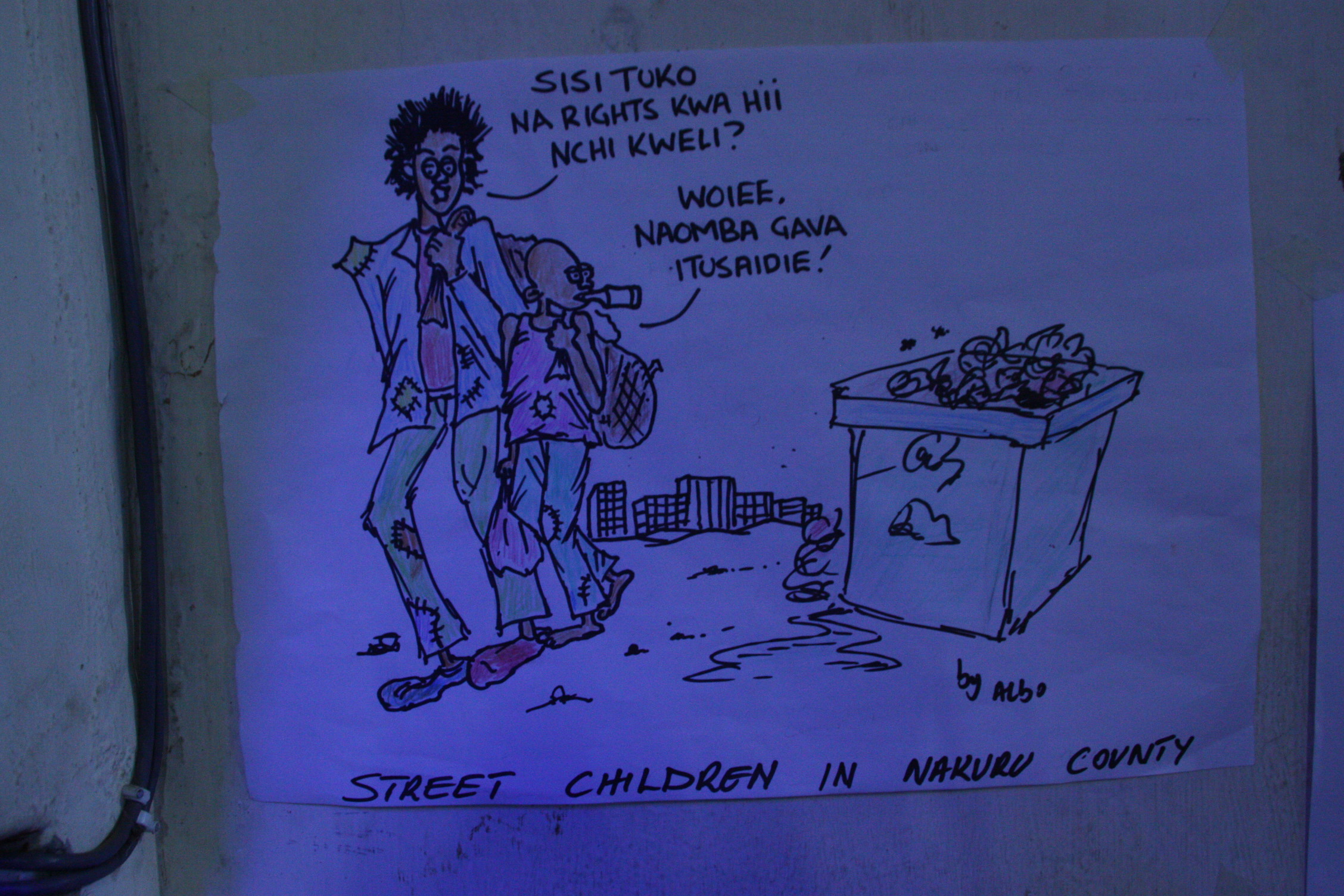
The cartoonists have also gone out of the box to stir the debate that street children have rights too and that they should ask the government to address their issues.
This cartoon calls for street children to ask for their rights. It will also be exhibited at the launch (Photo/Kioko).
All these issues are real in the county that was once fated as the cleanest in the east African region and most recently as the fastest growing in the Africa.
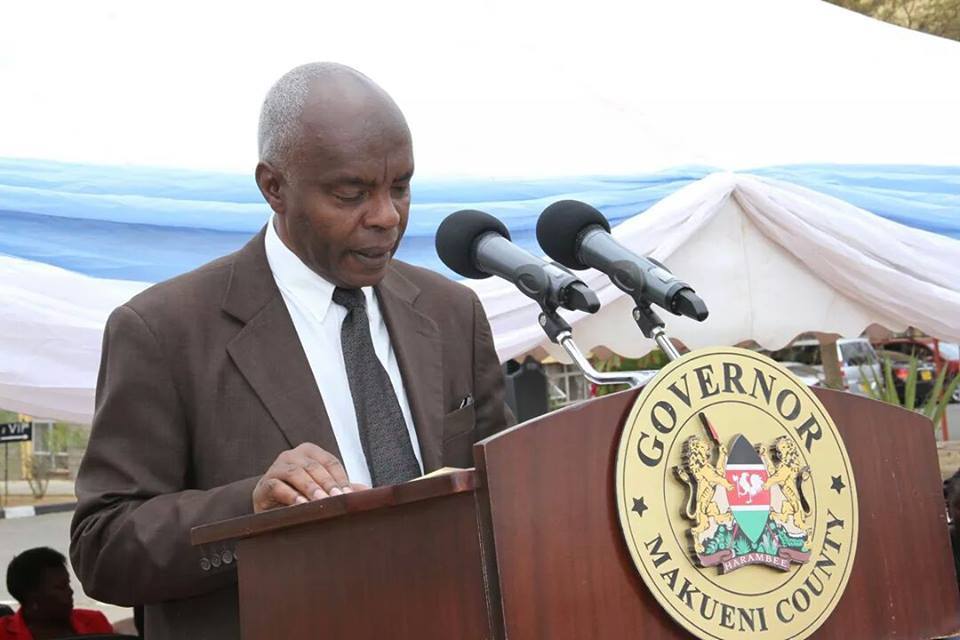
Makueni Governor Kivutha Kibwana residents on social media want his government to give water and roads first priority in the 2015/2016 budget Photo:Facebook
The 2014/2015 financial year is almost coming to an end with only two months left to the closure of business of the financial year. The budget making which is a very vital process has kicked off in earnest with most counties having conducted public hearings of the 2015/2016 financial year as outlined in the constitution.
Makueni County is no exception and despite the wrangling between the Governor, Kivutha Kibwana and Members of the County Assembly (MCAs) over budgetary allocations for the last two years in row, residents are looking ahead for a brighter new financial year devoid of infighting.
Makueni County is semi-arid, characterized by unpredictable weather patterns leading to perennial droughts and subsequent famines and acute water shortages. The county also faces a myriad of other challenges ranging from high levels of poverty at a staggering 68 percent to poor infrastructure among others.
Although the new dispensation of devolved units brought a flicker of hope to residents of Makueni bedeviled by lack of basic facilities like water and food, the residents are yet to reap the benefits of devolution thanks to the endless bickering between the two arms of the government.
Despite the county receiving allocations of Sh5.7B and Sh6.2B in the last two financial years, there is little if any to celebrate about as the resources have remained underutilized for long periods due to delays of approval of the county budget.
In the 2013/2014 financial year operations were interrupted for more than four months after the governor and the MCAs failed to agree on some budgetary allocations while the current budget was approved early February this year only a few months to the 2015/2016 financial year due to the same wrangling.
Now that a new financial year is beckoning, residents are optimistic that the money allocated for the county shall be put to use despite the county being on the verge of dissolution.
A commission appointed by President Uhuru Kenyatta to look into a petition filed by more than 50,000 residents to dissolve the county over the infighting begins its work on Thursday 23.
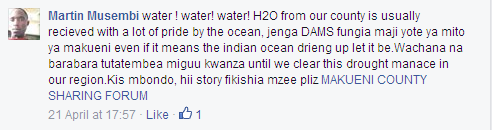
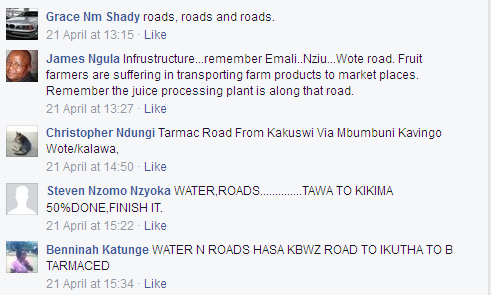
Even before the budget process is finalized residents have already taken to social media to highlight key priority areas that the county government needs to allocate more resources.
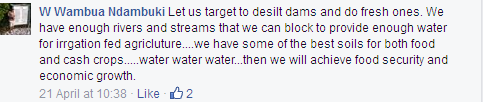
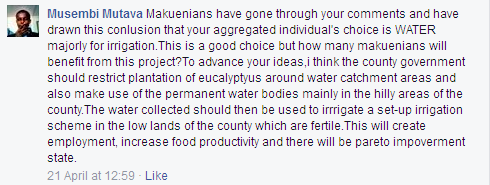
Water and infrastructure tops the list while education and agriculture also features prominently in the Facebook debate.
Some residents even suggested ways in which the water problem in the county can be addressed.
Roads came second with residents urging the county government to allocate money for tarmacking of the Emali-Nziu, Tawa-Kikima, Kibwezi -Kitui among other roads.
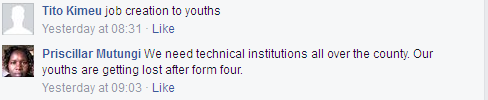
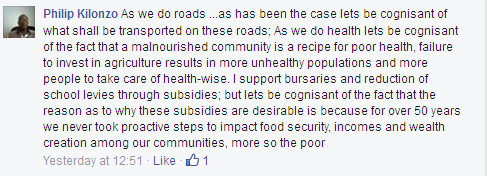
Several others suggested that education and youth empowerment should also be given considerable amount of money and asked the county government to establish technical colleges and institutions of higher learning besides awarding bursaries to deserving students to enable them acquire professional and vocational skills .
Agriculture was also mentioned as a key area that needed more resources.
Others called for an integrated approach to the allocation of the money.
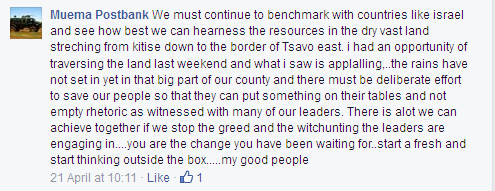
Some also underscored the need for harmony and peace in the county noting that no meaningful development can be achieved in a hostile environment. They argued that the county government should also work closely with the national government and other agencies besides bench-marking with other countries.
.
As the county government prepares to table its 2015/2016 budget before the 30th June deadline, Makueni residents can only hope that their views will be put into considerations and that the areas highlighted as key will be given the first priority.
Mbooni MP Kisoi Munyao’s petition to have the High Court stop the commission of inquiry on the dissolution of Makueni county government from commencing its proceedings on Thursday April 23 has been dismissed.
Justice Mumbi Ngugi declined to grant the petition to have the public hearings blocked, over what the MP termed as the inquiry’s breach of law, saying Hon. Kisoi was time barred.
The Judge argued that the Mbooni legislator had ample time from November last year when the petition was presented to President Uhuru Kenyatta to settle down the matter and that suspending the Mohammed Nyaoga- led commission on such a short notice would be an injustice to the residents of Makueni.
The MP had earlier Wednesday April 22 filed a case seeking to have the inquiry suspended arguing that many residents did not understand the dissolution petition.
Hon. Kisoi had also stated that, the reasons for the dissolution have never been made public and a majority of residents were not in a position to participate effectively or make informed choices in the public hearings scheduled by the commission.
“To date the commission has never published or publicized the actual petition that is the subject of their intended proceedings scheduled to commence on Thursday 23 ,how does the commission expect the residents to effectively submit statements of a petition whose contents they have never seen?”he posed.
In the case filed as urgent, the legislator further argued that the county government did not organize any civic education forums to educate the residents on the need for the petition and subsequent implications before agreeing to file it.
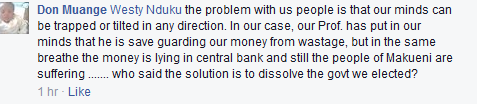
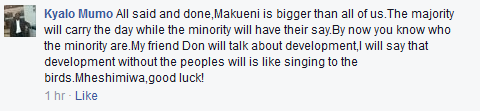
The move by the legislator created a buzz on the social media among residents of Makueni county who took to Facebook to express their views on the same.
Those who lauded the MP for the move said that dissolution will not solve the problems affecting the common man.
However, those opposed to Kisoi said a bigger force was behind his move to go to court seeking to stop the inquiry.
Others took a neutral stand and called for development and public participation from the people of Makueni
Kisoi has been one of the fiercest critics of Makueni Governor Kivutha Kibwana since he took office and has been on record calling on the Governor and the Makueni County Assembly Members (MCAs) to broker a truce and serve the electorate.
The youthful MP has never supported dissolution and his move to stop the inquiry on suspension of the county therefore did not come as surprise to many of the residents who know him as a political nemesis of the Governor.
The decision by Justice Mumbi to dismiss the petition has dealt a major blow to the opponents of dissolution especially the MCAs whose jobs will be put on the line if the county is suspended.
Ababu Namwamba said it. We have suspected it. Remember how parliament dealt with the Salaries and remuneration Commission (SRC)? Recent collapse of the Public Accounts Committee (PAC) under claims of bribery point to an active corruption network in our legislature. The PAC has now been reconstituted with different members of parliament replacing the disgraced committee members.
Are we going to see a different PAC that works for the interests of wananchi only? Is there hope in the August House when it comes to fighting corruption. If there were any doubts, then these have been multiplied many times over when parliament swiftly dealt the Ethics and Anti-Corruption Commission (EACC) a body blow by removing the Chairman Mumo Matemu and Vice Chairman Irene Keino. The vote was resounding 130 MPs against 52 and there were few voices speaking for the EACC leaders in parliament.
Their removal, follows the publishing of the “list of fame” which may deal permanent blow to some careers. Question is, is the removal of the top officials purely coincidental or is there a plot by parliament to stop the commission?
Our history has never favored anti corruption commission chairmen. John Githongo tried to fight it, he recorded the damning evidence for all of us to hear, yet in the end he had to flee for his life. Patrick Lumumba took on an M.P Cecily Mbarire who allegedly tried to bribe him to scuttle corruption investigations into the Ministry of Water. Swiftly, KACC was disbanded and Lumumba sent home, parliament killed the commission’s momentum and put yet another dent into the anti corruption fight.
Hon. Jeremiah Kioni was quoted:
“We must deal with them because this is an opportunity that may not come our way again.”
Suspended lands cabinet secretary Charity Ngilu who was an MP then could not hide her joy at Lumumba’s dismissal.
“I am very happy that we all seem to be united that we are not going to allow the same body to investigate and prosecute because they can abuse those powers.”
Come 2015 and the same “divided” parliament unites to send home the Anti Corruption leadership. Is he getting too close for parliaments comfort or did the masters call for his head? If he got too close to the navel of corruption, then it is possible that the corrupt networks could be behind his removal, just as they did with PLO Lumumba.
Another possibility is that Matemu is not the right man for the job considering that he has been accused of of meeting Anglo leasing suspects privately. It is also alleged that Matemu habitually bypasses official channels in requesting for files of ongoing investigations.
Will Kenya ever have a strong and independent anti-corruption commission which will fight graft without fear or favor?
“I find it ironical that there was a tribunal set up to investigate Matemu almost immediately after the National Assembly passed a motion to form the tribunal. It doesn’t matter if they find out that Matemu is corrupt or not, we never see that kind of hasty action against corrupt politicians,” said Steve a businessman.
However, the suspension of the two could be the beginnings of a strong anti-corruption commission.
President Uhuru Kenyatta has already appointed a tribunal consisting of Judge Jonathan Havelock as chair, Juster Nkoroi, Margaret Shava and Muathe Issa. The tribunal will present its findings in 30 days. If the findings recommend the sacking of Matemu and Keino, then we can confidently expect a bolder commission leadership that will carry out its mandate without interference from parliament.
Kenyan Mother Wins Goldman Prize for Anti-Lead Protest After Her Own Breast Milk Made Baby Sick – Democracy Now
East African Erin Brockovich’ wins prize for closing polluting lead smelter – The Guardian
The mother who defied threats to take on the factory spewing out toxin – Independent Uk
In November 2012, after months in court Phyllis Omido was acquitted in a case that had too many “loopholes.” The prosecution could not prove the charges brought against her that included organizing an illegal protest, threatening to breach peace and incitement to violence. Phyllis had been wrongly arrested, detained and prosecuted in another case of judicial harassment of an activist.
The policeman that was brought as a witness for the prosecution admitted that Phyllis and her co-accused were not armed with any weapons, did not cause any harm to anyone and were not violent. The judge dismissed the case.
The arrests and charges were attempts to silence Phyllis Omido, she did not relent in her fight for justice for the dwellers of Owino Uhuru who were suffering from the effects of lead poisoning as a result of pollution by Metal Refineries Export Processing Zone (EPZ) Ltd.
Her journey into activism began when she started working at Metal Refineries EPZ Ltd as a public relations officer. A few months in, her baby started falling ill frequently. In the end, her son’s health deteriorated so much that he had to be admitted in hospital. Doctors were unable to tell the cause of his illness until someone suggested that it maybe lead poisoning. When the tests came back, her son had close to 20 times the acceptable levels of lead in his blood.
She hadn’t realised that her work place which was basically a lead smelter was poisoning her with lead and she was passing it to her son through her breast milk.
She decided to tell the people what was happening, she got the children at the slum tested and they all had incredibly high levels of lead in their blood. From there on, Phyllis vowed to go head on against her former employer in a quest to have the factory closed. In the end, her campaign “Toa Sauti” resulted in the closure of the factory, whose pollution resulted in the death of at least 3 former employees.
She lived through threats on her life, attempted kidnapping and an attempt to fix her using the justice system in her quest. She paid a great personal cost to ensure that the voiceless slum dwellers who were getting poisoned yet the government and other authorities were looking the other way. Her unwavering dedication can perhaps be summed up when she says,
“It doesn’t matter how much money you earn in life – if you don’t leave a clean, healthy, sustainable environment for your children, you have done nothing.”
Phyllis set up an NGO, Center for Justice Governance and Environmental Action (CJGEA) which works to ensure environmental human rights of the economically marginalized communities. CJGEA works to ensure that voiceless communities do not suffer injustice at the hands of greedy individuals and corporations.
Her work has finally gotten her the global recognition with the Goldman Environmental Prize – Africa 2015. The Goldman prize honours grassroots environmental heroes from all the inhabited continents for sustained and significant efforts to enhance the natural environment often at great personal risk. The prize was established by Richard and Rhoda Goldman in 1989 and the first prize ceremony held in April 16, 1990. Her prize comes with $175, 000 to enable her pursue her vision.
Her job is just beginning, the soil, plants and water around Owino Uhuru slums are poisoned by the lead and continue to affect the health of the slum dwellers. The vegetables they consume are loaded with lead. It will need sustained cleanup effort and follow up.
She’s not yet done with Metal Refineries and those that allowed the injustice to happen. She wants them held to account for the miscarriages, infant death, sickness and other related effects that the community at Owino Uhuru suffered.
“Don’t be afraid. Do what is right. This thing happened because too many people were quiet. We really have to stand up and do what is right, especially for the environment. It concerns all of us,” – Phyllis Omido.
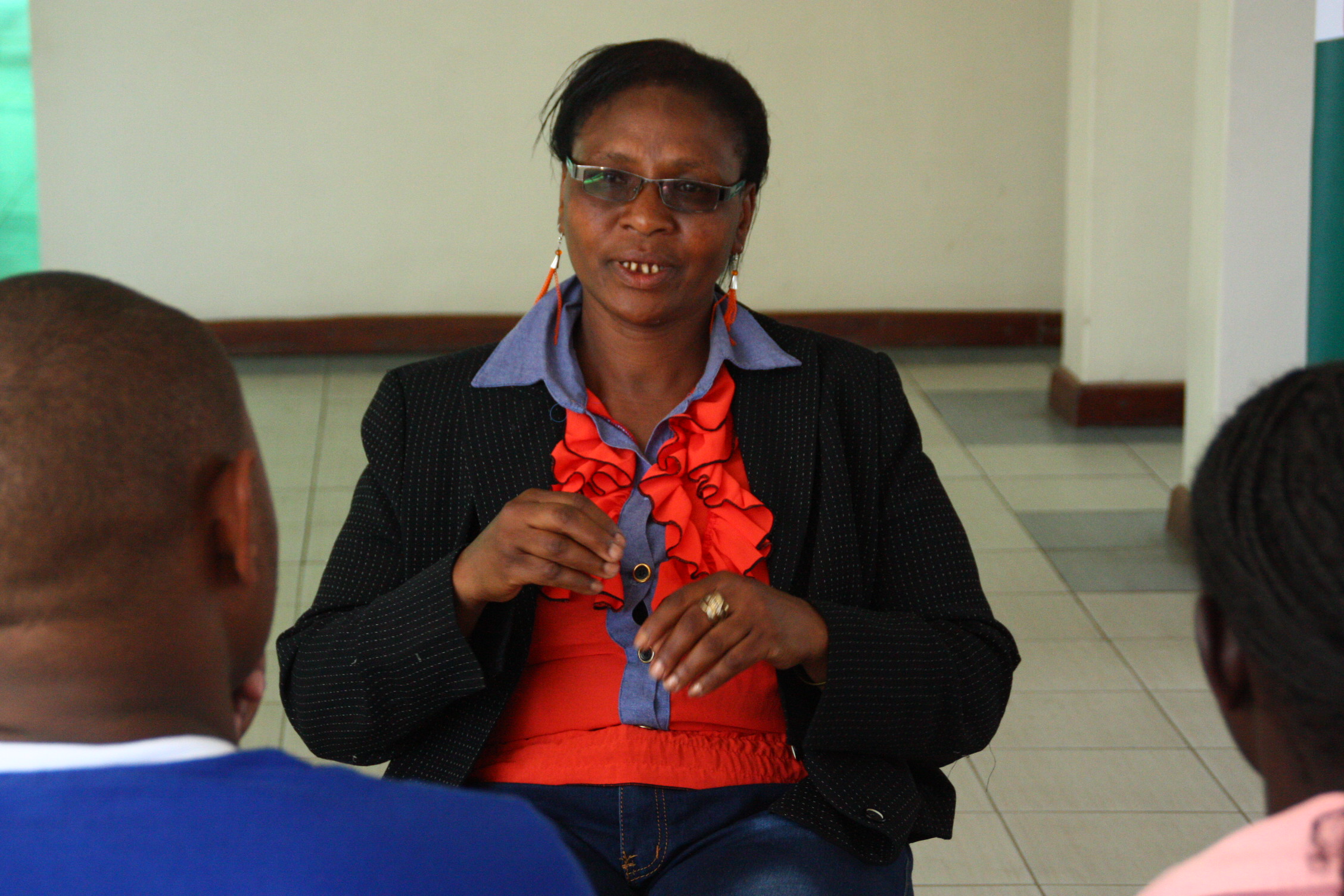
Njoroge and Akinyi follow their sign language interpreter during the training at the KNLS. They want more of such trainings to the deaf.
It was a first for the Bloggers Association of Kenya (BAKE) as two persons with hearing disability turned up for a training that had been organised for blogging enthusiasts in Nakuru.
Through a sign language interpreter the two, Martin Njoroge and Priscila Akinyi remained attentive throughout the training that was conducted at the Nakuru Branch of the Kenya National Library Services (KNLS).
They asked questions prodding on how the deaf can be involved more on such forums and even challenged for the creation of technology based programmes that are friendly to the deaf.
A participant with a BAKE flier during the training. More than 100 participants took part.
“What I liked most about the training was the whole concept of using blogs to track the implementation of the constitution,” said Njoroge.
Njoroge who has been participating on the developments of the Nakuru County Government and who even takes part in citizen participation forums said he would like more deaf people taught about the constitution.
“This will reduce instances in which they break the law out of ignorance,” he said.
Their interpreter Keziah Kimani said it was important for people with disability to be included in such forums.
“Kenya is encouraging inclucivity. We want more people with disability considered in every aspect,” she said.
BAKE’s Director of Training and Outreach, Njeri Wangari expressed the association excitement of the participation of the two saying they never expected it.
“It was fascinating and encouraging. It has given us something to think about and how we can target people with disabilities,” she said.
The training attracted more than 130 participants most of them youth in colleges and universities in Nakuru town and was held a day before the official launch of the Jukumu Letu Campaign in the County.
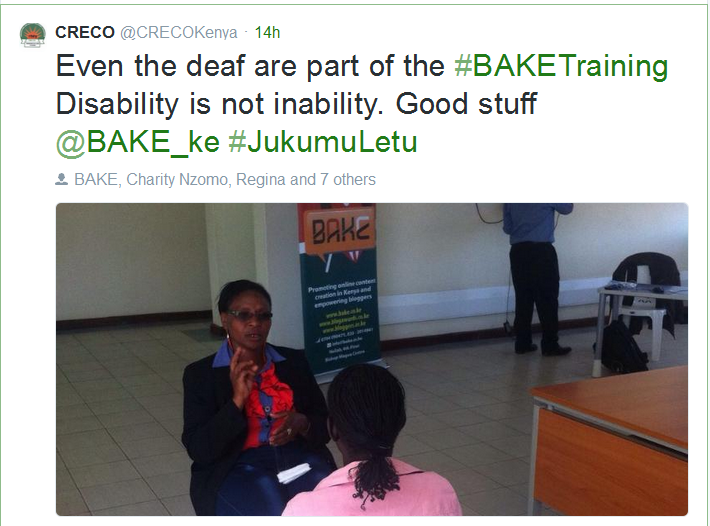
A tweet by CRECO. This was the first time that people with disability were showing up for a training on blogging in BAKE’s events.
Mercy Opande a blogger and student at Egerton University said the training would enable her to improve on her blogging.
Elijah Kinyanjui a veteran journalist who is also a blogger in the county was impressed saying after the forum it would be easy to bring unite the bloggers in the county.
“The initiative is welcome especially in this region where everyone is on the internet but there isn’t any unifying factor,” he said.
It is hoped that more deaf people will show interest in such initiatives. In addition, it is a challenge to Kenyans at large to embrace people with disabilities in all their activities as disability is not inability.
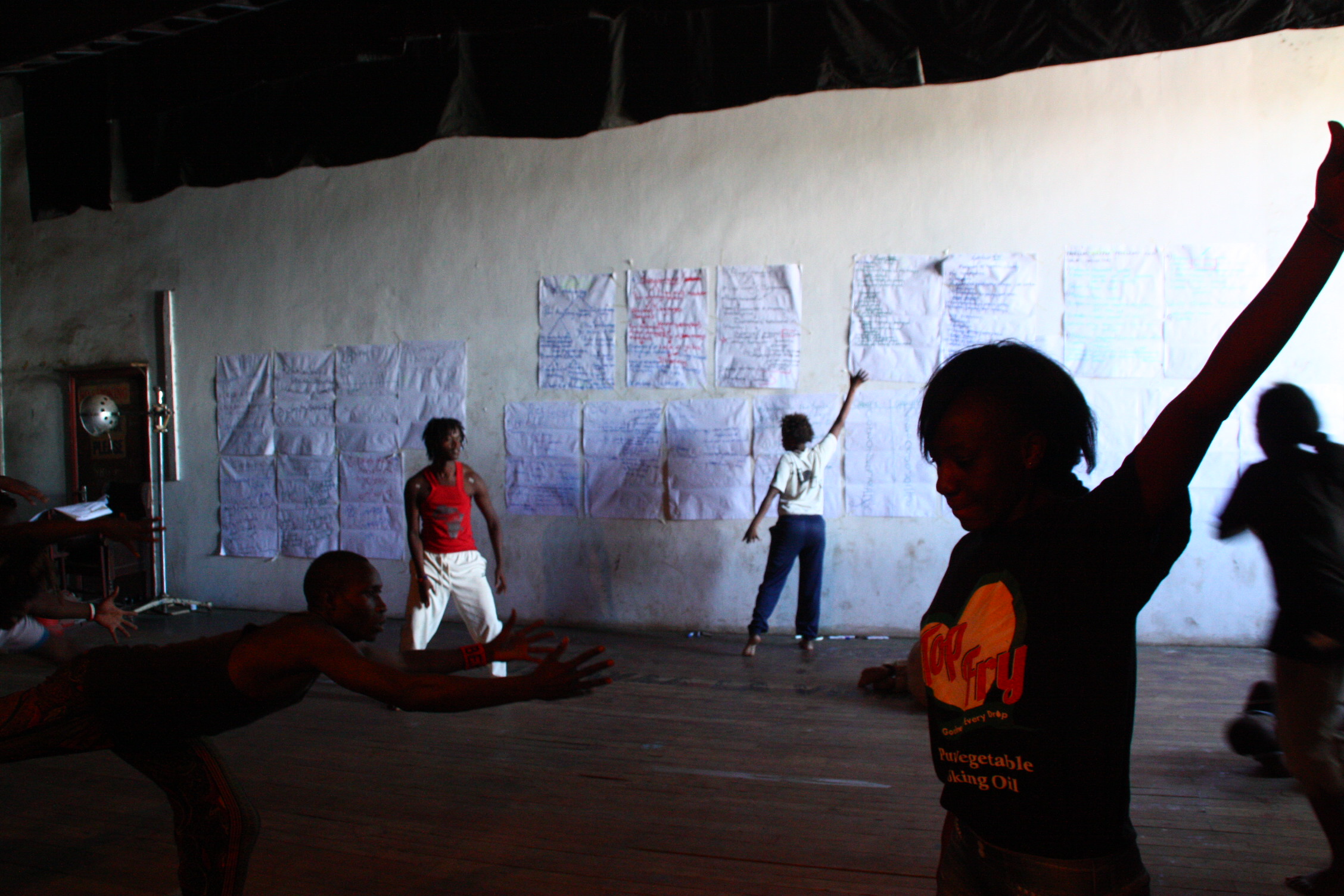
Actors at the Nakuru Players Theatre train ahead of the launch. The actors will present the pressing issues in the county through art.
The Jukumu Letu campaign will be launched in Nakuru on Saturday April 25th, 2015. Charity Nzomo the Communications Officer for Constitution and Reform Consortium (CRECO) has told the Kenya Monitor that all is in place for the launch of the initiative which seeks to sensitize locals towards citizen participation.
“The emphasis during the launch will be on the power of the people to voice out the issues,”
Nzomo told Kenya Monitor at the Nakuru Players theatre where different artists have been rehearsing ahead of the launch.
“When you have the power it becomes easier for you to exercise your responsibility,” she added.
Charity Nzomo the CRECO’s Communication Offer says all is set for the event.
The event which will take place at the Nyayo Gardens, an open space which is at center of Nakuru Town will see the artists act out the pressing issues for the county.
Charity said at least 5 groups comprising deejays, dancers, puppeteers and musicians will be participating. They include Dance into Space, Kenya Institute of Puppet Theatre, Sarabi Band, Deejays with a Course, and Cartoonists.
One of the cartoons that will be exhibited during the event which seeks to stir citizens participation on governance and the constitution.
Other groups and organisations that will take part in the launch are the Bloggers Association of Kenya (BAKE), Center for Enhancing Democracy and Good Governance (CEDGG), Dial-a-Radio, and Ghetto Radio. Already the activity which is one of its kind in the county has received a good reception from the local radio stations through programmes at Sauti ya Mwananchi Radio and Radio Amani.
“We are focusing on the themes of governance, constitution and constitutionalism, and accountability,” Nzomo added.
Mwangi Muraya of CEDGG, the local partner organisation is optimistic that the event will be successful.
“We have already created awareness and we are encouraged that citizens know it’s their responsibility to keep leaders on track,” he said.
After the Nakuru launch the Jukumu Letu campaign caravan will head to Mombasa County.
There has been low citizen participation in Nakuru County and it is hoped that the event will stir citizens to be much more concerned with the affairs of the county which is one of the most urban in the country.
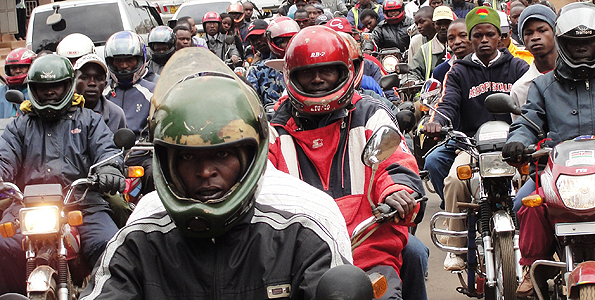
Boda Bodas bikes have helped many of Kenya’s unemployed to make ends meet but now some are using them to commit crimes (Photo/ictfire.com)
Nairobi has always had been prone to crime waves but the latest trend of robberies carried out by men on bikes popularly knows as boda bodas has everyone worried. The boda boda thieves appear to be particularly fond of robbing motorists and usually operate in groups of three with one staying on the bike as the other two – guns at the ready – rob their unsuspecting victims.
The brazenness of this new breed of two-wheel thugs can be seen from the fact that unlike thieves of old they are not afraid to pounce in broad daylight. The latest incident happened to a motorist outside Sameer Business Park, along mombasa road. Disturbingly, it’s the second such incident outside the building in as many weeks.
These #BodabodaThieves need 2 b stopped! They prowl near offices along Msa rd and rob motorists @ gun point. 2 episodes I’ve seen in 1 week! — Carol Radull (@CarolRadull) April 15, 2015
With the police seemingly slow to act, some Nairobians, no doubt with tongue in cheek, have some interesting suggestions on how to stop the thieves or at least give them pause before attacking another motorist.
Carry acid in ur cars and when they open the window rusha pap kwa uso. That person will definitely land in knh #BodaBodaThieves
That’s not to say the police haven’t taken any action against the thugs. Two boda boda thieves were reportedly killed by police officers while trying to rob a motorist along Lusaka road.
The boda boda thieves problem is not a headache unique to Nairobi. Across the border in Uganda the menace is prevalent enough to have inspired a movie. Titled – you guessed it! – Boda Boda Thieves the movie tells the story of a young man trying to find his bike in the backstreets of Kampala after it was stolen by a gang who are now using it to steal.
Last year, Governor Nairobi Evans Kidero announced a ban on boda boda business between 6pm and 6am, but this call has not been yielded much neither has enforcement been strict. It is one way of restricting their business to hours that they can easily be identified and if thieves, be arrested easily. However, the Governor may need to be firm and demand actions from his officers.
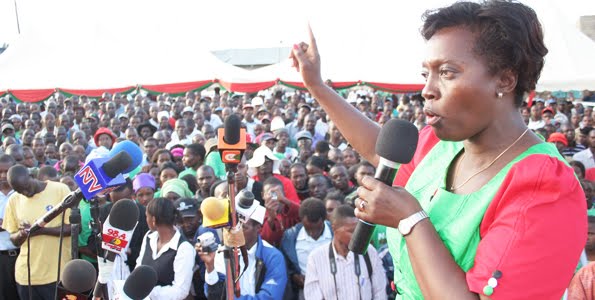
Martha Karua addresses a rally during her bid for the presidency in 2013. (Photo/ www.thelondoneveningpost.com)
Former presidential candidate Martha Karua has warned Kenya’s army and intelligence units not to interfere with the country’s politics and instead focus on making the country safe. Karua, who vied for the presidency on a NARC-Kenya ticket in the 2013 elections, made the comments during a forum held at the Hilton Hotel on Tuesday, headlined ““Rethinking Election Management in Kenya.”
The army should stay where it belongs and not meddle in politics nor accompany poticians to functions @MarthaKarua#RethinkingElectionsKE
Karua: Military & intelligence have become a feature in all political spaces. They should not meddle in politics. #RethinkingElectionsKE — Maskani Ya Taifa (@Maskani254) April 22, 2015
Karua’s warning to the army and intelligence wings comes in the wake of news that a Kenyan intelligence officer was arrested in The Hague last week for trying to “interfere” with an ICC witness. Deputy President William Ruto is currently on trial at the ICC for charges stemming from the post election violence witnessed in Kenya in late 2007 and early 2008.
The NIS being used to intimidate ICC witnesses at the Hague, rather than grapple with terrorism. Woi Kenya: http://t.co/Cw2X3Y2ZT9 — Ory Okolloh Mwangi (@kenyanpundit) April 21, 2015
Kenya’s Interior Ministry has denied the reports saying the intelligence officer never stepped foot outside the airport in The Hague. Spokesman Mwenda Njoka has demanded that the Daily Nation, the paper that first reported the story, issue a full unreserved apology.
Govt of Kenya says the arrest of the NIS officer in the #Netherlands isn’t linked to any case at the #ICC, he was going to #Germany — JFJustice (@JFJustice) April 22, 2015
The Kenyan Govt says the NIS arrest wasn’t linked to case at the ICC and has demanded for clarification and an apology from the @dailynation
Hon. Karua’s comments were informed by the increasing militarization of the security agencies. In the two years that the jubilee government has been in power, various core functions of government have been headed by people from the military. Karua remarked that this trend started at the Bomas of Kenya, the national tallying center for the 2013 General Elections, where she remarked that the intelligence and military officers at the facility was unprecedented.
Some of the key military men who have been appointed included Retired Major General Gordon Kihalangwa earlier appointed to head the department of Immigration, but has since been nominated as the next Interior Principal Secretary. Retired Major-Gen Joff Otieno was appointed Kenya’s Ambassador to Cairo. Retired Major Joseph Nkaissery was appointed Cabinet Secretary for Interior, among others. Such appointments are unprecedented in Kenya.
Tuesday’s forum was held to access the IEBC’s and Supreme Court of Kenya’s performance in 2013 and how Kenya can recalibrate both institutions for more transparent election in 2017. During yesterday’s session Karua also talked up the issue of election offences saying it should attract more consequences for it to be stopped.
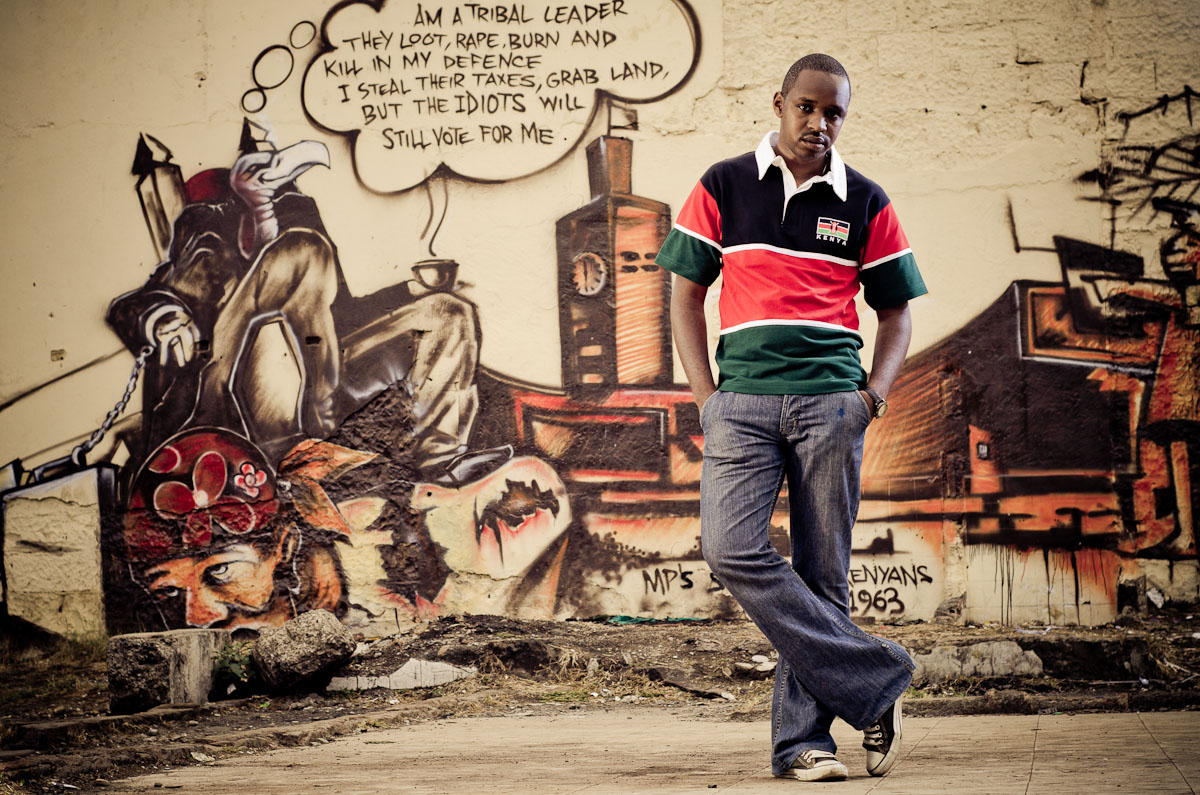
Boniface Mwangi poses in front of a graffiti mural. The activist has ignited a debate about who qualifies as a patriot in Kenya. (Photo/ https://mpasho.co.ke)
On Sunday activist Boniface Mwangi posted a photo of a crippled beggar crawling on all fours in front of Kenya’s parliament building.
Then twitter went kaboom! A group of outraged twitter users pounced taking issue with Mwangi’s post. Leading the charge was Njeri Atieno Thorne, a local communications consultant, who accused Mwangi of selling out his country by fixating on its negative aspects.
Thorne wasn’t just angry about Mwangi’s latest photo but also about a TED Talk he recently gave in the US. Thorne all but accused Mwangi of being a misguided agent of western countries who want to see Kenya fail.
Those on Mwangi’s side (full disclosure: yours truly counts himself among this number) quickly came to his defense. Chief among them was local columnist and cartoonist Patrick Gathara.
@NjeriThorne Sure. Let’s get outraged at the photographer who dares show us the truth! Ignore the turds in office. @bonifacemwangi
Central to this twitter one-upmanship between Thorne and Gathara is the question: who is a patriot? Thorne thinks Mwangi is an unpatriotic sellout because he criticizes the way Kenya is run not just locally but on global platforms like TED. Gathara argues those same traits make Mwangi a patriot whose example should be followed by other Kenyans. My two cents on this is Gathara is absolutely right. Kenya needs more people like Boniface Mwangi.
Thorne wants a Kenya where every citizen is a head-down striver working to improve their lot while turning a blind eye to how their hard-earned money is stolen by a rapacious and soulless elite. This see-no-evil, hear-no-evil approach only benefits those who are intent on Kenya remaining a dysfunctional kleptocracy. Mwangi offers a better alternative to achieving sustainable and equitable progress in Kenya. If that’s not patriotism then, to paraphrase William Shakespeare, such a thing never existed.
Internally displaced persons (IDPs) at a camp in Nyandarua. More than 600,000 person were displaced during the 2007 post election violence. The xenophobic attacks in South Africa can also be compared to Kenya’s PEV (Photo/Munyakei)
In the first part of this blog I wrote about Eric Ouma. In this second part I write about how Elizabeth was raped during the PEV. But more to that how she had her vaginal opening slit with a panga as her attackers said it was ‘small’ for them to penetrate.
Her story is also told in the CIPEV report and I retell it in this blog as I argue that so many Kenyans were ‘punished’ during the PEV for what they could not change. This is what is happening in South Africa. The ‘foreigners’ are being punished for having a certain identity which they can’t change. For long they lived with their South African hosts without much ado until recently.
Gender based violence related crimes formed a big chunk of the crimes that were committed during the post election violence (PEV) of 2007/2008.
In Nakuru there were men who were forcefully circumcised while in Kibera there were others who were sodomized. The intention was of course to make them feel as lesser men. But even so, so many women were raped in the various parts which were hard hit by the violence.
Philip, a Kibera resident who once told me about the sodomy cases in his area, also told me about how their women were infected with HIV-AIDS after being raped and how in turn the women infected them (the husbands).
Philip is a case study. His wife was raped and she infected him. She has since died and he is living positively.
So there are so many cases, and they have been recorded. But I just wish to reflect on the case of one Elizabeth W.
Her story was recorded by the commission that investigated the post election violence (CIPEV), commonly known as the Waki Commission. It is on pages 94-95.
Elizabeth was attacked at Eldama Ravine where she had a shop on new year celebrations of 2008.
“On 1 January 2008 we were still fearful,” she starts her account.
“We didn’t open our business. I worked at the Eldama Ravine shopping centre at Mama Faith’s Shop. It was just next to my house – they are joined together. But I stayed at home that day because I was scared.”
She was with her husband as their children had gone to Nyandarua to visit their grandparents when a group of 10 armed men attacked them at around 3 p.m.
“They were dressed in coats and they had smeared mud on their faces so you could not recognize them.”
She recounted that she heard them say they had come to finish them, minutes before they descended on her husband and killed him, on the spot.
When the attackers were sure they were done with her husband – but before he breathed his last – they turned on her.
“One of the men came towards me and asked me what I wanted to be done to me. I asked them not to kill me. One said we need to know what she is like, now that she never talks to us.”
She was raped by 4 men.
“I was wearing trousers with buttons at the waist. The men tore at my trousers trying to get them open and the buttons came off. They lifted me up and put me on the ground.”
“They were arguing among themselves who was going to be first. Then one said that if I escaped from the knife and arrows, I would die of AIDS. Some of them held my legs and some held my hands while they raped me.
She recounts,
“one man raped me and then the second one and the third. They put their penises in my vagina.”
But then
“it was either the second or the third man who said they were not able to get in me properly.”
And here they did to her what has never been heard of before.
“So they cut me. I think it was the panga they were carrying that they used. They cut my vagina.”
And then they went on, the bloody pile of her husband lying a stretch away.
“They continued raping me. It was when the fourth man was raping me that I went unconscious.”
Elizabeth told the commission that was her nature.
“When I had my children, the Doctor told me I had a narrow opening. Both my children were born by cesarean.”
I still can’t understand how a man can slit open the vaginal opening of a woman, let alone with a panga, and continue raping her as she is bleeding. Even if it was because of the mob psychology of the moment that was. Some things are just difficult to imagine.
And the pain they caused her in the ordeal is killing to imagine as well.
But perhaps one of the best lessons that this account teaches us is that, like Elizabeth, so many other Kenyans were ‘punished’ during the PEV for being who they are. That is for being nothing but what and how God had made them.
Elizabeth for instance did not ask God for what she was. Her husband had not asked God for the tribe he was that cost him his life. And the list is endless.
Yet such cases make you want to ask for justice, irrespective of wherever it may come from, for Elizabeth, for her husband, and for many more others…
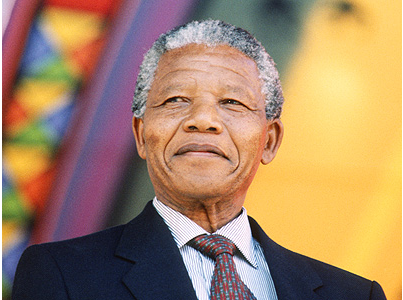
Nelson Mandela who was South Africa’s first black President. The ongoing xenophobic attacks in South Africa can be compared to the 2007/08 post election violence that happened in Kenya killing more than 1,000 people.
Kenyans will be quick to condemn South Africans for the xenophobic attacks that are happening at the country fondly referred to as the rainbow nation at the moment. But these attacks are not any different from what happened during the 2007/2008 post election violence. They speak of the death of the African love that our Pan-African fore fathers once had for the continent.
This is part one of the cruel deaths that took place during the Post Election Violence (PEV) which resonates with the South African xenophobic attacks. It is recorded in the report of the Commission for the Investigation of the Post Election Violence (CIPEV) otherwise known as the Waki Commission.
It’s the death of one Eric Ouma whose penis was chopped and placed in his mouth as he was drying. I blog on why his death touches me and why it’s important to remember the PEV crimes as we condemn xenophobic attacks in South Africa.
I do not know who Eric Ouma was or who his people are. I did not have any information about him or his whereabouts during his days on earth. But how he was killed during the post election violence (PEV) is an issue I may consider to write a thesis about in the coming days, God willing.
The first time I heard about Ouma was when I read about his death in Naivasha in the report that was compiled by the Waki Commission. Note that in formal terms the commission is known as the Commission of Inquiry into Post Election Violence (CIPEV).
So in the CIPEV report the account about Ouma’s death is recorded in pages 120-121. It was told to the commission by his sister Judith on 25th July, 2008.
Judith told the commission that Ouma was killed on January 28th, 2008. That morning some people had informed him that Judith and her husband had been killed. Apparently Judith had a shop and on hearing that they had been killed, her brother rushed to the shop to check on them. The three used to live at Karagita, in the outskirts of Naivasha.
Judith told the commission that her brother had been mistaken for her husband as he was peeping to see if indeed they had been killed. If only he had known in advance that they had already fled.
“My brother was clobbered to death before he was mutilated,” she said.
“The people who did that to him were using spiked clubs. They had fixed nails on the club and as they hit his face the nails would pluck flesh from his body,” so her account goes.
But he did not die on the spot. He died slowly. Out of the pain caused by ethnic animosity.
“I found blood was still pouring out of his body and he was kicking as he was dying,”
recounted Judith of her brother’s image when she arrived at his death scene.
She said the security officers who were there refused to assist her take the body to the mortuary.
“The police told me to get away from them, that I should not disturb them, that if I insisted I would end up like my brother and that it was not their work. I didn’t have anything to do.”
She was only able to get assistance 48 hours later. By then Ouma’s body was decomposing and dogs were feasting on him.
“He was smelling badly. His body had insects that had started to eat him due to rotting.”
Something else that tells you that Ouma died a painful death is the account by Judith that he had his manhood mutilated.
“I found that his penis had been cut and placed in his mouth; his testis were chopped off and placed in his hand.”
Personally, this part always touches me. So Ouma’s killers made a cigar out of his penis and made him smoke it?
As Judith concluded her account she told of how Ouma’s death kept on haunting his first born son, Ochieng aged 5, and who was present when his father was being murdered.
“He has since gone mad. He keeps on saying, “baba wanakata kichwa yako, wana kata kitu chako…Dad they are chopping off your head, they are chopping off your thing (penis).”
Ouma may be dead, but the effects of the PEV will be with us for quite some time as we heal the wounds of the likes of Ochieng, his son, who witnessed the violence.
His death also is the irony of the relative haven of peace that Kenya was known to be prior to the 2007 PEV. This is because Ouma was residing in an estate called “makao ya amani.” Translated that will be “the peace estate” or still “the haven.”
We may need to paraphrase the question of how he was snatched from that ‘haven’ to the question of whether indeed we have managed to reconstruct it (the haven) to a place where he would feel safe should he come back to life, today.
Makueni Senator Mutula Kilonzo Jnr.The senator has asked Speaker Stephen Ngelu and MCAs in the list of shame to step aside Photo:Facebook
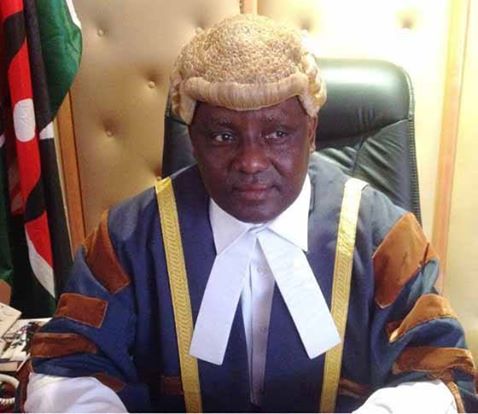
Pressure has continued to pile on Makueni County Speaker Stephen Ngelu and six Members of the County Assembly (MCAs) whose names appeared in the infamous list of shame to step aside and pave way for investigations.
Makueni Senator Mutula Kilonzo Junior said Speaker Ngelu, the six MCAs and others in the graft list should heed President Uhuru Kenyatta’s directive and relinquish their positions.
Nguumo MCA and Minority Leader John Mwenze, Deputy Speaker Bernard Musau of Makindu ward and counterparts Cosmus Mutunga of Emali/Mulala, Bensely Mathuku of Kikumbulyu South, Timothy Maneno of Nguu/Masumba ward and Bernard Kiswii of Kikumbulu North ward appeared in the Ethics Commission and Anti-Corruption (EACC) list for claiming per diem after a fully sponsored trip to Dubai by Kibwezi west MP Dr. Patrick Musimba.
Makueni Speaker Stephen Ngelu Photo:County Assembly Communications Unit
Speaker Ngelu and Assembly Clerk Edward Libendi are accused of colluding with the MCAs to pay them full per diem of close to Sh390, 000 each.
Others are Acting County secretary Rael Muthoka and Procurement Officer Alex Mutuku accused of flouting procurement procures of a diary project at Kikima.
Speaking recently during a tour in Mavindini, the senator wondered why the MCAs claimed a per diem after the fully paid trip by MP Musimba.
“You cannot go on an all expense trip to Dubai and claim a refund from the public coffers,” he said.
“For their names to be cleared, they should first step aside to create room for investigations, but if found guilty they should be arrested,” added the senator.
Makueni Parish Father- in- Charge Fr. Paul Munguti has also asked those adversely mentioned in corruption to step down.
Fr. Paul said residents do not have confidence with leaders whose names made it to the infamous list of shame.
“We cannot trust anyone who has been involved in corrupt deals to protect our resources let them go home, the law is very clear,”said Fr,Munguti during a requiem mass on Sunday.
Four officers in the list including Ag. County Secretary Ms.Muthoka, Procurement Officer Mutuku, MCA Mwenze of Nguumo and MCA Maneno of Nguu/Masumba ward have already stepped aside.
However, Speaker Ngelu and the others are yet to resign. Ngelu has said that he will not step aside terming the allegations as false.
While his deputy, Musau has said there is no need to resign as investigations in their case are complete.
“Why would I step aside and the EACC has already finished investigations?” he posed.
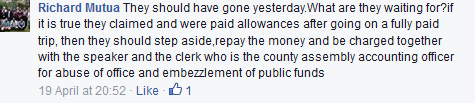
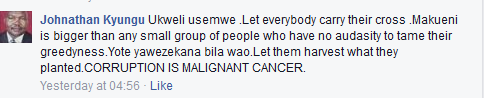
Makueni residents on social media have supported the renewed calls by the two leaders and now want those who have not stepped aside to do so.
Whether the leaders will bow to the mounting pressure and step aside, only time will tell.