
Saturday, December 20, 2025
Home Blog Page 24

Vimal Shah sues blogger Cyprian Nyakundi, Aly Khan Satchu for defamation

Vimal Shah, CEO of Bidco Africa. Photo courtesy of mobile.nation.co.ke

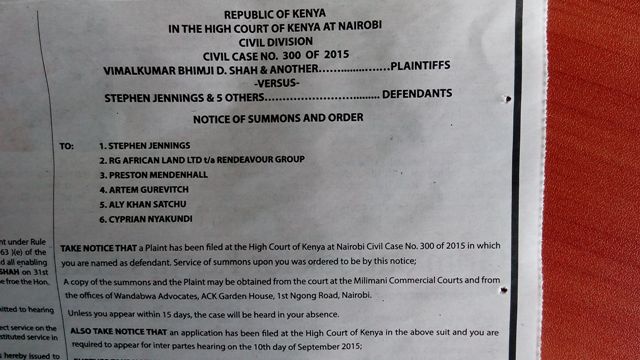
Manufacturing company BIDCO and its Chief Executive Officer Vimalkumar Bhimji Shah have sued blogger Cyprian Nyakundi, Aly Khan Satchu, Stephen Jennings, Artem Gurevich, Preston Mendenhal and Rendea Vour Group for defamation. In a paid up advertisement in the newspapers, the respondents/defendants have been instructed to go before Justice Joseph Sergon to answer the charge of defamation.

Nyakundi posted on his blog and tweets about how the plaintiffs have oppressed Ugandans and alleged other human rights violations against Kenyans in its factory. In a series of 20 posts on his blog www.cnyakundi.com he made disparaging remarks that could hurt the plaintiffs name and negatively affect its profits. In addition, a series of posts on Twitter under the hashtags #BIDCOAreLandGrabbers, #StopFundingBIDCO, #LettertoVimal and BIDCOExposed Nyakundi leads Kenyans in casting aspersions on BIDCO’s dealings.

 

bidco 1


bidco 2

bidco 3


bidco 4


Stephen Jennings is a New Zealand businessman who also has interests in Kenya and Russia among others. In Kenya, he is part of the businessmen embroiled in a tussle over Tatu City. He is the founder and CEO of Rendea Vous Group, a Venture Capital & Private Equity firm. This is the connection between Vimal Shah and Jennings as they are both involved in the project. It is believed that in his monthly shows #MindSpeak which is owned and hosted by Aly Khan Satchu, Jennings made disparaging remarks on Vimal Shah and this could have led to the joint suit alongside Nyakundi, Satchu et al for defamation.

Artem Gurevich, the Chief of Staff of  Rendez Vous Group which owns, according to the organization’s website, more than 30,000 acres (12,000 ha) of land in the urban growth trajectories of major cities in Kenya, Ghana, Nigeria, Zambia, and the Democratic Republic of Congo. The company is also connected in the ownership imbroglio of Tatu City and is therefore the connection to Vimal Shah.

Preston Mendenhal is a Reandeavour’s head of corporate affairs.

Bidco Africa, previously Bidco Oil Refineries Limited, is a multinational consumer goods company headquartered in Thika, Kenya with subsidiaries and distributorships across 16 countries in Sub-Saharan Africa. Its products include Edible Oils, fats, margarine, laundry bars and detergents, personal care products, and animal feeds. Bidco Africa owns over 40 brands and is the largest producer, marketer, and retailer of consumer goods in the region.

A few weeks ago, Nyakundi was involved in an extortion claim with another blogger Christian Dela. In a leaked audio recording with head of BIDCO communications team, Nyakundi asks for sh50M to delete all tweets and posts and also clarify that BIDCO are not frauds as he had alleged. It is further alleged that for the posts he made, Nyakundi was paid sh8000 to defame BIDCO.

A week or so later after the recording was shared online, Criminal Investigations Department (CID) officers went to Nyakundi’s home to pick him for questioning. He was not there and they found his siblings. However on hearing that CID are looking for him, Nyakundi took to Twitter to question the officers integrity stating that they are intimidating him not to expose corruption and human rights abuses. He then went on a self-imposed exile then came out a few days later.

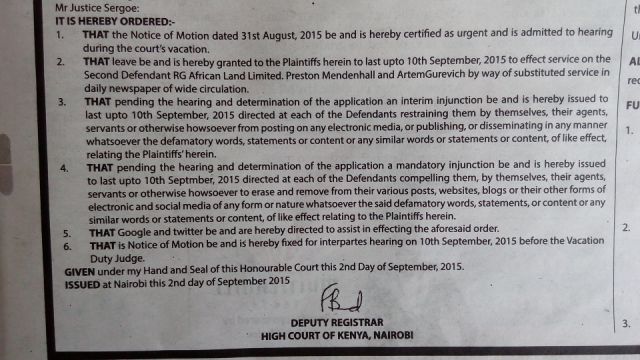
In the civil suit before the Milimani Court division, civil case no. 300 of 2015, all the respondents are required to delete the defamatory remarks on their platforms.

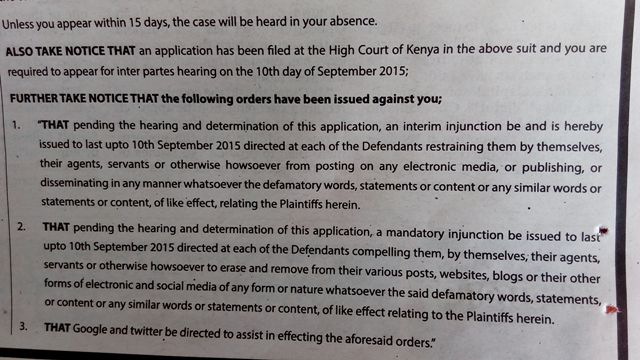
That pending the hearing and determination of the application a mandatory injunction be and is hereby issues to last up to 10th September 2015, directed at each defendants compelling them, by themselves, their agents, servants or otherwise howsoever to erase and remove from their various posts, websites, blogs or their other forms of electronic and social media of any form or nature whatsoever the said defamatory words, statements or content or any similar words or statements or content of like effect relating to the plaintiffs herein, read part of the orders.

The defendants/ respondents will appear before the Judge on September 10th 2015. The notice to appear further states that

Unless you appear within 15 days, the case will be heard in your absence.

Also, take notice that an application has been filed at the High Court of Kenya in the above suit and you are required to appear for inter partes hearing on the 10th day of September 2015

It will be remembered that Nyakundi was also sued by Safaricom for defamation. While the case has yet to begin because on the said day the judge was absent and he has yet to set another hearing date, Nyakundi took to social media to fund-raise for legal fees for the suit using the same platform of the plaintiff’s, MPesa.

It is hoped that Nyakundi will this time obey the court order and remove the content on his platforms as he did not comply with the previous court order as directed to remove Safaricom posts on his Twitter timeline and blog.

This case will further define defamation in the online space and provide useful lessons on sharing content that is likely defamatory, or libelous to bring a company or individual to disrepute.
Fate of Makueni County dissolution to be known today

The fate of the dissolution of Makueni County will be known today when the commission looking into the petition to suspend the County Government will hand over its report to President Uhuru Kenyatta.

The Mohammed Nyaoga- led commission is expected to present its findings and recommendations on the wrangling between Governor Kivutha Kibwana and Members of the County Assembly that prompted more than 50,000 residents to petition the president to suspend the county.

In their petition, the residents had argued that the protracted infighting between the two arms of government had paralyzed operations in the county and that dissolution was the only solution to end the impasse.

Under article 192 of the Constitution, the President may suspend a county in an emergency arising out of internal conflict or war or any other exceptional circumstances.

While presenting their views to the commission, 94 percent of residents rooted for dissolution and if the commission grants the residents’ prayers Makueni will go in history as the first county to be dissolved under the new dispensation of the devolved system of governance.

After receiving the report and upon being satisfied that there exists justifiable reasons to suspend the county President Uhuru will within seven days forward the findings to the Senate. The Senate will also within seven days adopt or reject the report.

However if the Senate adopts the report, the President will suspend the County Government for a period of ninety days though the Senate can at any time terminate the suspension.

During the period of suspension, the Governor, his deputy, members of the executive committee and MCAs will be on half benefits and an interim County Management Board will be appointed to carry out the County Government functions until such a time when the suspension is lifted or elections are held.

The tabling of the report has created anxiety and tension especially county leaders whose fate now hangs in the balance. Reports on social media that the commission has recommended for the suspension of the county has continued to elicit mixed reactions.

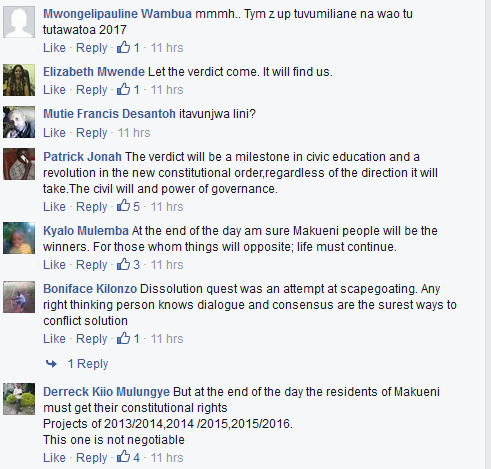
Already Governor Kivutha has taken to social media to state that his government will accept the verdict of the commission.

In his official Facebook  page the governor said,

“When our lawyer made his final submissions to the Nyaoga commission he stated that the county government submits itself to the mercy of the people of Makueni and the Senate. The People of Kenya are sovereign according to Article One of the Constitution. Let us all accept the verdict of the commission.Whatever the verdict our people have proved to themselves worthy defenders of devolution.They have made history.”

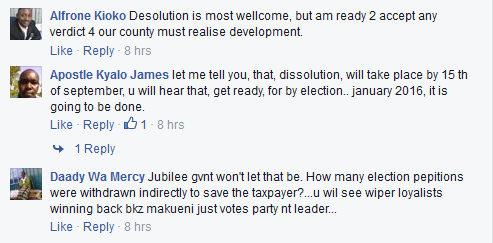
Residents of Makueni on Facebook also expressed their varied opinions.

k1

k2


Committing to long term climate change goals is crucial for Kenya

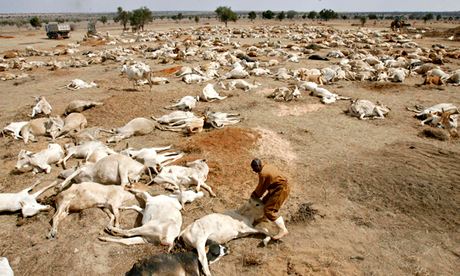
Drought striken herds in northern Kenya. Photo courtesy of www.theguardian.com

By Caroline Kibii

With just three months to the Paris Climate Change Summit, nations and the civil society are intensifying their efforts to create awareness on the significance of the climate goals.

The ongoing climate conference in Bonn, Germany focuses on several aspects including the long-term goals that are a vital part of the expected Paris Agreement.

Stabilizing greenhouse gas concentrations under Article 2 of the United Nations Framework Convention on Climate Change (UNFCC) and limiting global warming to 2 degrees Celsius outlined in the Copenhagen Accord are long-term principles that leaders have committed to before. UNFCC reiterates that greenhouse gas concentrations must be stabilized in the atmosphere with the developed countries taking the lead.

Decarbonisation is a long-term goal that several countries have expressed their support with 60 countries committing by June 2014 and about 131 countries committing by August 2015 according to Track0. Decarbonisation calls for carbon neutrality. This means a global decarbonized economy that is flexible to the climate result below 2 degree Celsius.

Kenya is not part of the supporters for the inclusion of a long-term goal in the Paris Agreement. Again, Kenya is listed to have not stated its qualitative and quantitative long-term goals in its Intended Nationally Determined Contribution submitted on 23 July 2015 as per Track0 analysis.

Unless Kenya clearly outlines its long-term plan in line with the expectations of the international community, then it will not be considered as a supporter of the goal.

For instance, the Democratic Republic of Congo that submitted its Intended Nationally Determined Contribution on 18 August 2015 stated its long-term goal. DRC has a development vision ranging from 2012 to 2060 with an intention of being a developed country with a green economy by 2060.

Our neighbor, Ethiopia also stated that in the long term, it aims to attain its aspiration of becoming carbon neutral with a midterm target of reaching a middle-income status.

Emission reduction as a long-term goal encompasses a zero target for greenhouse emissions.

Reducing emissions means that a deviation from the business as usual path will be inevitable. Kenya and other developing countries that have set their greenhouse gas emissions reduction target relative to business as usual will have to redefine their targets.

Carbon dioxide, which is a major greenhouse gas, is the reason behind the global temperature rise. Thus, averting global warming demands that carbon dioxide emission must come to zero in the end.

Man-induced carbon dioxide emissions in the atmosphere accelerate the climate change risks.

Attaining a zero carbon dioxide emission target means altering all human activities that contribute to its concentration in the atmosphere.

It means doing away with fossil fuels and adopting a green energy source. While this may be a challenge to the developing countries, trying to keep up with their emerging economy, fulfilling a global climate target is essential.

Unless we contain the fossil fuels deep underground, we shall not attain the ambitious zero target of greenhouse gases emission. Unless stop burning coal, we shall continue feeling the effects of global warming.

We shall continue to die of heat waves. Our sea level will keep rising until the day it swallows everyone and everything on earth. Unless we make it, a condition for all carbon emitters to be accountable for their emissions, it will be impossible to counter climate change risks.

Carbon budget, which is part of the United Nations’ long-term goal, should be a basis for setting ambitious targets. However, carbon Brief warns that carbon budget will cost a lot of money to arrive at a zero target.

Just like other African countries, Kenya should also voluntarily prepare, communicate and commit to its long term low emissions curve. Putting it on paper is not enough. Proper implementation of the policies and guidelines will significantly contribute to reduced effects of climate change.

In order to ensure that present and future generations have equal rights and access to natural state of the earth, we must fight climate change in every way possible. We created the effects; we must find solutions.

With the anticipation of a legally binding document during the Paris conference, it will make no sense if parties to it fail to adhere. Each nation should be ready to play by the rules.

“It’s not enough to just have conferences. It’s not enough to just talk the talk. We’ve got to walk the walk,”

said President Barrack Obama while addressing the Global Leadership in Arctic: Cooperation, Innovation Engagement and Resilience conference.

Whether all nations will sign the agreement or not is not a problem, the big issue is whether all countries will commit to cutting down their emissions according to their set targets.

Caroline Kibii is an environmentalist.

Mombasa creatives learn about internet and law

0

DSC_5331-001

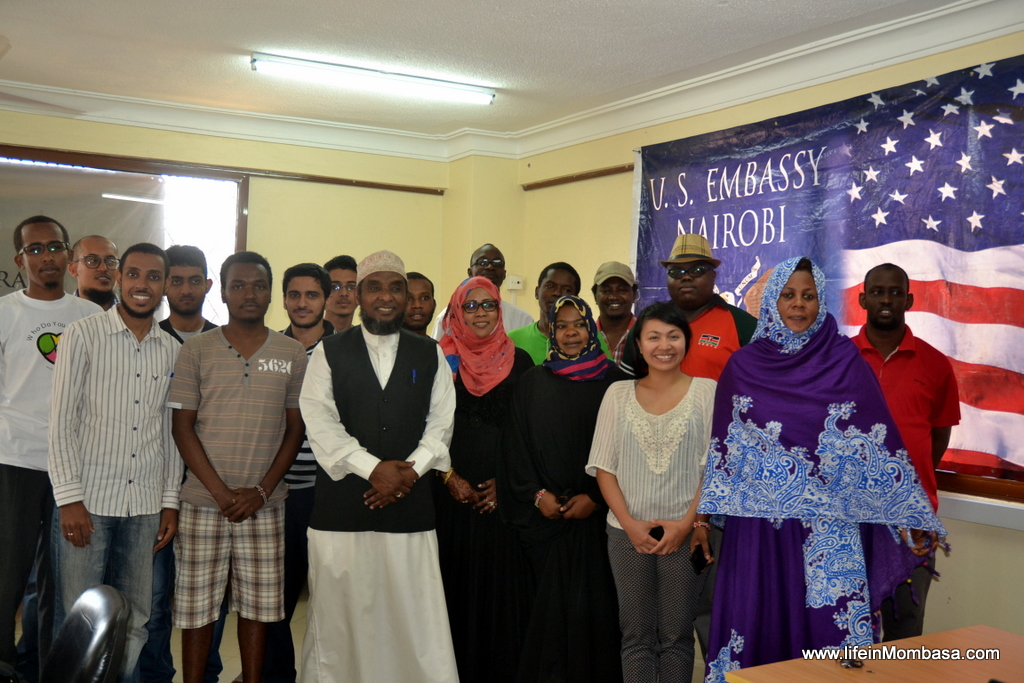
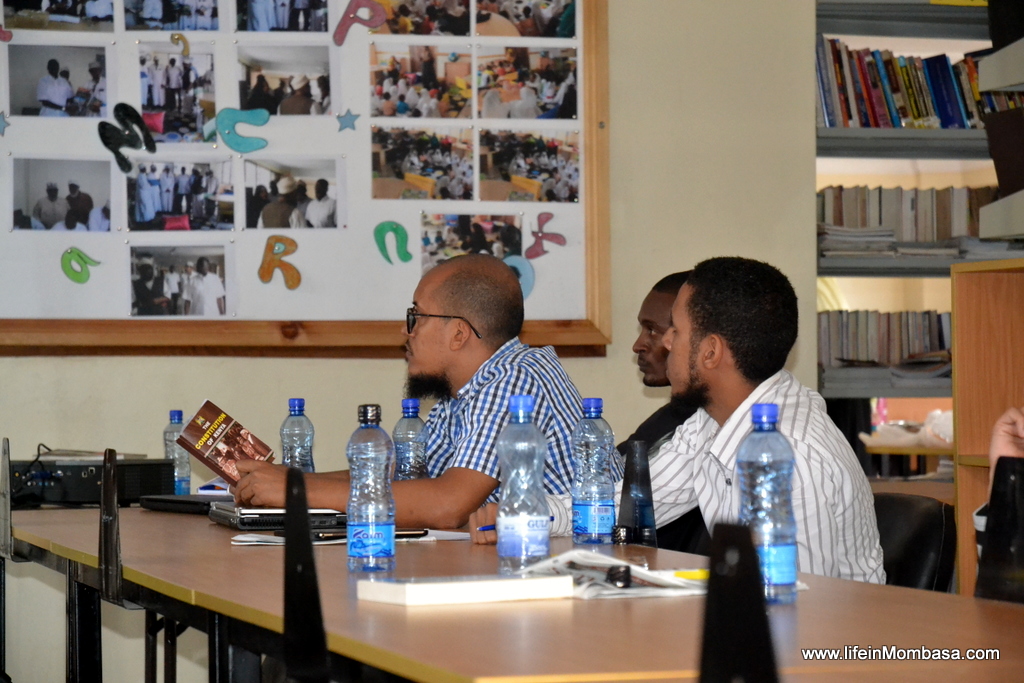
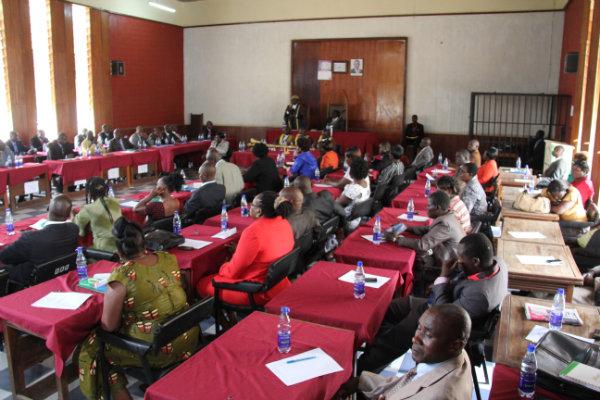
High Court Advocate and law lecturer Mugambi Laibuta was in Mombasa on Saturday the 29th of August for the Internet and law workshop in Mombasa at the MEWA Library. He was conducting the workshop alongside Riva Jalipa of Article 19. The workshop which was organised by the Bloggers Association of Kenya (BAKE) in Mombasa for the first time in Mombasa after previous workshops were held in Nakuru, Nyeri, Kisumu and Nairobi.

In attendance were bloggers, social media enthusiasts, professionals and students from the coastal city. The training covered issues around defamation, intellectual property, freedom of information and media, plagiarism and also emphasized on social media policies among others.

The need for legal understanding for internet users in Kenya follows the increased number of  bloggers and social media users that have been taken to court for defamation and misuse of telecommunication devices. There’s also a need for ethics in blogging following leaked audio where blogger Cyprian Nyakundi is alleged to have attempted to blackmail BIDCO for sh50 million in order to take down blog posts.

During the workshop, there was an agreement that some of the bloggers are going against the law by writing defamatory posts against individuals and organisations with most in agreement that legal action is necessary in some instances. However, there’s still apprehension among bloggers that laws could be used to suppress the freedom of expression and negate online content creation. Notably, it is the blogs with political content that draw most ‘fire’ thus many bloggers are opting for “safe” topics like fashion, travel or food.

The issues of copyright also drew interest from the bloggers many who are grappling with content theft on the internet.  Photographers and writers are finding that other people including mainstream media use bloggers content without proper credit or attribution. Participants were enlightened on trademarks and intellectual property laws that bloggers and online content creators need to be aware of.

Mr. Davis Mbele, felt that the workshop was beneficial for people using the internet.

“I believe it’s fair to assume all who were present were enlightened about the use of theDSC_5321-001(1) internet. The article 33 and 34 of the Constitution that talk about the freedom of speech and expression were the main highlight of the discussion. We learned that with the right to speak about anything on the internet, especially blogs, comes an even greater responsibility. That there is a legal framework to ensure we exercise the write to express ourselves in the appropriate manner as inscribed by the law”.

Blogs and social media have become ways that Kenyans are using to bring out some of the societal ills such as corruption in government and private sector. According to lawyer Mugambi Laibuta,

“There’s need for whistle blowers in Kenya. Blogs and social media are some of the ways  that people can use to get word out. However, they need to be legally aware, responsible and safe in the manner they do it.”

Salim Ghalgan, MEWA’s chairman welcomed the move to hold the training in Mombasa.  He said his organisation is grateful for BAKE arranging these kinds of events in Mombasa. MEWA is happy to host the event and will keep doing so to ensure that Mombasa residents get empowered through the valuable knowledge.

Indigenous poultry farmers in Makueni receive farming equipment from KAPAP

7


Indigenous Chicken Photo:Google
Indigenous Chicken
Photo:Google

By Daniel Kituku

Members of the Makueni Indigenous Poultry Farmers’ Cooperative Society have received a major boost after the Kenya Agricultural Productivity Program (KAPAP) a five- year project funded by World Bank, donated to the farmers poultry equipment worth Sh5M.

The equipment included six incubators for each sub county, six power generators, one food mixer, one posho mill, 172 veterinary kits, 135 feeders, 78 brooders, 72 weighing scales and 172 pieces of protective clothes were handed over to the beneficiaries during a colorful ceremony held in Wote attended by poultry farmers across the county and senior County Government officials among other partners.

Speaking during the commissioning of the equipment, Chief Officer Department of Agriculture Jane Nzesya said poultry was not only a key source of meat but also a farming enterprise that has helped enhance food security in the county.

Nzesya said the County Government will work together with poultry farmers to formulate policies that will improve poultry farming and solve some of the challenges like as diseases and lack of feeds.

The Chief Officer urged farmers to embrace indigenous poultry due to their resistant to diseases and high market demand.

“ Nowadays people are going back to traditional foods including indigenous chicken and farmers should exploit the opportunity,” she said.

She called on other NGOs to emulate KAPAP and equip farmers with necessary farm tools and equipment instead of capacity building which she said can be done by the county government extension officers.

Speaking at the same event, KAPAP Coordinator Esther Wambua urged the beneficiaries to use the equipment to boost production.

She urged other farmers who have not joined the cooperative to register as members so to benefit with equipment and skills for enhanced poultry production.

Belice Kimanthi one the beneficiaries from Kee Division extolled the initiative by KAPAP saying that the equipment will help in addressing some of challenges facing poultry farming especially feeding and incubation.

“We have been facing a major problem of feeds but now with the food mixer we will be able to make our own feeds,” she said.

Poultry farming has in the recent past become a lucrative business in the country owing to the increasing demand of meat and eggs especially from indigenous chicken in both rural and urban settings. Due to its profitable nature, most farmers have now ventured into the business to reap the benefits associated with the enterprise and these equipment will help the beneficiaries transform the enterprise from subsistence to commercial farming.

Audit report questions expenditures on some of Machakos Governor Maendeleo Chap Chap projects

Photo:Google
Photo:Google

An audit report on the financial operations of the Machakos County Executive in the 2013/2014 fiscal year has revealed grave financial irregularities ranging from blatant flouting of procurement procedures, unsupported expenditure, huge pending bills, un-surrendered imprests to a tampered cashbook under the period of review.

Notably, some of projects that have earned Governor Dr. Alfred Mutua the accolades of the top performing governor were questioned by Auditor General Edward Ouko casting doubts on the government’s financial prudence on the much-hyped Maendeleo chap chap mantra.

For instance the tarmacking of the 33Km Kithimani –Makutano Ma Mwala by 11 contractors at a total cost of Sh568.7M did not have a procurement plan but the County Government still invited bids from eligible construction companies for road works.

Consequently, no feasibility study for the road was carried out and the advertisement for the works was done once in the Daily Nation and in a monthly publication called The Anchor contrary to Section 54 (10) of the Public Procurement and Disposal Act, 2005.

The report further states that the road was hurriedly commissioned and opened to traffic on 26 June 2014 yet the work on the road was incomplete.

“By 14 October 2014, only four contractors had substantially completed their works to the satisfaction of the Resident Engineer, while the other seven contractors had not completed the works and were still under the contractual agreement,” reads the report.

On the procurement of 70 ambulances at a cost of Sh145.3M the audit report noted that the ambulances were second hand and that no needs assessment had been done before the ambulances were procured.

The log books for the ambulances were not produced for audit review and the vehicles were in civilian number plates and registered in the name of a private company.

“It is not clear how the ambulances, which were meant to belong to the County Government, could be registered in the name of Pharmatec Limited,” states the report.

Similarly, the purchase of 32 tractors to aid farming at a cost of Sh41.2M was done without a needs assessment was carried out. The report further states that no details were provided on the procurement process of the tractors and therefore their value and age could not be determined as supporting documents were not availed.

“No work tickets were availed for audit scrutiny to indicate how the tractors were being utilized making it difficult to monitor the use of the tractors,” says the report.

The County purchased 91 Nissan Tiida as police vehicles and the Kenya Police Service took possession of the Tiidas without a memorandum of understanding as earlier planned.

The vehicles also did not have work tickets and can be fueled by either the County Government or the Police thus creating a loophole for fraudulent activities where both parties can claim to have fueled the vehicles.

The report also questioned the procurement of 40 green houses and seeds by the Department of Agriculture at a total cost of Sh50.8M without a distribution list of the beneficiaries.

Other questionable expenditures revealed include road marking between Kamulu and Koma Hill section done for Sh8.5M through a request for quotations instead of open tender and the street lighting project from Kyumbi turnoff to Machakos town, which did not have a cost analysis to determine the total amount incurred on the project.

The report also raised eyebrows on the construction of the governor’s office, which had stalled despite Sh57M being spent on the project.

“A visit to the project site established that the project had stalled and Sh57M had been spent out of which Sh28M had been paid out. It was therefore not clear whether the project was properly planned and budgeted for,” outlines the report.

Similarly, imprest amounting to Sh46M which was due for surrender remained un-surrendered as at 15th August 2014 while the cash book had been tampered with to read certain figures, which the Auditor General said was fraudulent.

The report also revealed pending bills amounting to Sh712M with the Department of Transport and Water having the highest amount of sh385M and sh234M respectively.

The audit report on the Machakos County Executive arm has raised several expenditures queries and financial propriety on some of the projects that Governor Mutua has initiated and it would be interesting to see how things will play for the governor ranked the best in the country in various opinion polls.

TNA throws a rotten egg on its own face

TNA nominated Senator Joy Gwendo. Photo courtesy of www.the-star.co.ke

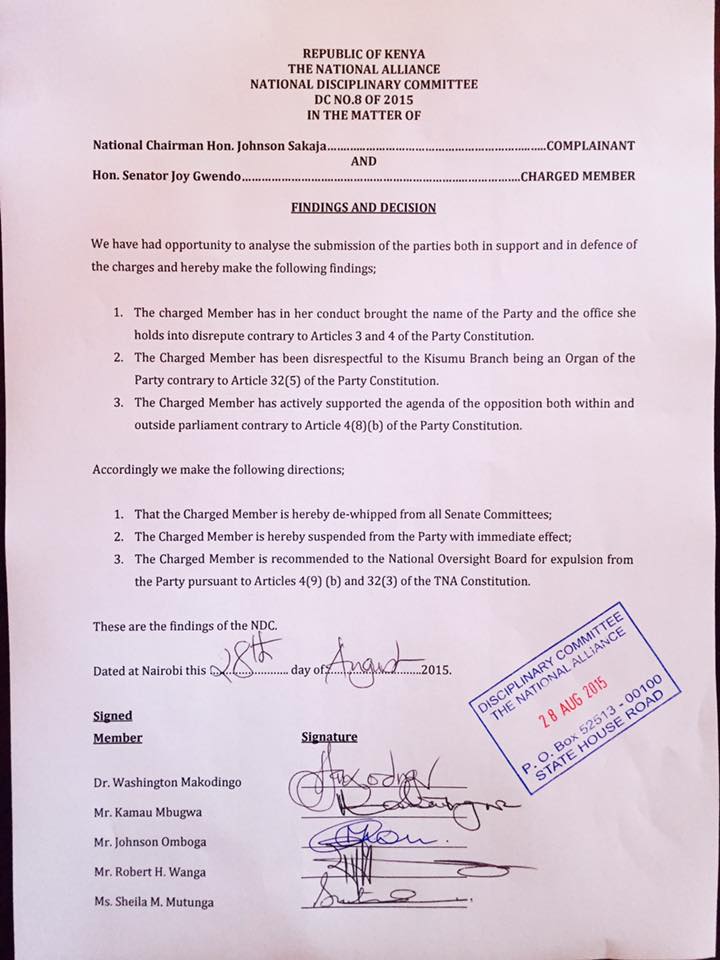
The National Alliance (TNA) Party of Kenya has thrown a rotten egg on its own face by the verdicts of the party’s disciplinary committee on legislators Senator Joy Adhiambo Gwendo and MPs Moses Kuria and Priscilla Nyokabi. The committee threw away the complaints against Nyokabi and Kuria but decided to suspend Gwendo, in a move that has led to public outcry of how political parties continue to malign women, at least that is the larger perception.

Kenyans feel and rightly so that the difference between the verdict of Moses Kuria who is alleged to have incited his constituents to violence and Joy Gwendo who is alleged to have disrespected the part is as stark as day and night.

Kuria’s allegations were dismissed on account that the shared video was edited hence could not be relied upon. Such a decision would only make sense if TNA made it public the video expert who was consulted to interrogate it and found the video edited. Further, a linguist who saw the edited video and stated that indeed there was some worthy and useful context that preceded the hate speech assertion must suffice. On the face of it, regardless of what he stated before, or the bit that was edited out, he has a hate speech case to answer.gwendo

For Joy Gwendo, it is alleged that she was disrespectful to the party, she was disrespectful to the Kisumu branch office and she was associating herself with the opposition (ODM) all these which brought the name of the party to disrepute. The complainant in her case is TNA Party chairman Hon. Johnson Sakaja. This decision has certainly and obviously taken a gender angle.


Johnson Sakaja took to Twitter to allay fears that the decision by the disciplinary committee is final.

Kenyans will be waiting with bated breadth to see how the reviews are done. While not much would be expected, the least would be not to rubber stamp the decision to suspend Senator Gwendo. Moses Kuria is likely to be let go. At a media forum early in the year when he had just taken over as the Gatundu South MP, he explained that he was put in charge, during the 2013 election, of voter registration, technically saying he won TNA and the Jubilee coalition power. Such a person is quite valued, regardless of his negative rants which cast aspersions on the party’s image. But as the review is being awaited, there are those who feel the decision on Senator Gwendo is prudent.


There are those who took a middle ground


What is sure is that the rotten egg on TNA’s face will remain smelly, even if it is washed away. How will in fact the review, in whom the complaint is the party chairperson, who will also preside over the review, rule against his own complain? Unless he declines to preside over it (he can still have a voice on the decision) or Kenyans are looking at a good play book; recommend suspension, then review process revokes it and the party is seen as democratic.

But what is most unfortunate is that the voter who should ideally make an informed decision from such, will not, will soon forget about it and move to support it at the time of calling.

For Senator Gwendo, if the review process rubber stamps the decision of the disciplinary committee, it is expected that she will head to the court to safeguard her seat. This will be a long process, which may end closer to the General Elections and the suspension be meaningless.

Sensitization on democracy and devolution takes shape in Kwale County

Participants during the workshop on youth and democracy in Kwale County.

By Asha Kadura Bakari

After attending a training on youth and democracy organized by the Institute of Education Democracy (IED), some feedback on how they took their lessons to their community from a Kwale County participant is below.

The objectives were:

  • To find out whether the youths are aware about democracy and devolution.
  • To establish good foundation for the youths in governance and their participation in their county.
  • To identify the problems facing the youths and their possible solutions in governance.

In order to achieve the set objectives of the report, the following data collection methods were used for fact findings:

  • I prepared questionnaires and gave them to the audience so that I could get the feedback. The questionnaires were based on the topic devolution and democracy.
  • Grouping /sorting – I grouped the members based on the questionnaires; feedback, those with relating answers I grouped them together for knowing the percentage population of youths that they represent at the county level, this helped to know how relevant devolution is to the youths.
  • Presentation – I made oral presentation to the audience as I used the questionnaires, feedback as the guiding tool in my presentation.
  • Open discussion – lastly, I engaged my audience in open discussion as they asked questions and I answer them.

Findings

To the group that I talked to, I found out that they did not know their rights as youths and they could participate in governance issues. They appreciated and I told them that I would encourage the county government not to forget people from such areas since they are also youths from Kwale County.

Recommendations

They recommended that I organize for them to meet with the county officials together with the youth representative in the parliament so that they could share their problems as youths.

Conclusion

From my recommendations I conclude that; the county government has not satisfied all the youths in all the parts of the county especially when it comes to; leadership and governance.

As a youth ambassador, it is my responsibility to help and raise the voice of the youths in my county.

Tracing the sh51M unsupported expenditure in Homabay County Assembly

Homa Bay County Assembly members in session. Photo courtesy of www.the-star.co.ke

By George Githinji

The Auditor General reports that the County Assembly of Homabay had an unsupported expenditure of sh51 million during the 2013/2014 financial year. That is, the Assembly reported to the Auditor General’s office that it had spent the sh51 million, but sufficient documents were not availed to the Auditor General to prove that the expenditure was authorized or even to prove that goods and services paid for were received for this expenditure.

Much of the unsupported expenditure reported in the Homabay County Assembly arises from non-surrendered imprests. Imprests are cash advances given to government officers that must be returned or accounted for with proper records. They are often not returned or accounted for and sometimes officers who have failed to account for them are allowed to obtain new imprests against government policy.

In the key audit findings for the County Assembly of Homabay, the Auditor General includes ward offices operation expenses, rent payment for ward offices, unaccounted for imprests for transport allowance, unaccounted for provision sum and contingency, purchase of furniture by Members of the County Assembly (MCAs) and payment of mobilization fund to the MCAs. These are the sections in the report that we are going to look at in determining the sh51 million that was ‘unaccounted for’ (unsupported expenditure) in the Homabay County Assembly.

Ward Offices Operation Expenses

The Homabay MCAs received imprests of sh50,000 each per month for ward office expenses totaling to sh24, 000,000 in the financial year 2013/2014. However, no records were maintained to show how the money was utilized.

Rent Payment for Ward Offices

The forty MCAs of Homabay County received imprests of sh20,000 each per month to pay rent for their ward offices, all totaling to sh9,600,000 in the 2013/2014 financial year. However, there was no lease agreement made between the property owners (landlords) and the County Assembly as required.

Unaccounted for Imprests for Transport Allowance

In the financial year 2013/2014, Members of the County Assembly of Homabay were paid transport allowances totaling to sh4,285,000. The money was not accounted for by the end of the financial year.

Unaccounted For Provision Sum and Contingency

Included in the Bill of Quantities for the refurbishment of the County Assembly Hall was a provisional sum of sh1,000,000 for electrical works. Physical verification of the project revealed that no electrification works were carried out. The funds set aside for electrification were paid for services not rendered.

Purchase of Furniture by MCAs

The MCAs were given imprests of sh200, 000 each to purchase furniture for their Ward Offices. They purchased the furniture from various supermarkets without following the required procurement procedures. Afterwards, the total sh8,000,000 given to the MCAs for the purchase of furniture was not accounted for and there was no evidence produced to confirm that the furniture have been taken on charge and recorded in the Assets Register.

Payment of Mobilization Fund to MCAs

During the 4th quarter of the year under review (April to June 2014), the (40) elected Homabay MCAs were each paid sh100, 000 all totaling to sh4, 000,000 through their bank accounts. The purpose of this fund was to mobilize citizens to participate in the determination of ward offices site. Nevertheless, the payment vouchers were only supported with list of names of Members of County Assembly and the authority from Salaries and Remuneration Commission (SRC) in form of circulars to pay the fund was not produced for audit review. Consequently, the propriety of the payment could not be determined.

Summary of the sh51M unsupported expenditure in Homabay County Assembly

Expenditure Amount in sh
Ward Offices Operation Expenses 24,000,000
Rent Payment for Ward Offices 9,600,000
Unaccounted for Imprests for Transport Allowance 4,285,000
Unaccounted For Provision Sum and Contingency (electrical works) 1,000,000
Purchase of Furniture by MCAs 8,000,000
Payment of Mobilization Fund to MCAs 4,000,000
Total 50,885,000


Mombasa leaders tackle crime head on

0


Tuk Tuk in Old Town Mombasa
Old Town Mombasa (www.willtravellife.com)

“Usidanganywe na mtu kwamba atakuchanja upigane na serikali…. Serikali iko  na jeshi, polisi, wapelelezi hutaiweza” (Do not be fooled to take  (MRC) oaths and start fighting the government. It is futile as the government has the police, army and investigators.)

Those were the warning words of Hon. Rashid Bendzimba the MP of Kisauni when he warned Kisauni youth against joining the Mombasa Republican Council (MRC) and other gangs that are recruiting youth. Chanja refers to a practice where youths are oathed into MRC and made to believe they are protected or “invisible” to the government bullets. The MP is yet another Mombasa leader that is taking on the insecurity situation  head on following a surge of violent crimes and gangs is Mombasa.

His counterpart Hon. Abdulswamad Nassir and Governor Ali Hassan Joho have already started dealing with the crime in the Old Town by holding community security barazas, encouraging community policing and deployment of county security in the old town region.

Since last year when a European was killed by unknown thugs in the streets of Kibokoni and earlier this year, a well recognized elder in the region was also shot by unknown assailants sending the rich historic old town into panic and dismay. Nonetheless, Mombasa County Commissioner Nelson Marwa has been assuring residents that security has been beefed up in all areas of concern. Last week in a press conference, he addressed the press about the security measures the county had taken to ensure that security is restored.

However, the County of Mombasa is not alien to gang crime which is accompanied by the resilient issue of drugs and substance abuse. The Deputy County Commissioner of Mombasa Salim Mahmoud, addressed journalists at a press meeting in his office following a crackdown by the police in old town before that had resulted to 22 suspects arrested in connection to a gang that has been terrorizing residents in the area disguising themselves in buibuis. He further added that some of the suspects were nabbed with knives, pangas and narcotics.

There will be County Askaris stationed in Old Town whose only job will be to ensure that there’s security. According to Mombasa Governor, Ali Hassan Joho, the crime rate in Old Town is being carried out by local youth who are finding shelter in the community. He called for a unity of purpose between the central government and county government in order to combat the criminals. Mvita MP, Abdulswamad Nassir also joined in the fight against crime in Old Town and agreed that the county would deploy more police in the area.

Governor Joho further added that  some of the individuals who carry out terrorist attacks and bank robberies in the region are local Muslim youths. He said they commit the crimes while wearing the buibuis and hijabs to hide their identities.

“We are appealing to all parents in Old Town to volunteer information regarding their children who are involved in crime,” he said.

The county has seen a slight increase of tourists flocking in numbers and this is perhaps the light at the end of the dark tunnel that had plummeted the tourism sector in the region to its knees.

‘Wanjiku of the Constitution’ is not happy with its implementation

IMG_4586
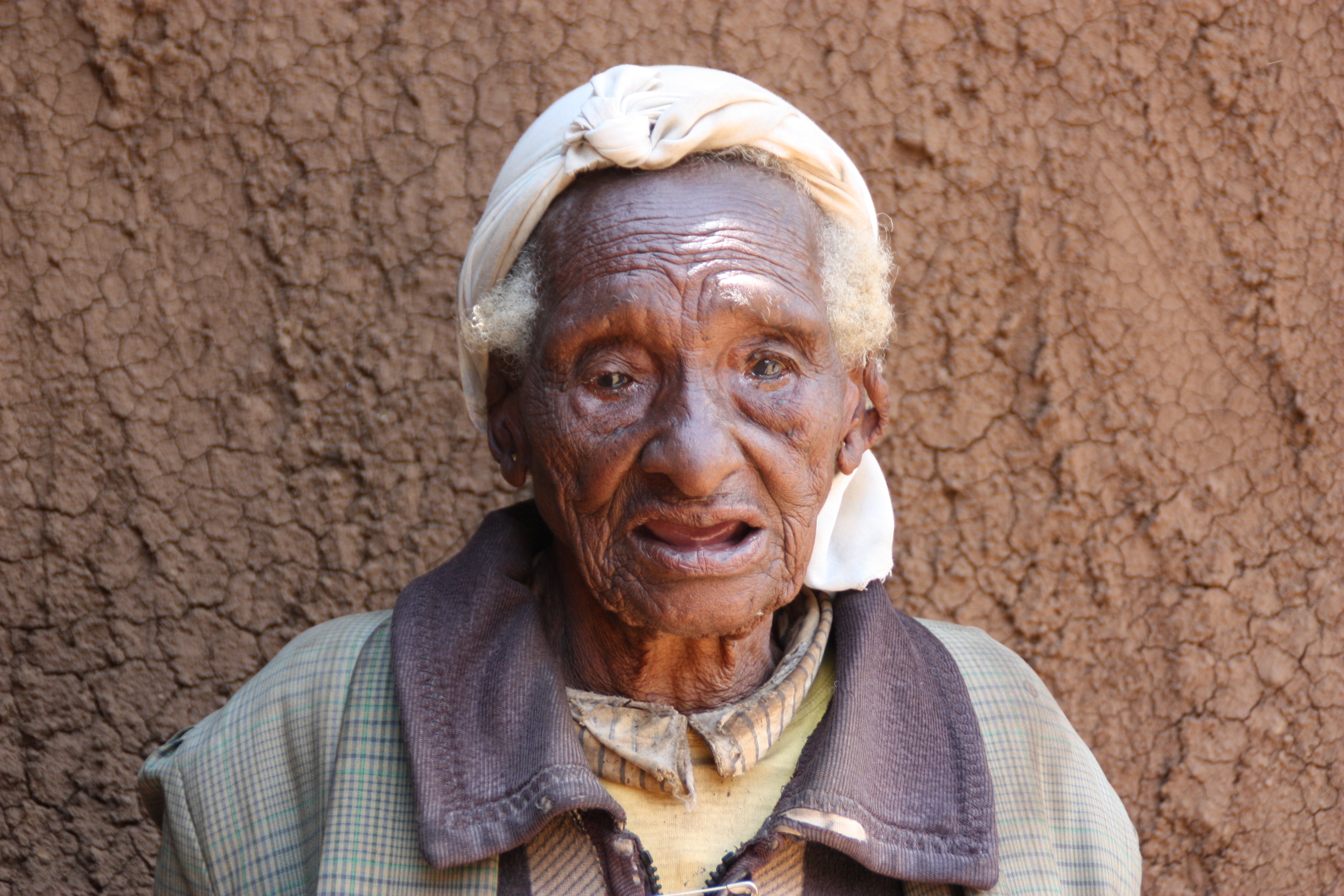
Monica Wangui is in a big way the ‘Wanjiku of the Constitution’ (Photo: Kioko Kivandi).

Today Thursday August 27th 2015 marks exactly five years since the promulgation of the new constitution. As Kenyans take stoke of the document that heralded the legal reforms that had for long been desired in the country, there is a woman who must not be forgotten, for she is the symbolic figure of why the Constitution was associated with ‘Wanjiku’.

That woman is one Monica Wangui Kamau of Kiwanja Cha Ndege in Njoro Sub County, Nakuru. Wangui was a common figure during the process of the search for the new law from the days of the Commission that was led by Prof. Yash Pal Ghai to the days of the Committee of Experts (CoE) that was led by Nzamba Kitonga.

Many Kenyans will remember her images in many dailies as she met either with Prof. Ghai to present her views or as she devoured a copy of the law which was on the proposed document. In a very significant way she represented the average Kenyan whose issues the Constitution aimed to address.

“I was born during the age set of Kamande,”

an ever jovial Wangui told me at her home in that authentic style in which dates of birth were given in the old times. Her identity card reads she was born in Thika in 1907.

“I don’t know about your academic years,”

Wangui, a Mau Mau veteran who speaks of the emergency war with emotions adds, before stating why she too wanted reforms in the country.

“The first constitution was dictatorial,”

she says almost reminiscing what she personally went through in the colonial days and the later days of post independence Kenya – but mainly during the days of Daniel Moi whose reign she does not celebrate at all due to the land conflicts that characterized his days in State House.

But today, Wangui, the symbolic figure that is the ‘Wanjiku of the Constitution’ feels not much has been achieved with the law that she so much looked forward to.

“The constitution is okay but it is not being followed,”

she tells me in an interview, stopping to rub her eyes before staring at me with a finality that speaks of the seriousness in her voice.

“I feel like the President (Uhuru Kenyatta) is doing well but his commanders are letting him down,”

by which she means the County Governments, but more specifically the Governors.

“County governments are using us, citizens, like a toilet paper,”

she says while explaining that county governments are not doing well in the implementation of devolution.

Wangui is unhappy with the wrangles between county governments and the national government that have characterized the close to three years that governors have been in office. This she feels is the greatest challenge facing the implementation of the devolved system of government which is one of the key gains that has been pointed out in the new Constitution.

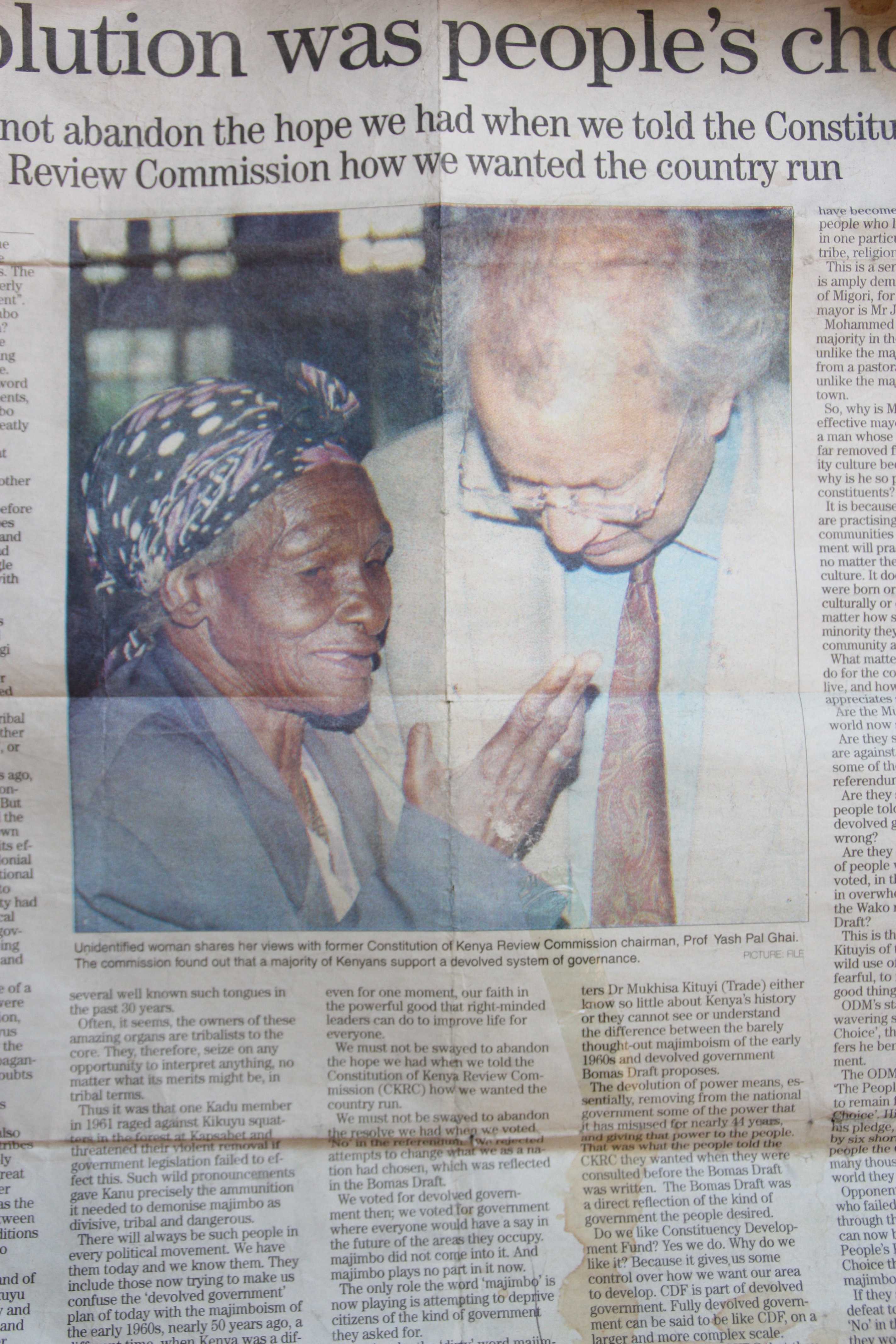
Actually in one of the newspaper cuttings that Wangui keeps is one with an article by Sarah Elderkin entitled ‘Devolution was people’s choice’. The article runs with a photo she had with Prof. Ghai.

Monica
‘Devolution was a people’s choice’ is the title of this article in which Wangui’s photo was published several years ago (Photo: Kioko Kivandi).

And apart from decrying what she feels is the poor implementation of devolution, Wangui says there are several other issues that have not turned out to be how she had dreamt. Key among them is patriotism and she wonders why Kenyans have not been inspired to love their country even more by the new Constitution. This she feels is responsible for the many evils committed by both leaders and citizens.

“During the colonial days we had collaborators. Today we still have such people who persecute the country by evil ways. I feel like the colonial government is coming back.”

“Despite having the new constitution we still have greedy people in the country, like the ones who sell people illicit liquor,” she added.

Wangui also wonders why Kenyans have not ended the beast of corruption fully through the new law or even insecurity.

“Why do we get attacked by terrorists yet we have a new Constitution?”

she asked calling to mind the terror attacks the country has gone through in recent times.

“Does this Constitution take care of the needs of the welfare of the poor like street children?”

she also posed saying that for reasons she does not know, she had not received her monthly stipend as an elderly for months.

On land and the welfare of Mau Mau veterans she asked if the Constitution recognizes their existence.

“If there is justice, how come we still have Mau Mau veterans without land?”

she said alleging that Mau Mau veterans currently residing in the Rift Valley did not get a share of the money that was issued by the British government as compensation to the crimes that took place during the emergency.

Wangui is a mother of 22 and while talking of her children she counts with her fingers “one, two, three” in Gikuyu then jumps to 22 which she pronounces in English but in an expression that is sugar coated in her mother tongue.

“All those came from this,”

she says pointing at her tummy as a way of saying that although she may be having a frail structure she is still strong.

Listening to her throughout the interview that took close to three hours, I discovered we might be quick in doing an elitist counting of the gains of the five years of the Constitution without taking time to reflect how those gains have cascaded to the grass roots.

Extending timelines and sittings have occasioned passage of key Constitutional Bills

Kenya-constitution-006
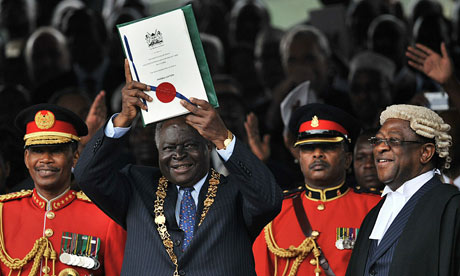
Former President Mwai Kibaki at the Promulgation of the Constitution on August 27th, 2010

The latest move by the National Assembly to extend the timelines to pass key Constitutional Bills is not new. Since the passage of the Constitution in August 2010 which set specific timelines to pass specific laws, the August House has year after year has been extending the time needed to pass them.

On August 22nd 2011, Parliament voted to extend its sittings in a bid to beat the August 26 deadline to enact key constitutional Bills. MPs also voted to reduce the procedures needed to initiate debate on the Bills from 14 days to four days. The House Business Committee (HBC) that defines Parliament’s daily agenda, voted to bring motions to Parliament to extend sitting time and eliminate lengthy procedures required to pass constitutional Bills. Bills normally take 14 days from the date of publication before they can be introduced to Parliament for debate. The MPs went another step to pass procedural motions to eliminate the traditional Question Time and suspend private members’ motions in order to discuss the Bills.

These laws are those that had to be passed within one year after the promulgation of the Constitution. Some of the laws that had to be passed within one year include legislation on citizenship, Kenya National Human Rights and Equality Commission (KNHRC), Ethics and Anti-Corruption Commission (EACC), legislations on elections and political parties including the Independent Electoral and Boundaries Commission (IEBC) and vetting of Judges and Magistrates among others.

In February 2012, Parliament was forced to extend its working hours in a last-minute rush to beat the deadline to pass seven Bills crucial to implementation of the Constitution. They had 12 days to pass the land management and devolution laws before the February 27 deadline. The Bills were County Governments Bill, 2012, Transition to County Governments Bill and the Intergovernmental Relations Bill, the National Land Commission Bill, the Land Bill, the Land Registration Bill and the Community Land Bill. Some of these Bills, like the Community Land Bill has yet to see the light of day today.

Kenyan MPs at a past session of parliament. Corruption scandals involving MPs have shocked Kenyans given that they are some of the best remunerated elected representatives in the world. (Photo/http://uchaguzi.co.ke)

The tight legislative schedule MPs worried that they may be forced to rubberstamp the draft laws without adequate scrutiny. Indeed due to the previous similar manner of passing Bills, the then Minister for Justice and Constitutional Affairs Hon. Kilonzo Kilonzo revealed that MPs made more than 100 blunders as they hurriedly amended and approved 21 constitutional Bills ahead of the expiry of the implementation deadline set in the Constitution in August in 2011. The President assented to them but he hoped they will be corrected through Miscellaneous Amendment Bill.

The week of August 20th 2012, Parliament sat for extra hours in order to pass to pass five constitutional Bills whose deadline was expiring the next Monday. The move saw MPs debate and pass the Leadership and Integrity Bill 2012, National Intelligence Service Bill, the National Security Service Bill, the Kenya Defence Forces Bill and the Petitions to Parliament (Procedure) Bill.

In September of the same year, MPs extended the time required to pass the Election Regulations 2012 so that they can go through the voluminous guidelines tabled. The Elections Act stipulated that Parliament should approve the regulations at least six months to the General Election due on March 4, 2013. The then Constitution Oversight Implementation Committee (COIC) Chairman Mohamed Abdikadir said,

“We have resolved to amend the Elections Act 2011 to reduce the time of passing election regulations from six months to four months,” said Mr Abdikadir.

The regulations included the contentious nomination fees where those aspiring to run for president will pay Sh500,000, Senate, county women representative and governor aspirants Sh250,000, parliamentary aspirants Sh150,000 and county assembly members Sh50,000.

MPs were also to discuss the Elections (Voter Education) Regulations 2012, the Elections (Kenya Citizens Residing Outside Kenya) (Registration and Voting) Regulations 2012 and the Elections (Registration of Voters) 2012.

In July 2013, MPs sought to push to December the implementation of the Freedom of the Media Bill, Support for County Governments Bill, and the Public Participation and County Assembly Powers, and the Privileges and Immunities Bill. They managed to marshall the numbers and extended the deadline.
On August 19th 2014, lawmakers managed to whip 257 members to be in the House at the time, which is above the 233 or two thirds of the 349 members needed to amend the Constitution. The laws which were to have been passed by then included Public Services Bill, Persons Deprived of Liberty Bill and the Environment Management and Coordination (Amendment) Bill and other Bills are to implement Article 47 of the Constitution on fair administrative action, Article 50 on fair hearing and those to do with accounts and audits of public entities and changes to the procurement laws

Yesterday, MPs approved a special motion allowing the extension of a deadline for passing the last batch of Bills to implement the Constitution to August 2016. The motion by the Constitutional Implementation Oversight Committee (CIOC) was approved 260-11. Before the afternoon sitting, MPs had been barred from leaving the country and when they gathered in the chambers, they were not allowed to leave until all matters touching on the Constitution were dealt with.

A section of MPs in session. Photo courtesy of oneworld.org

The last batch of 28 Bills, some which have been introduced while others have not include the Minimum and Maximum Land Holding Acreage, Agreements on National Resources Bill, Forest Bill, Community Land Bill, Physical Planning Bill, Investigation and Historical Land Injustices Bill, Land Use Bill and Evictions Bill.

Others are the Energy Bill, the Petroleum Exploration and Production Bill, the Bill on Representation of Marginalised Groups, Two-Thirds Gender Principle Bill, the Seeds and Plant Varieties Bill, the Organisation and Administration of Appeal Bill, and the Small Claims Court and the Contempt of Court Bill among others.

The prudence in extending the Bills is to ensure they give them the requisite time to avoid mistakes as had been occasioned especially before the General Elections. The main reason for the perennial extension has been delays by key institutions primarily the Attorney General’s office and the Commission on Implementation of Constitution (CIC) in delaying, sometimes due to differences, in availing the Bills to Parliament for debate.

But this needs to be arrested. Parliament needs to call to order these officers who are delaying key constitutional processes. Already, the CIC’s term expires this year and in the budget, Treasury factored their gratuity meaning that they will not extend their term. It is time the National Assembly sanctions those who delay to present these key Bills on time so as to avoid further extensions. They should also be presented in good time to allow for quality and healthy debate to inform the contents of the Bills so as to avoid amendments or provisions that infringe on other rights enjoyed by Kenyans.

Kenyans feel Mutahi Ngunyi apology insufficient

Mutahi Ngunyi. Photo courtesy of softkenya.com

Mutahi Ngunyi has made an apology for making disparaging comments on the luo ethnic community and some specific individuals like the Law Society of Kenya (LSK) CEO Apollo Mboya and Raila Odinga


 Ngunyi had in a number of tweets casts aspersions on luos progressing because of their affinity to Raila Odinga.  Just before the disparaging tweets, Mutahi Ngunyi had followed Raila Odinga and Uhuru Kenyatta on Twitter and immediately thereafter started comments that can be seen to be targeting Raila and the luo as dependent on him yet he is a failure.  


Ngunyi continued being personal on his tweets


Apollo Mboya has since filed a petition with the National Commission and Integration Commission (NCIC) as he says the tweets were personally targeted at him. He wrote to the commission

“In particular, the posts target members of a specific community as lacking individuality and in a state of mental slavery, assertions that are not only false but may very well constitute hate speech directed at specific members of a community (of) which I am a member,” read the letter in part.
“It is my view that the words uttered by Mutahi Ngunyi are intended to incite feelings of contempt, hatred, hostility, violence and/or discrimination against a community on the basis of ethnicity and, therefore, committed an offence under Section 62 of the NCIC Act.”

Kenyans shared their thoughts on the apology, many stating that the apology is not sufficient to exonerate him from criminal culpability.


Kenyans had earlier showed their displeasure at the tweets using the hashtag #ShutMutahiNgunyiUp.

As it stands, the tweets are still on his timeline, something some have argued as insecure as he should at least have deleted them. Mutahi looked remorseful when making the apology in an interview with NTV, perhaps coming to terms with the gravity of his tweets.

How the NCIC deal with this issue will continue to shine a spot light on the commission and its role in stemming hate speech in the country. In the past their perceived favoritism on political leaders or people who hold high offices in the country like Hon. Moses Kuria, Hon. Chirau Ali Makwere and Hon. Alfred Keter among others may offer a view of whether to believe they will stem the vice especially since Ngunyi works with government, specifically the National Youth Service (NYS) where he was contracted to spearhead its restructuring and reform.

Kisumu County Assembly expenditure for 2013/2014 financial year was full of anomalies

Kisumu Assembly Snip
Some of the anomalies pointed out by the Auditor General include issuing of unsecured car and mortgage loans to MCA’s (Photo: Star).

An assessment of the records of the County Assembly of Kisumu by the Auditor General has revealed that the Assembly’s expenditure for the 2013/2014 financial year was characterized by anomalies.

According to a recent report of his office, officers did not follow the due process of law in conducting government business in all the seven key expenditure issues that were assessed.

“During the evaluation of internal controls of the County Assembly with regard to its expenditures, it was found that the set control procedures like budgetary controls, reallocation of funds, procurement plans, and maintenance of procurement records and posting of all payment vouchers in the vote books were not consistently followed by responsible officers,”

so says the Auditor General in the report.

First, the Assembly spent sh42 million

“between November 2013 and June 2014 to cater for rent, salaries and ward office maintenance to all its elected Members.”

The amount was spent as cash float to all its elected 35 members (MCA’s) and was credited to their personal accounts, says the report.

However

“the Assembly did not provide any supporting documents to account for the cash float paid and it was not clear how the funds were spent by the Assembly members.”

But perhaps the mega unexplained issue is that of the awarding of a tender for the construction of an ultra-modern chamber at the County at the cost of sh745 million. Although the Assembly is said to have followed the right procedure in the advertisement of the tender the Auditor General questions how it was ultimately awarded.

During the above process 12 contractors are said to have applied for the tender, a pool from which 8 of them were invited to present proposals.

“However, it was noted that a consultant was awarded the contract at contract value of 3.99 percent of the contract sum of the proposed building in accordance with the Ministry of Public works (condition of engagement and scales of fees) without inviting all the other firms to submit their proposals,” the report says.

“In the circumstances, the validity and appropriateness of the contract could not be confirmed,” it adds.

The Auditor General report revealed that even after the Assembly entered into a contract with the contractor it had not handed over the site “months into the financial year.” But it notes that the Governor at one time wrote a letter to the Speaker of the Assembly

“advising suspension of the proposed procurement of the contract for the Assembly building due to significant procurement anomalies arising from lack of capacity and possible impropriety.”

“Under the circumstances, the validity and appropriateness of the procurement process and the resultant contract could not be confirmed,” the report says.

It will be noted that the MCA’s have since opposed this plan advising that the money for the construction of the new Assembly be channeled towards development projects.

That is not all. The Assembly also committed a number of anomalies in the issuance of car and mortgage loans to its members totaling to sh250 million.

To start with the above loans were advanced “without application forms from individual members.” Secondly due diligence was not taken to advise the members on their repayment schedules in respect of what the law says.

“Review of the pay-slips and other related records revealed that members loan recovery put some members in pecuniary embarrassment as the recovery resulted to members earning below a third of their basic pay contrary to (what the law stipulates in regard to) the amount an employer is allowed to deduct from an employee wages.”

The Auditor General says no security was given for the above loans.

“No recourse was made available to the County Assembly in case of a default to pay the loan since the loans appeared to have been unsecured and the cars and lands were not jointly registered in the name of the Assembly and the respective MCA’s.”

The Auditor General also reveals that the expenditure of more than sh5.5 million on procurement of air tickets could not be ascertained. He also queries the use of close to sh0.5 million for the procurement of movable toilets for the members for two months in October and November 2013.

“It was not clear and no justification was given as to why the Assembly sourced for the services while toilet facilities are within the precincts of the Assembly.”

Other issues that have been queried by the Auditor include the payment of mobilization services to MCA’s totaling sh3.5 million and foreign and local travels costing more than sh50 million.

“No evidence was produced to ascertain the need or reasons for the travels as a justification for the expenditure and whether it was beneficial to the County Assembly and the general public,” he says.

“The County Assembly of Kisumu should in future adhere to budgetary controls and financial regulations,”

reads part of his recommendations to the lake region law making house.

Mombasa residents to be enlightened on the internet and the law

0
Law and Training Mombasa

The Bloggers Association of Kenya (BAKE) in partnership with Article 19 will be holding the Internet and Law Kenya workshop slated for 29th of August in Mombasa. The workshop which will discuss issues around communication laws, `the legal system, defamation among other topics will take place at the MEWA Library in Majengo.

Bloggers in Kenya have in the recent months got into trouble with the law after being sued for various offences. Blogger and activist Abraham Mutai was arrested following his expose on the corruption in Isiolo county and detained for over 48 hours as he was being questioned. Police accused him misusing a licensed communication platform to cause anxiety among the members of public.

Another blogger Robert Alai has been in and out of court on accusations of defamation, alongside posting annoying tweets that caused inconvenience or needless anxiety to individuals. The most recent case is that of blogger Cyprian Nyakundi who has been taken to court by Safaricom for defamation for offensive articles that were termed as ‘unsubstantial and unsupported. Nyakundi is also in the eye of the storm following audio clips that were leaked recently where he and Christian Dela are purportedly heard trying to extort sh40 million from BIDCO.

The Bloggers Association of Kenya undertakes training of bloggers as part of its mandate. BAKE creates awareness on the status of online freedoms and how to protect these freedoms, building a network of the region’s actors in this domain, and advocacy to engender a more progressive digital rights regime in Kenya. A few months ago, the organization released a report on the state of blogging and social media use in Kenya.

Article 19 is a London-based human rights organization with a specific mandate and focus on the defense and promotion of freedom of expression and freedom of information worldwide. The Article 19 East Africa offices conduct training and advocacy to institutions and individuals on freedom of information and expression.

This workshop is part of a series across the country. Already, it has been held in Nairobi, Nakuru, Kisumu and Nyeri.

The training for the workshop will undertaken by Mr. Mugambi Laibuta, an Advocate of the High court and Riva Jalipa of Article 19.